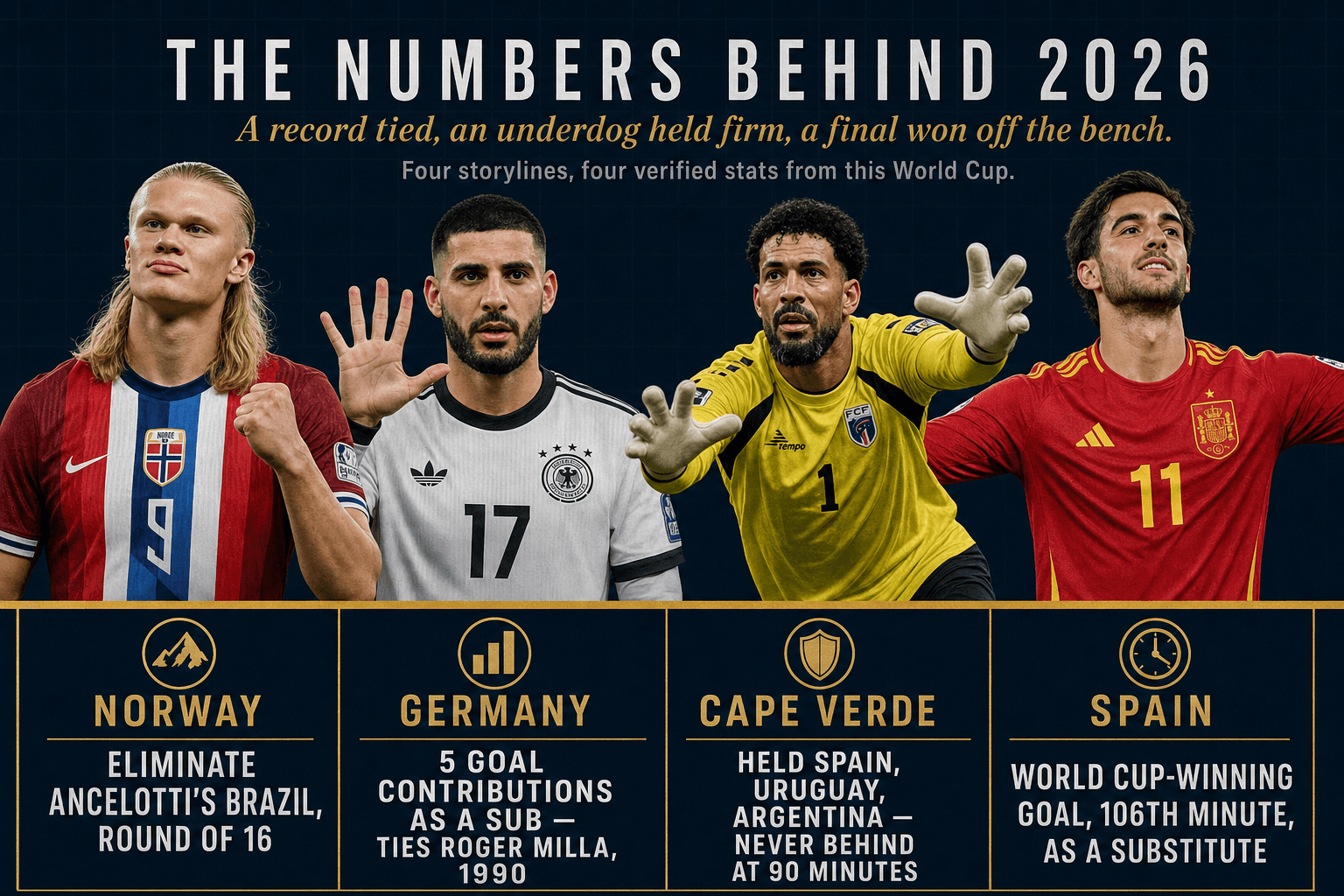
Every World Cup produces a handful of genuinely defining storylines and then buries the rest under the sheer volume of a month-long tournament. The 2026 edition, expanded to 48 nations across the United States, Canada and Mexico, produced more of those storylines than any tournament in the sport's history, and BackPage FC followed nearly all of them from the first qualifying whistle to Ferran Torres's extra-time winner in New Jersey. This is the complete thread, every piece connected to the next, exactly as it actually happened.
The Nations Who Made History Just by Arriving
Before a single knockout match was played, three nations had already rewritten their own football history simply by qualifying. Haiti reached their first World Cup in 52 years without playing a single home qualifying game, a specific circumstance we detailed in full in our piece on Haiti's improbable qualification. Curaçao, a nation of roughly 156,000 people, became the smallest country ever to reach a World Cup, documented in our piece on Curaçao's historic debut. And Cape Verde produced the most complete debut performance the tournament has ever seen: as we chronicled across our pieces on their extraordinary group stage and the diaspora squad that built it, the Blue Sharks faced three of the eight nations that have ever won the World Cup and were never behind at full time against any of them, before Vozinha's heroics against Spain and Sidny Lopes Cabral's extra-time wonder goal against Argentina made the goalkeeper and the substitute into overnight global names, a story we followed all the way through to Vozinha's transfer saga and Messi's shirt-swap request.
Norway's Dark Horse Run and the Fall of Ancelotti's Brazil
Norway arrived as the tournament's most dangerous dark horse, built around Erling Haaland, and delivered on every part of that billing, documented in our pieces on their golden generation and the squad stories behind their run. Their Round of 16 elimination of Carlo Ancelotti's Brazil, a result we covered in full in our piece on Brazil's sixth consecutive European elimination, ended Ancelotti's specific chase to become only the third manager in history to win both the Champions League and the World Cup, a list we detailed in our piece on Lippi and Del Bosque's exclusive club. Norway's run eventually ended against England in the quarter-final, but the specific culture they brought to the tournament, built on collective belief over individual reputation, remains one of the summer's most quietly significant stories.
Ecuador's Defensive Discipline and the Chain That Followed
Ecuador qualified having started their campaign on minus three points, documented in our piece on the Byron Castillo deduction, and reached the knockout stage on the back of a defensive record that made them one of the tournament's hardest teams to break down. Their eventual elimination by Mexico, covered in our piece on Mexico's historic Round of 32 win, set in motion a chain of results that ran directly through the rest of the tournament: Mexico's unbeaten run and clean sheet record were themselves ended by England at the Azteca, documented in full in our piece on England's ten-man win in the stadium where the Hand of God happened. England became just the third team ever to beat Mexico at that specific venue in a World Cup match, a specific historical parallel to 1986 that made Tuchel's side's achievement all the more significant heading into the rest of the tournament.
Bellingham's Transformation and Tuchel's Costly Final Act
Jude Bellingham's tournament, documented in our piece on how Tuchel built the best version of Bellingham this summer, produced back-to-back knockout braces matching a 40-year-old Maradona record and carried England through Mexico and Norway. It was not enough to survive the semi-final against Argentina. As we detailed in our piece on Tuchel's costly defensive substitution, England led, dominated, and then retreated the moment Tuchel withdrew an attacker for a defender with twenty minutes still to play, a specific pattern with real precedent in his own managerial history against Ancelotti's Real Madrid. Argentina punished the retreat and eliminated England, ending Tuchel's own chase to join Lippi and Del Bosque on the Champions League and World Cup double list, the exact same list Ancelotti had already fallen short of against Norway.
The Officiating Storylines: Embolo and Egypt
Two separate controversies defined the tournament's relationship with VAR and match officials. Breel Embolo became the first player in World Cup history sent off through the mistaken identity protocol, a decision we explained in full in our piece on Switzerland's elimination against Argentina. Days earlier, Egypt had led Argentina 2-0 with eleven minutes remaining in their own Round of 16 tie in Atlanta, only for Argentina to score three unanswered goals in thirteen minutes, Enzo Fernández's stoppage-time winner completing one of the biggest comebacks in World Cup history. The Egyptian Football Association subsequently said it "cannot remain silent" over what it called biased officiating, specifically criticising a disallowed 62nd-minute goal from Mostafa Zico that VAR ruled out for a foul by Marwan Attia in the build-up. FIFA's chief of refereeing Pierluigi Collina rejected the allegations directly, saying "unfounded allegations have no place in our sport," while FIFA president Gianni Infantino added that "nobody can claim that FIFA refereeing can be influenced by anyone, not even by the FIFA president." Both controversies, arriving within days of each other and both involving the eventual finalists, produced the tournament's most sustained conversation about officiating consistency at the biggest stage the sport offers.
The Numbers Behind the Football: In-Contest Possession and Ball Recovery
Beneath every result documented above sat the specific statistical mechanisms we explained in our pieces on in-contest possession and ball recovery time. Spain's eventual triumph was built on precisely the qualities those metrics measure: a counter-press that forced turnovers in just over eleven seconds on average, and a defensive record that limited France, the tournament's most explosive attacking side, to just two shots on target in the semi-final. The teams that went furthest, Spain, France, Argentina and England, were consistently the tournament's best performers in both categories, confirming that the specific tactical qualities these newer metrics measure are not abstractions. They are the actual mechanism behind who wins and who goes home.
Spain's Ending: The Unbeaten Record, De la Fuente, and the Final
Spain's own path through the tournament, documented across our pieces on their world-record unbeaten run, Unai Simón's shattered clean-sheet record, the youth system De la Fuente built from nothing, and Mikel Merino's father-tribute goals off the bench, culminated in a 2-0 semi-final win over France that we detailed in full, extending their unbeaten run past 37 games. The final itself, a 1-0 extra-time win over Argentina decided by substitute Ferran Torres in the 106th minute, made Luis de la Fuente, at 65 years and 28 days old, the oldest manager in history to win a World Cup, surpassing his own compatriot Vicente del Bosque's previous record. The specific connection between Spain's manager and Argentina's, documented in our piece on the teacher and the student meeting in the final, added a layer of narrative symmetry to the tournament's last act that few World Cup finals have ever carried: Lionel Scaloni had literally studied under Luis de la Fuente at a coaching course in Las Rozas nine years earlier, and the teacher beat the student when it mattered most.
Forty-six goals scored by substitutes, more than the previous two World Cups combined. A goalkeeper and a substitute turning Cape Verde into a global story. A dark horse beating the manager chasing football's rarest double. A semi-final lost to a manager's own tactical instinct, twice repeated. And a World Cup final decided, in the end, by a player who started the match on the bench. Every thread of this tournament led back to the same idea: preparation and structure, not individual moments alone, decided who actually lifted the trophy.
The Impact Substitutes Who Decided the Tournament
Running underneath every major storyline above was a quieter pattern that turned out to be the tournament's defining tactical signature: the number of matches decided not by a starter, but by a substitute introduced specifically to change the outcome. Gabriel Martinelli's 95th-minute winner for Brazil against Japan in the Round of 32 kept Carlo Ancelotti's tournament alive long enough to reach the Norway elimination documented above. Andreas Schjelderup, introduced at half-time for Norway against Brazil, delivered the cross for Erling Haaland's opening goal and the pass for his second, turning a goalless stalemate into the result that ended the Champions League and World Cup double chase for good. Mikel Merino, never a guaranteed starter for Spain, scored the stoppage-time winner against Portugal in the Round of 16 and the 88th-minute winner against Belgium in the quarter-final, both while performing the corner flag celebration built as a tribute to his father, documented in full in its own piece.
The numbers behind that pattern are genuinely unprecedented. Substitutes had scored 46 goals by the tournament's later stages, already more than the 2022 and 2018 World Cups combined, where substitutes managed 30 and 16 respectively. At one stage of the group phase, 21.4 percent of all goals scored had come from substitutes, the highest share in World Cup history, beating the previous record of 18.7 percent set in 2014. Fifty of the first 266 goals scored through the quarter-final stage alone had come from the bench, a specific data point that included Gonçalo Ramos's stoppage-time winner for Portugal against Croatia and Merino's own stoppage-time winner against Portugal moments later. Substitutions themselves were only introduced to the World Cup in 1970, meaning this specific tactical tool has existed for less than half the tournament's history, and 2026 became the edition that leaned on it more heavily than any other. Germany's Deniz Undav personally embodied that shift, tying Cameroon legend Roger Milla's 1990 record of five goal contributions as a substitute at a single World Cup, scoring a game-tying goal and a game-winning goal as a substitute in the same match against the Ivory Coast, only the fourth player in the competition's history to manage both in one appearance.
All of it built toward the specific moment that closed the entire tournament. Ferran Torres, introduced from the bench in the 62nd minute of the World Cup final, scored the only goal of the match in the 106th minute of extra time, the actual World Cup-winning goal, delivered by a substitute, exactly as Martinelli, Schjelderup and Merino had done at earlier stages of the same competition. No tournament in history had leaned on its bench this heavily at the biggest moments, and none had ever let a substitute settle the final itself. Spain's last substitution was not an exception to how this World Cup was decided. It was the pattern's logical conclusion.
What the Whole Tournament Actually Proved
Threaded together, the 2026 World Cup told one consistent story across a dozen different nations: preparation, culture and structural continuity mattered more than individual star power on its own. Cape Verde's diaspora scouting network, Norway's collective belief, Ecuador's defensive discipline, and Spain's decade-long youth pipeline all produced results that outperformed what conventional squad valuations would have predicted. Messi's Argentina, built around the greatest individual talent of his generation, still lost the final to a Spanish side whose entire philosophy was built on the opposite premise. The tournament's biggest lesson, repeated across nearly every storyline BackPage FC followed from qualifying through to the final whistle, was that football's oldest cliché turned out to be its truest one this summer: the team, built properly and over time, beats the individual, no matter how brilliant that individual is.
Haiti, Curaçao, Cape Verde, Norway, Ecuador, England, Spain. Every thread of this World Cup connected to the next. Which single storyline from this tournament will you remember most in ten years? Tell us below.