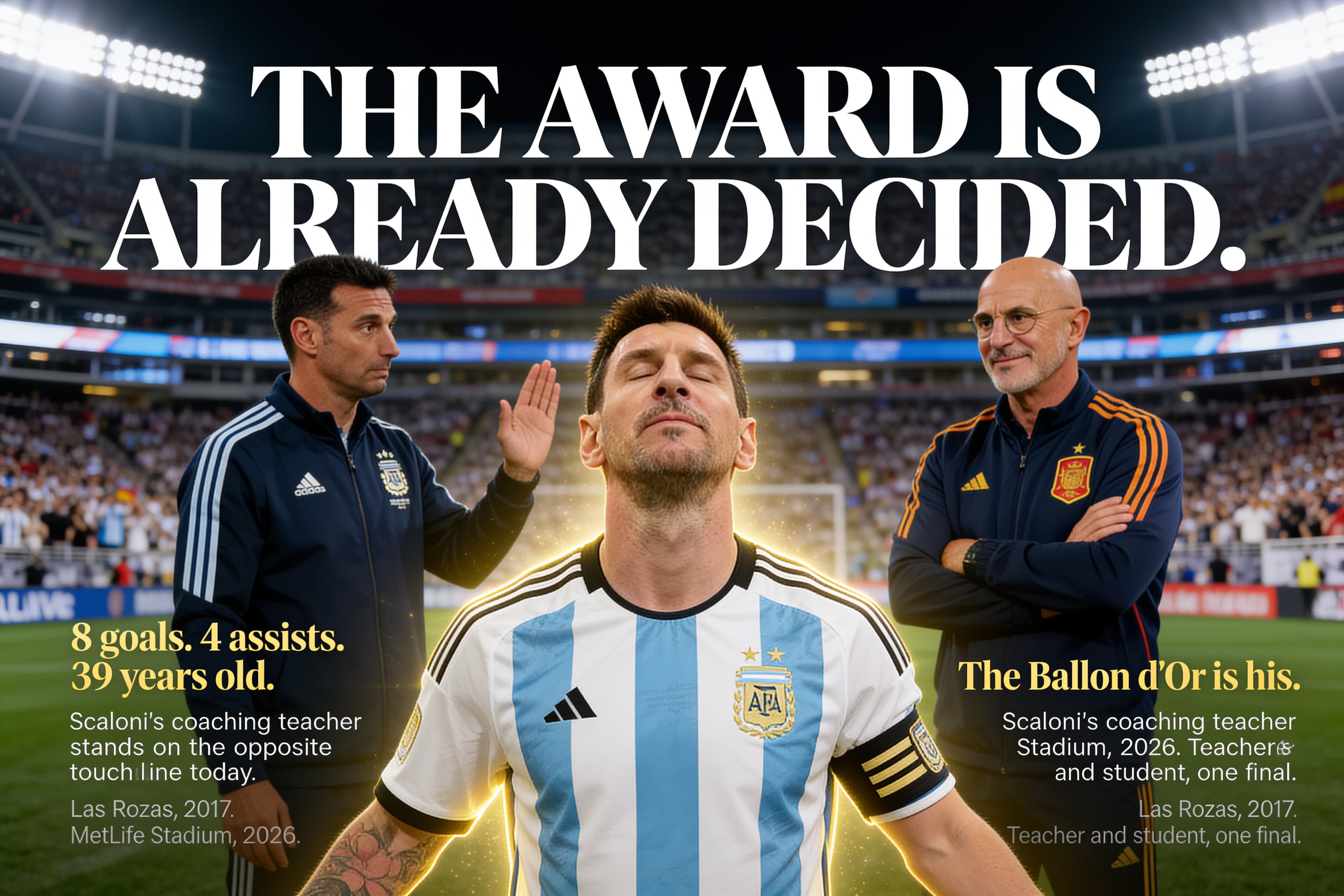
Lionel Messi does not need to win the World Cup final against Spain to win the Ballon d'Or. That is the specific, uncomfortable truth sitting underneath one of the most anticipated finals in the tournament's history. At 39 years old, playing his club football outside Europe at Inter Miami, Messi has produced eight goals and four assists across seven matches at this World Cup, a statistical return that would define most careers on its own, delivered at an age when most elite players have already retired. Along the way he has rewritten the tournament's record books entirely: his 21 career World Cup goals have shattered Miroslav Klose's long-standing record of 16, his 12 career World Cup assists are the most ever recorded, and his two assists in the semi-final against England, creating both goals in the 2-1 comeback, extended a run of goal involvements in eleven consecutive World Cup matches stretching back to 2022. As we detailed in our piece on Spain's semi-final win over France, the final now pits Luis de la Fuente's Spain, chasing history of their own, against an Argentina side that has already delivered the specific individual body of work the Ballon d'Or voting panel simply cannot ignore, regardless of what happens at MetLife Stadium on Sunday, July 19.
Why Messi Wins Even If Argentina Lose
The Ballon d'Or has always been, in part, a popularity contest layered on top of a statistical one, and Messi's specific combination of numbers, narrative and reputation makes him close to unbeatable this year under any realistic scenario. A 39-year-old producing eight goals and four assists at a World Cup, doing it outside Europe's traditional power leagues after back-to-back MLS MVP seasons and an MLS Cup with Inter Miami, doing it as the sport's most decorated individual player ever attempting one final defining chapter, is a story voters will not walk past easily, whatever the final scoreline says. Prediction markets already installed Messi as the outright favourite for a record-extending ninth Ballon d'Or before the final was even set. Should Argentina actually win the tournament, the conversation is effectively over before it begins. Should they lose, Messi has still outperformed every direct individual rival across the competition that matters most to the voting body's collective memory. No player, not Kylian Mbappé, not Lamine Yamal even in the event of a Spain triumph, realistically stands in his way. And there is a genuine historical footnote attached: every Ballon d'Or in the award's seventy-year history has gone to a player at a European club at the moment of victory. Messi would be the first winner playing his club football outside Europe entirely, a marker of how completely one player has bent the award's geography around himself.
Messi does not need Sunday to win the Ballon d'Or. He already has it. The final in New Jersey will decide the World Cup. It will not decide who wins football's most prestigious individual award, because the voting panel decided that months of tournament football ago, watching a 39-year-old outproduce players half his age.
The 2023 Precedent: An Average Club Season, a World Cup, and an Eighth Ballon d'Or
Anyone who doubts that the World Cup decides this award on its own should revisit what happened the last time Messi won it. His 2022-23 club season at PSG was, by his own standards, relatively average: 21 goals and 20 assists in a campaign where he was whistled by his own supporters at the Parc des Princes, briefly suspended by the club, and gone to Inter Miami by the summer. Erling Haaland, in the same voting window, scored 52 goals, broke the Premier League single-season scoring record, and won the treble with Manchester City. West Ham's Michail Antonio spoke for half of football when he said before the ceremony that if Haaland didn't win it, "it's a scandal." Haaland didn't win it. Messi took his eighth Ballon d'Or, and everyone understood why: he had captained Argentina to the World Cup in Qatar with seven goals and three assists, winning Player of the Tournament, and no volume of club goals against Premier League mid-table sides was ever going to outweigh that in the voting room. The 2023 result settled two things about this award permanently. The World Cup counts more than any club season, however historic. And the Ballon d'Or is, at its core, a narrative and popularity contest that rewards the story voters most want to tell. In 2026, Messi holds both cards again, except this time his tournament numbers are even better, he has rewritten the record books doing it, and there is no treble-winning Haaland on the ballot to make the vote even look close.
The Teacher and the Student: Scaloni's History With De la Fuente
The specific personal history connecting the two finalist managers is one of the most remarkable subplots the World Cup has produced. Nine years ago, Lionel Scaloni was a recently retired professional footballer pursuing his UEFA Pro coaching license at the Spanish football federation's training centre in Las Rozas, on the outskirts of Madrid, a specific programme reserved for former players who had spent at least eight seasons playing in Spain. His teacher on that course was Luis de la Fuente. Scaloni has spoken about it directly and warmly: "He was my professor, Luis de la Fuente, in the coaching course." Less than a year after completing that programme, Scaloni took interim charge of Argentina in 2018. He has since ended a 28-year wait for a major title with the 2021 Copa América, delivered the 2022 World Cup, added a second consecutive Copa América in 2024, and now stands one win away from something no side has achieved since Brazil in 1958 and 1962: retaining the World Cup as champions. De la Fuente, for his part, has called Scaloni "a model student" with "the touch of someone who is determined to grow," adding that beyond the professional respect, "I feel that way because I am his friend." Sunday's final is not simply Spain against Argentina. It is, in the most literal sense available in football, the teacher against the student he personally trained for the exact role he now occupies on the opposite touchline.
Spain's Own Historic Weight Going Into the Final
As we documented in our piece on the youth system De la Fuente built from the ground up, Spain arrive at this final carrying their own specific historic weight. Their 2-0 semi-final win over France in Dallas, sealed by Mikel Oyarzabal's penalty after Lucas Digne fouled Lamine Yamal in the box and Pedro Porro's second-half finish, stretched their unbeaten run to 37 consecutive matches, equalling Italy's all-time international record set between 2018 and 2021 and surpassing the 36-game run Argentina themselves compiled before the 2022 World Cup. Win on Sunday, and Spain stand alone in football history at 38 while lifting the World Cup for a second time, exactly as they did in 2010, the only previous occasion Spain reached this exact stage. It would complete the specific pattern we detailed in our earlier coverage, Euro 2008 preceding the 2010 World Cup, Euro 2024 now potentially preceding a second World Cup title under the same manager who delivered the continental trophy first. De la Fuente's own case for individual coaching recognition, entirely separate from Messi's playing accolades, would be significantly strengthened by becoming only the latest man to deliver a European Championship and World Cup double for the same nation inside a compressed cycle.
The Bellingham Exchange and the Performance That Followed
The specific noise around Messi's motivation in the semi-final deserves its own accurate telling, because it has been widely distorted. In just the fourth minute of the England match, Messi and Jude Bellingham were involved in a visibly heated exchange over a refereeing decision, gesturing at each other before Messi pointedly nodded away at the England midfielder. The clip went viral within minutes, and an entire narrative built itself around the idea that Bellingham had provoked the greatest player of all time into beast mode. The reality, by Bellingham's own account afterward, was more mundane and somehow more revealing: "We were discussing a foul actually. Messi said 'what about the one on me?' and I said 'you're strong enough to take it.' It was nothing bad. I'm sure everyone will do their thing and make it a big deal, but it was nothing big really." What is not in dispute is what followed. Messi created both Argentina goals in the final minutes of a match England had led, and Bellingham, in defeat, called sharing a pitch with him a privilege. As we explored in our piece on England's semi-final collapse against Argentina, the specific momentum shift that turned that match came directly from Argentina's attacking players growing in confidence precisely when England retreated, and Messi, with assists for Enzo Fernández's equaliser and Lautaro Martínez's stoppage-time winner, was the central figure orchestrating that shift once the door was left open.
What Sunday Actually Decides
The World Cup final decides the World Cup. It does not decide the Ballon d'Or, and it does not decide whether Sunday's meeting between a teacher and his former student produces the specific kind of managerial folklore that outlasts any single scoreline. Spain's shot at an outright unbeaten record, De la Fuente's own coaching legacy, and Argentina's attempt at the first successful title defence in 64 years all hang on ninety minutes in New Jersey. Messi's individual legacy, and the specific award that will confirm it later this year, does not.
What Happens to the Golden Boot Race
Messi's eight goals also place him at the centre of a Golden Boot race that has run through nearly every knockout stage of this tournament, documented across our coverage of the semi-finals. Kylian Mbappé matched him on eight before France's semi-final exit, meaning Messi can be caught only from within Sunday's final itself, and the tiebreaker already favours him: with the two level on goals, the Golden Boot goes to the player with more assists, a category Messi leads outright with four. Erling Haaland's run ended with Norway's elimination in the quarter-finals. But the specific combination of goals, assists, and the sheer competitive theatre of a 39-year-old still directing a World Cup final from the number ten position is not a combination any statistical rival can fully replicate, however many goals they scored in matches Argentina were not involved in. The Golden Boot itself remains mathematically live heading into Sunday. The broader individual narrative that the Ballon d'Or panel actually rewards each year has, in practice, already been decided.
The Specific Symmetry of Two Coaching Journeys
There is a deeper symmetry worth noting beyond the direct teacher-student relationship itself. Both De la Fuente and Scaloni built their international coaching careers from the ground up through youth and age-group football rather than arriving via glamorous club appointments. De la Fuente's path through Spain's Under-19s, Under-21s and Olympic programme, documented in full in our piece on his grassroots system, mirrors Scaloni's own foundation coaching Argentina's youth ranks before his surprise interim senior appointment in 2018. Neither man was the obvious, headline appointment for their respective federations at the moment they were hired. Both have since delivered the two biggest prizes in international football for their nations. The specific fact that one taught the other his coaching fundamentals, at a training centre outside Madrid nine years ago, adds a layer of narrative symmetry to Sunday's final that very few World Cup finals in the tournament's history have ever carried into the biggest match of the calendar.
Messi may have already secured the Ballon d'Or regardless of Sunday's result, and the final pits Scaloni against the man who literally taught him to coach. Does this final feel bigger than the World Cup itself? Tell us below.