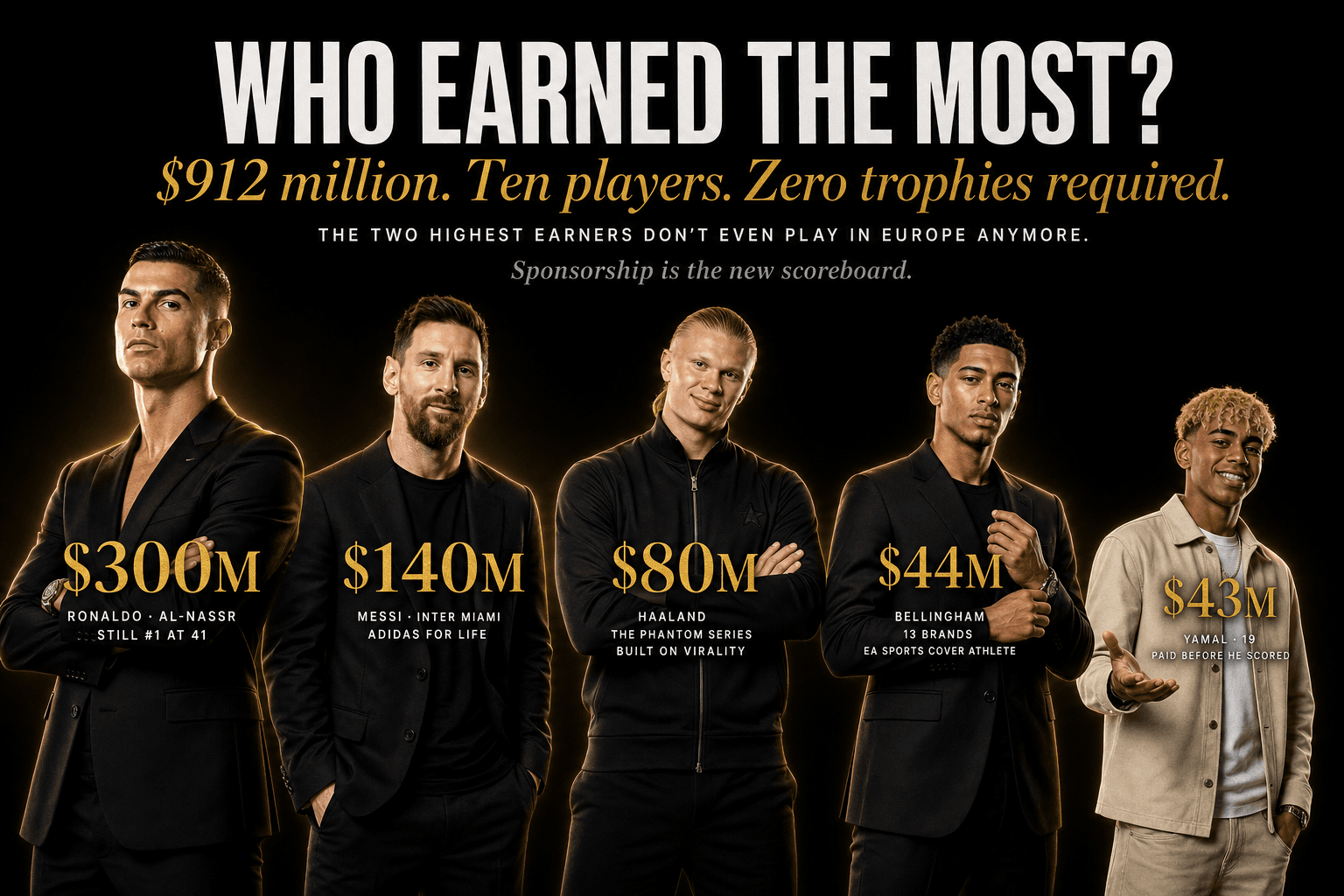
Who actually earned the most money at this World Cup? Not prize money, the real money: salaries, sponsorship deals, boot contracts and global brand campaigns built around individual players. Forbes puts the answer in one number: the ten highest-paid footballers at the 2026 World Cup earned a combined $912 million over the past twelve months. Cristiano Ronaldo, still football's financial king at 41, tops the table at an estimated $300 million, around $230 million of it from his Al-Nassr contract alone. Lionel Messi sits second at $140 million, built on his Inter Miami deal and lifetime partnerships with Adidas and Apple. Jude Bellingham, who has never won a World Cup and does not need to, earned an estimated $44 million, roughly a third of it from sponsorship deals rather than his Real Madrid salary, and Lamine Yamal sits just behind him at $43 million at nineteen years old. As we documented in our piece on how Bellingham matched Maradona's knockout-stage record this tournament, on-pitch performance and commercial value have become two connected but distinct currencies, and this tournament is where the second one gets set: a standout World Cup performance makes a player trend, trending makes him powerful, and that power converts directly into deals, some of them signed while the matches are still being played.
Who Earned What: The Full Money Table of This World Cup
The complete list reads like a map of where football's money now lives. Ronaldo leads at $300 million, followed by Messi at $140 million, Kylian Mbappé at $95 million, Erling Haaland at $80 million, Vinícius Júnior at $60 million, Mohamed Salah at $55 million, Sadio Mané at $54 million, Bellingham at $44 million, Lamine Yamal at $43 million, and Harry Kane at $41 million. Forbes tracks earnings over the previous twelve months, combining on-field salary with off-field endorsement income. Two things stand out immediately. First, the top two names both now play outside Europe entirely, in Saudi Arabia and Major League Soccer, and still out-earn everyone playing in the Champions League. Second, a 19-year-old who had never scored a World Cup goal before this tournament, Yamal, earns within a million dollars of England's captain and record goalscorer, purely on the strength of projected stardom and commercial reach.
Bellingham's Portfolio: Built Across Every Category That Matters
Bellingham's endorsement portfolio spans sportswear, fashion, gaming, food and beverage simultaneously, anchored by an Adidas relationship that stretches back to his teenage years at Borussia Dortmund and now includes fronting the Predator boot relaunch alongside David Beckham. Louis Vuitton signed him as a Supporter of the House for their Spring/Summer 2026 campaign, positioning him explicitly as a fashion figure rather than simply an athlete wearing a sponsor's product. SKIMS, Lucozade, McDonald's and Beats by Dre round out a commercial footprint built specifically to capture as many different audience segments as possible rather than relying on a single dominant sponsor category, and EA Sports made him the global cover athlete for EA Sports FC 26, the single most visible individual honour in football gaming. Roughly a third of Bellingham's estimated $44 million in earnings arrives from these off-pitch sources, on top of his Real Madrid wages, a commercial position that already places him inside territory usually reserved for players a decade further into their careers.
Lamine Yamal: World Cup Campaigns Before a World Cup Goal
Lamine Yamal offers the clearest illustration of how quickly this economy now moves. Forbes estimates his total earnings at $43 million, built from a playing contract still relatively modest by superstar standards and an endorsement portfolio that already includes American Eagle, alongside 2026 World Cup campaign appearances for Coca-Cola, McDonald's, Powerade, and Visa specifically. Yamal is the youngest player ever to represent Spain's senior national team, documented in full in our piece on Spain's youth development system and the generation it produced, and sponsors began signing him to global tournament campaigns before he had scored a single World Cup goal, betting entirely on projected stardom and existing social media reach rather than proven tournament pedigree. That bet has since paid out: Yamal won the penalty that opened Spain's semi-final victory over France and will start Sunday's final against Messi's Argentina.
Ten players. $912 million. A single year. None of it dependent on winning the tournament they are all currently competing in. Bellingham's single-season earnings alone are roughly half of what Ronaldinho's entire career net worth amounts to today, despite Ronaldinho having actually won the World Cup and Bellingham not yet having done so.
The Deals Being Fought Over While the Tournament Is Still Running
The clearest proof that World Cup exploits convert directly into money is that the sport's biggest sponsorship negotiations did not wait for the final whistle. Kylian Mbappé's Nike contract was set to expire on July 31, mid-tournament, and as Forbes reported, Nike secured a one-month extension during the World Cup itself while Adidas and Under Armour tabled competing offers for his next deal, a bidding war conducted between matches, with every goal he scored recalculating his price in real time. The Golden Boot race turned into a straight sponsorship fight: Adidas sponsors the trophy itself and holds Messi on a lifetime contract, meaning a Messi win puts the brand's name on both the award and the man holding it; Nike counters through Mbappé and Erling Haaland, whose signature Phantom series was created specifically for this tournament; and Harry Kane chases it in Skechers' SKX_01, the brand's first-ever football boot line, making a Golden Boot for Kane the single biggest validation a challenger boot brand has ever had at a World Cup. Meanwhile, tournament sponsors built live campaigns around individual players' exploits, most visibly Visa's Haaland campaign, which offered cardholders prizes every time he scored one of his trademark tap-ins during the tournament, tying a global brand's activation directly to one striker's finishing.
The numbers attached to these in-tournament stakes are specific. A sports marketing consultant quoted by Forbes estimated that Kane winning the Golden Boot alongside an England trophy would have been worth approximately $13.4 million a year in additional commercial income for the following three to four years. And the precedent is already established: Mbappé's 2022 Golden Boot moved him from 35th to 3rd on Forbes' list of the world's highest-paid athletes, with his endorsement income alone climbing into the $25 to $40 million range. That is the actual economy this World Cup runs on. The Forbes list measures what players earned coming into the tournament. What they do inside it, a semi-final assist, a viral celebration, a Golden Boot, is being priced, bid on and signed against while the matches are still being played.
Ronaldo's Al-Nassr Deal Dwarfs Everyone
Cristiano Ronaldo's specific financial position sits in a category of its own. Forbes puts his past-year income at $300 million, around $230 million of it earned on the field at Al-Nassr, a figure that alone exceeds what most of the list earns from salary and sponsorship combined, and that is before accounting for his separate commercial empire built across decades with Nike, his CR7 branded product lines, and a business portfolio that extends well beyond conventional athlete endorsement into hotels, fitness centres and fragrance. Ronaldo's continued presence at the top of football's rich list at 41 years old, still playing at this World Cup, reflects a specific commercial reality: his value as a global brand now operates largely independently of his output on the pitch, sustained by three decades of accumulated visibility that a newer star, however talented, simply has not had time to build yet. Messi's parallel position at $140 million tells the same story from the other side of Sunday's final: the two most-followed athletes on the planet both monetise audiences they spent twenty years building, wherever they happen to play their club football.
The Social Media Mechanism Behind the Numbers
The specific mechanism driving these figures upward is not simply footballing quality. It is the direct, unmediated relationship between a player and hundreds of millions of followers that social media has created, removing traditional media's gatekeeping role entirely. A single standout World Cup performance, amplified instantly across every platform, can add measurable value to a player's sponsorship portfolio within days rather than the years it once took for a reputation to solidify through newspaper columns and television highlights alone. Bellingham's two goals in ninety-eight seconds against Mexico, documented in our piece on England's ten-man win at the Azteca, generated exactly this kind of instant global visibility spike, the specific moment sponsors and marketing analysts point to when explaining why his commercial trajectory accelerated mid-tournament rather than waiting for a final trophy lift to justify a new contract renegotiation. A player's stature in the modern game is now built as much by algorithm-driven virality as by silverware, and the two increasingly reinforce each other in a loop no generation of footballers before this one has ever operated inside. That is the real power shift this tournament has exposed: traditional media no longer decides which players matter. The amplification of a single moment does, and the players who trend hardest walk into every negotiation, with clubs, with sponsors, with the sport itself, holding leverage no agent could once have manufactured.
What This Means for the Sport's Financial Structure
The specific consequence of this shift extends beyond individual player wealth into the broader financial ecosystem clubs and leagues now operate within. A player's commercial value increasingly functions as a genuine transfer market asset in its own right, a factor clubs weigh explicitly alongside on-pitch output when negotiating fees, as we explored in our piece on how release clauses and transfer valuations actually work. A club signing a player with Bellingham or Yamal's specific commercial reach is not simply buying footballing output. It is buying a marketing asset capable of generating shirt sales, sponsorship interest and global audience engagement that a footballer of comparable on-pitch quality without the same social media following simply cannot deliver. The World Cup accelerates all of it, compressing years of gradual reputation-building into a single month of globally concentrated attention, watched by an audience that dwarfs any other single sporting event on the calendar.
Kylian Mbappé and the Haaland Comparison
Kylian Mbappé's specific commercial position, documented in our piece on his World Cup partnership with Michael Olise, reflects a similar dynamic to Bellingham's: a player already carrying a Ballon d'Or before this tournament began, whose Nike relationship and personal brand were built to global scale years before his current run of tournament goals, and whose $95 million past-year earnings place him third on the tournament's rich list despite France's semi-final exit. Erling Haaland's commercial surge follows the same pattern from a different direction. As we detailed in our piece on Haaland's Manchester City contract, his specific goalscoring identity, built around a highly marketable, almost cartoonish physical presence and celebration style, has translated into a sponsorship portfolio that grew explosively once his individual highlight reels began circulating independently of any single club's marketing department. Both players demonstrate the same underlying principle driving this entire economy: a distinctive, easily clip-able individual moment, repeated often enough across social platforms, now builds commercial value faster than a trophy cabinet ever could.
The Widening Gap Between Tournament Winners and Tournament Earners
The specific tension this creates for football's traditional value system is worth stating directly. For most of the sport's history, commercial reward followed team success closely: winning the World Cup meant a player's stock rose, sponsors circled, and earning power increased in rough proportion to what had actually been achieved on the pitch. That relationship has not disappeared entirely, but it has been substantially diluted by a parallel economy that now rewards visibility, personality, and platform independently of results. A player can lose a World Cup semi-final and still see his sponsorship value climb through the tournament, provided his individual performances generated enough attention, a dynamic we examined from the opposite direction in our piece on why football's pre-social-media legends never earned anything close to this. The numbers there make the point brutally: Ronaldinho won the World Cup itself in 2002 and finished an entire two-decade career worth around $90 million, roughly two Bellingham seasons. Ronaldo Nazário's groundbreaking 1996 Nike contract, worth $180 million across its whole lifetime, amounts to about seven months of Cristiano Ronaldo's current income. The generation that built football's global audience never got to bill for it. The specific players who benefit most from this structure are not necessarily those with the most medals. They are the ones whose individual moments travel furthest, fastest, across the platforms where football's global audience now actually spends its attention.
Ten players earned $912 million combined this year, without any of it depending on who actually wins the World Cup. Is football's financial structure now driven more by social media reach than by trophies? Tell us below.