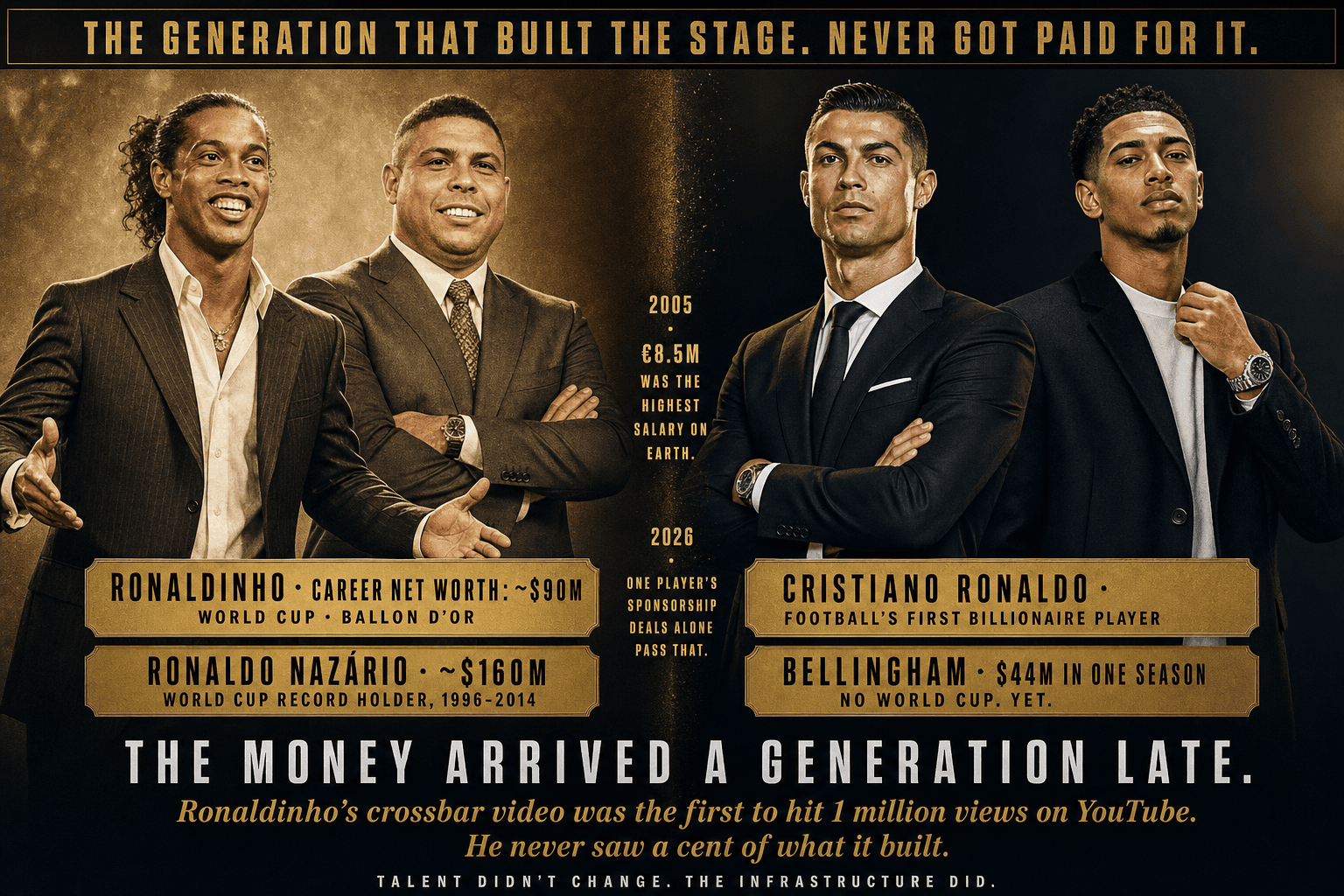
Ronaldinho won the World Cup with Brazil in 2002. He won the Ballon d'Or in 2005. He was twice named FIFA World Player of the Year. He is, by consensus, one of the ten most naturally gifted footballers to ever play the sport, a player who briefly replaced David Beckham as the highest-paid footballer on the planet at the peak of his Barcelona years. His entire career net worth today is estimated at around $90 million. Jude Bellingham, who as we documented in our piece on his record-matching World Cup run this summer has never won a World Cup, earned an estimated $44 million this past year alone, roughly half of Ronaldinho's total career wealth, accumulated across two decades of genuine footballing genius. The gap is not a story about talent. It is a story about timing, and specifically about the exact moment football's money and social media's reach arrived to change the sport's economics permanently, a moment that came a full generation too late for its most beloved entertainers.
Ronaldinho: Highest Paid in the World, and Still Nowhere Near Today's Numbers
At his 2007 peak, Ronaldinho was reported to earn a salary of €8.5 million at Barcelona, a figure France Football described at the time as completely out of this world by the standards of the era. Adding endorsement income from Nike, Pepsi, Coca-Cola and Sony brought his combined annual earnings to around €15 to €16 million, which made him, briefly, the single highest-paid footballer on the planet. Compare that figure directly to Cristiano Ronaldo's current Al-Nassr income, which Forbes puts at around $230 million per year on the field alone, roughly twenty-five times what made Ronaldinho the world's best-paid player less than two decades earlier. And Ronaldinho's story carries a further warning the modern generation will likely never face: without the diversified commercial machinery today's stars retire into, his post-career finances unravelled publicly, with Brazilian courts freezing his assets over unpaid fines in 2018 and a five-month detention in Paraguay in 2020 over a false passport, before esports and business ventures rebuilt his fortune. Ronaldinho's peak-era wealth was not modest by the standards of his own time. It has simply been dwarfed by a football economy that expanded at a pace no player of his generation could have anticipated, arriving in full force only after his best years had already passed.
Ronaldo Nazário: A World Record Nike Deal That Still Falls Short
Ronaldo Luís Nazário de Lima, the original R9, retired as the World Cup's all-time leading goalscorer, his 15 tournament goals standing as the record until Miroslav Klose passed it in 2014, and a record that now belongs to Lionel Messi, who took his own World Cup tally to 21 at this very tournament. A two-time Ballon d'Or winner and three-time FIFA World Player of the Year, R9's Nike relationship was, for its era, genuinely groundbreaking: a ten-year contract signed in 1996 reportedly worth over $180 million across its lifetime, including the specific honour of having the original Mercurial boot designed around his exact playing style. That deal made Ronaldo one of the wealthiest athletes of his generation. His current net worth sits at an estimated $160 million, built across a career at Barcelona, Inter Milan, Real Madrid and AC Milan, three World Cup finals, and one of the most extensive individual sponsorship portfolios football had seen up to that point. It remains, today, less than what several current World Cup squad members earn in two or three seasons alone.
Ronaldinho's peak salary at Barcelona was €8.5 million a year, once the highest in the world. Cristiano Ronaldo's current Al-Nassr income is roughly twenty-five times that figure annually. Neither the gap between Ronaldinho's talent and Ronaldo's, nor the gap between their eras' respect for the game, explains that difference. Timing does. Ronaldinho retired just before social media turned individual footballing moments into a permanent, monetisable global broadcast.
Eto'o, Kaká, and a Golden Generation Priced in a Different Currency
Samuel Eto'o, documented in full in our piece on his career as the greatest African footballer of his generation, won the Champions League three times and was widely considered among the two or three best strikers in the world for the better part of a decade. His current net worth is estimated at $95 million. Kaká, the 2007 Ballon d'Or winner and a Champions League-winning midfielder with Milan before a world-record move to Real Madrid, sits at an estimated $105 million. Compare both figures to Neymar's current $450 million net worth, a player from the same footballing culture whose career overlapped the exact moment social media reach began converting directly into commercial value, benefiting from a hybrid position between the old era and the new one that Eto'o and Kaká's careers simply concluded too early to capture in full. And the ceiling has moved further still: Cristiano Ronaldo became football's first billionaire player, with Messi's career earnings now estimated around the billion-dollar mark too. No player from the pre-social-media generation, however decorated, finished anywhere near that territory.
Why the Money Arrived Late
The specific mechanism explaining this gap is not simply inflation or the general growth of football's television revenue, though both played a role. It is the fundamental restructuring of how a footballer's value gets created and captured. Before roughly 2010, a player's commercial worth depended almost entirely on traditional media: television highlight packages, newspaper coverage, and a small number of major boot and kit sponsors who controlled access to a player's image and reach. A player like Ronaldinho, however brilliant, was commercially limited by the infrastructure available to broadcast his brilliance. Social media removed that infrastructure bottleneck entirely. A single Bellingham celebration, clipped and shared within minutes of the final whistle, now reaches more people directly, without a broadcaster's permission or a newspaper editor's decision, than an entire season's worth of Ronaldinho highlight reels could have reached through 2005's media landscape. As we explored in our piece on this tournament's highest-earning players, that direct reach is now the primary currency sponsors are actually buying, and it simply did not exist as a purchasable asset during Ronaldinho, Eto'o or Ronaldo Nazário's playing careers.
The Numbers That Built the Gap: Football's Money Explosion in One Table
The scale of what changed is easiest to see in the raw numbers of the industry itself, not the players' bank accounts. The Premier League's first domestic television deal, covering 1992 to 1997, the years R9 and Ronaldinho were breaking through, was worth £191 million in total. The current domestic package sold to Sky Sports and TNT Sports is worth £6.7 billion, a thirty-five-fold explosion in the value of simply showing the matches. Deloitte's Football Money League tells the same story at club level: the top twenty clubs in world football generated over €12 billion in combined revenue in 2024-25, a record, and Real Madrid became the first club in history to generate €1 billion in a single season, with nearly €600 million of that arriving from commercial income alone, more than most entire clubs earned across the decade Ronaldinho dominated. The World Cup itself has inflated on the same curve: the 2026 tournament carries a record $896 million prize pool, roughly double Qatar 2022's $440 million and multiples of anything on offer when Ronaldinho actually lifted the trophy in 2002, with this year's winner collecting around $50 million and every group-stage nation banking eight figures just for showing up. Football did not get slightly bigger between Ronaldinho's prime and Bellingham's. It became a different industry, the one we mapped player by player in the real money table of this World Cup, and the legends' careers simply ended before the industry they built finished being constructed.
Media Power: From One Viral Video to 675 Million Followers
There is a detail from 2005 that captures the entire media shift in a single fact. Ronaldinho's Nike crossbar clip, the grainy footage of him volleying the ball against the bar four times without it touching the ground, was the first video in YouTube's history to reach one million views. The most naturally viral footballer who ever lived fronted the first viral football video ever made, and the mechanism that would eventually pay players billions did not yet exist in any form he could own: no follower counts, no player-run accounts, no sponsored posts, no direct audience. The clip made YouTube famous. It made Nike famous. It could not make Ronaldinho meaningfully richer, because the infrastructure for converting attention into personal income had not been built. Two decades later, Cristiano Ronaldo is the most-followed human being on Instagram at around 675 million followers, with Messi at roughly 506 million, audiences larger than any broadcaster on the planet, owned outright by the players themselves. FIFA reported that around 1.5 billion people watched the 2022 World Cup final; a single Ronaldo post now reaches nearly half that number without a television network involved. That is the media power this generation holds and the legends never did: the game went from footballers appearing on media, at a broadcaster's discretion, to footballers being the media, selling access to their own audience directly to any brand willing to pay. Football's global boom built the stage. Social media handed this generation the box office.
What Loyalty and Legacy Bonuses Actually Provide Today
Modern football has also developed specific financial mechanisms that older generations never had access to at all. Long-term loyalty bonuses, image rights structures separated entirely from base wages, lifetime brand partnerships of the kind Messi holds with Adidas, and sponsor deals signed before a player has even completed a season of senior football, exactly as happened with Yamal, did not exist in any comparable form when Ronaldinho, Eto'o or Ronaldo were coming through their own academies. A player breaking into a major club's first team in 2026 has access to an entire financial architecture, agents specialising purely in commercial rights, marketing departments dedicated to individual player brand-building, and platforms that convert a single viral moment into contract renegotiation leverage, that simply had no equivalent twenty years ago. The talent gap between football's cult heroes and its current superstars is, in most honest assessments, narrower than the earnings gap suggests. The infrastructure gap between the two eras is not narrow at all. It is the entire explanation.
Clarence Seedorf: Four Champions Leagues, One Modest Fortune
Clarence Seedorf remains the only player in football history to win the Champions League with three different clubs, Ajax, Real Madrid and AC Milan, a genuinely unmatched individual record across the competition's modern era, with four winners' medals in total. His playing career spanned nearly two decades at the very top of European football, including a central role in Milan's 2007 triumph in Athens. Seedorf's current net worth is estimated in a similar bracket to Eto'o and Kaká, comfortably wealthy by any conventional standard, but nowhere close to what a player with his specific trophy haul would command if his prime years had overlapped with today's commercial landscape rather than the pre-2010 one. The specific football achievement of winning Europe's premier competition four times across three separate institutions has, in a genuinely direct sense, been outpaced financially by players who have won considerably less but happened to play their formative seasons after football's money and social media's reach finally converged.
The South American Generation That Built Modern Football's Aesthetic
The broader generation Ronaldinho, Ronaldo Nazário and Eto'o belonged to, alongside contemporaries like Rivaldo, Romário, Roberto Carlos and Juan Román Riquelme, defined an entire aesthetic era of the sport built around individual flair, improvisation and joy that predates the more clinically marketed, algorithm-optimised highlight culture of today's game. That generation's football is still widely cited by current stars, including several competing at this very World Cup, as their primary childhood inspiration. Their financial legacy, however, tells a separate and less flattering story: genuine footballing genius, watched by hundreds of millions across an entire era, converted into commercial value at a fraction of the rate the same audience size would generate today. The players themselves rarely frame it as an injustice publicly. But the specific gap between cultural impact and financial reward, for this exact generation, remains one of football's most under-discussed economic stories.
Ronaldinho won the World Cup and the Ballon d'Or, and his career earnings still sit below what modern stars make in two seasons without winning anything yet. Does this change how you view football's greatest players from before the social media era? Tell us below.