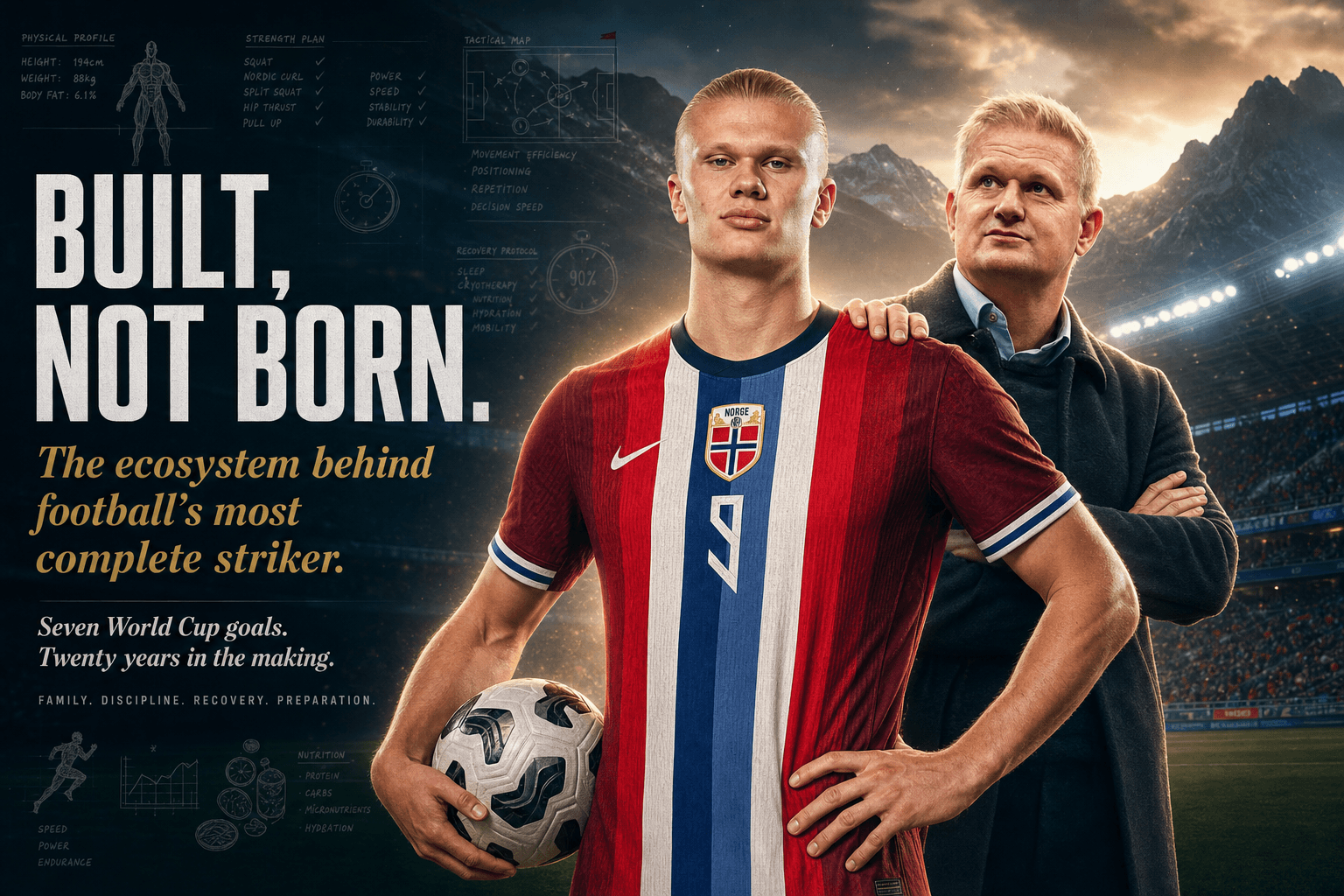
Erling Haaland leads the World Cup Golden Boot race with seven goals, has just knocked five-time champions Brazil out of the tournament with a brace, and is doing it all with the same calm, almost bored expression he wears after every goal. None of that is an accident. Haaland was built for this, quite literally, by a father who played the game at the highest level and has spent two decades constructing the ecosystem that produced the most lethal striker at this World Cup.
A Career Engineered From the Start
The rivalry that ended Alf-Inge's career is still one of the most talked-about feuds in Premier League history. In 1997, while playing for Leeds, Alf-Inge was on the receiving end of a horror challenge from Manchester United's Roy Keane that ruptured Keane's own anterior cruciate ligament, an incident that led to accusations Alf-Inge had exaggerated the severity of Keane's injury at the time. Keane never forgot it, and in 2001, by then facing Alf-Inge again with the Norwegian at Manchester City, Keane took his revenge with a tackle widely regarded as one of the most deliberate and dangerous in the competition's history, effectively ending Alf-Inge's career. That personal history, of a father who understood exactly how brutal elite football could be and how quickly a career could be taken away, has clearly shaped how deliberately he has managed his son's rise — nothing left to chance, no stage of the process outsourced to people who did not have Erling's specific interests at heart.
Alf-Inge Haaland, Erling's father, played professionally in the Premier League for Nottingham Forest, Leeds United and Manchester City, and represented Norway at international level before retiring early after the injury that ended his career, a horror tackle from Roy Keane in 2001 that closed one of the Premier League's most explosive personal rivalries. Erling's mother, Gry Marita Braut, was a heptathlon champion, giving her son an athletic pedigree from both sides of the family that few footballers can match. Having lived the highs and lows of top-level football himself, Alf-Inge has been described as the architect of Erling's rise, someone who understood exactly what it took at the elite level and built his son's environment around that knowledge from an early age.
That guidance has stayed hands-on well into Erling's superstar years. Reports from the Spanish press suggested Manchester City paid Alf-Inge around £26 million for his role in negotiating his son's original transfer to the club, with further commission payments made to the agency overseen by the late Mino Raiola. Alf-Inge has also remained a fixture around his son's football life in more personal ways: teammate Jack Grealish has called Haaland "the best professional I have ever seen," crediting his recovery routines, diet and preparation, all of it closely guided by his father as mentor as much as parent.
Comfortable Because He Has Never Had to Fight for a Platform
Part of what makes Haaland such an unusual figure in modern football, at just 25 years old and already one of the most recognisable athletes on the planet, is how little ego he carries into a sport that rewards self-promotion. Raised in a family with the financial security and football knowledge to support every stage of his development, Haaland has never needed to manufacture a persona or chase attention the way many young stars do when trying to secure their first big move. He famously did not recognise actor Tom Holland when the Spider-Man star invited him to dinner, an anecdote that has followed him around media coverage precisely because it captures how detached he is from the celebrity ecosystem that surrounds elite footballers.
That same relaxed self-assurance shows up constantly in his public persona. He runs an unfiltered Snapchat account where he posts Shrek-filter selfies and Game Boy sessions, spends his downtime playing Minecraft and EA Sports FC rather than chasing Hollywood circles, and recently went viral for "raw-dogging" a transatlantic flight — staring at a blank seatback screen for seven hours without food, water or sleep, purely out of focus. None of it reads as performative. It reads as a young man who was never short on resources or belief growing up, and who therefore never developed the need to prove himself off the pitch the way he does on it.
62 goals in 54 Norway appearances, and seven at this World Cup alone — level with Mbappé and Messi heading into the quarter-finals.
The Diet and the Discipline Behind the Numbers
None of the eccentric habits described earlier would matter without results to back them up, and Haaland's on-pitch output is backed by a genuinely unusual physical regimen. His daily intake reportedly runs to around 6,000 calories, built around raw milk, eggs, steak, honey, and less conventional additions like cow heart and liver, alongside a self-described "magic potion" of milk blended with spinach and kale that he carries to training sessions. He has said the diet, combined with his training programme, helped take him from 86kg to 94kg in what he insists is "gross muscle mass" rather than simple weight gain.
His recovery routine is treated with the same seriousness as his training. Haaland installed a £50,000 cryotherapy chamber at his home in Cheshire, uses ice baths and yoga as standard recovery tools, and meditates daily — the source of the cross-legged goal celebration that has become his signature. He goes to bed around 10pm, switches off devices beforehand, and wears blue-light-blocking glasses in the evening to protect his sleep. His former RB Salzburg coach Stanislav Macek has said Haaland used to do 300 press-ups and 1,000 sit-ups a day even as a teenager, underlining that the physical discipline predates the fame by years.
Staying Grounded Amid Real Madrid Speculation
That same steadiness is showing up in how Haaland has handled persistent transfer speculation linking him to Real Madrid, a story BackPage FC has tracked closely in our reporting on his release clause and Manchester City contract situation. Even with his own father previously helping negotiate his move to City and reportedly floated as someone who could produce more of Erling's milk-based diet by hand if needed, Alf-Inge has been careful not to publicly stoke transfer talk during the tournament, allowing his son to focus purely on Norway's campaign rather than club politics playing out in the middle of a World Cup run.
Haaland himself has given little away, staying almost entirely focused on football in press conferences throughout the tournament, a marked contrast to some of his more media-savvy peers who use major tournaments partly as a stage for personal brand-building. It fits the wider pattern: a player who has never needed to perform for attention because attention, resources and elite football knowledge were built into his life from birth.
How He Compares to Messi and Mbappé's Leadership Styles
Part of what makes Haaland's calm so notable is the contrast with the other two players occupying the top of the Golden Boot table. Messi, in what is likely his final World Cup, has spent this tournament as the elder statesman, visibly emotional and openly reflective in a way that reflects a career reaching its natural conclusion. Mbappé, by contrast, has spent this tournament dealing with off-pitch controversy, including the racist abuse directed at him following France's win over Paraguay, responding publicly and forcefully in a way that has made him as much a spokesperson for his squad as its top scorer.
Haaland has occupied neither role. He has largely stayed out of the political and emotional storylines dominating other parts of the tournament, letting his statistics do almost all of the talking. Even his celebrations, the now-signature cross-legged meditation pose after each goal, read as understated compared to Messi's raw emotion or Mbappé's showmanship. For a 25-year-old carrying an entire nation's first World Cup run in 28 years on his shoulders, that level of detachment from the noise around him is, in its own way, as remarkable as the goals themselves.
Rocking the World Cup Alongside Messi and Mbappé
All of that groundwork is now showing up on the biggest stage in football. Haaland's brace against Brazil sent five-time champions Ancelotti's side home in the Round of 16 and pushed his tournament tally to seven goals, level with Kylian Mbappé and one behind Lionel Messi's tally in the race for the adidas Golden Boot. It also extended a run in which he has now scored in 14 consecutive competitive internationals for Norway, and taken his overall Norway tally to 62 goals in just 54 appearances — numbers that put him statistically ahead of almost every other striker of his generation at the equivalent stage of their careers.
What makes it remarkable in context is that this is Norway's first World Cup appearance since 1998, a wait BackPage FC covered in detail in our piece on Norway's long road back to the tournament. Haaland has turned a 28-year absence into arguably the standout individual storyline of the entire competition, doing it in the same tournament as Messi's likely final World Cup and Mbappé's continued pursuit of France's all-time scoring record, and doing it while remaining, by almost every account from teammates and opponents alike, entirely unbothered by the company he is keeping.
Do you think Haaland's upbringing, more than his talent alone, explains why he handles World Cup pressure so effortlessly?
What Comes Next in the Golden Boot Race
With Norway through to the quarter-final against England at Hard Rock Stadium in Miami, Haaland now has at least two more matches to close the gap on Messi and potentially finish the tournament as its outright top scorer, a feat that would be extraordinary given Norway's underdog status heading into the competition. His current tally already puts him among an elite group of players to have scored at least seven goals in two different career tournaments including club and country appearances, and a strong quarter-final showing would only add to the growing sense that this World Cup has served as his true arrival on football's biggest individual stage, twelve years after his father first predicted he would get there.
Whatever happens against England, the story of how Haaland got to this point is now inseparable from the story of the goals themselves: a family that understood professional football intimately, resources that meant nothing was left to chance, and a personality shaped by comfort and security rather than the need to prove anything to anyone. That combination, as much as the finishing itself, is what makes Haaland such a singular figure among the other superstars chasing the Golden Boot alongside him, and why so many pundits now describe him as a player who was quite deliberately built for exactly this moment, rather than one who simply arrived at it by accident in the first place.