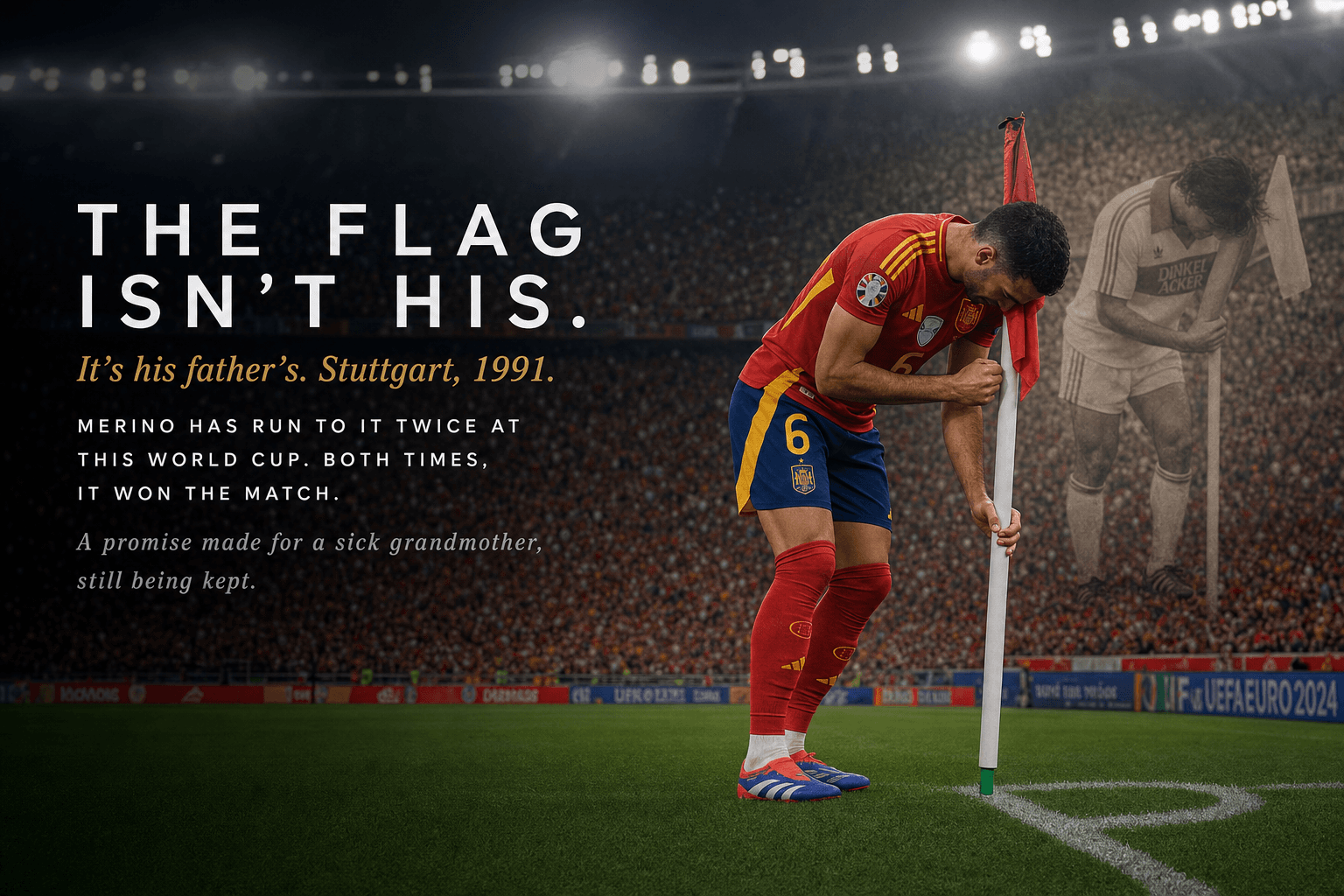
The goal that sent Spain into the 2026 World Cup semi-final did not just win a football match. It completed a pattern that began thirty-five years before Mikel Merino was born into professional football's specific brand of generational storytelling. When Merino turned home the rebound off Senne Lammens's parried save in the 88th minute against Belgium — the decisive contribution documented in our France vs Spain semi-final preview — he did not celebrate the way most footballers celebrate the biggest goal of their career. He ran, immediately and without hesitation, to the corner flag, and circled it. It is the same thing he did after his Round of 16 winner against Portugal. It is the same thing he did in Stuttgart at Euro 2024. It is not his celebration. It has never really been his celebration. It belongs to his father, and the specific story behind it is one of the most quietly devastating pieces of football folklore currently active in the sport.
Osasuna, 1991: A Sick Grandmother and a Promise
Mikel Merino runs around the corner flag after scoring a goal as a tribute to his father Ángel, a former professional footballer who played 17 years in Spain across clubs including Leganés, Las Palmas, and Osasuna. Merino has explained the celebration's origin directly: "The story goes that one day, my grandmother was feeling a bit unwell, and my dad had a game that day. He told her, 'Don't worry, I'm going to score a goal and dedicate it to you.' He didn't know how he was going to do it, just that he would, and it just so happened that he did score. He ran over to the corner flag, and since it was the first thing he saw, he ran around it — kind of like a tribute for my grandmother, to show her that the goal was for her, and that's how the celebration was born."
That specific match was Osasuna against VfB Stuttgart in the 1991 UEFA Cup, played at the stadium then known simply as the Neckarstadion — now the Stuttgart Arena. Ángel Merino scored, ran to the corner flag, and circled it, fulfilling the promise he had made to his sick mother-in-law before kickoff. Mikel has since explained: "My father was a footballer as well, and he used to do that celebration as well for my grandma. In a way of trying to honour him, a show of respect for my father and how much I love him and how much I respect him, I do it." Every single time Mikel Merino has scored since his professional debut, he has run to the same corner and made the same circle — an act of filial tribute repeated so consistently that it has become as recognisable as any signature celebration in the modern game.
Stuttgart, 2024: The Coincidence That Shouldn't Have Been Possible
On July 5, 2024, Mikel Merino headed home Dani Olmo's cross in extra time to give Spain a 2-1 win over Germany in the Euro 2024 quarter-final — at the Stuttgart Arena, the exact stadium where his father had scored and circled the corner flag thirty-three years earlier. Merino did not need to manufacture the tribute. The stadium had done it for him. He ran to the same corner, in the same city, in front of a crowd separated from his father's moment by more than three decades, and completed the exact gesture that had started as a private promise to a sick grandmother in 1991. His immediate run to the flag mirrored his father's celebration so precisely that Spanish media described the moment as creating a poignant echo across generations, highlighting the deep familial bond and tradition that the gesture represents. Ángel Merino's promise to his mother-in-law had, by pure coincidence of venue, become something closer to prophecy fulfilled by his own son.
Mikel Merino's father scored in Stuttgart in 1991 and ran around the corner flag for a sick grandmother. Thirty-three years later, in the exact same stadium, Merino scored the goal that sent Spain to a Euro 2024 semi-final and ran to the same corner. Now, at the 2026 World Cup, he has scored the decisive knockout goal in back-to-back rounds — against Portugal, then against Belgium — running to the corner flag both times. The tribute has outlived the coincidence. It has become the pattern itself.
Los Angeles, 2026: Same Flag, New Stadium, Same Story
Merino's 88th-minute winner against Belgium at SoFi Stadium in Los Angeles secured Spain's place in the World Cup semi-final for the first time in sixteen years — since they won the tournament outright in 2010. He converted after the ball slipped from Lammens's grasp, and immediately ran to circle the corner flag once more, recreating his father's celebration for a second major tournament in a row. Speaking afterward, Merino offered a specific reflection on the pattern repeating itself: "I did it again, it happened to me again; so I think the coincidence really exists. If you are ready and you try, it can happen to you too." It was the second consecutive World Cup knockout match Merino had decided from the bench — following his stoppage-time winner against Portugal in the Round of 16 — a specific pattern of impact substitution we detailed in our piece on Deschamps vs de la Fuente and the two managers' contrasting paths to this semi-final. Manager Luis de la Fuente's reaction was characteristically understated: he had told Merino before sending him on that he would play in the number 10 position, and afterward told him simply, "You are incredible."
The De la Fuente Connection: A Player He Built From the Ground Up
The specific context that makes Merino's role in this tournament resonate beyond the individual celebration is his relationship with the manager who has trusted him at the most important moments. As we documented in our piece on the contrasting managerial paths of Deschamps and de la Fuente, Merino is one of the specific players who won the European Under-21 Championship under de la Fuente in 2019, alongside Dani Olmo, Mikel Oyarzabal, Fabián Ruiz, and Unai Simón — all of whom now play for the same manager who developed them as teenagers, at the biggest stage the sport offers. De la Fuente's specific trust in deploying Merino as an impact substitute, in the exact number 10 role, at the exact moment two consecutive knockout matches required a decisive contribution, reflects years of accumulated understanding between manager and player rather than a tactical gamble made in isolation. The corner flag celebration belongs to Merino's family. The specific stage on which he has now performed it twice at this World Cup belongs, in a structural sense, to the manager who built the pathway that put him there.
Father, Son, and Now a Third Generation
At Euro 2024, Merino dedicated his Stuttgart celebration not only to his father but to his then two-month-old son, Marco, whom he had barely seen in the weeks surrounding the tournament. Merino reflected afterward: "When that happens you remember everything — the good things and the bad things, all the things you have at home. The injury, not seeing my little one grow: I used that as strength to get the best out of me. This is the product of the hard work my family always inculcated in me." The corner flag celebration is no longer simply a tribute running in one direction, from son back to father. It has become a three-generation thread — Ángel's promise to a sick grandmother in 1991, Mikel's inheritance of the gesture across his entire career, and now the specific knowledge that Marco will one day be old enough to understand exactly why his father runs to the same corner, every single time, regardless of the stadium or the stakes.
What Tuesday in Dallas Means for the Story
Spain face France in the semi-final at AT&T Stadium in Arlington, Texas, the specific match documented in full in our piece on Mbappé, Yamal, and Spain's world-record unbeaten run. As we explored in our piece on Spain's historic unbeaten streak, this is only the second World Cup semi-final Spain have ever reached — and Merino, introduced from the bench in either or both of the previous two knockout rounds, has been the specific mechanism by which they got there. Should Merino score again against France, at a third different stadium, in a third different tournament phase, the corner flag celebration would extend its own specific, improbable run — a private family tribute born from a sick grandmother's worry in 1991, now inseparable from Spain's entire 2026 World Cup campaign. Football rarely offers a single gesture this consistently loaded with meaning, repeated at the exact moments a nation is watching closest.
Why This Story Fits Spain's Entire World Cup Narrative
There is a specific thematic resonance between Merino's individual family story and the broader Spain campaign that makes it worth situating alongside the team's other defining threads. Unai Simón's now-broken 519-minute clean sheet record, documented in our piece on his all-time World Cup record, was a story about individual consistency sustained across an entire tournament. Spain's world-record unbeaten run was a story about collective identity built over three years. Merino's corner flag celebration is neither of those things — it is the specific, human-scale story running underneath the statistics, the reminder that every player producing these historic team achievements carries their own private history into each match. Spain's 2026 World Cup has been built on Yamal's teenage brilliance, Simón's defensive record, and de la Fuente's decade-long development project. It has also, twice now in the knockout rounds specifically, been decided by a substitute honouring a promise his father made to a sick grandmother thirty-five years before either of them had any reason to expect it would matter this much.
The specific weight of Angel Merinos original promise also deserves one final piece of context most retellings gloss past: he did not know how he would score, or whether he even could, when he told his mother in law not to worry. Professional footballers rarely guarantee goals, because goals are rarely guaranteeable. He simply believed hard enough, said it out loud, and then delivered it within the same ninety minutes. Whatever specific blend of coincidence, self belief, and pure sporting fortune allowed that exact promise to be fulfilled in 1991 has now been inherited, twice over at major tournaments, by a son who appears to carry the same conviction. Merino did not simply learn a celebration from his father. He appears to have inherited the specific footballing instinct that makes such promises occasionally, remarkably, come true.
Merino's corner flag celebration has decided two consecutive World Cup knockout matches and echoed his father's 1991 tribute in two different major tournaments. Could he do it again against France — and is this the most meaningful celebration story in football right now? Tell us below.