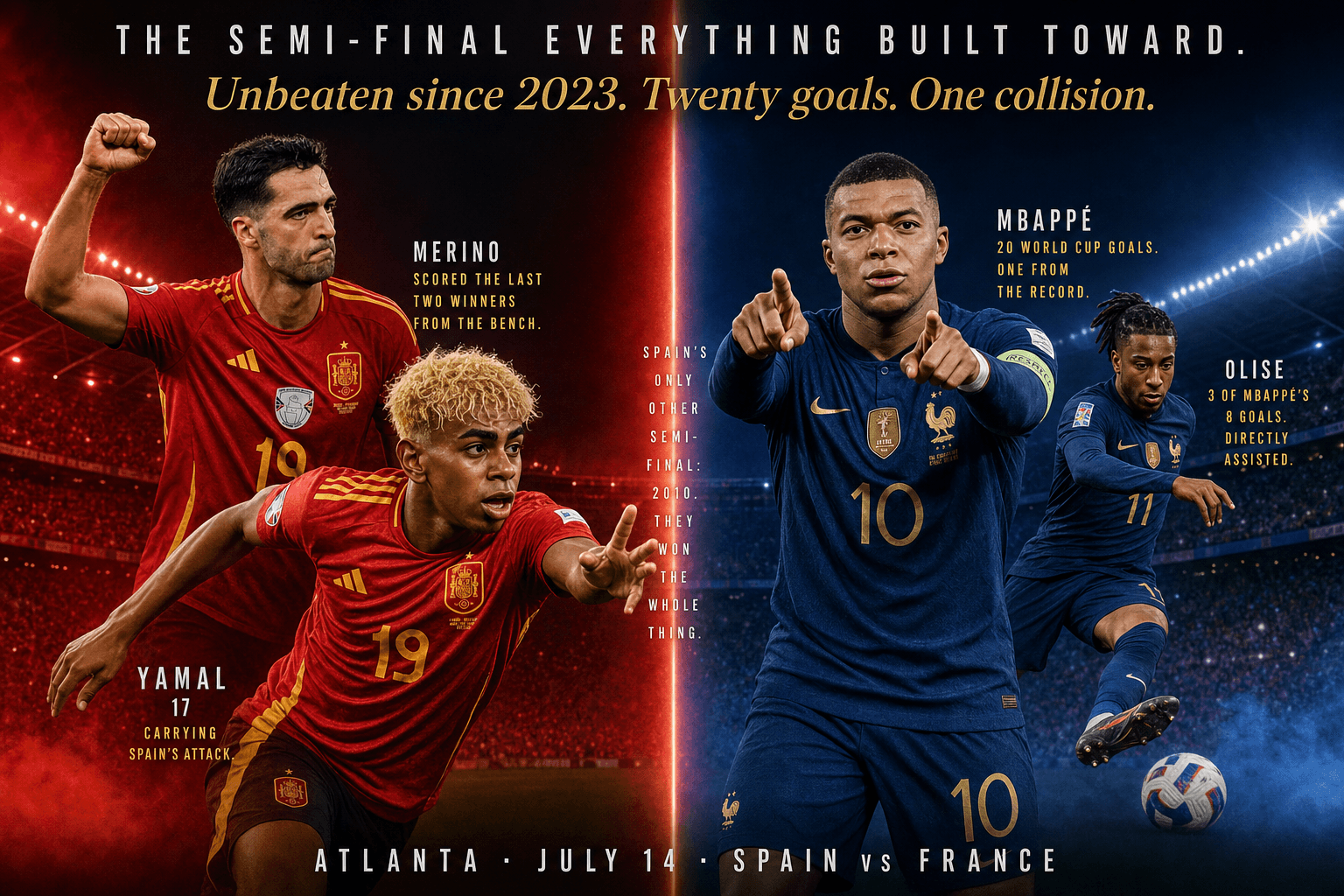
Every bracket in a World Cup produces one match that feels like it was always going to happen, regardless of how the draw actually unfolded. Spain versus France in the semi-final of the 2026 World Cup is that match. Spain — the world-record holders for consecutive unbeaten competitive matches, the team that has not lost since March 2023 — against France, the back-to-back finalists chasing a third consecutive appearance in the last game of the tournament, built around a player who has just become the second man in history to score 20 World Cup goals. Mbappé against Yamal. Olise against a Spanish midfield that has conceded almost nothing all tournament. Merino, on the bench, waiting for his moment again. As we documented across our coverage of Spain's world-record unbeaten run and the Mbappé-Olise partnership driving France's campaign, both of these teams have been building toward exactly this collision since the group stage began. Now it is here.
Spain's Historic Path: Only the Second Semi-Final in Their History
Spain's 2-1 win over Belgium in the quarter-final sent them to their first World Cup semi-final since 2010 — the year they won the entire tournament. That detail is worth sitting with precisely: in the ninety-six-year history of the World Cup, Spain have reached the semi-finals exactly twice, and the only other time they did it, they went on to lift the trophy. ESPN confirmed Spain's win sent them through to face "back-to-back finalists France in a potential epic," with the report specifically noting that a second World Cup crown has now come into view for Spain, sixteen years after their first.
The specific symmetry extends further than the semi-final booking. As we detailed in our piece on Spain's Round of 32 win over Austria, that 3-0 victory was Spain's first World Cup knockout-stage win since the 2010 final itself — sixteen years of knockout frustration ended in a single afternoon. Every knockout match Spain have played at this tournament has therefore been laced with the same specific historical weight: this is the generation attempting to finally follow the only precedent Spanish football has for what happens next. In 2010, a solitary Iniesta goal in extra time separated Spain from the trophy. In 2026, Spain are two matches away from discovering whether history repeats itself or whether this specific group of players writes an entirely new chapter.
Unai Simón's Record Ends — But Spain Still Won
The specific statistical footnote from the Belgium quarter-final matters enormously in the context of our piece on Unai Simón's all-time World Cup record of 519 consecutive minutes without conceding a goal. Charles De Ketelaere's first-half equaliser for Belgium — following Fabián Ruiz's opener for Spain — finally ended that streak, a run that had stood since Simón's tournament began and had broken Walter Zenga's 1990 record along the way. The record's end did not cost Spain the match. It simply confirmed that even the most dominant defensive performance in World Cup history eventually meets a finish it cannot stop. Spain conceded. Spain still won. The specific resilience of a team that can absorb the end of a historic individual record in the 30-something minute of a quarter-final and still find a way to the semi-final, without visible disruption to their composure, is the same quality that has defined this entire Spanish campaign.
Merino: Arsenal's Super-Sub Is Now Spain's
The specific player who has decided Spain's last two knockout matches did not start either of them. Mikel Merino scored the stoppage-time winner against Portugal in the Round of 16, and then, against Belgium in the quarter-final, delivered an almost identical impact: introduced from the bench, he turned home the rebound of a Pau Cubarsí shot that Belgium's injury-replacement goalkeeper Senne Lammens could only parry into his path, scoring the winner just one minute and fifty-seven seconds after coming on. ESPN's recap specifically noted that "it was Mikel Merino who scored off the bench yet again to give them the winning goal" — the second consecutive knockout match in which Spain's most decisive contribution has come from a substitute rather than a starter. He is now the sixth different player to score as a substitute at this World Cup, but the specific pattern of scoring the actual winning goal, in consecutive knockout matches, elevates his contribution beyond a simple impact-substitute statistic into something closer to a defining tournament narrative.
The parallel to Merino's club career at Arsenal is not incidental. He has built a reputation at the Emirates for precisely this quality — arriving from the bench in tight matches and scoring the goal that changes the entire complexion of a game, most notably in Arsenal's Champions League run. Luis de la Fuente is now deploying that exact same weapon for Spain at the biggest possible stage, and the fact that it has worked in back-to-back World Cup knockout matches suggests it is not luck but a specific, repeatable tactical resource that Spain's manager trusts completely when a match remains unresolved deep into the second half.
Mikel Merino has scored the winning goal in Spain's last two World Cup knockout matches — both from the bench, both in the biggest moments available. Unai Simón's 519-minute record finally ended against Belgium, but Spain won anyway. Spain are in their second-ever World Cup semi-final, the first time since they won the entire tournament in 2010. Mbappé has 20 World Cup goals, level with Messi, the second man in history to reach that number. This is not a semi-final. This is the collision point of two teams' entire tournament identities.
Mbappé: The Second Man to Twenty
Kylian Mbappé's curling finish in France's 2-0 quarter-final win over Morocco moved him level with Lionel Messi in the 2026 Golden Boot race and made him only the second player in World Cup history to reach 20 career tournament goals, sitting within one of Messi's all-time record of 21. Opta confirmed Mbappé is also the first player ever to register 10-plus goal involvements at multiple separate World Cups — eight goals and three assists in 2026, following eight goals and two assists in 2022. He had earlier missed a penalty, saved by Yassine Bounou, before recovering to score the opener and then turn provider for Ousmane Dembélé's second — Dembélé's fifth goal of the tournament making France only the second side in fifty years, after Brazil's Ronaldo and Rivaldo in 2002, to have two players score five-plus goals at the same World Cup.
The Ballon d'Or context is impossible to separate from what happens in this semi-final. As we explored in our piece on the Mbappé-Olise partnership driving France's campaign, Mbappé arrived at this tournament already holding the Ballon d'Or. A second consecutive World Cup final appearance, potentially a second World Cup win, achieved as the tournament's joint-top scorer and with the specific individual record of 20 career goals, would make his case for retaining the award in the same year almost impossible to argue against. The concerning detail is the ice applied to his ankle after his Morocco substitution — the specific injury question that now hangs over France's build-up to Tuesday, given how central his fitness is to everything France attempt to do in this semi-final.
Olise's Role in the Semi-Final Equation
Michael Olise's specific function within this France side — the creative provider whose passing has directly produced three of Mbappé's eight tournament goals — becomes more significant, not less, in a match against Spain's specific defensive shape. Spain's back line, organised around Cubarsí's positional intelligence and the collective structure that limited Belgium to just 0.38 expected goals despite their equaliser, is the most disciplined defensive unit remaining in the tournament. Breaking it down requires exactly the kind of precise, early-delivery passing that Olise has provided all tournament. As we detailed in our piece on the France vs Morocco quarter-final and the Real Madrid subplot running through it, Olise's technical quality operates specifically in the moments most opponents cannot organise against quickly enough. Spain's defence organised against Belgium well enough to hold them to 0.38 xG. Whether it can organise as effectively against Olise finding Mbappé in behind is the specific tactical question the semi-final poses.
Yamal: The Teenager Carrying Spain's Attack
Lamine Yamal's role in Spain's run to the semi-final has been to test opposing goalkeepers repeatedly and create the moments that eventually break matches open, even when he is not the one finishing them. Against Belgium, Yamal tested both Thibaut Courtois and his injury-enforced replacement Lammens multiple times across the match, part of Spain's 2.08 expected goals output that eventually yielded Ruiz's opener and set up the platform for Merino's winner. At 17 years old, Yamal is now playing in a World Cup semi-final — the specific stage his talent has been building toward since Euro 2024 — against a France side that has no equivalent teenage phenomenon of his precise profile, but does have Mbappé, who was Yamal's age when he first announced himself on the same international stage in 2018. The generational torch-passing subtext between the two — one a proven World Cup winner and record-setter, the other a teenager writing his own version of the same story in real time — is one of the semi-final's most compelling individual threads.
The Ball Recovery Time Battle: Two Teams Who Dominate the Same Metric
The specific tactical dimension that could decide this semi-final is the one we explored in our pieces on ball recovery time and what it reveals about the tournament's best teams and in-contest possession as the metric explaining Spain's defensive dominance. Both Spain and France have been among the tournament's most efficient teams in both categories — Spain through their patient, technical circulation that minimises the time the ball spends contested, France through the specific speed with which Olise and Mbappé convert transitional moments into converted chances before an opponent's defensive shape can reset. When two teams who both excel at controlling the same specific phase of the game meet each other, the contest becomes less about which team dominates possession in the conventional sense and more about which team wins the individual duels in the brief windows where the ball is genuinely up for grabs. Spain's press, organised around Rodri and Pedri, will look to suffocate France's transitions before they start. France's speed in behind, built around Mbappé's movement and Olise's delivery, will look to create exactly the kind of broken-play moments that Spain's system is specifically built to prevent. Whoever wins that specific, largely invisible battle in midfield is more likely to control the match that everyone can see.
What History Says — and What Merino Might Say Again
The specific weight of this semi-final is that both teams arrive with genuinely elite claims: Spain's unbeaten record, their only previous semi-final ending in the trophy, Unai Simón's shattered-but-still-historic defensive record, and Merino's habit of deciding matches from the bench. France's genuine claim to the tournament's best individual player in Mbappé, the specific Dembélé partnership giving them attacking depth no other semi-finalist can match, and Didier Deschamps now the first manager in history to record 20 World Cup wins. Both teams have won the tournament before. Both teams believe, with genuine statistical justification, that they are the team most likely to win it again. Tuesday in Atlanta will resolve which belief was correct.
Spain's unbeaten record against Mbappé's 20 World Cup goals. Yamal against Olise. Merino waiting on the bench. Who wins the semi-final, and does the winner go on to lift the trophy? Tell us below.