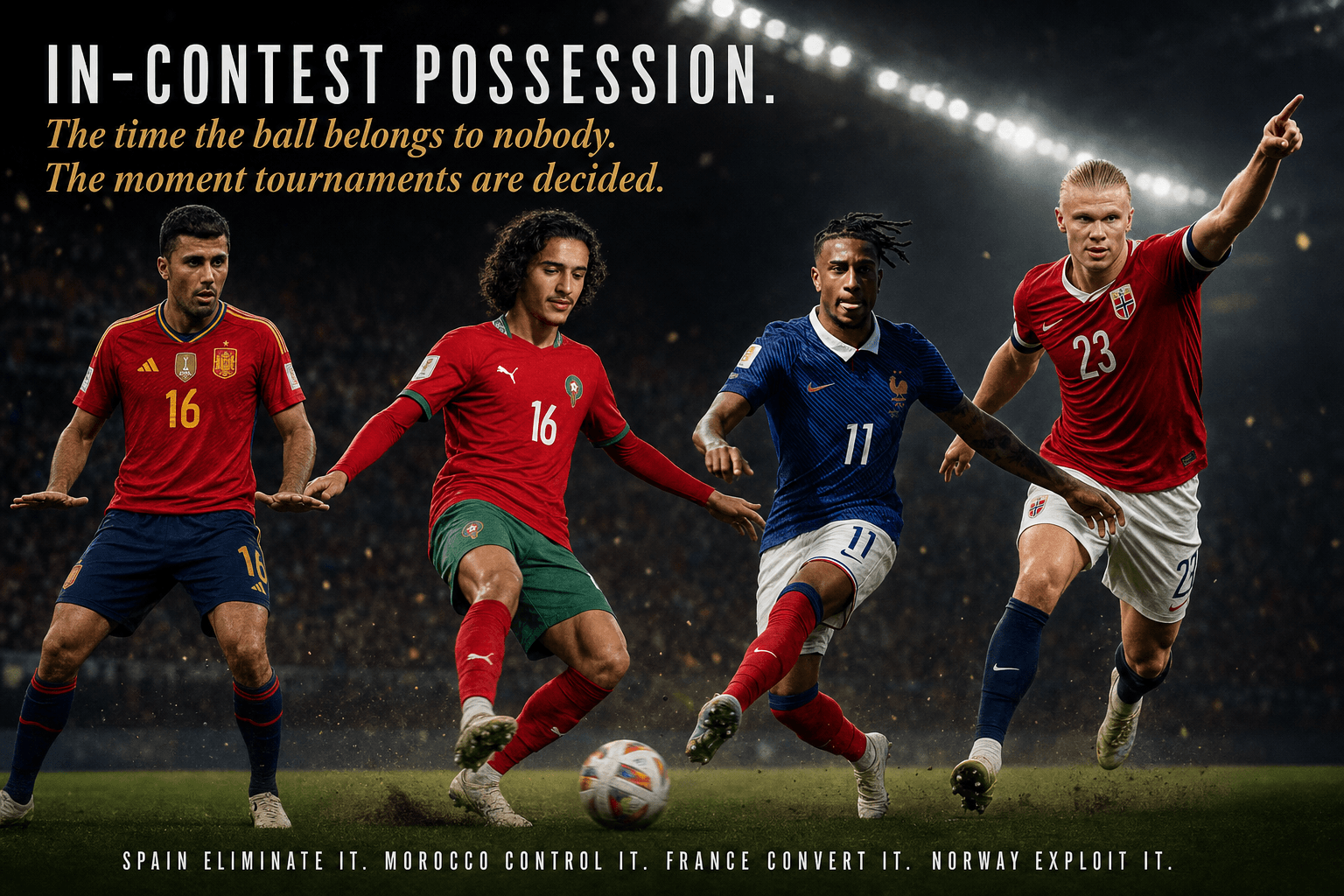
You have seen the percentage appear alongside the conventional possession figures during World Cup 2026 broadcasts. Two numbers — a team's controlled possession and a third figure that sits between the two teams' shares and adds up to something left over. That third figure is "in-contest possession" and it is the most revealing stat at this World Cup that the majority of football coverage is not explaining properly. Conventional possession tells you which team had the ball. In-contest possession tells you how much of the game nobody had it — how much time was spent in the contested, chaotic, uncontrolled space where the next goal, the next transition, the next decisive moment is most likely to originate. Understanding it changes how you read every match at this tournament.
What In-Contest Possession Actually Means
FIFA define in-contest possession as a period where neither team has controlled possession of the ball. The ball enters the in-contest state through possession contests — duels, aerial challenges, physical battles where both teams are directly competing for the ball on the ground or in the air. It also occurs after defensive events where neither player gains controlled possession: when a ball falls loose following a duel, after a clearance that neither team immediately controls, when the ball rebounds from a goalkeeper's initial save, or from a block or deflection. The ball sits in this contested, unresolved state until one team establishes clear controlled possession — a decisive pass, a controlled touch, a goalkeeper's secure catch.
The conventional possession percentage you have watched for decades divides controlled time between the two teams and presents it as the primary measure of game control. A team with 60% possession is assumed to have dominated. A team with 35% possession is assumed to have been under pressure throughout. In-contest possession exposes the gap in that logic: if 15% of the match is spent in a contested state that neither team controls, the 60-35 split only accounts for 85% of what happened. The remaining 15% — the duels, the loose balls, the second-phase scrambles — is where counter-attacking teams build their threat. It is where Norway score against Ivory Coast after 82 minutes of structured possession. It is where Morocco's Issa Diop arrives in the 91st minute when the Netherlands think they have done enough. It is where the goals that change tournaments are made.
When It Started: The 2022 World Cup Introduction
FIFA introduced the in-contest possession metric publicly at the 2022 World Cup in Qatar. The stat appeared alongside conventional possession percentages in match broadcasts and data feeds for the first time at that tournament, generating significant discussion among coaches and analysts. The England FA's coaching blog noted that an average of 11% of games at the 2022 World Cup were spent in an in-contest state — meaning more than one in every ten minutes of football was neither team's controlled possession. The figures varied dramatically by team and by match: Spain, who dominated the tournament's possession statistics, averaged just 9% of their games in contest — because their patient, controlled circulation limited the opportunities for contested phases to occur. Saudi Arabia, by contrast, recorded the tournament's lowest average possession duration at just five seconds before losing control — meaning their brief periods of possession were constantly generating in-contest moments as the ball was immediately challenged and disputed.
The specific example that illustrated the stat most clearly in 2022 was Spain's 7-0 defeat of Costa Rica: Spain held 78% possession in that match, with just 7% of the game spent in contest. When one team dominates possession so completely and patiently, the contested phase of the game almost disappears — there are no duels because the ball is never disputed. Costa Rica never had enough of the ball to force Spain into a contested situation. The stat captured what conventional possession could not: the complete absence of competitive struggle for ball control in that specific match.
Spain at 2026: Still the Masters of Minimising Contest
At the 2026 World Cup, Spain have continued the approach that made them the 2022 in-contest masters. As we documented in our analysis of Spain's world-record unbeaten run that now stands at 35 competitive matches, the specific quality that defines this generation of Spanish players is the ability to sustain possession in a way that eliminates the contested phase of the game — not through negative football, but through the technical quality that means the ball rarely enters an undefined state. Rodri's first touch, Pedri's body orientation, Yamal's ability to receive under pressure and immediately control — every individual technical choice that reduces the time between receiving and releasing the ball is a choice that keeps possession controlled rather than in-contest. Spain's group stage, which produced three consecutive clean sheets and no goal conceded, reflected that control at its most systematic: opponents could not generate the in-contest moments from which their best attacks would be created.
FIFA introduced in-contest possession at the 2022 World Cup. It measures the time neither team controlled the ball — duels, loose balls, contested scrambles. At 2026, it reveals why Spain win without conceding, why Morocco exploit transition, why Bouaddi's 91% pass accuracy is the most important stat of the tournament, and why Haaland's five goals have all come from exactly the moments in-contest possession creates. The best teams at this World Cup are defined by how they use it, not just by whether they have the ball.
Bouaddi, Morocco, and Controlling the Contested Space
The Morocco story at this tournament is specifically illuminating through the in-contest lens. As we covered in our piece on Morocco at the World Cup 2026 and the specific threat they represent, Ayyoub Bouaddi's performance against Brazil in the group stage produced statistics that translate directly into in-contest terms: 91% pass accuracy, 87 touches, 53 carries. A player who completes 60 of 66 attempted passes is a player who keeps the ball in controlled possession rather than in-contest at a rate that outperforms almost every midfielder at this tournament. The Olympics.com analysis of Bouaddi's Brazil performance noted that his pass accuracy trailed only Gabriel and Marquinhos among all outfield players, despite operating under significantly more defensive pressure than either centre-back. Casemiro — whose role is specifically to minimise in-contest moments by winning possession duels and immediately recycling — was comprehensively outperformed by an 18-year-old who had chosen Morocco over France weeks before the tournament began.
Morocco's 82% possession in extra time against the Netherlands — noted in our Morocco analysis — is the specific in-contest corollary: when Morocco dominate possession in that phase, the contested ball moments that would allow the Netherlands to build counter-attacks simply do not occur. The Atlas Lions controlled the game by controlling the possession, and the in-contest metric for those 15 minutes was likely among the lowest recorded at this tournament in any single period of play.
Norway, Haaland, and Exploiting In-Contest Moments
The counter-argument to the Spain model is the Norway argument, and it runs directly through in-contest possession. As we detailed in our piece on Haaland's first World Cup and what four goals in two matches means, Norway under Ståle Solbakken do not seek to minimise in-contest possession. They seek to maximise their quality when it occurs. Every Haaland goal at this tournament has come from a moment that began in a contested state: a cross delivered into a contested box, a second-phase chance after an initial clearance, a ball that fell in an undefined space and was controlled first by the striker. His 86th-minute goal against Ivory Coast — calmly finished after Patrick Berg's pass found him in space — came after a period of sustained in-contest pressure in the final minutes when Norway were chasing the match. The Ivory Coast match had Ivory Coast equalising and appearing to have the game under control before the in-contest phase of Morocco's late pressure produced the decisive second-phase opportunity. Norway's system is built around the quality they can bring to those moments. Haaland's five goals prove they have found the player most capable of converting them.
Brazil, Ancelotti, and the In-Contest Problem
The Brazil story at this World Cup is partly an in-contest possession story. Ancelotti's squad — older than most, relying on Vinicius's individual quality in transition — has struggled to maintain the kind of controlled possession that minimises in-contest moments in the way Spain does. Their 1-1 draw with Morocco in the group stage produced a match where Morocco's in-contest exploitation — through Bouaddi's midfield control and the specific transition moments Hakimi's pace creates — limited Brazil to a single Vinicius goal despite having their full attacking resources available. The piece on why Ancelotti was hired to solve Brazil's European problem explains the larger context: the five consecutive World Cup exits to European teams that prompted Brazil's change of manager. In-contest possession is the tactical mechanism through which those exits were often produced — European teams that could contest possession more effectively in the crucial phases of knockout games, winning the duels and the second balls that in-contest moments generate, while Brazil's individual quality was less relevant when the ball was not in their controlled possession.
What In-Contest Possession Predicts for the Knockout Rounds
The teams that will win the 2026 World Cup are the teams that have the highest-quality answers to in-contest possession. Spain, who minimise it through technical quality and patience. Morocco, whose Bouaddi and El Aynaoui double pivot wins the contested duels and immediately recycles into controlled possession. France, whose Olise-Mbappe combination thrives in the transition moments that in-contest possession creates — Olise's 91% pass accuracy at this tournament mirrors Bouaddi's, and Mbappe's speed in behind a defensive line is specifically calibrated to the space that in-contest moments open up. As we explored in our piece on the Mbappe-Olise partnership and what it means for the Real Madrid summer, the three Mbappe goals that Olise has assisted have all come from passes that arrived in the specific window between in-contest and controlled possession — the moment the ball was Olise's but not yet under full control, when Mbappe's run had already begun. That is the Olise function: to convert in-contest moments into controlled possession so efficiently that by the time the opposition's press arrives, the opportunity has already been created.
When you watch the 2026 World Cup from this point in the tournament, the in-contest possession metric is the lens that explains what conventional statistics miss. It explains why Norway, who had 42% of the ball against Ivory Coast, scored twice. It explains why Morocco, at 82% possession in extra time against the Netherlands, produced no further goals but eliminated all further Dutch threat. It explains why Bouaddi's 91% pass accuracy is the most important statistical achievement of the group stage. And it explains why Spain — 35 competitive games unbeaten, tournament favourites, world-record holders — remain the hardest team in the world to beat. They do not just have the ball more. They make the game exist on their terms. In-contest possession is where the terms are disputed. Spain have chosen not to play there. Everyone else is still figuring out whether they can match that choice.
The specific value of understanding in-contest possession at this stage of the tournament is that it gives you a predictive tool rather than just a descriptive one. Teams entering the quarter-finals with the highest quality of in-contest management — the fastest conversion from contested to controlled, the best second-phase organisation, the individual players most capable of winning duels and immediately using the ball — are the teams most likely to win in the specific pressure conditions that knockout football creates. Spain's technical patience. Morocco's Bouaddi at the double pivot. France's Olise-Mbappe transition. Norway's Haaland in second-phase spaces. Each represents a different answer to the same question: when the ball is nobody's, whose player gets there first and does what with it?
In-contest possession is the stat FIFA introduced in 2022 that explains the 2026 World Cup better than any other. Do you think possession statistics are being properly reported and understood by commentators and analysts — and which team's approach to in-contest possession do you find most interesting? Tell us below.