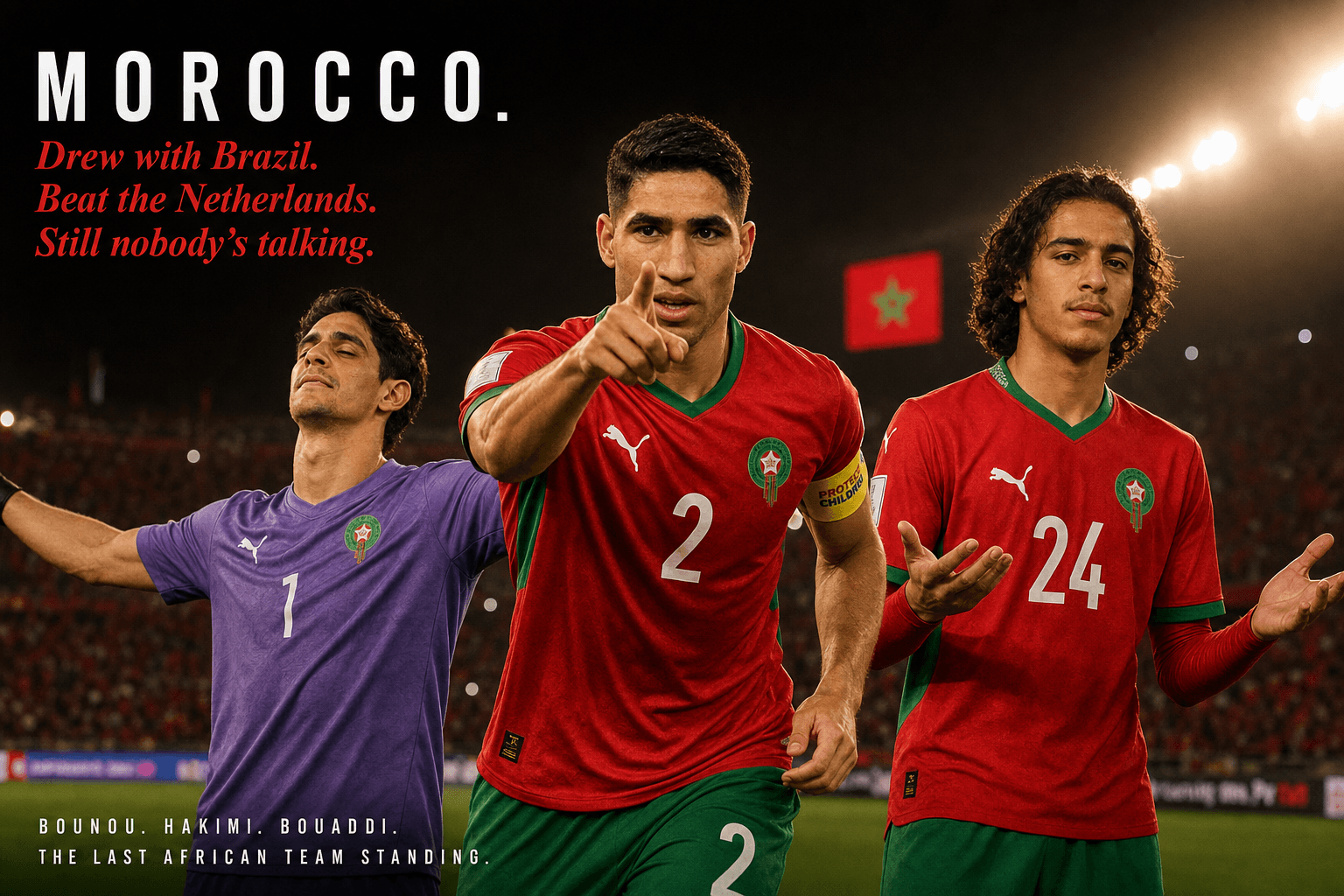
One of the two African teams left in the World Cup is still playing. The other — Senegal — went out to Belgium in extra time. Morocco are the Atlas Lions, the continent's last representative, the team that reached the semi-final of the previous World Cup and became the first African side in history to do so. They have been here before. They know what a knockout tournament at this level requires. And yet, across the coverage of the 2026 World Cup, the narrative around Morocco has been quieter than almost any other team in the last 16. Haaland has five goals. Mbappe has six. Brazil are navigating the European curse. England face Mexico at the Azteca. France are favourites. In among all of that, Morocco have beaten the Netherlands on penalties in one of the tournament's most dramatic matches, held Brazil to a draw in the group stage, and advanced to the Round of 16 against co-hosts Canada. That is not the profile of a team anybody should be treating lightly. The mistake every Morocco opponent makes is treating them lightly.
Bounou: The Goalkeeper Who Wins Tournaments
The specific individual who defines Morocco's knockout credentials most clearly is not a forward and not a captain. It is the goalkeeper. Yassine Bounou — known universally as Bono, who plays for Sevilla and has been one of La Liga's most reliable goalkeepers across the past four seasons — has now won both of Morocco's World Cup penalty shootouts. Spain in the 2022 Round of 16 in Qatar. The Netherlands in the 2026 Round of 32 in Monterrey. Both times, Morocco were the underdog on paper. Both times, the match reached penalties. Both times, Bounou was the decisive difference. Against Spain in 2022, he saved three penalties. Against the Netherlands on Monday, he saved Crysencio Summerville's fourth-round kick after both teams had already missed twice, setting up Ismael Saibari to score the winner. The specific quality Bounou brings to a penalty shootout is not simply reflexes. It is preparation, psychological composure, and the ability to read a penalty taker's movement before the kick is taken. Morocco under manager Mohamed Ouahbi are a team specifically equipped for the high-pressure, low-margin format of knockout football. The goalkeeper is the clearest evidence of that specific readiness.
Hakimi: The Captain Nobody Mentions Enough
Achraf Hakimi has won the Champions League with Real Madrid and with PSG, making him part of a rare group of players with back-to-back UCL medals at different clubs — a parallel that connects him to Willian Pacho of Ecuador, as we noted in our Ecuador defensive record and UCL context piece. What makes Hakimi specifically dangerous at this World Cup is not his Champions League pedigree but the way he functions as Morocco's primary wide attacking threat — a right wing-back who operates closer to a winger in possession while maintaining his defensive responsibilities in Morocco's compact shape. Opta confirmed that Hakimi has accumulated 30 touches in the opposition's box across his World Cup career — the most of any Moroccan player all-time. Against the Netherlands alone, he hit the crossbar in the 52nd minute, rattled a shot over the bar, had a cross across the box nearly converted by Saibari, and was a constant source of threat that the Dutch backline could not consistently neutralise. He is Morocco's captain, their most recognisable player, and their most dangerous attacking weapon when given the space to run.
Bouaddi: The 18-Year-Old Who Had Casemiro Chasing Shadows
Ayyoub Bouaddi is 18 years old. He plays for Lille. He was born in France, captained France at Under-21 level, and switched his international allegiance to Morocco in May 2026 — less than a month before the World Cup began. In Morocco's 1-1 draw with Brazil in the group stage, he was the player of the match by any objective measure — 87 touches (team-high), 91% pass accuracy, 53 carries (most of any player on the pitch), and a defensive contribution that included 4 tackles and 6 recoveries. The player he was directly matched against, Casemiro — Real Madrid's former defensive midfielder and one of the most decorated midfielders of his generation — was described by multiple journalists as chasing shadows.
Arsenal have already begun a formal pursuit, with Mikel Arteta identifying him as a priority target for the Emirates engine room. The Gunners have maintained contact with his representatives for several months. PSG, Chelsea, Liverpool, and Manchester City are also tracking his development. Bouaddi told The Athletic's David Ornstein after the Brazil match: for the moment, I am only focused on the World Cup and I cannot answer this right now. The composure of that sentence — from an 18-year-old at his first major tournament, addressing the biggest clubs in European football — tells you as much about the player as the 91% pass accuracy does. He also previously played against Real Madrid in the 2024 Champions League while at Lille — described at the time as "toying with the Galácticos". At 18, he is already comfortable on the biggest stages. At the 2026 World Cup, he is the most watched teenager in the competition. The conversation about him joining Arsenal or a comparable club will intensify with every match Morocco play.
Opta's analysis confirmed that Morocco's passing volume in the extra-time period against the Netherlands was remarkable: 82% possession in those 15 minutes, the most by any team in a World Cup extra-time period this tournament. That is not the statistic of a team clinging on. It is the statistic of a team that found its rhythm, dominated possession against a technically excellent opponent, and was only denied by Verbruggen's specific individual brilliance. Morocco did not scrape past the Netherlands. They were the better side across 120 minutes and the win was deserved on the balance of play.
The Brahim Diaz Dimension: Real Madrid Inside Morocco's Attack
One of the more specifically interesting subplots within Morocco's forward line is Brahim Diaz — the Real Madrid attacking midfielder who represents Morocco internationally rather than Spain, the country of his birth. Diaz's international alignment with Morocco is one of the tournament's more compelling individual story choices: born in Málaga, developed through Spanish academies, at Real Madrid since 2023 — he represents the African nation of his family's heritage rather than the European nation where he grew up and works. As we explored in our piece on Real Madrid's reported pursuit of Michael Olise for a potential world-record fee, Olise's arrival at the Bernabeu would most directly affect Diaz's role in the Madrid attack. The specific position Olise would fill — creative wide midfielder feeding Mbappe — is the position Diaz currently occupies when available. The World Cup is therefore not just a tournament for Diaz. It is a shop window in which he is auditioning for continued relevance at his club while simultaneously competing for Morocco's World Cup ambitions. If Morocco meet France in the quarter-final, and France's Olise torments Morocco's defensive structure, the story has an additional layer: the player whose Real Madrid position Olise would take is on the opposite side of the pitch.
Morocco's Knockout Credentials: Why This Is No Fluke
The 2022 World Cup semi-final was the moment that ended the argument about whether Morocco's tournament performances were fluky or structural. Reaching the last four at a World Cup — eliminating Spain and Portugal along the way — requires consistent tactical organisation, individual quality in multiple positions, and the kind of psychological resilience that only comes from a squad that has faced and overcome serious knockout pressure. The 2026 campaign adds further evidence to the structural case. Their draw with Brazil — against a team managed by the most decorated European club manager in history, specifically hired to solve Brazil's knockout problem — shows the same defensive discipline and counter-attacking quality that defined their 2022 run. Their victory over the Netherlands adds the shootout chapter that their 2022 journey also required. The pattern is consistent: Morocco defend compactly, attack with precision through Hakimi's overlaps and Diaz's movement, and rely on Bounou's specific brilliance when the match reaches its most compressed pressure points. That pattern won them a semi-final in 2022. It has taken them to a Round of 16 in 2026. The question for the summer is how much further it goes — and whether Canada or France can produce the answer before Morocco find another one.
The Canada Match and Why It Is Not Safe
Canada qualified as co-hosts and finished second in their group — a solid group-stage performance that reflects the growth of football infrastructure in a country historically more associated with ice hockey and American football. The home advantage at Houston on July 4 is real: a large Canadian fanbase, the Independence Day context making neutral American support favour the underdog, and the specific motivation of a host nation that has never won a World Cup match in their history until this tournament. Canada are not an irrelevant opponent. They are a team that Morocco will need to play properly to eliminate. Morocco's matchday scheduling — R16 on July 4 in Houston — gives them limited preparation time after the physical and emotional demands of the Netherlands extra-time and penalties. Bounou's legs. Hakimi's pace. El Aynaoui's pressing intensity. All of those weapons have been deployed for 120 minutes against a top European opponent. The 72-hour recovery before Canada is the specific logistical challenge that physical preparation must manage.
Morocco's specific strength in this context is their defensive structure — compact, organised, hard to break down — which does not decline as quickly under fatigue as an expansive attacking system does. If Morocco are tired against Canada, they defend well and hit on the counter. That has been their pattern at both World Cups. They are the team who makes their limitations work for them in a way that most opponents discover only after the final whistle. And if Morocco eliminate Canada and France beat Paraguay, the quarter-final is set: Atlas Lions vs Les Bleus, the rematch two years and one world title in the making. As we detailed in our piece on the Mbappe-Olise partnership that is driving France's World Cup ambitions, France arrive at that potential quarter-final as tournament favourites with six Mbappe goals and five Olise assists. Morocco arrive having beaten the Netherlands and drawn with Brazil. The favourite-underdog framing is accurate. The actual football outcome is not predetermined. It never was in 2022, either.
Morocco drew with Brazil, beat the Netherlands on penalties, and are the only African team in the last 16. Are they the tournament's most underrated threat — and can they reach the semi-finals again and go one step further than 2022? Tell us below.