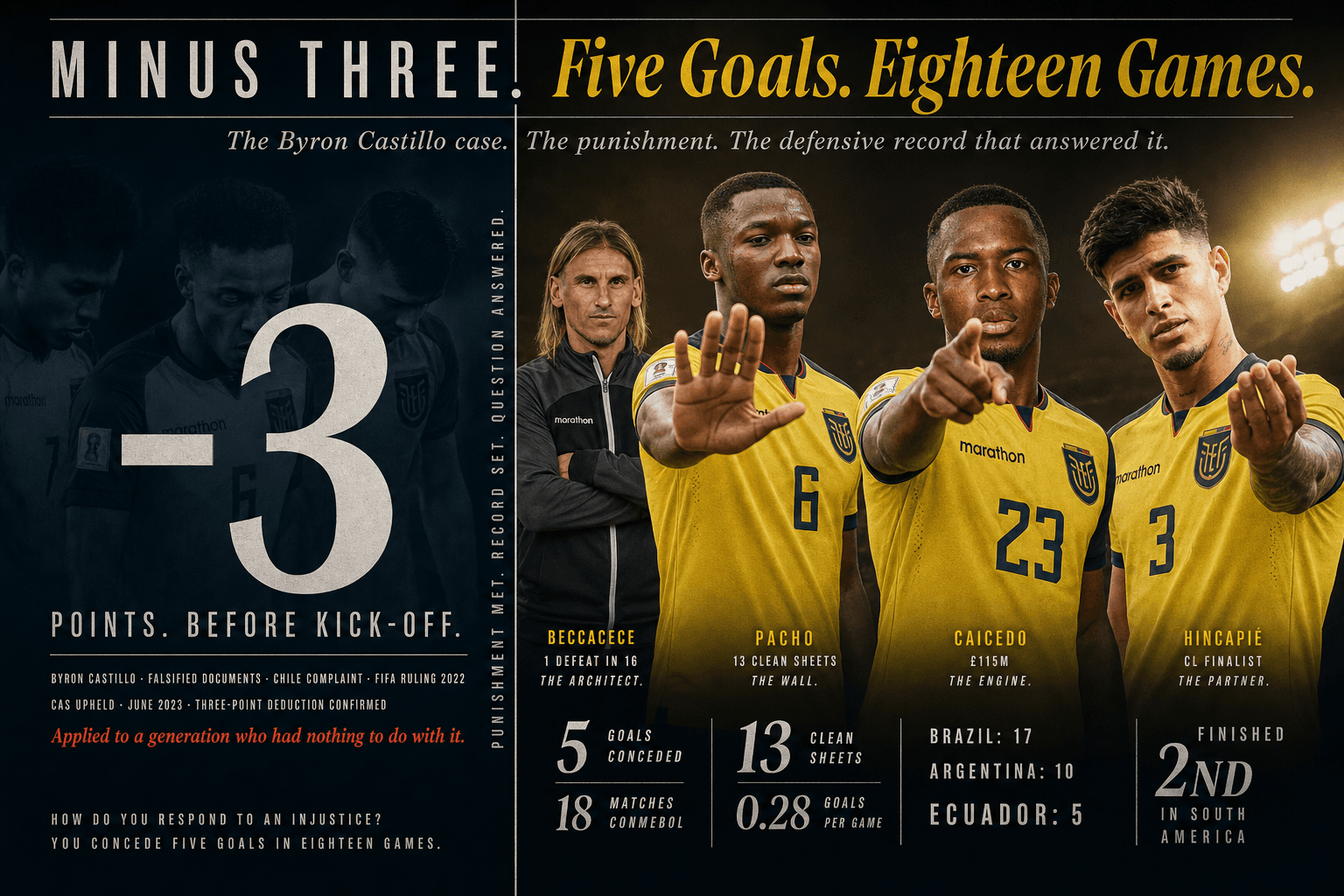
If you have arrived here asking why Ecuador started the 2026 World Cup qualifying campaign with minus three points, or why Ecuador were deducted points in World Cup qualifying, or how a team penalised before kick-off went on to concede five goals in eighteen matches and finish second in South America — this piece answers all of it. This is the complete explanation of the Byron Castillo case, the FIFA ruling, the Ecuador point deduction, and the defensive record that turned punishment into proof of character. For the full match-by-match account of their qualifying campaign and World Cup group stage, see our Ecuador dark horse analysis and our Ecuador World Cup tournament update.
Why Were Ecuador Deducted 3 Points? The Byron Castillo Case Explained
The Ecuador point deduction for the 2026 World Cup qualifying campaign traces directly to a legal dispute that began in late 2021 and was not fully resolved until 2022. Byron Castillo was a left-back who played for Ecuador during the 2022 World Cup qualifying campaign in South America. He made eight appearances as Ecuador navigated CONMEBOL qualification for Qatar 2022.
The problem arose when Chile — who failed to qualify for Qatar 2022 — filed a formal complaint with FIFA alleging that Castillo had provided falsified birth documents to secure his eligibility to represent Ecuador. The specific allegation was that Castillo was born in Colombia, not Ecuador as his documents stated, which would mean he was ineligible under FIFA's eligibility rules. FIFA investigated and concluded in September 2022 that Castillo's documents did contain irregularities, but stopped short of stripping Ecuador of their 2022 World Cup place. Instead, FIFA's disciplinary committee imposed a future penalty: a deduction of three points to be applied to Ecuador's next World Cup qualifying campaign — the 2026 cycle.
Ecuador appealed the ruling. The Court of Arbitration for Sport (CAS) reviewed the decision. In June 2023, CAS upheld the deduction. The three-point penalty would be applied when the 2026 qualifying campaign began. Ecuador did not escape the punishment. But they also did not lose their 2022 World Cup place. The specific legal outcome was: keep Qatar, lose three points in the next cycle. Ecuador went to Qatar 2022 and were eliminated in the round of 16 by Senegal on goal difference. Then they returned to qualifying for 2026 knowing they were already minus three.
Why Did Ecuador Start With Negative Points? The Mechanics Explained
The question why did Ecuador start with negative points is exactly what the FIFA disciplinary ruling produced. In conventional World Cup qualifying, every team begins on zero points. Three points for a win, one for a draw, zero for a defeat. Simple accumulation across a specified number of matches. Ecuador's 2026 qualifying campaign began with the three-point deduction already applied to their account — meaning before any team had played a single match, Ecuador were already on minus three. They needed to win a game just to get back to zero.
The deduction fell on a completely different set of players from those involved in the original irregularity. Castillo himself had effectively ended his professional career in the aftermath of the case. The players carrying the penalty into 2026 qualifying — Willian Pacho at PSG, Piero Hincapié at Arsenal, Moisés Caicedo at Chelsea, Enner Valencia at Internacional — had no connection to the falsification. They were punished for a decision made before many of them were regular first-team players. That is the specific injustice the deduction represents: a collective punishment applied to a new generation for an individual irregularity from a previous one.
Ecuador's response to that specific injustice is what defines the story. They could have started the campaign demoralised, distracted by the legal processes, disadvantaged by the mathematics of beginning in deficit. Instead, they produced a qualifying campaign that remains one of the most defensively dominant in CONMEBOL history.
Ecuador's 2026 World Cup Qualifying Goals Conceded: The Full Record
The Ecuador 2026 World Cup qualifying goals conceded total: five. Across eighteen matches in CONMEBOL — the most competitive qualifying region in football, containing Argentina (2022 World Cup champions), Brazil (five-time World Cup winners), Colombia, Uruguay, and Venezuela — Ecuador conceded five goals. That is a number so low that it requires the context of what other teams conceded in the same campaign to land with its proper weight.
Brazil conceded seventeen goals. Argentina, the reigning world champions who won the tournament, conceded ten. Colombia conceded twelve. Uruguay conceded nine. Every other team in CONMEBOL qualified with a goals-against figure more than double Ecuador's five. The second-best defensive record in the entire qualification phase across CONMEBOL belonged to Venezuela, who conceded eight — still sixty percent more than Ecuador across the same number of matches.
Ecuador's qualifying goals conceded breakdown: their five goals came from multiple opponents across eighteen games. The thirteen clean sheets they recorded tell the other side of the story — thirteen times across the South American qualifying campaign, no opponent scored against them at all. Against Brazil, Argentina, Colombia, Uruguay, and Venezuela — the nations most capable of producing top-level attacking football — Ecuador repeatedly held firm. LeagueLane's tactical analysis confirmed Ecuador's 0.28 goals conceded per game as the best defensive rate of any South American nation in the qualifying phase.
Ecuador Defensive Record: How Beccacece Built It
The Ecuador defensive record at the 2026 World Cup qualifying phase was not accidental. It was the product of a specific tactical philosophy installed by Sebastián Beccacece — the Argentine manager appointed in August 2024 who, notably, never played professional football himself. His approach was built around a single central principle: make Ecuador impossible to beat first, then find a way to score second.
The system is a 4-3-3 in possession but shifts to a compact 4-5-1 or even 4-4-2 out of possession — a disciplined mid-low block that compresses the space between Ecuador's defensive and midfield lines, denying opponents the vertical passing lanes that break defensive shapes. Beccacece's first sixteen games as Ecuador manager produced only one defeat, which immediately confirmed the system's effectiveness across CONMEBOL's varied tactical challenges.
The defensive core that implements it begins with Willian Pacho. The PSG centre-back — the first Ecuadorian to win the Champions League, having done so twice in 2025 and 2026 — brings elite-level positional reading and aerial authority. Alongside him, Piero Hincapié, who played in the 2026 Champions League final for Arsenal, provides complementary qualities: quicker recovery pace, comfort on the ball, and the kind of one-on-one defensive technique that comes from competing against Premier League and Champions League opposition every week. Together they form the defensive partnership that makes Ecuador's qualifying record possible at the most basic level — two Champions League-quality centre-backs defending together under a coach who organises a system specifically designed to minimise concessions.
In front of them, Moisés Caicedo provides the defensive midfield screen that covers the channels and breaks up transitions before they can reach the back four. Caicedo, signed by Chelsea for £115 million in 2023, is described by those who watch him most closely as one of the finest holders in European football. The combination of his screening and the back four's compactness creates a structure that CONMEBOL opponents — even Argentina, even Brazil — found consistently difficult to penetrate through normal build-up play.
The Numbers That Make the Deduction More Remarkable
The Ecuador point deduction of three points entering qualifying means the achievement of finishing second in CONMEBOL should be read with an asterisk — not one that diminishes it, but one that clarifies it. Ecuador finished second on 29 points. Without the deduction, they would have finished on 32 points. With 32 points, they would have finished above Argentina's 36-point total only with a perfect record — which they did not achieve. So the deduction did not change their finishing position. It simply meant every match they played had to overcome an already-existing deficit before any progress was made.
The psychological weight of starting on minus three in a ten-team round-robin competition is not trivial. The first game — the opening result — determines whether you climb to zero, stay negative, or fall further behind. Ecuador lost their opening qualifying match to Argentina 1-0. After matchday one, they were on minus four. Standing four points behind the entire rest of the CONMEBOL field before the second round of fixtures had produced a single result. That is where Ecuador's World Cup 2026 qualifying campaign started. The Byron Castillo deduction had done its maximum possible damage — an immediate loss compounded by a pre-existing deficit.
They responded by conceding four more goals across the remaining seventeen matches, winning enough games to finish second, and arriving at the 2026 World Cup as a team that had been punished, defeated on day one, and then simply refused to accept either of those facts as defining outcomes.
At the World Cup: The Record Continues
The Ecuador defensive record that defined qualifying has continued at the tournament itself. Two goals conceded across three group-stage matches — both in separate games (one against Ivory Coast, one against Germany), none against Curaçao in a 0-0 draw where Ecuador registered 27 shots without scoring. The defensive structure that produced five goals conceded in eighteen qualifying games has produced two goals conceded in three World Cup games against genuinely higher-level opposition.
The most significant result came in the final group match: a 2-1 win over Germany, the group winners, with goals from Nilson Angulo and Gonzalo Plata. Ecuador, who started qualifying minus three points and could not score against Curaçao in the group stage, beat the 2014 World Cup champions in the most important match of their campaign with goals that came from exactly the system Beccacece built — organised defence, set-piece threat, clinical conversion of the specific chances created. Gonzalo Plata's 77th-minute winner was exactly the kind of goal the Ecuador defensive record was always designed to create space for — defend until the moment arrives, then take it.
Ecuador are now in the Round of 32, facing Mexico at the Azteca. The team penalised before the qualifying campaign began, which conceded five goals across an eighteen-match cycle, which beat Germany at a World Cup, now faces a home nation in the most intimidating domestic football environment in North America. The Byron Castillo case produced a three-point deduction. It did not produce the outcome it was designed to prevent. Ecuador are here. The defensive record that defines them travels to Mexico City on June 30. The story continues.
Now you know why Ecuador started with negative points, how they conceded only five goals in eighteen qualifying matches, and what the Byron Castillo case actually means — do you think Ecuador can go further at this World Cup than anyone expected? And how high can their defensive record reach? 👇