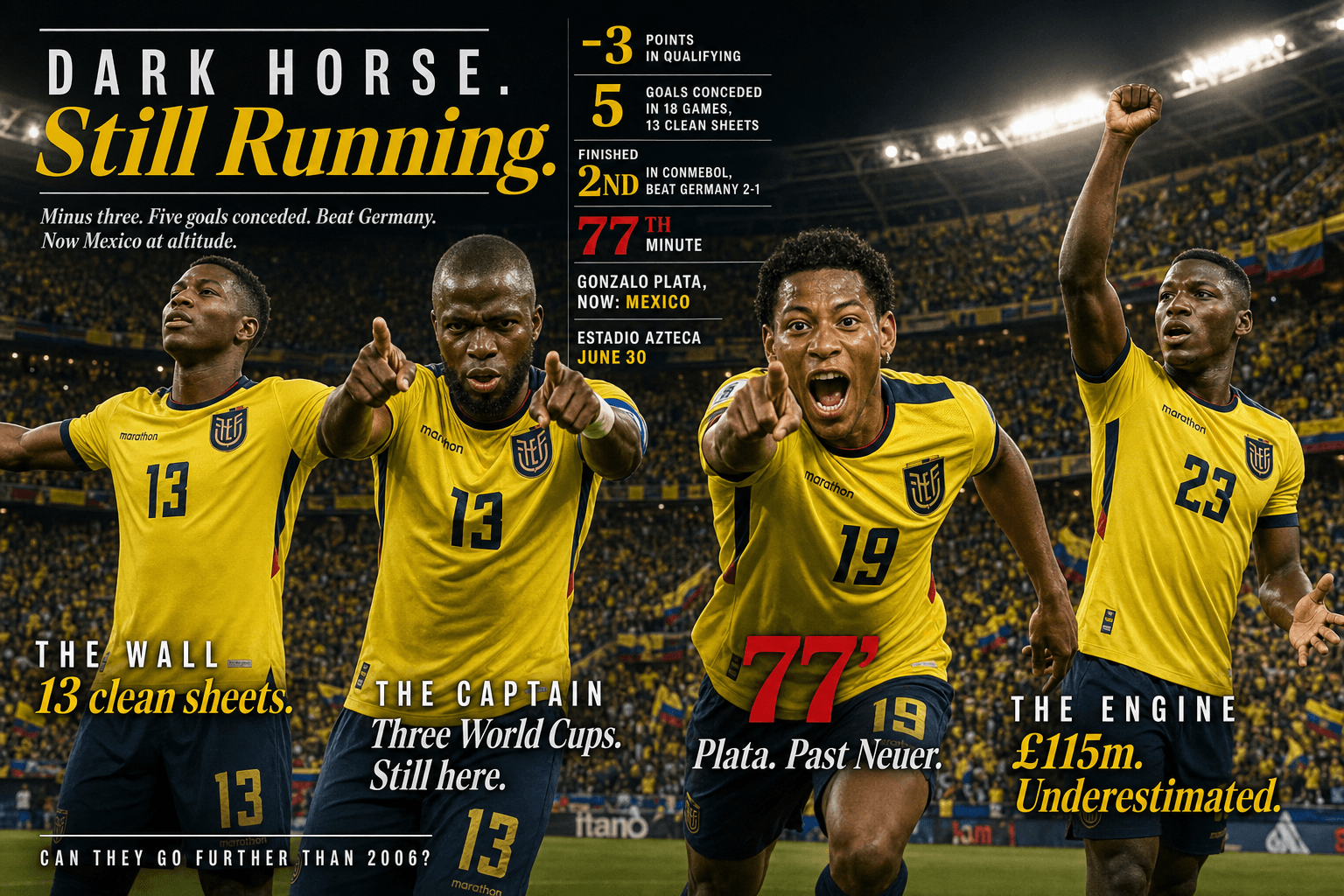
Before this piece, the full context of how Ecuador got here — the three-point deduction, the five goals conceded in eighteen qualifying games, the defensive record that made them the most underrated team at this World Cup — is covered in our original Ecuador dark horse analysis. For the complete explanation of the Byron Castillo case, the FIFA ruling, and how Ecuador's defensive record was built despite the punishment, read our Ecuador point deduction and defensive record explainer. This is the update. Ecuador are through to the Round of 32. They beat Germany 2-1. They are playing Mexico at the Azteca on June 30. And the question that was always the most interesting one about this squad — can they go as far as 2006 — is suddenly a live discussion rather than a theoretical one.
Ecuador Defensive Record: The Stat That Defines This Team
Start with the number that made Ecuador worth watching before they arrived in North America. Why were Ecuador deducted 3 points in World Cup qualifying? The Byron Castillo passport falsification case saw FIFA impose a penalty for the previous cycle's documentation irregularity — not on the players involved, but on the generation that followed them. Ecuador started qualifying on minus three. They finished second in CONMEBOL, above Brazil and Uruguay.
Ecuador's 2026 World Cup qualifying goals conceded: five. In eighteen matches. Against the best teams in South America. That defensive record — 0.28 goals per game, 13 clean sheets, the best of any nation across the entire South American qualifying phase — is what defines this team's identity. Why did Ecuador start with negative points and still finish second? Because they conceded five goals across an entire campaign while every other CONMEBOL nation was conceding double figures. The point deduction made their achievement mathematically impressive. The defensive record made it tactically extraordinary.
Now at the 2026 World Cup itself, after three group games, the Ecuador defensive record is holding. Two goals conceded in the group stage. From Germany, one of the best attacking teams in Europe. The number has become a story at the tournament itself, not just in qualifying.
Group E: From Crisis to Germany Scalp
June 14: Ivory Coast 1-0 Ecuador. A heartbreaking 90th-minute goal in the opener left Ecuador with the worst possible start — a loss against the group's fourth seed, a nation they were expected to handle. The defeat was not about defensive collapse. It was a single moment at the worst possible time. Beccacece's back three held for 89 minutes. The 90th-minute concession was cruel and immediate.
June 20: Ecuador 0-0 Curaçao. The goalless draw against the World Cup's smallest-ever nation generated the loudest criticism Ecuador have faced all tournament. Ecuador registered 27 shots against Curaçao without scoring once. The narrative formed immediately: Ecuador cannot score. Ecuador are defensively organised but toothless. Ecuador are a team that qualifies for things but cannot impose themselves when it matters. Beccacece heard all of it. Enner Valencia, 36 years old and playing at his third World Cup, had not found his best form across the first two matches. The criticism was not entirely unfair. But it was incomplete.
June 25: Ecuador 2-1 Germany. Everything that had been said about Ecuador's attacking limitations was answered in New Jersey in the space of 77 minutes. Leroy Sane gave Germany an early lead with a controversial strike. Nilson Angulo cancelled it out quickly. Gonzalo Plata, arriving at the far post from a Kevin Rodriguez flick from a corner in the 77th minute, jabbed the ball into the net past Manuel Neuer. Ecuador had beaten the group winner. They had answered every question about their ability to score at this level. They had done it with exactly the weapon that defines them — defensive organisation maintained until the moment the set piece arrived, then clinical conversion of the single chance created.
Why Were Ecuador Deducted 3 Points? (And Why It Makes This Sweeter)
The Byron Castillo story is one of the strangest in recent World Cup history. Ecuador fielded Castillo — a player later found to have provided falsified birth documents — during the 2022 qualifying campaign. FIFA investigated, ultimately upheld Ecuador's 2022 qualification but applied a three-point penalty to their 2026 qualifying record. Ecuador began the 2026 qualifying campaign before a single ball was kicked, already minus three. They received the punishment for an irregularity connected to a completely different group of players.
That context makes what they then produced in qualifying — finishing second in CONMEBOL, conceding five goals, recording thirteen clean sheets — not merely a football achievement. It is a statement. They were handicapped, publicly punished, widely written off as a team whose qualifying run was compromised from the start. They finished second in South America anyway. Now they have beaten Germany at a World Cup. The three-point deduction that was supposed to derail them has become the backstory that makes the Germany result resonate.
Ecuador started qualifying minus three points. They conceded five goals in eighteen games. They couldn't score against Curaçao. And then they beat Germany 2-1 with a set-piece winner to qualify for the Round of 32. This is not a team that does things the easy way. This is a team that does things the right way.
For the full legal timeline of the Byron Castillo case and how FIFA's ruling was applied, read our dedicated explainer on Ecuador's point deduction and defensive record.
Enner Valencia, Pacho, Hincapié: The Squad's Real Story
The individual stories within Ecuador's group stage are worth noting before the Mexico game changes the conversation entirely. Enner Valencia, who was not at his sharpest across the first two matches, remains the captain and the standard. Sports Mole notes that with Plata and Valencia capable of punishing any defensive lapse, Mexico are backed to win but will not be able to simply contain Ecuador's threat. Valencia's first World Cup goal in 2026 has not arrived yet. That matters — because the man who scored three in 2014 and three in 2022 is overdue, and overdue Valencia at a World Cup is an extremely specific kind of danger.
Willian Pacho, who arrived at this tournament with back-to-back Champions League winner's medals from PSG, has been exactly what Ecuador needed in defence. The back three that Beccacece built in qualifying — disciplined, compact, capable of holding shape under sustained pressure — has conceded two goals across three World Cup games and has not looked uncomfortable against elite opposition. Germany's first goal was a legitimate quality strike. Everything else was managed.
Piero Hincapié, who lost the Champions League final to Pacho's PSG two weeks before flying to North America, was on the pitch against Germany. The two Ecuadorian centre-backs who faced each other in Budapest three weeks ago were now defending the same goal together. That is the depth of quality Ecuador have assembled at the back — and the reason why their defensive record is not an accident of fixtures but a reflection of genuine structural quality.
Mexico at the Azteca: The Mountain in Front
Mexico won all three group games without conceding a goal — beating South Africa 2-0, South Korea 1-0, and Czechia 3-0. Three wins, three clean sheets, six goals, nine points. They topped Group A, the first team to clinch a spot in the Round of 32 at this tournament. Their reward was to stay in Mexico City. Estadio Azteca awaits. The Round of 32 match, confirmed for Tuesday June 30 at 9pm ET, is Mexico at home in their own fortress, against a team that just beat Germany but finished third in their group.
The honest assessment is that Mexico are favourites. They are at home. They have not conceded. Their squad — Raul Jimenez, Edson Álvarez, Hirving Lozano in his final tournament, the energy of a country hosting the World Cup for the third time — carries momentum that is genuinely difficult to break down. Javier Aguirre has built a team that is organised, physically formidable, and almost impossible to play against at the Azteca where the altitude already advantages the host.
But here is what the critics who dismiss Ecuador are missing. The Estadio Azteca sits at 7,200 feet — 2,200 metres above sea level. Mexico played all their group games on home soil specifically because finishing top gave them the right to remain in Mexico throughout. The altitude advantage that Mexico are counting on against every European and African opponent at this tournament is not an advantage against Ecuador. Quito sits at 2,850 metres — higher than the Azteca by 650 metres. Ecuador train, qualify, and win competitive matches at altitude that makes Mexico City feel like sea level by comparison. The air that exhausts European opponents by the 70th minute is familiar to Ecuador's players from their very first professional training session. The heat that catches South African and South Korean players by surprise at the Azteca is closer to the conditions Ecuador's squad has played in all season than to what either of Mexico's previous group opponents experienced.
The altitude advantage is real for Mexico against most teams. Against Ecuador it is neutral at best. On defence, compact positioning, and physical endurance through 90 minutes in thin air — Ecuador's record suggests they are built for exactly this.
Mexico's Clean Sheet Record: Easy Opponents or Real Strength?
Three clean sheets for Mexico across the group stage. South Africa, South Korea, and Czechia. The user brief poses the relevant question directly: are Mexico's clean sheets evidence of genuine defensive quality, or the product of opponents who weren't testing them at the level Ecuador will? It is a fair question. South Africa are ranked 74th in the world. South Korea's attackers — the group's strongest opposing attackers — managed zero goals and 1.1 expected goals across the match. Czechia were limited. None of those opponents carried the combination of physical quality, defensive organisation, and counter-attacking threat that Ecuador bring.
Mexico's defence has not been tested by a team built the way Ecuador are built — deep-sitting, disciplined, waiting for the set piece or the single counter-attack chance and then converting it. South Africa tried to contain Mexico and were beaten by Mexican quality. Ecuador will contain Mexico and then look for their moment. That is a fundamentally different challenge. Mexico may keep their clean sheet against Ecuador. They may concede from a Plata toe-poke at a corner in the 77th minute. Their clean sheet record is impressive. It has not been tested against this specific kind of opponent yet.
The 2006 Precedent and What Comes After Mexico
The 2006 World Cup in Germany was Ecuador's best-ever tournament performance. They qualified from a group containing Poland, Germany, and Costa Rica, finishing second behind the eventual champions. They then lost 1-0 to England in Stuttgart — David Beckham's free-kick the deciding moment. They went home. But they had gone further at a World Cup than they ever had before. Ecuador at a World Cup 2006 meant the Round of 16 was their ceiling.
If Ecuador beat Mexico on June 30, they match and potentially surpass their 2006 achievement — depending on the bracket path. The Round of 16 would represent Ecuador's deepest ever run in the competition. Their potential opponent at that stage, if England beat DR Congo on July 1 in Atlanta, is Thomas Tuchel's England. That specific matchup carries its own dynamics.
England's group stage — wins over Croatia, Ghana, and Panama in Group L — raised questions that the opponents did not fully answer. Against Ghana and Panama, two teams that set up in low, compact defensive blocks and invited England to break them down, Tuchel's side struggled to create clear-cut chances. The patterns were familiar: good ball movement in wide areas, crosses into the box without consistent finishing, moments of individual quality from Bellingham and Kane but insufficient collective mechanism to dismantle a disciplined shape. Ecuador are the definition of a team that implements exactly the low-block defensive structure that England found uncomfortable against lesser opposition. If the Ecuador-England Route to 16 materialises, Beccacece's defenders will already know their tactical assignment from watching England's group stage footage. Ecuador at their best, holding shape, waiting for the corner in the 77th minute — is specifically what Tuchel's England hasn't convincingly solved.
Can Ecuador Reach the Quarter-Finals?
Beat Mexico on June 30. That is the first task and the only one that matters tonight. The altitude levels the playing field. The defensive record says Ecuador can hold out against the best forward lines available. The Germany result says Ecuador can score when it matters. Enner Valencia's tournament goal — if it comes — will come at the Azteca in the kind of high-stakes moment he has spent his entire World Cup career producing for exactly.
The quarter-final route from here requires beating Mexico and then beating England (or whoever emerges). Neither is probable in isolation. Both together as a sequence would be the greatest result in Ecuadorian football history. But the team that started qualifying minus three points and conceded five goals across eighteen games is not a team built to accept probabilities. They are built to do one thing better than almost anyone else in the tournament — defend until the moment arrives, and then take it.
The moment came in the 77th minute against Germany. The moment is coming again on June 30 in Mexico City. The question is not whether Ecuador can produce it. We know they can. The question is whether Mexico will be ready for the team whose default condition is being underestimated.
Ecuador qualified from World Cup 2026 qualifying with minus three points and five goals conceded in 18 games. They just beat Germany. They face Mexico at the Azteca on June 30. Can they go further than 2006 — and do you back them to beat Mexico? 👇