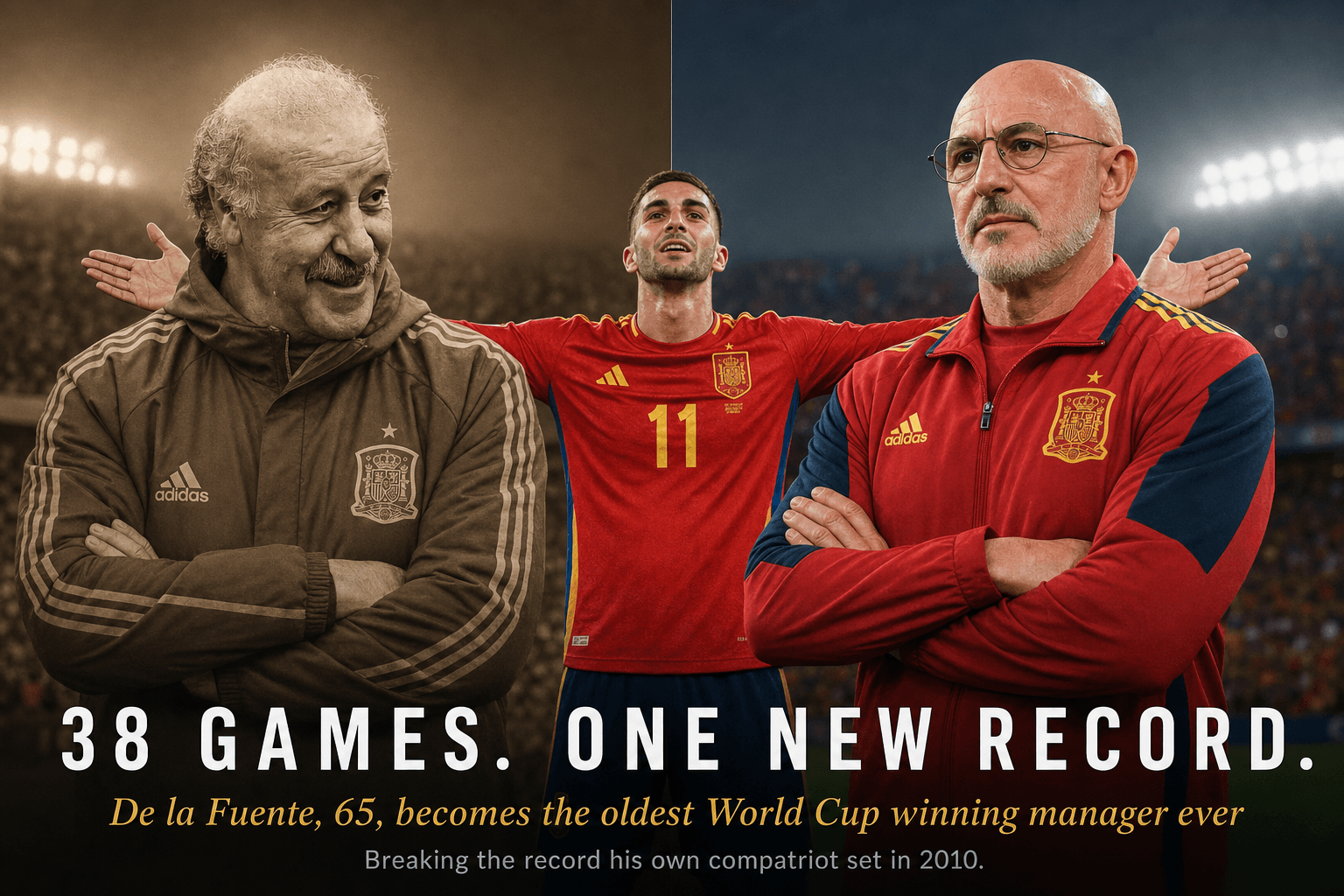
When the final whistle confirmed Spain's 1-0 extra-time win over Argentina on July 19, two separate world records were broken in the same moment. Spain's unbeaten run in competitive international football reached 38 matches without defeat, surpassing the previous all-time record of 37, a mark Italy had held since their own run between 2018 and 2021. And Luis de la Fuente, at 65 years and 28 days old, became the oldest manager in history to win a World Cup, breaking the record previously held by his own compatriot, Vicente del Bosque, who was 59 years and 220 days old when Spain won their first title in 2010. Both records belong to the same specific story we have followed from the opening group match to the final whistle, documented across our pieces on Spain's unbeaten run and the youth system De la Fuente built from nothing. This is the complete version, now that the ending is known.
38 Games: The Number That Broke Italy's Record
Spain's win over Argentina extended their unbeaten streak to 38 games in all competitions, a record of 29 wins and 9 draws with zero defeats, breaking a tie with Italy's 2018-21 run for the longest unbeaten streak by a men's national team in history. The run began in March 2023, ran through Euro 2024, an unbeaten Nations League campaign, and every single match of this World Cup, six group and knockout wins plus two draws along the way. The specific significance of surpassing Italy's mark is that Roberto Mancini's Azzurri had built their own run on a genuinely golden generation, Euro 2020 champions who went unbeaten for three years before their run ended. Spain's 38 games did not simply match that achievement. They exceeded it, with a squad that, as we detailed in our unbeaten run coverage, includes players who were still teenagers when the streak began.
De la Fuente: 65 Years, 28 Days, and a Record That Belonged to His Own Federation
At 65 years and 28 days old, Luis de la Fuente became the oldest coach ever to lead a team to the World Cup title, surpassing the mark of his compatriot Vicente del Bosque, who was 59 years and 220 days old when Spain won their first World Cup in 2010. The specific detail that makes this record resonate beyond a simple number is that both men, del Bosque and de la Fuente, delivered Spain's only two World Cup titles, sixteen years apart, and both did so later in their careers than any other World Cup-winning manager in the tournament's history. Spain has now produced both ends of a very specific record: the previous holder and the new one, from the same footballing culture, using variations of the same underlying philosophy.
The Grassroots System That Made Both Records Possible
Neither record happened by accident, and both trace back to the exact development pipeline we detailed in full in our piece on De la Fuente's grassroots system. Mikel Merino, Fabián Ruiz, Mikel Oyarzabal and Unai Simón all won the European Under-21 Championship together under De la Fuente in 2019, years before the 38-game streak even began. Ferran Torres progressed through Spain's Under-17 and Under-19 age groups from the age of six, eventually scoring the actual World Cup-winning goal as a substitute in the 106th minute of the final. Pau Cubarsí, promoted directly from Barcelona's academy into a World Cup-winning back line at 19, was named Young Player of the Tournament, an award we detailed in full in our piece on every 2026 World Cup award and its history. The specific continuity between De la Fuente's decade of youth-level coaching and the senior squad he eventually inherited is the single mechanism connecting both records: a 38-game unbeaten run built by players who learned the same system as teenagers, delivered by a 65-year-old manager who coached most of them before they were old enough to vote.
Italy held the men's unbeaten record at 37 games for three years. Del Bosque held the oldest-winning-manager record for sixteen. Spain broke both records in the same match, with the same generation of players De la Fuente developed personally from the Under-19s, delivered by the same manager who once taught Argentina's own coach how to become one in the first place.
Third Team Ever to Hold Both World Cups Simultaneously
The specific historical weight of Spain's 2026 win extends beyond the two individual records. Spain became the first nation to be reigning champions of both the men's and women's World Cups simultaneously, having won the Women's World Cup in 2023. That specific achievement, a single football federation holding both trophies at once, reflects the same structural investment across the entire Spanish game that produced De la Fuente's specific generation, rather than a coincidence limited to the men's side alone.
What De la Fuente Said When It Was Over
De la Fuente's own reflection after the final captured the specific culmination of the decade-long project: "Once we finished the game, I had a group of footballers who said, 'Coach, what else is there to win, we have won everything, in every category.'" He added: "I feel pride, to be honest. Accompanying my players on this journey is an honour." The specific players saying that to him were, in many cases, the same players he had coached to Under-19 and Under-21 titles years before any of them wore the senior shirt, a circle we traced from its beginning in our grassroots piece to its actual completion at MetLife Stadium.
What Comes Next for the Record
Both records now stand as the specific benchmarks the rest of international football must measure itself against. Spain's 38-game run continues into whatever comes next for this squad, with no defeat yet in sight. De la Fuente's age record, by its specific nature, can only be broken by a manager older than 65 winning a future World Cup, a genuinely rare combination of longevity and continued elite performance. Both records belong, for now, entirely to Spain, and both trace back to the exact same decision De la Fuente made over a decade ago: build the generation yourself, rather than simply inheriting whichever one arrives.
Spain broke two world records in the same match: the longest unbeaten run in men's international football, and the oldest World Cup-winning manager ever. Which record do you think is more remarkable? Tell us below.