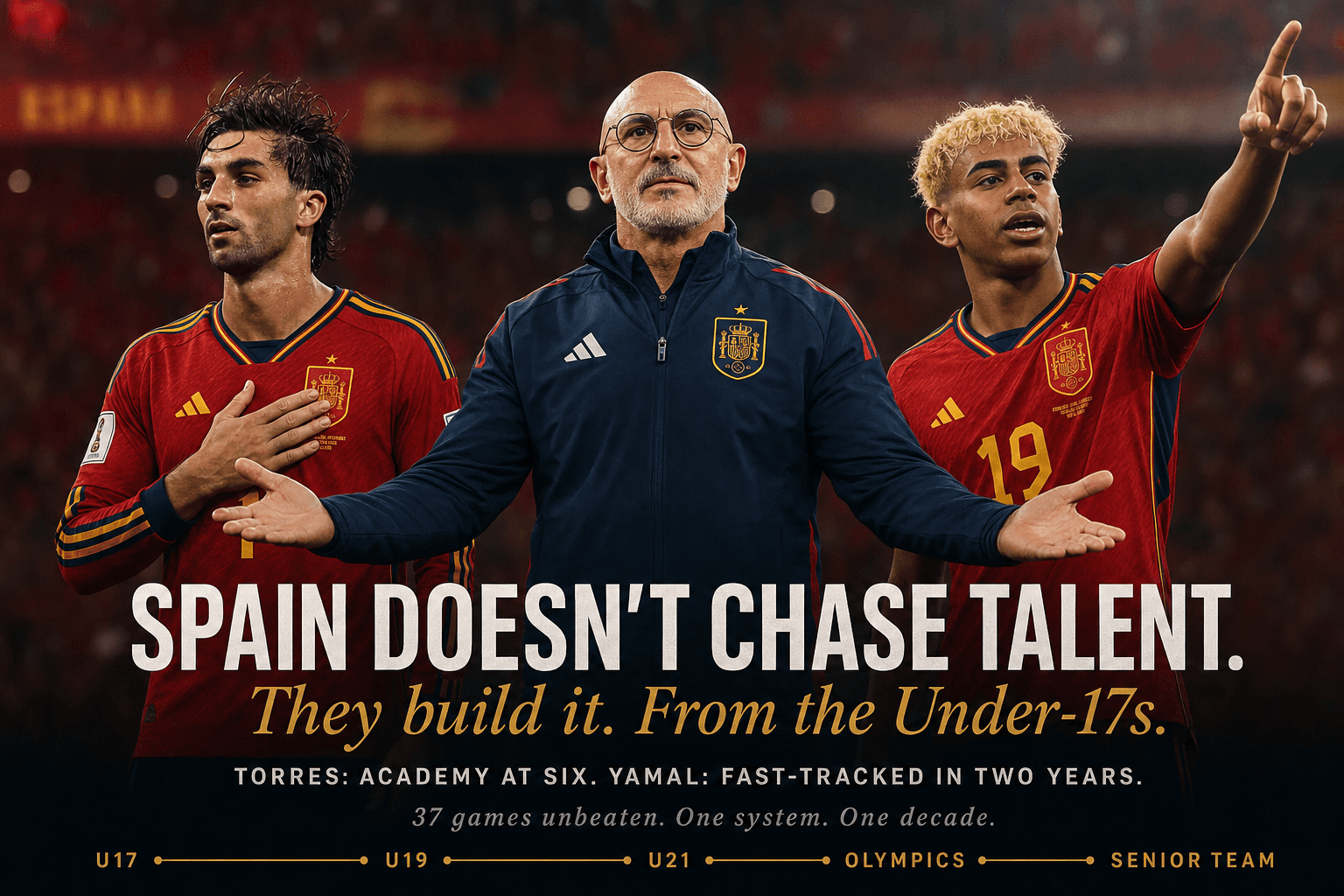
Every four years, football writers search for a single explanation for why Spain keep producing teams that outperform their individual name recognition. The answer is rarely tactical. It is structural, and it starts long before any of these players had a European club jersey with their name on the back. Luis de la Fuente did not inherit Spain's 2026 World Cup finalists as fully formed internationals. He coached a significant number of them as teenagers, at Under-19 and Under-21 level, years before any of them wore the senior shirt he now manages. As we detailed in our piece on De la Fuente's contrasting path to this tournament, this is not incidental to Spain's success. It is the entire mechanism.
Ferran Torres: Six Years Old at Valencia, Twenty-Six at a World Cup Semi-Final
Ferran Torres joined Valencia's youth academy at the age of six. He progressed through every age group, made his first-team debut in 2017, and along the way represented Spain at Under-17 level, winning the European Championship in 2017. He moved up to the Under-19s and won that European Championship too in 2019, scoring both goals in the final. By the time Torres made his senior Spain debut in September 2020, the federation had already spent thirteen years watching him develop, coaching him through two continental age-group titles, and building a detailed picture of exactly what kind of player and person he was before he ever needed to prove it at the top level. Against Portugal in this tournament's Round of 16, it was Torres, introduced from the bench, who delivered the pass that Mikel Merino finished for Spain's winning goal, documented in full in our piece on Merino's corner flag tribute to his father. Two players, developed through the exact same age-group pipeline, combining to win a World Cup knockout match nearly a decade after they first crossed paths in Spain's youth setup.
The Under-21 Champions Who Became the Senior Spine
De la Fuente's specific method has been to promote players he already coached rather than simply select the best available talent from Spain's leagues. Mikel Merino, Fabián Ruiz, Mikel Oyarzabal and Unai Simón all won the European Under-21 Championship together under De la Fuente in 2019. Four players from that specific age-group triumph were later selected for Spain's Euro 2024 squad, each contributing directly to the trophy win. The same core, older and further developed, forms a significant part of the squad that has now reached the 2026 World Cup semi-final. De la Fuente did not scout this generation from the outside. He built it, tournament by tournament, from Under-19 level in 2013 through the Under-21s, an Olympic silver medal in 2020, and now to a second World Cup semi-final at senior level.
Spain do not assemble a World Cup squad by identifying the best available players each summer. They develop a specific generation from age 17 or 19, through Under-21 tournaments and Olympic campaigns, and then promote that same generation intact once it is ready. Ferran Torres joined Valencia's academy at six. He won a European Under-17 title, then an Under-19 title. He is now assisting Mikel Merino's goals at a World Cup, nine years after they were both age-group teammates. This is not talent identification. This is a pipeline.
Quintessentially Spanish: The Philosophy That Outlasts Any Single Generation
De la Fuente has described his approach explicitly as wanting to play a brand of football that is quintessentially Spanish, a conscious echo of the Euro 2008 side built around Xavi, Iniesta and David Silva that began Spain's golden run. By the time Spain reached 35 matches unbeaten earlier in this World Cup cycle, the run had already become the longest in the sport's history, and every subsequent result has simply extended a record with no modern precedent. The specific continuity matters: Spain's youth teams are not coached to a generic possession template that changes with each new age-group coach. They are developed inside the same philosophical framework that produced Euro 2008, the 2010 World Cup and Euro 2012, then Euro 2024, and now this tournament. A player who progresses through Spain's Under-17s, Under-19s and Under-21s learns one coherent footballing language rather than several competing ones, so that by the time they reach the senior squad, as we documented in our piece on Spain's world-record unbeaten run, the transition requires almost no adaptation at all.
Why This Is Not About Individual Talent
The specific argument this pattern makes is one that runs against the instinct of most football coverage, which tends to attribute international success to a golden generation of individually brilliant players arriving together by coincidence. Spain's version of events is closer to the opposite: the system produces the players, rather than the players simply arriving and the system organising around them. Rodri, Fabián Ruiz, Merino and Torres all operate within a structure that existed before any of them were senior internationals and will continue after they retire. As we noted in our piece on Unai Simón's World Cup record, even Spain's goalkeeper was developed inside this same continuity, part of the Under-21 generation De la Fuente coached before either of them reached the senior team together. Winning a World Cup, in Spain's specific footballing culture, is treated as a team sport built over a decade rather than an individual quality contest settled in a single transfer window.
The First Time in FIFA Ranking History
The broader context validating Spain's specific model arrived before a ball was even kicked in the semi-final. Spain, Argentina, France and England entered the 2026 World Cup as FIFA's top four ranked teams, and all four reached the semi-finals, the first time this has happened since FIFA introduced its rankings in 1992. The alignment was partly structural: FIFA introduced a new seeding system for 2026 specifically placing the top four ranked nations in separate quadrants of the draw, ensuring they could not meet each other before the semi-final stage provided each won their group. All four did. Not since 1990, when England and Argentina were both involved without meeting each other, has a World Cup's final four all been previous tournament winners. Spain's presence in that exclusive group is the direct product of the development pipeline described above, not a coincidence of a talented squad arriving together by chance.
Semi-Finals Twice, Winners of Both: Can Spain Complete It?
Spain have now reached the World Cup semi-final exactly twice in their history, and won the semi-final match on both occasions. In 2010, that semi-final win over Germany led directly to their only World Cup title. In 2026, their semi-final win over France, documented in full in our piece on Spain's 2-0 win extending their unbeaten run, has put them in exactly the same position. The specific pattern of Spain being clinical precisely when the stakes are highest, rather than earlier in a tournament when the margin for error is wider, connects directly to a squad that has been developed together since adolescence and trusts the specific system it has known since Under-17 level. Whether that trust converts into a second World Cup title now rests on a single final against the winner of Argentina vs England.
A Model Built to Outlast Any Single Manager
The specific durability of Spain's approach is that it does not depend on De la Fuente remaining in charge indefinitely. The federation's youth coaching structure, the shared tactical language taught from Under-17 level upward, and the specific habit of tracking players through multiple age-group tournaments before senior selection all predate his appointment and will outlast it. When Vicente del Bosque managed Spain to the 2010 title, he inherited the first generation to fully emerge from this same continuity, the Xavi-Iniesta core developed through the same federation pipeline a decade earlier. De la Fuente inherited the next full cycle. Whoever eventually succeeds him will inherit whichever generation is currently working through Spain's Under-19s and Under-21s right now, developing inside the same system, learning the same football, waiting for their own version of this exact tournament run.
The specific contrast with how other major footballing nations recruit is instructive. England, Spain's opponents in the 2024 European Championship final and a potential opponent again in this World Cup final, have historically drawn their senior squad from a much wider and less centrally coordinated pool of academies, each Premier League club developing players according to its own methodology before the national federation ever gets meaningful involvement. France operates similarly, with Clairefontaine providing some centralisation but nowhere near the specific continuity of coaching philosophy and personnel that Spain applies from Under-17 level through to the senior team. Neither approach is necessarily inferior in terms of raw talent production, both nations have reached this same semi-final stage. But Spain's specific model, tracking individual players across a decade of international age-group football before they ever start a senior match, is a structurally different bet: one that prioritises tactical continuity and shared footballing identity over simply assembling the most gifted individuals a given generation happens to produce.
Pau Cubarsi offers the clearest current example of the pipeline still functioning in real time. Barcelonas academy graduate broke into the senior Spain squad directly from age-group football with almost no gap, a specific fast-tracking that only happens when a federation has already tracked a player closely enough at youth level to trust him immediately at the highest stage. The same applied to Yamal, whose rise from La Masia to Euro 2024 winner to World Cup semi-finalist happened inside barely two years, a timeline only possible because Spains scouting and development network had already identified and monitored him long before his senior debut became a formality rather than a gamble. The system does not simply produce depth. It produces readiness, players who arrive at the senior level having already been assessed, trusted and integrated into the same footballing philosophy for years beforehand.
None of this guarantees a trophy. Spain went trophyless between Euro 2012 and Euro 2024, a twelve-year gap during which the same broad philosophy of youth continuity was in place without producing a major title, a reminder that the system creates the conditions for success rather than manufacturing it automatically. What changed under De la Fuente was not the underlying model, which Spain has maintained in some form since the 1990s youth reforms, but the specific quality of the generation that model happened to be developing at the exact moment he took charge. The pipeline gave him Yamal, Cubarsi, Merino and Torres, ready and waiting, the moment Euro 2024 arrived. The same pipeline has now delivered a second World Cup final in sixteen years. The system does not guarantee the outcome. It simply ensures Spain are never starting from nothing.
Spain do not chase individual stars. They build a generation from the Under-17s and promote it intact a decade later. Is this the most sustainable model in world football, and can it deliver a second World Cup? Tell us below.