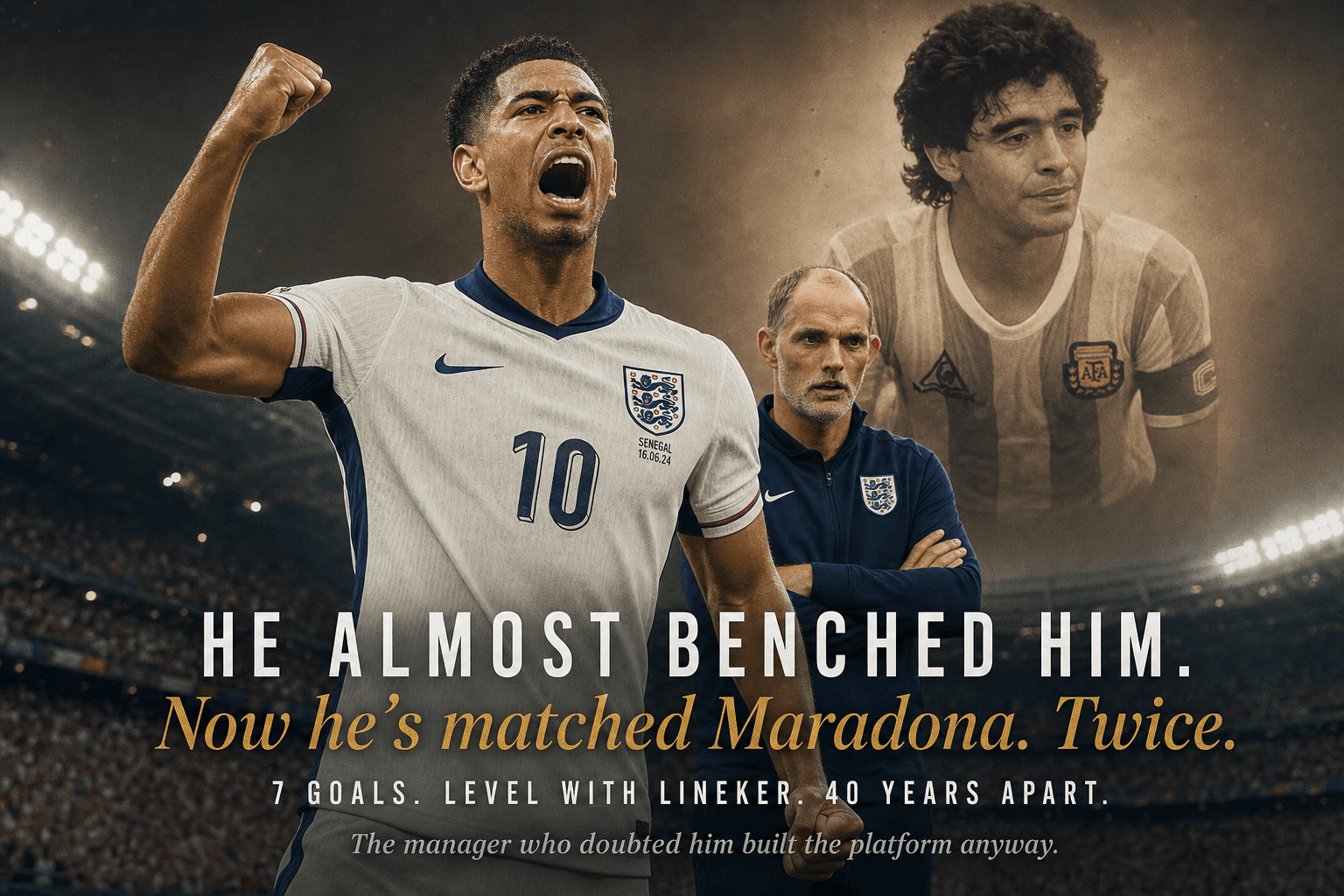
In November 2025, Thomas Tuchel described the battle for England's number 10 shirt as open competition between Jude Bellingham and Aston Villa's Morgan Rogers. By June 2026, days before the World Cup began, reports openly questioned whether Bellingham would even start the opening match against Croatia. Six weeks later, he has seven World Cup goals, has matched a Diego Maradona record that stood untouched for forty years, and is level with Gary Lineker for the most non-penalty goals by an Englishman in a single major tournament. As we detailed in our England vs Mexico coverage, the transformation from benched to indispensable has happened in the space of one tournament. Understanding how requires going back through an injury-ravaged season, a public falling out over his own manager's mother, and a shirt he was never guaranteed to wear.
The Season Before: Surgery, Rogers, and a Shirt Up for Grabs
Bellingham's route into this World Cup began with genuine uncertainty. He underwent shoulder surgery in summer 2025, missed the start of the domestic season, and was overlooked entirely for England's October international camp. When he returned, Tuchel made his stance explicit: "Rather than finding the best players a position to just have them on the field, it's maybe better to put everyone in their best position and have a competition. At the moment, the competition is between the two of them." Rogers, in outstanding club form for Villa, started twelve of Tuchel's first thirteen matches in charge. Bellingham started just four, with three more appearances from the bench — a stark contrast to Euro 2024 under Gareth Southgate, where he had missed only 29 minutes across seven matches.
Then came February 1, 2026: a hamstring injury inside ten minutes of a Real Madrid league match, Bellingham leaving the pitch in tears. Tuchel called it a "race against time," admitting he was "not sure" whether Bellingham would even be fit for March friendlies. Even as the World Cup approached, Tuchel warned he had "14 or 15 potential starters" and that reputation alone guaranteed nothing. There was, by multiple reports, a real possibility Bellingham would not start England's opener against Croatia at all.
The Mother, the Rage, and a Manager's Warning
The friction between Tuchel and Bellingham predates this World Cup by over a year. After England's shock defeat to Senegal in June 2025, Bellingham's furious reaction to a disallowed goal drew a response from Tuchel that generated days of coverage: "If he smiles, he wins everyone, but sometimes you see the rage, the hunger and the fire and it comes out in a way that can be a bit repulsive. For example, for my mother, when she sits in front of the TV, I see that." Tuchel added that the edge "needs to be channelled toward the opponent... not to intimidate team-mates, or to be over aggressive to team-mates or referees." The specific phrasing — invoking his own mother's reaction — became the defining soundbite of a manager publicly wrestling with how to handle his most talented, most combustible player.
Six months ago, Tuchel wasn't sure Bellingham would start the World Cup opener. He warned about behaviour that "intimidates teammates." He gave Morgan Rogers the shirt in qualifying. Bellingham has since scored seven World Cup goals, matched a Maradona record untouched since 1986, and been named Man of the Match in back-to-back knockout rounds. The manager who benched him built the platform that made him England's best player.
Croatia: The Shirt, the Goal, the Turning Point
When the team sheet for England's opener against Croatia was confirmed, Bellingham had the number 10. He scored. From that point, as we documented across our tournament coverage, he has been England's most decisive player — not through reputation, but through a specific, sustained run of knockout-stage performances that has redefined how his entire international career is discussed.
Matching Maradona: The Record Nobody Had Touched Since 1986
Bellingham's brace against Mexico in the Round of 16 made him the first player to score two goals in a World Cup match at the Azteca Stadium since Diego Maradona did it against Belgium in the 1986 semi-final — the same stadium, the same feat, forty years apart. Then, against Norway in the quarter-final, he did it again: another brace, extending a different and even rarer Maradona connection. Opta confirmed Bellingham became the first player to score two or more goals in consecutive World Cup knockout-stage matches in the same edition since Maradona achieved it in 1986 — against England in the quarter-final, then against Belgium in the semi-final. Bellingham matched it at 23 years and 12 days old, the youngest to do so since Pelé at 17 in 1958.
The scoring numbers sit alongside those records with their own weight. Bellingham's six goals this tournament are all from open play — none are penalties — tying Gary Lineker's 1986 mark for the most non-penalty goals by an England player in a single major tournament. His career World Cup tally now stands at seven, level with Pelé, with only Kylian Mbappé (12) having scored more before turning 24. Separately, Harry Kane's own penalty against Mexico took his career knockout-stage tally to six, equalling Lineker's long-standing English record for that specific category. Two different Lineker records, matched by two different England players, in the same tournament.
Whatever, Whatever: The Norway Exchange
After England's 2-1 extra-time win over Norway, Tuchel was blunt about the team's performance: "Sloppy, lot of technical mistakes, not fast enough, not repetitive enough. We were lucky today." About Bellingham specifically, his tone shifted entirely: "Enough said. He does it every single match. World class." When Tuchel's broader criticism was put to Bellingham, his response carried an edge of its own: "Yeah, well. Whatever. Whatever. It's difficult out there. It's a tough shift." He continued: "Maybe he doesn't know what it's like to play in those kind of conditions against Erling Haaland, Ødegaard, Nusa, Sørloth. That's not an easy team to play against." Asked directly whether he agreed England had been lucky, Bellingham offered two words: "No comment." It was the same fire Tuchel's mother had once found repulsive — now aimed, calmly and publicly, back at the manager himself.
What Comes Next: Messi, Argentina, and Tuchel's Own History
England now face Argentina in Atlanta — a semi-final complicated further by the Embolo red card controversy that ended Switzerland's run. Beyond the football, Tuchel's own place in history is tied directly to what Bellingham does next. As we explored in our pieces on managers who've won the World Cup twice and the Ancelotti-Tuchel double race, Tuchel is now the only remaining candidate to join the exclusive list of managers who have won both the Champions League and the World Cup. Should England beat Argentina, the final awaits against the winner of France vs Spain. One more goal from Bellingham would make him the outright holder of England's single-tournament scoring record, surpassing Lineker and Kane both. The player Tuchel wasn't sure would start the opener is now the reason England believe they can win it.
Dan Burn's Cameo and the Team Around Him
Bellingham's brilliance has not existed in isolation. Against Mexico, Dan Burn came on in the 75th minute and made the joint-most clearances of any player in the match — the most by a substitute introduced that late in a World Cup game since 1966. England had just 33.2% possession that night, their lowest in a World Cup match on record, and still won. The specific pattern across both knockout rounds has been the same: England absorb pressure, defend with genuine physical commitment, and rely on Bellingham to produce the moment that decides it. Harry Kane and Bellingham have combined for 12 of England's 13 goals at this tournament. It is not a team built around one man's brilliance alone — but it is unmistakably a team that has needed his brilliance every single time the stakes have been highest.
The specific irony of Bellingham needing a team built on grit rather than possession to produce his moments of individual brilliance connects directly to the wider question of what Tuchel has actually built. A manager who publicly doubted his best player, benched him for a rising academy graduate in qualifying, and then criticised the very performances that carried England to the semi-final, has nonetheless extracted the most productive World Cup of Bellinghams career. Whether that is deliberate man-management, genuine tactical conviction, or simply circumstance meeting talent at the right moment, the results are difficult to argue with. Tuchel doubted him. Bellingham matched Maradona anyway.
Lineker himself has weighed in on where this leaves Bellingham in the pantheon of English football, telling Netflix's Rest is Football that there is a real chance Bellingham ends up as England's greatest ever player, name-checking Bobby Charlton as the only comparable historical benchmark. Coming from the man whose 1986 records Bellingham has now twice matched in a single tournament, the endorsement carries specific weight. It is also, in its own way, a continuation of the exact theme running through this entire story: a legendary figure from the game's past watching a 23-year-old catch up to records nobody expected to see challenged again, in real time, at the tournament that matters most.
The specific numbers around Bellinghams involvement across his major tournament career now place him third on England's all-time goal involvement list at major tournaments, with 12 (nine goals, three assists) — behind only Kane's 25 and David Beckhams 14, and ahead of every other England player in the sports history. He achieved that specific ranking before his 23rd birthday had even passed by much more than a fortnight. The Rogers competition, the injury layoffs, the mother comment, the Norway exchange — every specific piece of friction that defined his build-up to this tournament is now a footnote to a run of knockout performances that has, in the space of five matches, rewritten where he sits among England's greatest ever tournament performers.
Bellingham has matched Maradona, tied Lineker, and clashed publicly with his own manager along the way. Is this now the best England career has ever looked at a World Cup — and can he outscore Messi to the trophy? Tell us below.