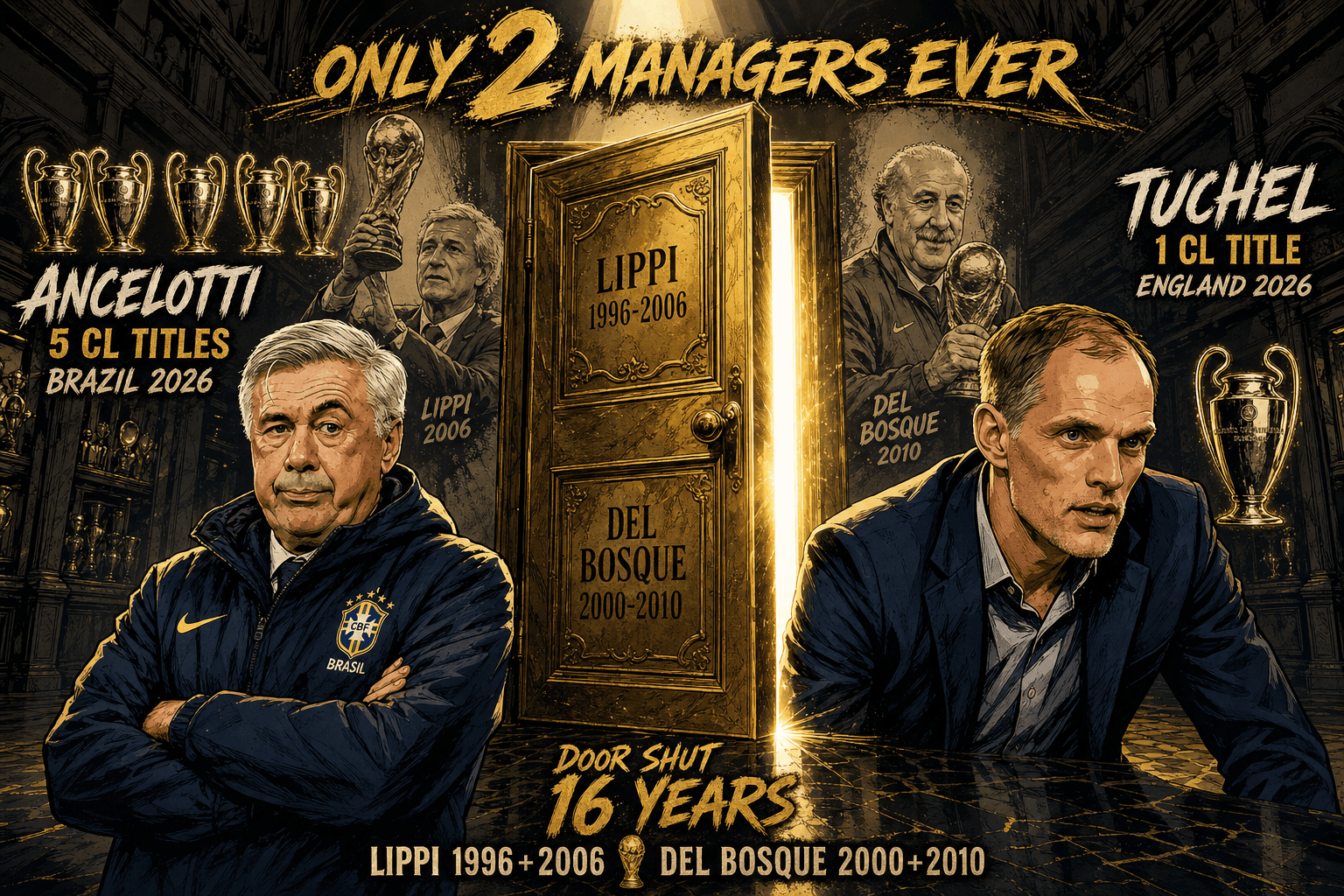
In the entire history of association football — through every manager who has ever paced a touchline, every coach who has ever written out a formation, every tactical visionary and motivational genius who has ever taken a squad to a major final — exactly two men have achieved what Ancelotti and Tuchel are both chasing this summer. Win the Champions League. Then win the World Cup. Both. In a career. Two men. That is the complete list. The door has been shut for sixteen years. For the first time since it was created, two credible, credentialed candidates are standing in front of it simultaneously. The summer of 2026 will decide whether either of them walks through.
The Door: Lippi Opens It, Del Bosque Confirms It
The exclusive club was founded on a summer evening in Berlin on 9 July 2006. Marcello Lippi's Italy won the World Cup on penalties against France, with Fabio Grosso converting the decisive kick. At the final whistle, a sixty-something Italian manager with silver hair and a quiet demeanour became the first person in football history to have won the European Cup and the World Cup as a head coach. Lippi had won the Champions League with Juventus in 1996, beating Ajax on penalties in Rome. Exactly ten years separated the two achievements. The same method — a penalty shootout — connected them.
Four years later, in Johannesburg on 11 July 2010, Vicente del Bosque's Spain beat the Netherlands 1-0 in extra time. Andrés Iniesta's goal in the 116th minute gave Spain their first World Cup. Del Bosque, who had won the Champions League with Real Madrid in 2000 and again in 2002, joined Lippi in the only category in football that neither money nor time alone can buy. Two men. In the entire history of the sport. That is the whole list. Since Del Bosque lifted the World Cup in South Africa sixteen years ago, the door has stayed shut. Nobody has joined them. The list remains at two.
Why? Because the two competitions demand such fundamentally different skills that mastering both, across different stages of a career, over the course of decades, is almost structurally impossible. The Champions League rewards continuity — a manager who works daily with players, who builds a system over months, who can make tactical adjustments in real time across a nine-month campaign. The World Cup rewards something entirely different: the ability to build cohesion from scratch in a matter of weeks, to manage egos at international level, to produce peak performance from a squad that has played together infrequently and at high pressure. The club game and the international game are not just different in scale. They are different in kind. Lippi and Del Bosque mastered both. Everyone else — Guardiola, Mourinho, Ferguson, Deschamps, Zidane, Klopp — mastered one.
Reggiolo, 1959: The Making of Carlo Ancelotti
Carlo Ancelotti was born in Reggiolo, a small town in the Emilia-Romagna region of northern Italy, on 10 June 1959. He became a footballer first — a good one. As a midfielder for AS Roma and then AC Milan across the 1980s, he won two Serie A titles and, in 1989 and 1990 under Arrigo Sacchi, two consecutive European Cups with Milan. He understood football's rhythms from the inside before he ever tried to shape them from outside. When he eventually moved into coaching, that understanding became his foundation.
The managerial career that followed is not just impressive. It is structurally different from every other coaching career in history. Ancelotti became the only manager in history to win a top-division league title in five of Europe's top five leagues — Serie A with Juventus and Milan, the Premier League with Chelsea, Ligue 1 with PSG, the Bundesliga with Bayern Munich, and La Liga with Real Madrid. No one else has won any four of those five, let alone all of them.
Then there are the Champions Leagues. 2003 with Milan, beating Juventus on penalties. 2007 with Milan, a 2-1 win over Liverpool with Inzaghi's double. 2014 with Real Madrid — La Décima, the club's tenth European Cup, the most anticipated trophy in Spanish football for twelve years. 2022 with Madrid again, a dramatic comeback against City and Liverpool to win it. 2024 with Madrid, a third title with the club. Five Champions Leagues as manager. The next highest total, shared by Zidane, Guardiola, and Bob Paisley, is three. Ancelotti has more than anyone else in the modern era. And yet, through all of it — five European trophies, league titles in five countries, a forty-year career in the game — the World Cup had never come. He had never managed a national team. Not once. Not even briefly.
Five Champions Leagues. League titles in Italy, England, France, Germany and Spain. The most decorated club manager in football history. And he had never sat in a national team dugout until the day Brazil called. The one thing missing from a forty-year career was also the hardest thing in football to get.
Rio de Janeiro, May 2025: The First Foreign Manager
On 12 May 2025, the Confederação Brasileira de Futebol announced what the football world had been speculating about for two years. Carlo Ancelotti would leave Real Madrid at the end of the 2024-25 La Liga season and become the head coach of Brazil. His official start date was 26 May 2025. The CBF statement described him as the most successful manager in football history — and was not exaggerating. It also announced something historically unprecedented: Ancelotti would be the first foreign manager to take substantive charge of Brazil in the modern era.
Ancelotti arrived inheriting a mess. Dorival Júnior, who had been appointed after Brazil's chaotic start to South American qualifying, was sacked in March 2025 following a catastrophic 4-1 defeat to Argentina in Buenos Aires. Brazil had been fifth in the CONMEBOL qualifying table — above the relegation zone but well short of the automatic places. The weight of expectation was enormous. Brazil had not won the World Cup since 2002. Four consecutive quarter-final exits — 2006, 2010, 2018, 2022 — had worn down a nation that has more World Cup titles than anyone and regards the competition as its rightful property. The 2014 semi-final, hosted on home soil, ended 7-1 against Germany. A generation of Brazilian fans had grown up watching their national team fall short at the moment it mattered most.
Ancelotti qualified them. He leaves Brazil ranked in their qualifying position and prepared for a Group C that features Morocco, Haiti, and Scotland. Morocco are not the opposition Brazil would have wanted — they reached the semi-finals in 2022, they have beaten Brazil before (doing so in 2023 for the first time in history), and they carry a defensive structure and tournament experience that makes them dangerous at any stage. Haiti and Scotland represent more achievable obstacles. But this is a Brazil squad with Vinícius Júnior, Rodrygo, Endrick, and Raphinha — the attacking quality is there. The question is whether Ancelotti, at 66, working at international level for the first time in his life, can deliver the collective coherence and tactical discipline that club management has given him across four decades.
He also faces the controversy that most Brazil managers eventually face. The squad he selected for this World Cup included Neymar, whose fitness record since 2023 has been defined by a catastrophic ACL injury sustained in October 2023 and a recovery that kept him out of football for over a year. Including Neymar ahead of fit, in-form alternatives like Joao Pedro generated immediate debate inside Brazil. Whether Ancelotti's faith in what Neymar represents — experience, technical quality, the ability to perform in the highest-pressure moments — is vindicated or not may be the defining subplot of Brazil's tournament.
Krumbach, 1973: The German Who Learned by Losing
Thomas Tuchel was born in Krumbach, Bavaria, in 1973. He played professional football — modestly, with injury ending his career at 25. He went into coaching. Augsburg's reserve team. Then Mainz, where he built a reputation for tactical creativity and player development that made the industry take notice. Then Dortmund, where he reached the DFB-Pokal final in his first season and consistently produced attacking football that exceeded the club's resources. Then PSG.
At Paris Saint-Germain, Tuchel won two Ligue 1 titles, the Coupe de France, and the Coupe de la Ligue. And then, in the extraordinary bubble-tournament summer of 2020, he reached the Champions League final. His PSG side, built around Neymar and Mbappé, beat RB Leipzig in the semi-final and faced Bayern Munich — the club that would later employ him — in the final in Lisbon. They lost 1-0. A single goal from Kingsley Coman. Six months later, Frank Lampard was dismissed at Chelsea and Tuchel was out of work.
What he did with Chelsea in the following months is, in the context of the managerial record he is now building, the most important thing to understand about him. He arrived in January 2021, barely knowing his squad, and won the Champions League in Porto in May 2021 — just five months into the job. Chelsea beat Manchester City 1-0 through a single goal from Kai Havertz. It was the meeting of two German managers on the biggest club stage in football, and Tuchel won it. In doing so, he became the first manager in Champions League history to reach successive finals with two different clubs — losing with PSG in 2020 and winning with Chelsea in 2021.
The lesson Tuchel carries from that Chelsea Champions League campaign is the same one Ancelotti has carried his entire career: tactical adaptability is more valuable than tactical identity. Tuchel changed Chelsea's system, their defensive structure, and their entire approach to pressing in a matter of weeks. He produced a coherent, disciplined unit from a group of players he had not chosen. That capacity — to read what a squad needs and deliver it quickly — is precisely what international management demands. You cannot build over years. You build in weeks or not at all.
London, October 2024: The Third Foreign Manager
Thomas Tuchel was confirmed as England manager on 16 October 2024, with his official start date of 1 January 2025. He became only the third foreign manager in the history of the England national team, after Sven-Göran Eriksson and Fabio Capello. His initial contract ran eighteen months — through to the end of the 2026 World Cup. The FA CEO Mark Bullingham was explicit about the brief: England wanted to win the tournament. Not to perform creditably. Not to reach the semi-finals. To win.
Tuchel accepted the mandate and delivered on its first phase. England qualified for the 2026 World Cup with a perfect record — eight wins, zero defeats, zero goals conceded. Eight clean sheets across the entire qualifying campaign. Twenty-two goals scored. It was only the second time in English football history that the national team had qualified for a World Cup without conceding a single goal — the other was the 1990 qualifying campaign under Bobby Robson. England qualified as the first European nation confirmed for the tournament, sealing their place with two games to spare. In February 2026, following that record-breaking campaign, the FA extended Tuchel's contract through to Euro 2028 — a home Euros, hosted across England, Wales, Scotland and the Republic of Ireland, with the final at Wembley. The extension was a statement of intent from both sides.
England arrive at the 2026 World Cup as genuine contenders, not hopeful pretenders. Harry Kane, despite injury concerns across the season, has delivered goals for Bayern Munich at the rate that has defined his career. Jude Bellingham at Real Madrid is one of the most complete midfielders in the world. Phil Foden's domestic form across the previous three seasons has established him as one of the Premier League's most dangerous forwards. Cole Palmer's rise at Chelsea has given England a creative option they did not have two years ago. The squad is arguably the deepest in a generation. Whether Tuchel can organise it to perform at a level consistent with its talent, against opposition that will arrive specifically prepared for England's key threats, is the defining question of his tenure.
England open in Group L against Croatia — a fixture loaded with tournament history — followed by Ghana and Panama. The group is winnable. Most analysts have England topping it. The real test begins in the knockouts, as it always does for England, as it has done every time for sixty years.
The Weight of England's 60 Years
England won the World Cup on 30 July 1966 at Wembley. Geoff Hurst's hat-trick. The disputed goal. Bobby Moore lifting the Jules Rimet Trophy. It is the most watched piece of sporting footage in English history and it happened sixty years ago. Since then, England have reached the semi-finals once, in 1990. They have lost two major finals — Euro 2020 and Euro 2024 — both on penalties. They have produced extraordinary individual players across six decades: Moore, Charlton, Lineker, Shearer, Gerrard, Rooney, Kane, Bellingham. None of them has stood on a podium holding a World Cup as a player. The hurt is real. It is generational. It is the context in which Tuchel's entire tenure will be judged.
He has said, publicly and repeatedly, that his sole focus is winning the 2026 World Cup. He said in his first interview that he wanted to add a second star to the England shirt. In a country where previous managers have been careful to manage expectations — to talk about journeys rather than destinations, processes rather than outcomes — Tuchel's directness was unusual. It may prove either prescient or catastrophic. There is no middle ground. A German manager who says England will win the World Cup, then doesn't, will define the failure sharply. A German manager who says England will win the World Cup and does is the most unlikely and perfect ending to football's most famous losing run.
Brazil's 24-Year Wait and the Ancelotti Paradox
Brazil's situation contains its own specific pressure. They are the most decorated team in World Cup history — five titles, more than any nation on earth. Their last title was 2002, when Ronaldo scored twice in the final against Germany to finish the tournament with eight goals and announce one of the great individual performances in World Cup history. Since then: quarter-finals in 2006, quarter-finals in 2010, 7-1 against Germany in 2014 on home soil, quarter-finals in 2018, quarter-finals in 2022. A nation that regards the World Cup as its birthright has watched four consecutive exits at the quarter-final stage.
Ancelotti has been handed that weight at 66 years old, in the first national team appointment of a career that spans forty-plus years. The paradox is this: the man with the most Champions League titles in history has come to the job that should, by any normal logic, be beyond his skill set. He is not a national team coach. He has never worked in the South American game, with its specific rhythms and expectations. He has never managed at a tournament where he cannot work with players daily, where the preparation window is measured in weeks rather than months, where the opponent's analysis of your squad is more complete than at any other competition.
And yet. Nobody who has watched Ancelotti's career across four decades would dismiss him. The man who won the Champions League five times, in five different eras of the competition, against five generations of opposition, did not do so through luck. He adapted. He read rooms. He understood when to demand and when to trust. At Real Madrid in his second spell, managing Vinícius Júnior and Benzema and Modric simultaneously — players of vastly different profiles and egos — he produced some of the most dramatic Champions League campaigns the competition has seen. The 2021-22 campaign, which featured comebacks against PSG, Chelsea, and Manchester City before a final win over Liverpool, was built as much on squad management and psychological resilience as tactical plan. That is a transferable skill. It is what international tournaments require.
The Numbers Behind Both Cases
The statistical record of both men heading into this tournament is worth laying out plainly, because numbers are the cleanest way to understand the scale of what they are attempting.
Ancelotti: five Champions League titles, the most in history. League titles in Italy, England, France, Germany, and Spain — the only manager ever to win a top-flight title in five of Europe's top five leagues. First national team appointment in a forty-year career. First foreign manager in the modern era of the Seleção. Brazil have not won the World Cup in 24 years. Group C opponents: Morocco, Haiti, Scotland. This is his one shot at the last trophy the game has withheld from him.
Tuchel: one Champions League title. The only manager to reach successive Champions League finals with two different clubs. Nine major trophies across Dortmund, PSG, Chelsea, and Bayern Munich. Third foreign manager in England's history. England have not won the World Cup in 60 years. Qualifying record under Tuchel: 8 wins, 8 clean sheets, 22 goals scored. Group L opponents: Croatia, Ghana, Panama. Contract extended to 2028. His whole career, distilled to one summer.
Guardiola, Deschamps, Zidane: The Ones Who Came Close
It is worth naming the men who have stood at this threshold and not crossed it, because the list is not short — and because their failure to complete the double illuminates just how rare the achievement is.
Pep Guardiola has won the Champions League three times — with Barcelona in 2009 and 2011, with Manchester City in 2023. He has never managed a national team. Whether he will ever take a national job is the defining unanswered question of his later career. He has the club record. He is missing only the platform.
Didier Deschamps won the World Cup with France in 2018 and reached the final in 2022. He has never won the Champions League as a manager — only as a player, with Marseille in 1993 and Juventus in 1996. The asymmetry mirrors Ancelotti's: club success on one side, international success on the other, never both.
Zinedine Zidane is perhaps the most poignant case. He won three consecutive Champions Leagues with Real Madrid, the most dominant managerial run in the modern competition's history. As a player, he won the World Cup with France in 1998 and scored the legendary header that all but settled the final. But Zidane retired from management after his third Champions League and has not taken a senior job since. He had all the credentials. The door was available. He did not walk through it.
Jürgen Klopp won the Champions League with Liverpool in 2019. He retired in 2024 without a national team appointment. José Mourinho won it in 2004, 2010. He has never managed a national side of relevance at a World Cup. The pattern holds: the greatest club managers rarely take national jobs, and when they do, the competition's specific demands often produce outcomes that their club record would not have predicted.
Lippi needed ten years between his Champions League and his World Cup. Del Bosque needed eight. Ancelotti is 66. The opportunity has arrived late in his career, by any measure. Tuchel is 52. He has time for multiple national cycles. The question is whether this cycle, this summer, produces the result.
The Door: What Both Need to Walk Through It
Ancelotti needs Brazil to navigate Group C, survive the round of 32, and go deep enough that Vinícius Júnior's individual quality and the squad's collective talent can outperform the weight of expectation. He needs Neymar to be fit and impactful rather than a symbolic selection that costs Brazil minutes and energy. He needs the defensive structure — which has been the persistent weakness of Brazilian World Cup campaigns since 2006 — to hold against elite attacking units in the knockouts. And he needs the luck that every champion requires: a bracket that opens at the right moment, an injury avoided, a penalty converted.
Tuchel needs England to do something they have not done in sixty years: perform at peak level when it matters most, in the knockout rounds of a World Cup, without the mental contraction that has characterised so many previous tournament exits. He needs Kane healthy and scoring. He needs Bellingham to play like the player he has been at Real Madrid rather than the player England has seen in glimpses. He needs the squad depth he has assembled — including his controversial selections and omissions — to be validated by results. And he needs England to convert when it matters, in the moments that England has historically not converted.
Both men are standing at the same door, at the same tournament, in the same summer. Only one can be a World Cup champion in 2026. It is possible that neither will be. The door has been shut for sixteen years not because of a lack of quality candidates — Guardiola, Mourinho, Klopp, Zidane have all been denied — but because the combination of timing, circumstance, and sustained performance required to complete this double is almost impossibly demanding.
But for the first time since del Bosque lifted the trophy in Johannesburg, two men with Champions League medals in their histories and national teams in their present are approaching the same summer simultaneously. The door is in front of both of them. The tournament begins on 11 June. History, in whichever direction it moves, will be made by the time the final whistle sounds in the final on 19 July at MetLife Stadium in East Rutherford, New Jersey.
Whether either of them walks through that door, or whether it stays shut for another World Cup cycle, is the question that makes this summer unlike any other in the sport's history.
Who do you back to complete the double — Ancelotti with Brazil or Tuchel with England? And if you had to bet on which man walks through that door first, who is it? Drop your take in the comments below. 👇