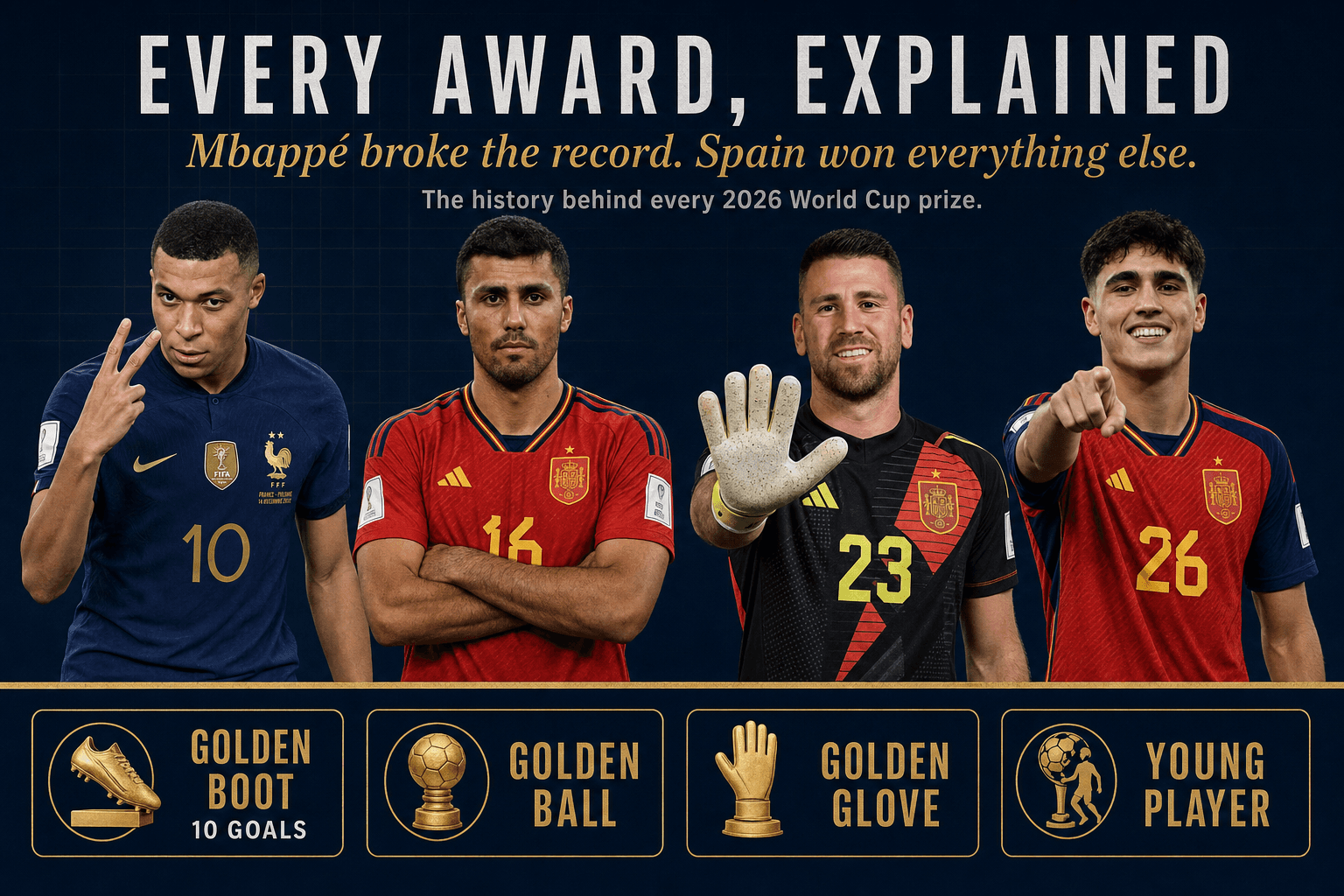
Kylian Mbappé finished the 2026 World Cup with more goals than any player has scored at a single tournament since Gerd Müller's ten in 1970, and he still had to settle for the Bronze Ball. Spain, the actual champions, swept almost every other individual prize the tournament had to offer. Between those two facts sits the complete story of this year's award season, a set of trophies most coverage lists in a single paragraph without ever explaining what each one actually measures, or why the history behind it makes the 2026 winners so specifically remarkable.
The Golden Boot: Mbappé Becomes the All-Time Leading Scorer
Mbappé won the Golden Boot with ten goals in France's eight matches, the most any player has scored at a single World Cup since West Germany's Gerd Müller reached double figures in 1970, fifty-six years ago. The award, decided by goals first and assists as the tiebreaker, went to Mbappé over Messi's eight goals after Mbappé scored twice in France's wild 6-4 third-place play-off win over England, a match that also completed his personal record: 22 career World Cup goals, one more than Messi's 21, making him the tournament's all-time leading scorer. It is the second consecutive World Cup Mbappé has beaten Messi to the award, having done so in Qatar with eight goals to Messi's seven. The Golden Boot has been awarded since 1930, though it only adopted its current adidas-branded format and assist-based tiebreaker system in more recent editions; Harry Kane, Ronaldo Nazário, and Gerd Müller himself all previously held the honour multiple times across their careers.
The Golden Ball: Rodri Edges Out Messi in the Sport's Oldest Individual Debate
Rodri was named winner of the Golden Ball, awarded to the tournament's best overall player as voted by media, with Messi taking Silver and Mbappé Bronze. The Golden Ball has existed since 1982 and has a specific history of rewarding complete midfield performances over pure goalscoring: Diego Maradona in 1986, Romário in 1994, Zinedine Zidane in 2006 and Luka Modrić in 2018 all won it while playing in deeper or more creative roles rather than as out-and-out strikers, exactly the profile Rodri fits. His award recognised the specific defensive midfield control we detailed in our piece on Spain's semi-final win over France, where his performance was widely credited as the platform for the entire run to the title.
The Golden Glove: Unai Simón Breaks a Record That Stood for Decades
Unai Simón won the Golden Glove after conceding only once across eight matches, against Belgium, the goal that ended his all-time record clean-sheet streak documented in full in our piece on Simón's 519-minute record. His seven clean sheets at this single tournament broke the previous World Cup record by two, and his career total of nine World Cup clean sheets now sits just one behind the all-time record of ten, shared by former France goalkeeper Fabien Barthez and England's Peter Shilton. The Golden Glove was introduced far more recently than the other major awards, first presented at the 2010 tournament, making Simón's specific combination of a single-tournament record and a near-miss on the all-time career record one of the most statistically significant goalkeeping performances the award has ever recognised.
Young Player of the Tournament: Cubarsí Joins an Elite List
Pau Cubarsí, 19, was named Young Player of the Tournament, an award given specifically to the best player born on or after January 1, 2005, joining a list of previous winners that includes Kylian Mbappé himself in 2018, Thomas Müller in 2010, and Enzo Fernández in 2022. Cubarsí's rise, part of the youth development system we detailed in full in our piece on De la Fuente's grassroots pipeline, made him the specific embodiment of Spain's broader philosophy: a teenager promoted directly into a World Cup-winning back line, anchoring a defence that conceded once in the entire tournament.
Mbappé scored more World Cup goals than anyone has managed in a single tournament since 1970, broke the all-time career scoring record, and still finished with the Bronze Ball because Spain's Rodri and Messi were both judged the tournament's superior overall performers. The Golden Ball has always measured something different from the Golden Boot. 2026 made that distinction more visible than almost any tournament before it.
The Fair Play Award and the Story Behind It
As detailed in full in our piece on this tournament's prize money breakdown, the Netherlands won the 2026 Fair Play Award, their first, becoming the eleventh nation to receive the honour since it was introduced in 1970. The award is determined by a formula combining disciplinary record with broader sportsmanship criteria, and only nations that reach the knockout stage are eligible, a specific rule that quietly excluded Iran's own widely praised conduct after their undefeated group-stage elimination.
The Third-Place Play-Off: The Forgotten Match That Decided the Golden Boot
The specific detail most coverage undersells is that the Golden Boot was not actually decided in the final. France beat England 6-4 in the third-place play-off, with Mbappé scoring twice to move from level with Messi to a two-goal lead that Messi, held scoreless in the final, could not overturn. The third-place match, often dismissed as a dead rubber both teams would rather skip, ended up being the single most statistically consequential fixture of the entire tournament outside the final itself.
The Lesser-Known Prizes Most Coverage Skips Entirely
Beyond the five headline awards, FIFA also presents a Best Goal award, voted on by fans rather than a technical panel, and a Dream Team, an all-tournament XI selected by FIFA's Technical Study Group that typically generates its own separate debate about specific snubs and inclusions. These awards rarely receive the same broadcast attention as the Golden Boot or Golden Ball, but they represent FIFA's attempt to recognise the specific individual moments, a single goal, a single position's best overall representative, that the headline statistical awards cannot fully capture on their own.
What the Full Award Sweep Actually Tells You
The specific pattern across every major 2026 award, Spain claiming the Golden Ball, Golden Glove and Young Player while conceding the Golden Boot to Mbappé's individually record-breaking tournament, tells the same story we identified across our full retrospective of this World Cup, documented in our piece on the complete tournament story: individual brilliance, however historic, did not determine who actually won. The team built on collective structure did.
Mbappé broke the all-time World Cup scoring record and still lost the Golden Ball to Rodri. Which award winner do you think was the most deserved this tournament? Tell us below.