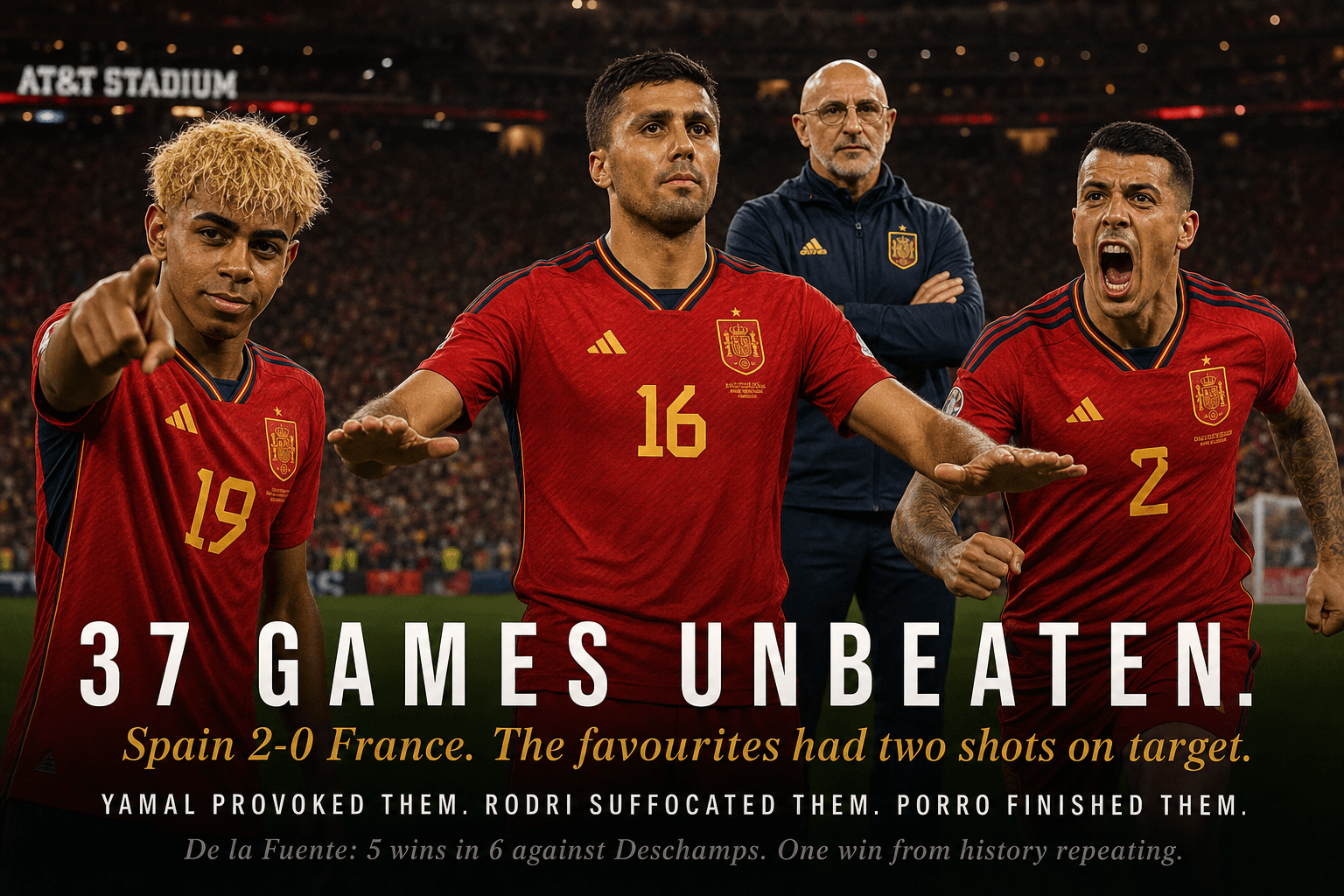
Spain did not need to be spectacular against France. They needed to be exactly what they have been all tournament, patient, suffocating, and clinical at the one moment that mattered, and Kylian Mbappe's France, the competition's most dangerous attacking side by every metric available, simply had no answer. Mikel Oyarzabal converted a 22nd-minute penalty after Lucas Digne fouled Lamine Yamal, Pedro Porro doubled the lead in the second half, and Spain won 2-0 at AT&T Stadium in Arlington to reach their first World Cup final since 2010, the only tournament they have ever won. As we documented in our piece on Spain's world-record unbeaten run, this win extends a streak that stood at 36 competitive matches without defeat entering the match, already the longest such run in the history of international football, surpassing Brazil's old record of 33. The win over France pushes that number to 37, with one match, the final against Argentina, still to come. As we detailed in our semi-final preview, this was billed as the biggest match of the tournament. It delivered exactly that, and Spain delivered the result almost nobody outside their own camp had fully backed.
How Many Games Are Spain Unbeaten?
Spain's win over France takes their unbeaten run in competitive international football to 37 matches without defeat. As we documented in our piece on Spain's world-record unbeaten run, the streak began after a defeat to Scotland in March 2023 and has since carried Spain through Euro 2024, an unbeaten Nations League campaign, and every match of this World Cup so far. The run broke Brazil's previous all-time record of 33 consecutive competitive matches without defeat earlier in this same tournament cycle, and every subsequent Spain result, including the France semi-final, has simply extended a record that already stood alone in the sport's history before this match kicked off.
De la Fuente 5, Deschamps 1: A Rivalry Now Settled
Luis de la Fuente's record against Didier Deschamps in semi-finals is now one of the most one-sided rivalries in modern international football. Including this match, the two managers have faced off six times across youth and senior level since De la Fuente's very first game in charge of Spain's Under-19s in 2013, a defeat to France that remains his only loss in the fixture. Since then: an Under-19 final win, an Under-21 triumph, a 2-1 comeback win in the Euro 2024 semi-final in Munich, a 5-4 Nations League semi-final classic in Stuttgart last summer, and now a 2-0 World Cup semi-final win in Arlington. Five wins from six meetings. De la Fuente himself was blunt about the improvement in this specific French side beforehand: "France are much better now than what they were when we faced them before. Individually, they have grown. Mbappe is better, Dembele is better." Being better made no difference. Spain won again.
Unai Simon: One Goal Conceded, Seven Matches, A Historic Pace
Spain's defensive record now sits at one goal conceded across seven matches this tournament, Charles De Ketelaere's equaliser in the quarter-final win over Belgium remains the only blemish, a moment that ended Unai Simon's all-time clean-sheet record. Against France, Simon was required to make saves from Ousmane Dembele twice and Kylian Mbappe once, but the French front line, the tournament's most productive collectively, having scored sixteen goals through the semi-final, created almost nothing of genuine quality. France finished the match with just two shots on target to Spain's six. Spain's remarkable defensive campaign is now on course to match, and potentially beat, one of the most celebrated defensive records in World Cup history: France's own 1998 winning side conceded only two goals across their entire seven-match run to the trophy. Spain have conceded once with one match still to play.
The Counter-Press: Winning the Ball Back in 11 Seconds
The specific mechanism behind Spain's suffocation of France connects directly to the tactical metrics we explored in our pieces on ball recovery time and in-contest possession. Spain's collective press has been described throughout the tournament as forcing turnovers in just over eleven seconds on average, a specific number that explains why Mbappe, the tournament's joint-top scorer entering the match, found almost no room to operate. Spain repeatedly crowded him in transition, limiting his touches in dangerous areas and denying him the space he needs to produce the decisive moments that carried France through six previous matches. The ball recovery speed did not simply limit France's attack. It removed France's attack from the match almost entirely.
France had scored sixteen goals and conceded two through six matches, the most dominant attacking side of the tournament. Against Spain, they managed two shots on target. Unai Simon has now conceded once in seven games. De la Fuente has beaten Deschamps five times in six meetings across a thirteen-year rivalry. Spain are one win away from becoming champions for the second time, and the pattern says it might already be written.
Rodri: The Ballon d'Or Pedigree on Full Display
Rodri's performance in central midfield was, by every account from the stadium, immense, controlling tempo, winning duels, and directing Spain's defensive shape throughout. It was the exact profile of performance that won him the Ballon d'Or, deployed at the exact moment Spain needed to neutralise the tournament's most feared attacking unit. Alongside Fabian Ruiz, who has yet to be on the losing side in a Spain shirt he has started this era, Rodri gave Spain the midfield control that made France's individually superior attacking talent almost irrelevant for ninety minutes.
Porro: From Third Choice to Two Goals in a World Cup Semi-Final
Few individual stories at this World Cup match Pedro Porro's for sheer improbability. He began the tournament as an unused substitute in the opener against Cape Verde, with Marcos Llorente preferred at right-back. Porro took over the starting spot from the second group match against Saudi Arabia onward and never relinquished it. His first-ever international goal arrived in the Round of 32 win over Austria, a thumping header, and he added a second in the biggest match of his career, finishing a first-time Dani Olmo assist to double Spain's lead against France. Porro is now a first-team mainstay for both Spain and Tottenham, where Spurs' summer rebuild under Roberto De Zerbi has been built partly around his continued development on the right flank.
The Pattern Spain Cannot Escape
Spanish football has a specific, recurring rhythm that this tournament is now threatening to repeat for a third time. Spain won Euro 2008, then the World Cup in 2010, then Euro 2012, a golden run of three consecutive major titles. After a long drought, De la Fuente delivered Euro 2024. Now, two years later, Spain are one win away from adding the World Cup to that cycle again. The specific sequence, European Championship success followed by World Cup glory, has happened before under almost identical circumstances. Spain are attempting to prove it was never a coincidence.
What Comes Next: Argentina or England in New Jersey
Spain do not yet know their World Cup final opponent. They face the winner of Argentina vs England, the second semi-final still to be played, on July 19 at MetLife Stadium. Both remaining possibilities carry their own historic weight. Argentina, led by Lionel Messi, are attempting to become the first team since Brazil in 1958 and 1962 to win back-to-back World Cups. England, built this tournament around Jude Bellingham's remarkable run under Thomas Tuchel, documented in full in our piece on how Tuchel turned Bellingham into a World Cup beast, are chasing their own piece of history: a Tuchel win would put him on the path toward the same rare Champions League and World Cup double we detailed in our pieces on managers who won it twice and player-manager double winners.
For Deschamps, the defeat to Spain ends his own bid for history regardless of who Spain eventually face, his fourteen-year reign now ending at the semi-final stage, the same institution he once revived as a manager after his own playing career took a very different turn at Marseille. For Spain, Merino remains available on the bench, having already decided two knockout matches this tournament with his father's corner flag tribute. One more win, against whichever side survives Atlanta, completes the pattern. History says it is exactly what happens next.
Yamal's Provocation and What Followed
The build-up to this semi-final carried its own edge after Lamine Yamal said publicly that France should be afraid of Spain. It was the teenager doing what he has done all tournament: refusing to defer to reputation, even against the side many neutrals still considered favourites entering the match. Yamal drew the game's opening goal himself, fouled by Digne inside the box, before being flagged narrowly offside on what would have been a stunning solo finish later in the second half after accepting Pau Cubarsi's through ball. His pre-match words looked, by full time, less like bravado and more like an accurate reading of the match to come.
Deschamps' Substitutions and a Frustrated Touchline
Didier Deschamps made wholesale changes as the match slipped away, bringing on Desire Doue and Rayan Cherki in search of a route back into the game, then exhausting his final substitutions by the 73rd minute. None of it created the sustained pressure France needed. Mbappe picked up a yellow card in the closing stages for a needless collision with Unai Simon as the goalkeeper shepherded the ball out of play, a small moment of visible frustration from a player who had spent the entire afternoon crowded out of the game by Spain's compact defensive shape. Deschamps, in charge of France for fourteen years, watched his side produce their least fluent attacking performance of the entire tournament at the exact moment it mattered most.
The specific tactical picture Spain presented across the ninety minutes rarely wavered. De la Fuente set his side up in the same 4-3-3 that has carried them through every match this tournament, with Cubarsi and Laporte holding a compact defensive line and Cucurella providing the width on the left that Porro mirrored on the right. Fabian Ruiz sat alongside Rodri to double up defensively whenever France attempted to build through Tchouameni or Kone, a specific tactical choice that meant Mbappe rarely received the ball in space between the lines where he does his most damage. Olise, so influential earlier in the tournament, was similarly starved of service. The match statistics reflected the eye test precisely: France, the tournament's most explosive attacking side for six consecutive matches, managed just two attempts on target across the full ninety minutes plus stoppage time.
For a France squad that had scored sixteen goals and lost only to Norway across their previous six matches, the sudden and complete absence of attacking rhythm against Spain was the single most striking storyline of the entire semi-final. Dembele's two efforts on target represented the entirety of France's genuine goal-scoring threat, both comfortably held by Simon. Barcola, so lively in the quarter-final win over Morocco, barely featured before his 57th-minute substitution. The specific gap between France's attacking output across the tournament and their output in this single match is the clearest evidence available of exactly how effectively Spain's defensive structure functioned when it mattered most.
Spain beat the tournament favourites 2-0 and extended a run that mirrors their 2010 triumph almost perfectly. Whether it is Argentina or England waiting in the final, can Spain complete the pattern? Tell us below.