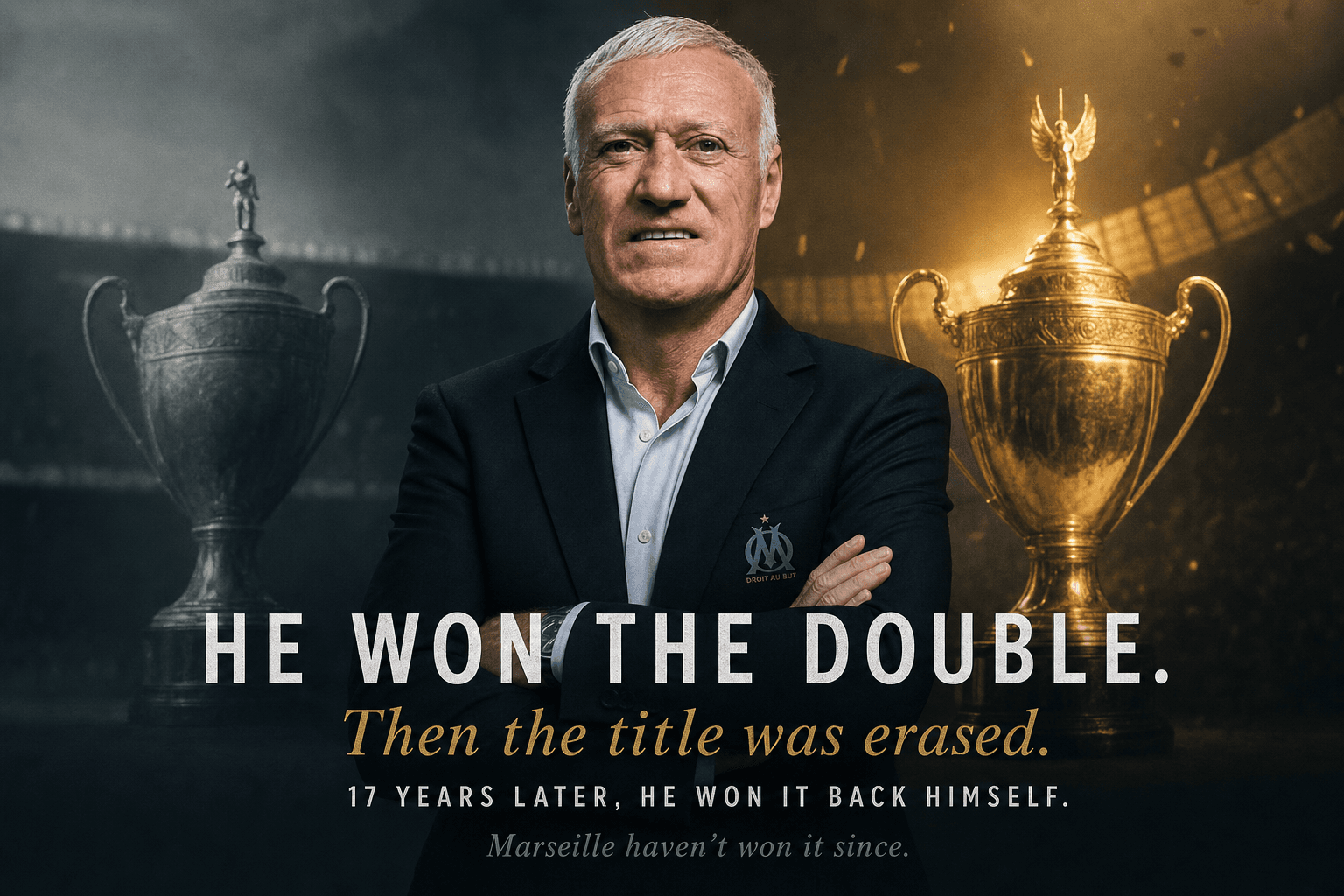
On May 26, 1993, Didier Deschamps became the youngest captain in history to lift the European Cup, leading Olympique Marseille to a 1-0 win over AC Milan in Munich — the first, and to this day still only French club triumph in the competition's original format, before Paris Saint-Germain finally matched it in 2025. Six days earlier, Marseille had also secured what looked at the time like a routine fifth consecutive Ligue 1 title. Deschamps had captained a genuine double: French champions and European champions, in the same season, the exact accomplishment that defines a club's golden generation. Then, twenty-four hours after the Munich final, the story fell apart entirely. As we explored in our pieces on football's rarest managerial doubles and the three men who won the World Cup as player and manager, Deschamps's career is defined by repeatedly completing achievements that stand alone in football history. The Marseille story is the one piece of that career that was, quite literally, erased from the record books — before Deschamps himself, seventeen years later, put it back.
The Scandal: What Actually Happened Six Days Before Munich
The French Football Federation stripped Marseille of their 1992-93 league title after the Ligue de Football Professionnel confirmed Tapie had bribed Valenciennes players. No champion was declared for that season — the title simply does not exist in the official record books. UEFA, in a decision that has generated debate ever since, elected not to follow the domestic federation's lead: because the scandal specifically affected a French league match rather than any element of the European campaign, Marseille's Champions League title was allowed to stand. Deschamps remains, officially and permanently, the captain of the only pre-2025 French club to win the European Cup. He is simultaneously the captain of a league title that, in the strict legal sense, was never actually won.
The Collapse That Followed
Despite finishing second to Paris Saint-Germain the following season, Marseille were relegated with immediate effect as further punishment. Deschamps, goalkeeper Fabien Barthez, and defender Marcel Desailly led an exodus of the club's talent. Marseille were promoted back at the first attempt, only to then be barred from competing in Ligue 1 as the full scale of Tapie's financial mismanagement came to light — with the club's debt nearly tripling during his tenure and bankruptcy a real and imminent possibility. Tapie, who had built the entire Marseille project on lavish spending pursued with the specific single-minded obsession of winning the European Cup at any cost, served eight months in prison. The club that had just completed the most significant continental achievement in French football history spent the following decade in genuine institutional chaos — relegation, bankruptcy proceedings, and a prolonged competitive decline that bore no resemblance to the European champions of 1993.
Marseille won a genuine double in 1993 — Ligue 1 and the European Cup — with Didier Deschamps as captain. The league title was stripped within 24 hours of the European final, following a bribery scandal that also triggered the club's relegation and near-bankruptcy. Marseille did not win the French title again for eighteen years. When they finally did, in 2010, the manager standing on the touchline was Didier Deschamps himself.
Eighteen Years Later: Deschamps Returns as Manager
The specific symmetry of that quote deserves to be stated plainly, because it is not simply poetic — it is factually precise. Deschamps was the last Marseille captain to lift a Ligue 1 title, in a season that was subsequently erased from the record books. Seventeen years later, as manager rather than captain, he became the man who delivered the club's next actual, undisputed, permanently recognised championship. Marseille's ninth Ligue 1 title, secured under Deschamps in 2009-10, came alongside a broader resurgence — six trophies total during his tenure, including their first Coupe de la Ligue in 2010, back-to-back League Cup successes by 2011, and a run to the last 16 of the Champions League for the first time since the historic 1993 campaign, where Marseille beat Zilina 7-0 away — still the biggest away win in the competition's history at the time.
The Title That Has Never Come Back
The 2009-10 Ligue 1 championship remains, to this day, Marseille's most recent domestic title. Paris Saint-Germain have won fourteen Ligue 1 titles in total, including five in a row as of the 2025-26 season, establishing a level of financial and competitive dominance in French football that Marseille — the club with the second-most titles in the country's history at nine, level on paper with Saint-Étienne but separated by the 1993 asterisk — have not come close to matching since Deschamps left the touchline. The specific football irony is stark: the man who delivered Marseille's last genuine championship, ending an 18-year wait that existed only because his own playing triumph had been stripped from history, moved on to international management in 2012 and has not returned. Marseille have spent the fifteen years since searching, without success, for anyone who could replicate what their former captain-turned-manager achieved in a single nine-month campaign.
The Financial Parallel: Tapie and the Big-Spending Owner Archetype
The Tapie era at Marseille — described by football historians as a period where the club's president buried millions into assembling stars including Jean-Pierre Papin, Chris Waddle, Abedi Pelé, and Deschamps himself, in pursuit of the European Cup at any cost regardless of long-term financial sustainability — bears specific resemblance to the ownership model we documented in our piece on Roman Abramovich's Chelsea era and the modern regulatory response it eventually produced. Tapie's Marseille, like Abramovich's Chelsea decades later, demonstrated that unlimited spending directed at a single European trophy could produce genuine footballing success — Marseille's 1993 triumph was real, on the pitch, regardless of what happened in the boardroom. But the specific absence of financial regulation in early 1990s French football meant Tapie's model collapsed catastrophically rather than being constrained gradually, the way modern Financial Fair Play and PSR rules — documented in our piece on why PSR rewards commercial revenue over owner wealth — are specifically designed to prevent today. Marseille's 1993 collapse is, in a specific historical sense, part of the case study that later regulatory frameworks were built to guard against.
What This Means for the France vs Spain Semi-Final
The Marseille story is not simply historical colour attached to Deschamps's biography. It is direct evidence of the specific quality that defines his entire career, on display again as France prepare to face Spain in the 2026 World Cup semi-final, documented in full in our piece on the France vs Spain semi-final preview. Deschamps has now spent three decades demonstrating an unusual capacity to return to the scene of institutional chaos or historical disappointment and personally deliver the resolution. He captained a Marseille double that was partially erased by scandal, then came back as manager and delivered the club's next real title himself. He lost the 1998 World Cup race for Brazil as a young captain against no direct historical precedent, then became the man who ended France's own specific championship drought as manager in 2018. The specific pattern — disappointment, distance, then a triumphant return delivered by the same man in a different role — is the through-line connecting a French league title stripped in 1993 to a World Cup semi-final Deschamps is trying to win in 2026, chasing a third consecutive final that would put him in territory no manager in the sport's ninety-six-year history has ever reached.
Why UEFA and the French Federation Made Different Calls
The specific regulatory divergence between UEFA's decision to let the European Cup stand and the French federation's decision to strip the domestic title deserves its own explanation, because it is the detail that allows Deschamps to hold both records simultaneously — captain of a permanently erased league title and captain of a permanently recognised European one. The bribery scheme was specifically targeted at a Ligue 1 fixture, an act entirely internal to French domestic competition and adjudicated entirely by French football's governing body. UEFA's own investigation concluded that no element of the actual European Cup campaign itself — the matches against Rangers, Club Brugge, CSKA Moscow, and ultimately Milan — was affected by any corrupt activity. The specific legal and administrative separation between domestic and continental governing bodies meant two entirely different verdicts could be reached about the same set of facts, applied to two different competitions the same squad had won in the same nine-day window. It is a specific quirk of football's fragmented regulatory structure that a genuinely damning scandal could simultaneously end one trophy's legitimacy while leaving another's completely untouched.
Deschamps captained Marseille's stripped 1993 double, then delivered their next title himself as manager 17 years later. Marseille haven't won Ligue 1 since. Is this the most underrated part of Deschamps's legacy — and can he add a World Cup final to it this month? Tell us below.