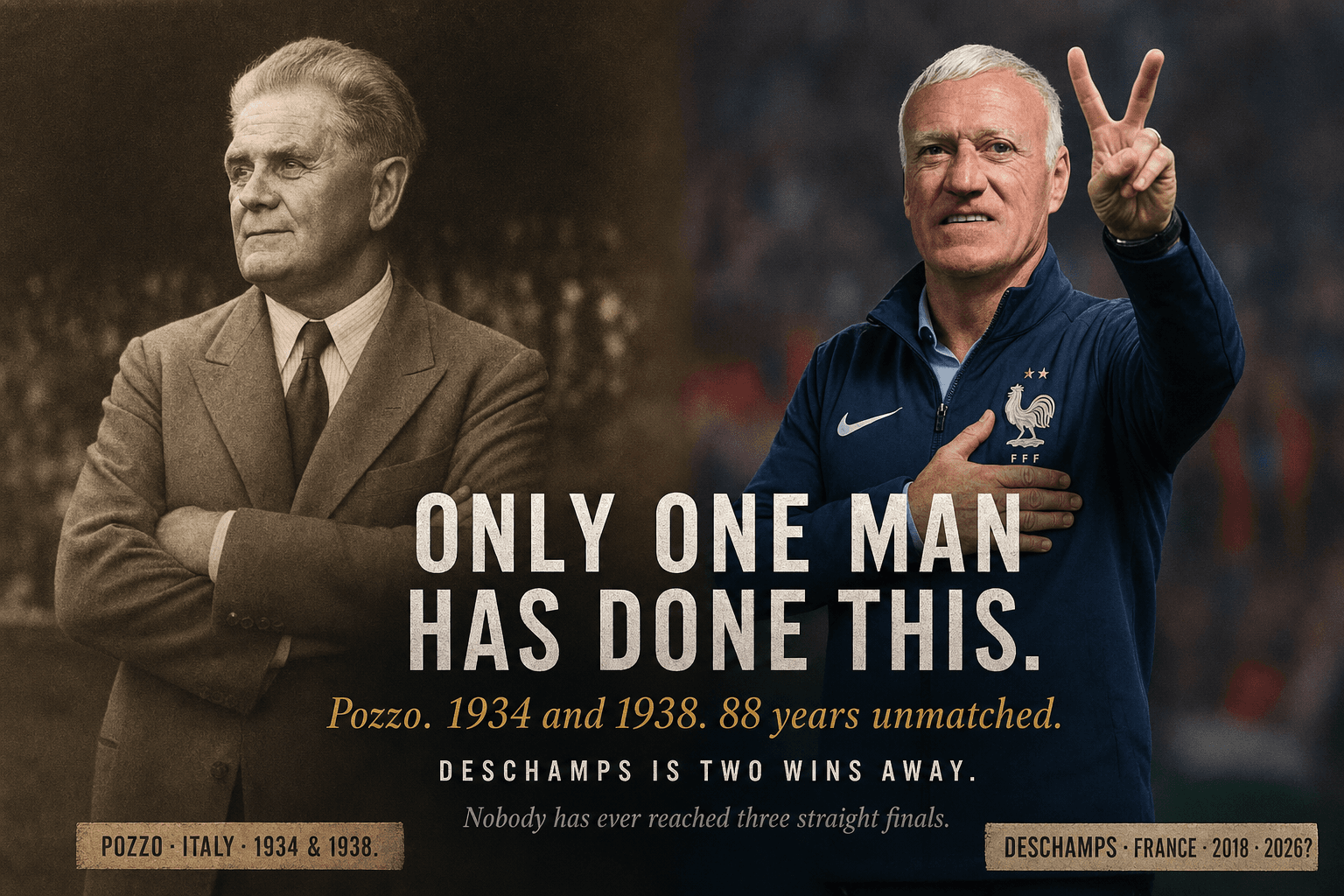
Twenty-one different managers have won the World Cup across ninety-six years and twenty-two completed tournaments. Exactly one of them has done it twice. Vittorio Pozzo led Italy to victory in 1934 and again in 1938 — a feat that has now stood alone, unmatched and unapproached, for eighty-eight years. Every manager since, including some of the most decorated coaches the sport has ever produced, has managed it once and then either fallen short on a second attempt or never got the chance to try again. Didier Deschamps, who won the World Cup as France's manager in 2018 and has now guided Les Bleus to the 2026 semi-final against Spain, documented in full in our piece on the France vs Spain semi-final preview, is two matches from becoming the second name on a list that has had exactly one entry since 1938.
Vittorio Pozzo: The Only Two-Time Winner
Vittorio Pozzo is the only person who has won the World Cup twice as a manager, leading Italy to victory in 1934 and 1938. Twenty-one different managers have won the World Cup in total, and all winning managers have led their own country's national team — no foreign coach has ever won the tournament in ninety-six years of history. Pozzo's achievement sits in a specific historical context that makes direct comparison to the modern game difficult: he managed across an era with only four completed World Cups, significantly less competitive depth among participating nations, and none of the squad rotation, media scrutiny, or physical demands that define the international calendar today. That context does not diminish the achievement — it simply means that every manager since 1938 has been attempting to repeat something under conditions Pozzo never had to navigate, and none of them have managed it.
The Managers Who Came Close
The list of managers who won once and reached a second final without winning is instructive. Franz Beckenbauer, as documented in our piece on the three men who won the World Cup as both player and manager, reached the 1986 final with West Germany and lost to Maradona's Argentina before winning in 1990 — but that sequence was a loss followed by a win, not two wins. Mário Zagallo reached a second final as Brazil manager in 1998, twenty-eight years after his 1970 triumph, and lost to France. Helmut Schön reached consecutive finals for West Germany in the 1960s and 70s, winning once. Carlos Bilardo won with Argentina in 1986 and reached the final again in 1990, losing to Beckenbauer's Germany. Every one of these managers got a second bite. Every one of them, without exception, missed.
The specific rarity this creates is worth stating precisely: winning a World Cup as a manager requires an extraordinary combination of squad quality, tactical execution, and tournament luck across seven matches played in a compressed month-long window, once every four years. Winning it twice requires that exact combination to repeat itself across an entirely different four-year cycle, with a substantially different squad, against different opposition, often with the specific burden of being the defending world champions — a status that has historically made teams more difficult to prepare, not easier, given the target it places on their back and the changed expectations surrounding every subsequent tournament.
Twenty-one managers have won the World Cup. Exactly one has won it twice — Vittorio Pozzo, in 1934 and 1938, a record that has now survived eighty-eight years and every attempt to match it. Deschamps has one World Cup as manager already. He is two wins from Atlanta and New Jersey away from becoming the second name on the shortest list in football history.
Deschamps' Specific Case for History
The specific detail that makes Deschamps's 2026 run genuinely unprecedented, regardless of the eventual outcome against Spain, is the consecutive final sequence. Beckenbauer and Schön are the only managers in history to reach consecutive World Cup finals — two tournaments in a row. Deschamps, having reached the 2018 final (won) and the 2022 final (lost on penalties), would make World Cup history simply by reaching the 2026 final as well: a third consecutive appearance in the sport's biggest match, something no manager has ever achieved. Winning that third final would not just make him the second man to win the World Cup twice as manager, alongside Pozzo. It would attach that achievement to a run of finals appearances that has no precedent anywhere in the tournament's ninety-six-year history.
Why Twice Is So Much Harder Than Once
The specific football reasons a second World Cup title is so difficult to engineer connect directly to squad turnover and tactical evolution. The France squad that won in 2018 — built around a 19-year-old Mbappé, N'Golo Kanté's peak defensive midfield years, and a settled Griezmann-Giroud attacking partnership — is structurally different from the squad Deschamps has assembled for 2026, documented in our piece on the Mbappé-Olise partnership now driving France's attack. Managing that generational transition — replacing key departing players, integrating new ones, maintaining the specific tactical identity that produces tournament-winning football across an eight-year span covering three World Cups — is itself one of international management's hardest ongoing challenges. Ancelotti, whose own bid to win a World Cup with Brazil ended against Norway, as covered in our piece on Brazil's elimination and the end of Ancelotti's World Cup and Champions League double bid, discovered exactly how difficult managing a squad transition into knockout-stage success can be, even with five Champions League titles behind him. Deschamps has now navigated three consecutive tournament cycles with France without a single knockout-stage elimination before the final — a specific consistency that Pozzo's eighty-eight-year-old record has never had to withstand from a direct modern challenger quite this credible.
What Winning Twice Would Actually Mean
Should France beat Spain in the semi-final and go on to win the 2026 final, Deschamps would simultaneously achieve two historically separate feats that have never previously belonged to the same man: joining Zagallo and Beckenbauer as a player-manager World Cup winner, documented in our companion piece, and joining Pozzo as a two-time World Cup-winning manager. No individual in the sport's history has ever held both distinctions at once. Pozzo never played at a World Cup as Italy's regulations at the time made this irrelevant to his path into management. Zagallo and Beckenbauer, the only other player-managers, never won a second title as manager. A Deschamps triumph in 2026 would therefore create an entirely new category of achievement — the only man to win the World Cup as a player, and then win it twice as a manager — with no existing precedent to compare it against, because nobody in ninety-six years has ever done both.
The Pozzo Era: Why His Record Belongs to a Different Football
Understanding what Pozzo actually achieved requires understanding the specific football landscape he operated in. The 1934 World Cup, held in Italy under Benito Mussolini's fascist government, was played by just sixteen teams in a straight knockout format after the group stage — a compressed, high-pressure structure that gave Pozzo's squad no room for the kind of gradual tournament momentum modern managers rely on building. The 1938 tournament in France, Italy's title defence, was the last World Cup before a twelve-year hiatus caused by the Second World War — meaning Pozzo's second triumph was also, in a specific historical sense, the final piece of pre-war international football before the sport itself was interrupted by global catastrophe. His Italy sides were built around a core of players who remained largely unchanged between the two tournaments, a continuity that modern international squads, subject to the demands of an increasingly saturated club calendar, injury attrition, and generational turnover, essentially never experience across a comparable four-year gap today.
There is also the specific matter of Italys 1938 semi-final and final route, played almost entirely on foreign soil against host nation France and eventual finalists Hungary, a genuine road warrior achievement that modern squads rarely have to replicate given how World Cups are typically staged with far more balanced travel and altitude considerations built into the fixture list. Pozzos achievement, viewed through that lens, becomes even more specifically remarkable: not simply winning twice, but doing so as both host nation in 1934 and travelling defending champion in 1938, a double context no subsequent two-time-final manager has ever had to navigate in precisely that combination.
Set against that specific historical backdrop, Deschamps chase for a second title carries its own distinct set of modern obstacles that Pozzo never faced: a 48-team tournament format introduced for 2026, an expanded and more physically taxing schedule, a global scouting and analytics infrastructure that makes tactical surprise far harder to manufacture than it was in the 1930s, and opposition — Spain, in this specific semi-final — building their own historic case simultaneously. Pozzos record has survived eighty-eight years partly because the conditions that produced it can never be exactly replicated. Deschamps is not trying to recreate 1930s football. He is attempting something that, by any reasonable measure, is harder to achieve now than it was then, which is precisely what would make matching Pozzos number so significant if he manages it.
Vittorio Pozzo is the only manager to win the World Cup twice, a record standing since 1938. Deschamps is two wins from matching it — and would do so as the only player-manager double winner to also win it twice as coach. Do you think Deschamps can make history in 2026? Tell us below.