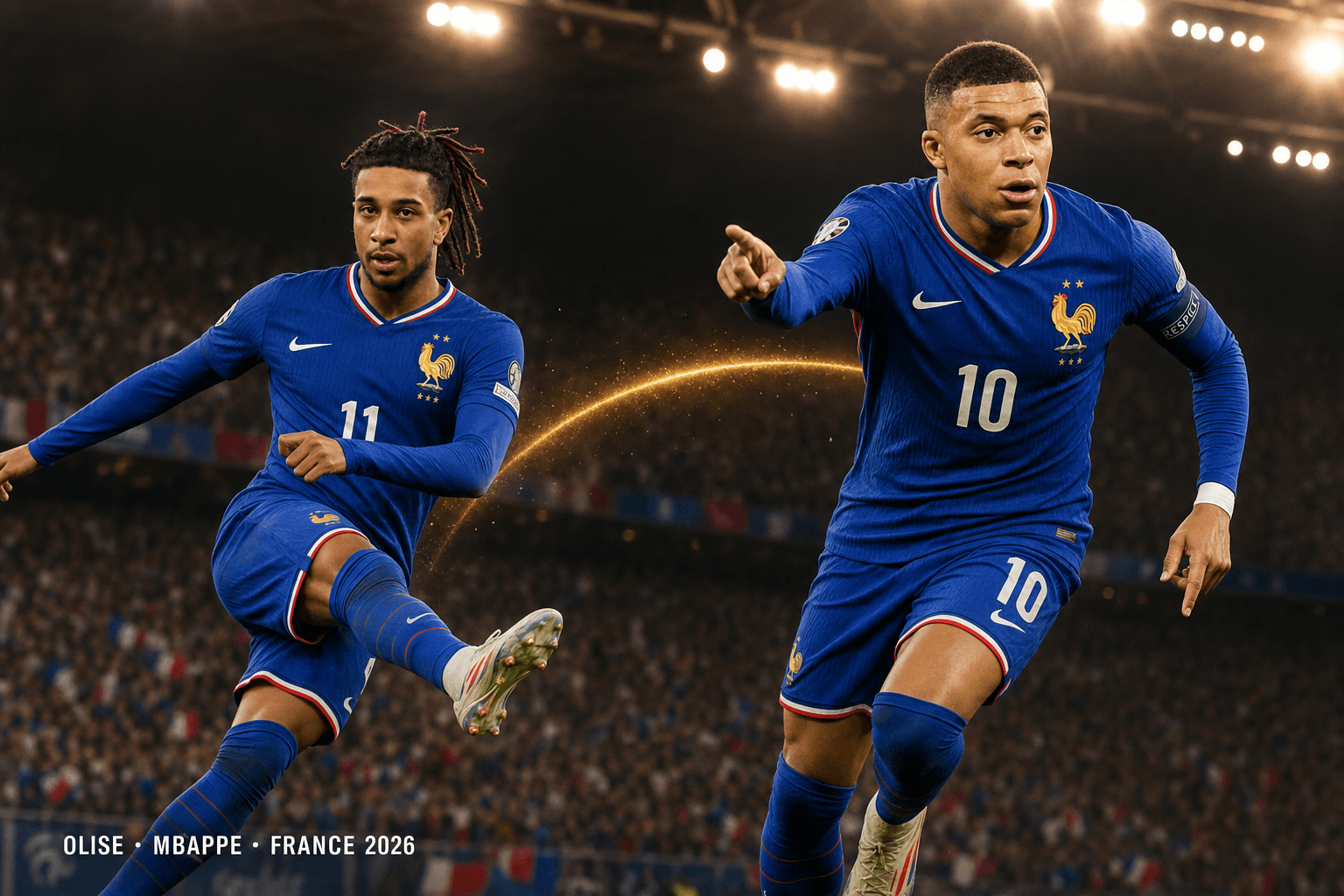
The transfer story of the summer did not begin in a boardroom. It began on a football pitch — specifically, on the left side of France's attack, where Michael Olise and Kylian Mbappe have developed one of the 2026 World Cup's most devastating attacking partnerships in three group stage matches. Olise has provided five assists at the 2026 World Cup. Three of them directly set up Mbappe goals. France, who beat Sweden 3-0 in the group stage and qualified top of their group with nine points, are among the tournament's clearest favourites for the title. And the specific football reason they are favourites — the mechanism through which their attack generates the most dangerous opportunities — runs through the Olise-Mbappe combination more than any other individual relationship in the squad. Real Madrid have been watching. So has the rest of European football.
What the Partnership Actually Looks Like
Olise's role in Didier Deschamps's system is specific and not easily categorised by conventional positional labels. He operates nominally from the right side but has the freedom to drift inside, create overloads in central areas, and identify the spaces between opposition defensive and midfield lines where the most dangerous through-balls are possible. Mbappe, operating from the left or centrally, has a career-defining strength: finishing from spaces created by late runs into the penalty area. The combination is not accidental — it is the specific kind of partnership that coaches design and drill because one player's greatest strength feeds directly into the other player's greatest strength without either player needing to compromise their preferred movements.
Against Iraq in France's second group game, Olise produced two assists in a 3-0 win — including a precise through-ball that sent Mbappe clear for a composed finish and a cutback that Mbappe converted first-time from the edge of the area. Against Senegal, Olise's movement created the space that led to Mbappe's strike. The pattern is not Olise delivering the ball into a conventional crossing position. It is Olise finding the specific pass that gives Mbappe the specific angle his finishing technique requires — the ball arriving at pace into a space where Mbappe is running, not standing. That distinction is the technical detail that separates this partnership from a conventional wide attacker and centre-forward combination.
Why Mbappe Specifically Needs This
Mbappe's career at Real Madrid has produced goals, performances, and Champions League success. It has also produced one persistent question: why does the world's most expensive player appear less dominant in the Madrid system than he did at PSG? The answer is partly systemic: PSG's infrastructure was built around making Mbappe the single most important attacking decision-maker on the pitch. Real Madrid's infrastructure was built before Mbappe arrived, with Vinicius Junior and Jude Bellingham as the central creative forces of Ancelotti's system. Mbappe arrived into an existing structure rather than as its defining element.
Olise solves that problem in a specific way. He is not a replacement for Vinicius or Bellingham. He is a player whose primary function is creating opportunities for the player he is playing alongside. At Bayern, 31 assists across the 2024-25 season came predominantly from a role in which Olise identified the space and delivered the ball to the player in the best position to score. That player was not always the same person — it changed depending on the system and the game state. But the function was consistent: Olise finds the pass that produces the opportunity. Mbappe, in the World Cup context, is the player most capable of converting those opportunities. The combination of those two specific qualities — Olise's pass-finding and Mbappe's finishing — is what France have been running at this World Cup, and what Real Madrid want to make permanent at the Bernabeu.
Olise has provided five World Cup assists. Three set up Mbappe goals. France are tournament favourites with Mbappe leading the Golden Boot race. And the partnership that has defined the 2026 World Cup's most dangerous attack is the same partnership Real Madrid are reportedly prepared to break the transfer record to acquire permanently. The football reason and the transfer story are the same story.
France as World Cup Favourites: The Squad Depth Argument
The wider context of France's World Cup campaign makes the Olise story larger than a bilateral partnership. France are not favourites simply because of Mbappe. They are favourites because of the depth at every position — Tchouameni and Rabiot in midfield, Griezmann's creativity in the half-space, Konate and Saliba at the back — combined with a forward line that contains Mbappe, Olise, and the ability to bring on Dembele, Coman, or Thuram from the bench. As we noted in our analysis of the Tuchel vs Ancelotti head-to-head and the bracket's defining matchups, France are on the same side of the draw as Brazil and England — meaning at least one of those three nations will be eliminated before the semi-finals. The specific path through the bracket makes France's depth more important than individual brilliance: they need to sustain quality across six or seven matches, not just produce it once.
Mbappe entered the tournament after winning the Ballon d'Or — France's second following Benzema's 2022 award — and with six World Cup goals already in 2026, tied with Argentina's Messi at the top of the Golden Boot race. The Olise partnership, which has contributed directly to three of those six goals, is the mechanism through which his World Cup is happening at this level. Take Olise out of France's system and replace him with a conventional wide attacker, and Mbappe's goal return drops. The partnership is not decoration around Mbappe's individual quality. It is the specific delivery system for it.
What Happens If France Win the World Cup
The specific consequence of France winning the 2026 World Cup — in terms of the Olise transfer saga — is significant. A Ballon d'Or-winning Mbappe who also wins the World Cup becomes, by any reasonable measure, the most celebrated player in Europe in the 2026 close season. His personal recruitment pitch to Olise — the argument that their World Cup partnership should be recreated at club level — becomes simultaneously more compelling and more visible. Bayern's counter-argument (stay, take the doubled wages, win the Bundesliga and Champions League) remains real. But the image of Mbappe lifting the World Cup trophy with Olise beside him, of their partnership producing the decisive contributions across seven knockout matches, changes the calculus.
Florentino Perez has timed previous Galactico signings to specific peak moments in player careers — the Ronaldo signing after his Manchester United and Champions League success, the Mbappe signing after his PSG career reached its natural conclusion, the Bellingham signing at the moment of maximum English football enthusiasm for the player. A Mbappe World Cup win with Olise as the primary assist provider is precisely the kind of peak moment Perez times his announcements around. As we explored in our piece on the Perez denial pattern and why the Olise denial is the confirmation, the summer announcement is coming. The World Cup is simply writing the press release.
The Vinicius Question and Why Olise Solves It
The specific internal Real Madrid context that makes the Olise signing strategically coherent — rather than simply expensive — is the situation with Vinicius Junior. As we covered in our analysis of the Galactico model in our piece on Real Madrid's transfer strategy, Vinicius is entering the final year of his contract and has been seeking terms that Madrid are reluctant to match. He sees himself as the club's primary attacking identity — its face, its most important player. Mbappe arrived and complicated that hierarchy. Neither player is fully comfortable sharing the billing. The creative tension produces results but also produces a less cohesive attacking unit than either player's individual quality would suggest. Olise does not compete with Vinicius for identity. He complements Mbappe without competing with either. His function — the provider, the creator, the player whose 31 Bundesliga assists demonstrate an ability to make the player he plays alongside more dangerous — fits into the Madrid system without generating the hierarchical complexity that has defined the Mbappe-Vinicius relationship. That is the specific football intelligence behind Perez's reported pursuit. He is not replacing Vinicius. He is changing the dynamic around Mbappe. The World Cup partnership with Olise has shown him exactly what that changed dynamic looks like.
France vs Paraguay and the Partnership Under Knockout Pressure
France face Paraguay in the Round of 16. The match represents the first knockout test for the Mbappe-Olise partnership under the specific pressure of an elimination game — where defensive organisation tightens, where the space that produces creative passes in group stage football compresses, and where the single decisive moment becomes more important than sustained dominance. Paraguay reached the Round of 16 by eliminating Germany on penalties — one of the tournament's biggest upsets, as we covered in our analysis of the knockout stage results. They are defensively organised and physically formidable. They will not allow France the space that Iraq or Senegal provided in the group stage. The question is whether Olise and Mbappe can produce in a compressed tactical environment what they have produced in more open group stage conditions. Their club football records suggest yes — both play for clubs that face compact defences in European competition regularly. But the World Cup knockout stage is a specific pressure test that no player fully replicates at club level. France against Paraguay on July 4 is the first real evidence of whether the partnership holds when the tournament genuinely begins.
Olise has assisted three of Mbappe's World Cup goals. France are tournament favourites. Real Madrid want to make this partnership permanent at the Bernabeu. Do you think the Mbappe-Olise combination at Madrid would be the best attacking partnership in club football — and does France winning the World Cup make the transfer inevitable? 👇