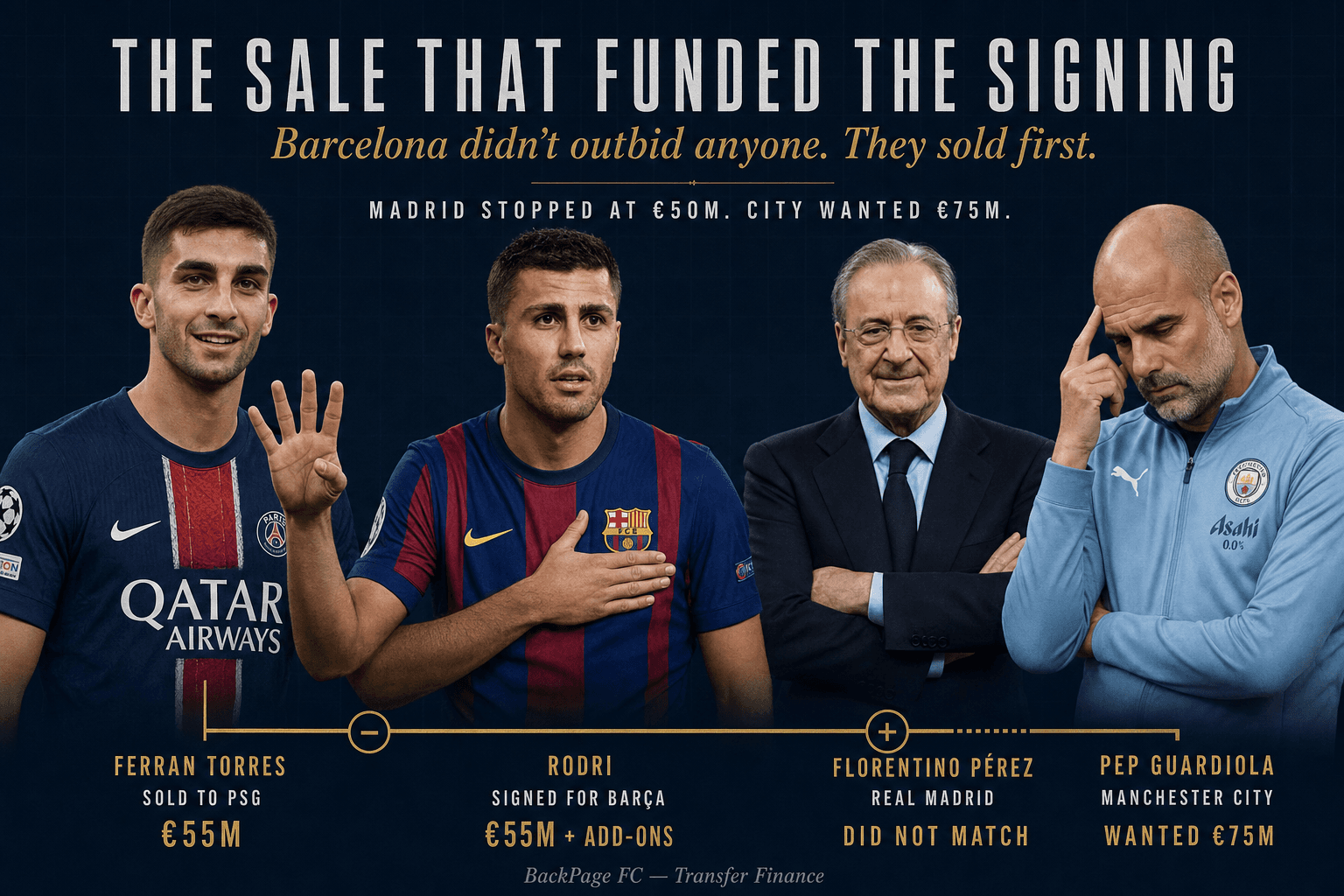
On Sunday 16 August 2026, Manchester City accepted Barcelona's third bid for Rodri. Two earlier offers had been rejected. The final package lands at roughly €76.5 million, with €60 million fixed, and the reigning Ballon d'Or winner will sign to June 2030.
The obvious reading is that Barcelona outmuscled Real Madrid for the best midfielder of his generation. That reading is wrong, and the actual story is a far better one for anyone who has followed our transfer-finance coverage this summer. Barcelona did not win a bidding war. Madrid never entered one. And the single move that made this transfer possible was not a bid at all. It was selling Ferran Torres to Paris Saint-Germain.
The Sequence, and the Fee Nobody Agrees On
The negotiation ran roughly two weeks, and it started because Rodri's representative approached Barcelona once Madrid stalled. A first offer under €50 million was rejected outright. A second was rejected. A third, tabled on Friday 14 August, closed it by the Sunday. Deco got it done in a fortnight.
The €60 million fixed fee is agreed across every account. The variable component is not, and the spread is genuinely large. Catalan outlet Ara reports €11.5 million in easily achievable add-ons plus a further €5 million conditional on Barcelona winning La Liga with Rodri playing over half the matches. COPE's Victor Navarro reported a different structure entirely: €65 million fixed plus €5 million. ESPN put the total package at €76.5 million, around £65.3 million. That is roughly €10 million of disagreement about how the same deal is built.
If you have read our piece on how release clauses and transfer structures actually work, that spread will not surprise you. We showed there how Wolves attached a three-instalment condition to Matheus Cunha's clause specifically to limit who could realistically trigger it, and how Chelsea paid Villarreal slightly above Nicolas Jackson's clause figure in exchange for friendlier payment terms. Fixed versus variable, and when the money actually lands, is frequently more important than the headline number. Which is why the same transfer can honestly be reported as €60 million and €76.5 million on the same afternoon.
One detail worth holding onto: City's directors had approved the sale before the Community Shield but deliberately withheld confirmation from Barcelona until after the final. Rodri, who cannot play at all after back surgery following the World Cup, was neither in the squad nor in the stands in Cardiff.
The Real Story: A Sale in Paris Bought a Signing in Barcelona
Here is the mechanism, and it is the whole article.
Barcelona entered this window back under La Liga's 1:1 spending rule, which means every euro they want to spend on wages must be matched by a euro generated. Their obstacle was never affording Rodri's transfer package. It was finding room under the salary cap to actually register him.
Selling Ferran Torres to PSG for a fee under €50 million generated roughly €40 million of net Financial Fair Play headroom. More importantly, it cut Barcelona's annual squad cost by about €21 million: roughly €11 million of remaining amortisation on his original fee, plus his €10 million gross salary coming off the wage bill. Mundo Deportivo identified that sale as the move that finally let Barcelona close the gap with City.
If you read our piece on how Squad Cost Ratio replaced PSR, this is the same logic in a Spanish accent. We argued there that the defining change in modern football finance is that clubs must now sell before they buy, because spending is pinned in real time to revenue rather than measured against a multi-year loss cushion. Newcastle proved it painfully, forecast at 98.5% of their squad cost limit and forced to sell Sandro Tonali and Anthony Gordon before doing anything else, a collapse we documented in our piece on the end of their project.
Barcelona just proved the same rule from the winning side. Sell first, buy second, and the sale that matters is the one that removes salary rather than the one that raises the biggest fee.
Barcelona did not find €76.5 million for Rodri. They removed €21 million a year from their wage bill by selling Ferran Torres, generated roughly €40 million of Fair Play headroom in the process, and used the space to register a Ballon d'Or winner. In 2026, the transfer that decides your window is often the one going out.
The Clause That Didn't Trigger, and the Price That Went Up
There is a delicious subplot here that ties directly to something we have written about at length.
When Ferran Torres left Manchester City for Barcelona in 2022, City protected themselves contractually. The deal entitled City to €8 million if Torres renewed at Barcelona, or up to €10 million if Barcelona sold him for more than €55 million. Neither triggered. The PSG fee came in under €50 million, just below the threshold. And Ara reports that City's directors responded by raising Rodri's asking price to recover the money they had just missed out on. Barcelona decline to confirm this.
Whether or not that specific claim is confirmed, the structure behind it is exactly what we set out in our piece on buyback clauses, sell-on clauses and matching rights. That article explained how Real Madrid built a system of contractual protections around academy players, how Manchester City learned the hard way after selling Cole Palmer to Chelsea with no buyback, no sell-on and no matching rights, and how City now clause up everything from James McAtee to Oscar Bobb.
The Ferran Torres clause is City doing exactly that, and it still did not pay out, because Barcelona's sale price landed on the wrong side of a €55 million line. City wrote the protection. Barcelona sold €5 million too cheap for it to fire. City's business is tracked on our Manchester City transfer records page.
Real Madrid Didn't Lose the Race. They Declined to Run It.
The framing everywhere is that Madrid were beaten to a galáctico. The evidence says something less dramatic and more interesting: Madrid never seriously wanted him.
For months, club sources insisted Rodri was not on the agenda. He was never on Madrid's midfield shortlist. Renewing Aurélien Tchouaméni was the club's vote of confidence in the in-house option. ESPN reported that Florentino Pérez had doubts over Rodri's injury record, while José Mourinho favoured signing a different profile entirely.
And when it came to price, the gap was never close. City set the asking price at €75 million. Madrid would go no higher than €50 million plus variables, citing the eleven months remaining on Rodri's contract and his injury history. City eventually dropped to €65 million. Madrid still did not move. Barcelona paid €60 million fixed in a package worth around €77 million.
That behaviour is entirely consistent with what we described in our piece on Madrid's free-transfer strategy: a club that has spent a decade building squads around expiring contracts and refusing to overpay for players entering their thirties. Rodri turns 31 next summer with eleven months on his deal. Madrid have made a career out of waiting in exactly that situation.
Pérez's caution also has a factual basis the "fell short" framing hides. Rodri tore his cruciate ligament in 2024-25 and was out for 220 days. He missed around twenty matches last season with two separate muscle injuries. He had back surgery after the World Cup. He cannot play for Barcelona yet and will not feature at the Joan Gamper Trophy against Al Ahly, the fixture originally targeted for his presentation.
What City Actually Lose: The Numbers Are Brutal
None of the above should obscure what Manchester City are surrendering, because at his peak Rodri was arguably the most statistically indispensable player in the Premier League.
Between his 2019 debut and September 2024, Rodri missed only 21 of City's 195 league matches. City's win rate was more than twelve percentage points lower in the games he sat out, and Opta's headline finding is the one that should worry Pep Guardiola most: City lost a third of the league games he missed, seven of 21.
In 2023-24 he was the only player in the entire Premier League averaging more than 100 successful passes per game, at 103. He took 126 touches per 90, twenty-four more than any City teammate. He led the division for open-play sequence involvements per 90 at 8.4. He became City's first ever Ballon d'Or winner in 2024, the first Spanish man to win it since 1960 and the first Premier League player since 2008.
He leaves after 298 appearances across seven seasons, having arrived from Atlético Madrid in 2019 for a then club-record £62.8 million. Trophy counts differ slightly by outlet, with Al Jazeera reporting 12 major honours and ESPN 13, including four Premier League titles, two FA Cups, three League Cups and the Champions League.
But That Peak Is Not the Present
Here is the honest counterweight, and it is why City were willing to sell at all.
The Rodri those statistics describe is the 2022-24 version. In 2025-26 he recorded 1,513 Premier League minutes, under seventeen full matches, with one goal and no assists, following a 2024-25 season lost almost entirely to the ACL tear. City are not selling the player who won the Ballon d'Or. They are selling a 30-year-old with eleven months left on his contract, a serious injury history, and recent back surgery, for around €76.5 million.
Framed that way, City's position looks considerably more rational, and Pérez's looks less like timidity than arithmetic. Barcelona are betting that a fit Rodri at 30 is still the best defensive midfielder in Europe. It is a real bet, not a formality, and the eventual verdict will rest on his body rather than his ability.
The Lesson Underneath the Headline
Strip away the names and this is a story about a rule. Barcelona could not sign Rodri until they had sold Ferran Torres, because La Liga's 1:1 rule ties registration to generated revenue. Newcastle could not keep Tonali because Squad Cost Ratio ties spending to income. Chelsea could break the British transfer record partly because missing Europe removed UEFA's stricter 70% cap, a mechanism we explained in our piece on why FFP only applies if you qualify. Manchester United have spent this window picking through mid-priced deals precisely because they did qualify.
Four clubs, four completely different summers, and in every single case the transfer story was really a compliance story. The Rodri deal is the clearest version yet, because the decisive move happened in Paris, involved a different player, and was an outgoing sale.
Next time your club signs someone, look at who left first. That is usually where the actual answer is.
Watch our full breakdown of how Barcelona funded the Rodri deal on BackPage FC Videos.
Barcelona sold Ferran Torres to sign Rodri, and Madrid refused to go past €50m for a 30-year-old with a serious injury record. Smart caution from Pérez, or the mistake of the window? Tell us below.