When we explained why PSR let the big six outspend everyone, the argument was about revenue: clubs with decades of Champions League commercial income could absorb losses that clubs like Newcastle simply could not. That was true. It was also only half the story, and the missing half is genuinely stranger than the part we already knew.
In 2024, Chelsea sold Chelsea Women to BlueCo, the company that owns Chelsea, for close to £200 million. Money moved from one pocket of the same trousers into the other, and it converted a loss into a £128.4 million profit in that year's accounts. They also sold two hotels beside Stamford Bridge to a sister company, generating £75.6 million that counted directly toward PSR compliance. Aston Villa sold 90% of Aston Villa Women to V Sports, the holding company that also owns Aston Villa, with the remaining 10% going to American investors, valuing the deal at £55 million. Everton transferred their women's team to a Friedkin-controlled company for a paper profit of around £60 million. All of it legal. All of it deliberate. All of it now banned.
Because from this season, PSR is gone. Premier League clubs voted to replace it with a Squad Cost Ratio system, and in doing so closed the exact loophole those three clubs had been using. Understanding what changed, and who it hurts, requires going back through everything we have covered this summer and reading it again with different maths.
Why PSR Was Never Really About Spending
This is the part that reframes our earlier explainer. PSR capped permissible losses at £105 million across a rolling three-year window. Read that carefully: it measured losses, not spending, and it measured them backwards across three completed years. It asked "how much money have you lost since 2022?" not "can you afford this squad right now?"
Several categories of cost could be added back and excluded from the calculation entirely, including infrastructure, youth development and women's football. And crucially, income from selling assets counted toward compliance, with no requirement that the buyer be an unconnected third party. So if your three-year accounts looked dangerous approaching a PSR deadline, you had a choice. You could sell a footballer, which weakens your team. Or you could sell a building, or an entire women's football club, to a company you already own, book the income, and comply without losing a single player.
Villa's move followed reported operating losses of roughly £195 million across 2022/23 and 2023/24. Chelsea's women's team sale manufactured a nine-figure profit out of an internal transaction. We covered the amortisation side of Chelsea's engineering in detail in our piece on Vision 30, where eight-year contracts spread transfer fees so thinly across the accounts that a £100 million signing showed up as roughly £12.5 million a year. Put the two mechanisms side by side and Chelsea's model becomes clear: minimise how much of a fee hits the books each year through long contracts, and manufacture profit when needed by selling assets to yourself. Neither was cheating. Both were reading the rulebook more carefully than everyone else.
The Premier League's vote to close the related-party loophole ends the second mechanism. The first, amortisation, still exists, though as we noted in our Vision 30 piece, UEFA already capped amortisation at five years for its own calculations.
Squad Cost Ratio: A Completely Different Question
SCR does not ask what you have lost. It asks what proportion of your football revenue you are spending on your squad, right now. Wages, transfer fee amortisation, agent fees and manager costs are added together and measured against actual football income. Domestically, the ceiling is 85% for clubs outside European competition. Breach it and a financial levy begins at that green threshold; go all the way to 115%, the red threshold, and points deductions become possible.
For clubs in Europe, UEFA's own squad cost rule sits on top at 70%, phased in at 90% in 2023/24, 80% in 2024/25 and 70% from 2025/26. The two systems run in parallel rather than one replacing the other, a gap that produces the strangest consequence of the entire financial framework, which we unpack fully in our companion piece on why FFP only applies if you qualify for Europe.
The Premier League's justification for the more generous 85% domestic threshold is competitive balance: clubs without European prize money get to spend a larger share of what they do earn. That sounds like help for smaller clubs. Follow it through and it is close to the opposite.
The Change Nobody Warned Newcastle About
Under PSR, a club could buy before it sold. If you believed a signing would generate future revenue, you could invest ahead of that revenue arriving and absorb the shortfall inside the £105 million three-year cushion. That is precisely how ambitious clubs historically closed gaps on established ones. Under SCR, that route is structurally impossible. Your spending is pinned in real time to income already through the door, which means you must sell before you buy. The cushion is gone, permanently.
Now reread everything we wrote this summer about Newcastle. In our piece on the collapse of their project, we tracked nearly £300 million of sales across three windows: Alexander Isak to Liverpool for a British-record £125 million, Anthony Gordon to Barcelona for £69.3 million, Sandro Tonali to Tottenham for £100 million. In our piece on Eddie Howe's resignation, we quoted his final words as manager: "We can't control the forces that are at play here." Here are the forces, with numbers attached.
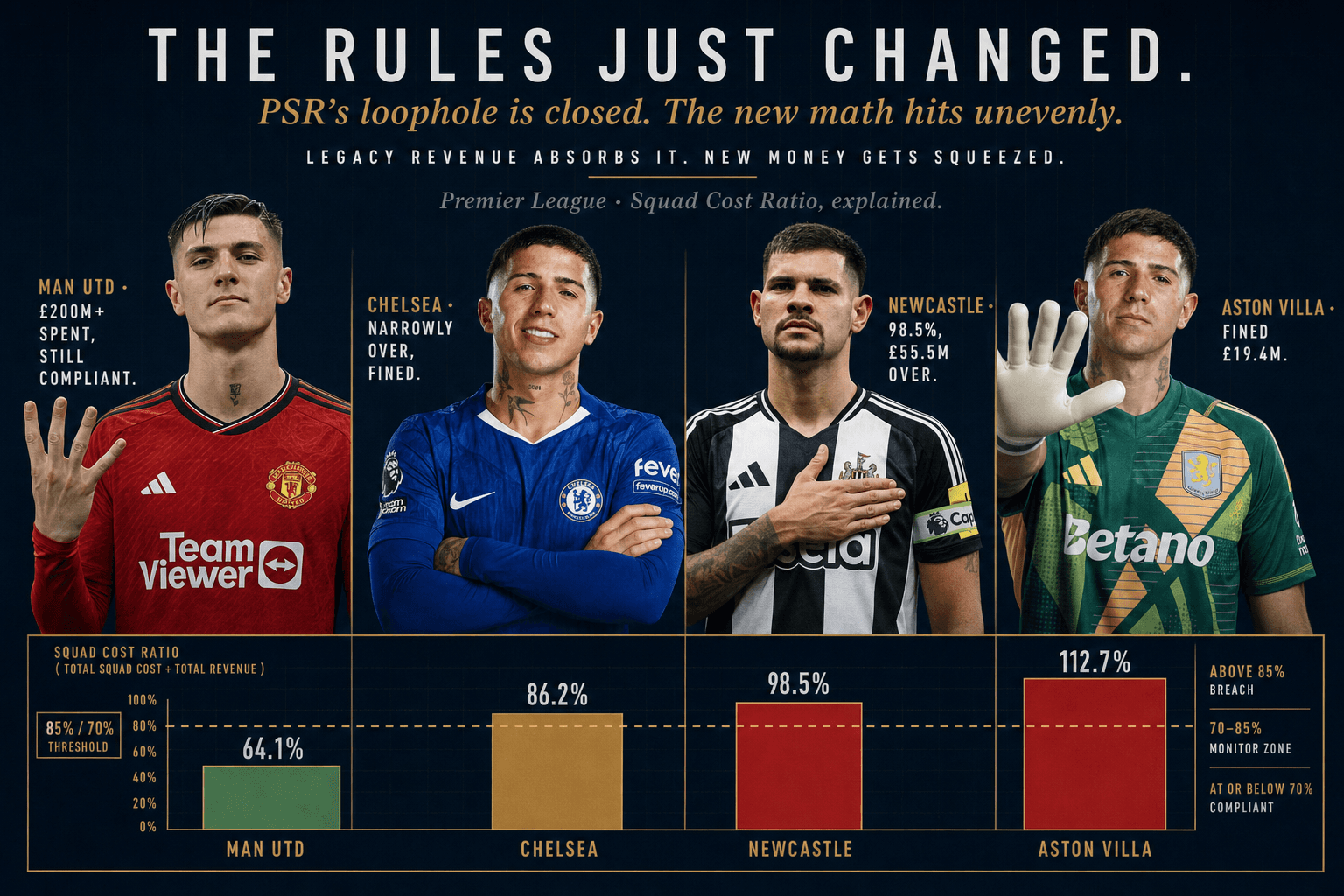
Newcastle's audited 2024/25 accounts were genuinely strong. Revenue of £335 million, wages of £243 million, a wage-to-revenue ratio of 72.6%, and a profit of £34.7 million. By any reasonable reading, a well-run football club. Then PSRwatch modelled their 2026/27 position under SCR: squad cost of roughly £404 million against football income of about £410 million. That is a 98.5% squad cost ratio, approximately £55.5 million above the 85% green threshold where the levy starts, though still £67.6 million short of the 115% red threshold that triggers points deductions.
A club that posted a £34.7 million profit is forecast at 98.5% of its permitted squad cost. That is not a contradiction; it is two rule systems asking two different questions and getting two different answers about the same football club. And the sales we documented, Gordon, Tonali, Bruno Guimarães on the brink of Arsenal, all follow directly from the second answer rather than the first. Newcastle's full record is on our Newcastle transfer records page.
The cruellest detail: Newcastle publicly supported replacing PSR with SCR, because PSR had put the brakes on them. They campaigned for the cage they are now sitting in.
Newcastle posted a £34.7 million profit and a 72.6% wage-to-revenue ratio in their audited accounts. Under the new rules, the same club is forecast at 98.5% of its squad cost limit, £55.5 million over the threshold. Nothing about the football changed. Only the question being asked changed, and the answer cost them their manager and three of their best players.
Barcelona: The Same Rule, Seen From the Winning Side
Newcastle show what sell-before-you-buy looks like when it goes against you. Barcelona showed the opposite in the same month, and it is worth understanding because the mechanism is identical even though the league is different.
La Liga runs a salary cap rather than a ratio, with clubs in full compliance able to reinvest euro for euro under its 1:1 rule. Barcelona wanted Rodri from Manchester City. The obstacle was never the transfer fee; it was finding room to register his wages. So they sold Ferran Torres to PSG, which generated roughly €40 million of net Fair Play headroom and, crucially, removed around €21 million a year from their squad cost: roughly €11 million of remaining amortisation plus a €10 million gross salary. Then they signed Rodri for €60 million fixed in a package worth around €76.5 million. We broke the whole deal down in our piece on how Barcelona actually funded the Rodri transfer.
Same principle, opposite outcome. Newcastle sold Tonali and Gordon because they had to and got nothing back. Barcelona sold Ferran Torres because they wanted something specific, and converted the space into a Ballon d'Or winner. Under real-time spending rules, the outgoing transfer is no longer the consolation. It is the strategy.
Villa: The Club That Sold Its Women's Team and Still Got Caught
Aston Villa are the fullest illustration of the trap, because they used the loophole and it still was not enough. Villa sold 90% of their women's team for £55 million to survive PSR domestically. Then UEFA confirmed they had breached the squad cost ratio anyway, spending approximately £252 million on wages and transfers against revenue of £257.7 million, comfortably above even the transitional 80% limit that applied at the time.
The fine was €22.5 million, roughly £19.4 million, for what UEFA classified as a significant breach. That is a club that took the most aggressive accounting step available to it, complied domestically, and was still hit with the largest recent squad cost penalty in English football, because the underlying problem was never the accounts. It was that spending had outrun revenue, and SCR measures exactly that. Villa's window activity is tracked on our Aston Villa transfer records page, including the Morgan Rogers sale to Chelsea and the Youri Tielemans release clause activation we broke down in our piece on how clubs discover release clauses, both of which read very differently once you understand what Villa's ratio needed.
Chelsea Breached Too. It Cost Them Almost Nothing.
Chelsea's own June 2026 statement, published on the club's website, confirmed that the 70% UEFA threshold for calendar year 2025 was narrowly exceeded and a fine would be paid. The penalty: €3 million, roughly £2.58 million, with €2 million suspended. Against Villa's £19.4 million, the gap is not subtle.
Analysts noted Chelsea's breach demonstrates how structurally demanding the 70% rule is even at their revenue scale, given the wage and transfer commitments accumulated since 2022. That is fair. It is also true that a £2.58 million fine, mostly suspended, did nothing to slow the window we documented in our piece on Xabi Alonso tearing up the BlueCo model: a British-record signing, plus Maxence Lacroix, plus the first players aged 35 and over signed since the takeover in Danny Welbeck and Jordan Henderson.
Set the two summers beside each other. Chelsea broke a financial rule, paid what amounts to a rounding error, and broke the British transfer record. Newcastle followed every rule and lost their manager, their record signing and their best winger. Both outcomes are the system working exactly as written.
Manchester United: £200m Spent, Still Compliant, Still on a Tightrope
United's summer passed £200 million: £62.5 million for Matheus Cunha from Wolves, £65 million for Bryan Mbeumo from Brentford, and a fee rising to £73.3 million for Benjamin Sesko from RB Leipzig. Analysis concluded they remain compliant, but are walking a financial tightrope that depends on sustained wage management and continued commercial growth.
That single sentence contains the whole argument. United can spend £200 million in one window and stay inside a ratio, because the denominator, decades of accumulated commercial revenue, is large enough to absorb it. Newcastle cannot spend at all without breaching, because theirs is not. Both clubs are following the same rule to the letter. The Cunha deal, incidentally, was the release clause structure we detailed in our release clause piece, where Wolves deliberately made the payment terms complex enough that only the largest clubs could realistically trigger it. United's business is tracked on our Manchester United transfer records page.
What This Means for Everyone Below the Top
Put the whole picture together and the conclusion is uncomfortable. Chelsea and Manchester City built their squads before the financial framework tightened. United built theirs across decades of commercial dominance. Those revenue bases are now permanently embedded in the denominator of every SCR calculation, and there is no longer a legal mechanism for any club to invest its way past them.
Not owner wealth: Newcastle's Saudi backing is the largest in the sport and made no difference. Not creative accounting: the asset-sale route is closed. Not investing ahead of revenue: SCR forbids it by design. Not even a trophy and a Champions League campaign, which Newcastle delivered and which still left them selling.
The rule genuinely applies equally to everyone, and that is precisely the problem. Telling every club it may spend 85% of its revenue sounds like fairness until you notice that United's 85% and Hull City's 85% describe two entirely different football clubs. Hull's austerity gamble, which we examined in our piece on their refusal to follow the promoted-club playbook, looks very different once you understand that promotion itself pushed them into a stricter regulatory bracket and forced them to sell their first-choice goalkeeper before 1 July.
There is one route left, and it is the one we described in our piece on Real Madrid's buyback, sell-on and matching rights clauses: manufacture profit through player trading rather than asset sales, and retain the upside on players you cannot afford to keep. Chelsea have been doing it for years through academy sales. Madrid have industrialised it. It is now, effectively, the only lever left that the rules still permit.
Next time your club sells a player it obviously did not want to sell, you will know exactly which spreadsheet made that decision. It was not the manager's.
Watch the full breakdown of how Squad Cost Ratio replaced PSR and what it means for your club on BackPage FC Videos.
Chelsea sold their women's team to themselves for £200m and it was legal. Now it's banned, but the replacement may lock the hierarchy in permanently. Is Squad Cost Ratio fairer than PSR, or just a better-looking cage? Tell us below.