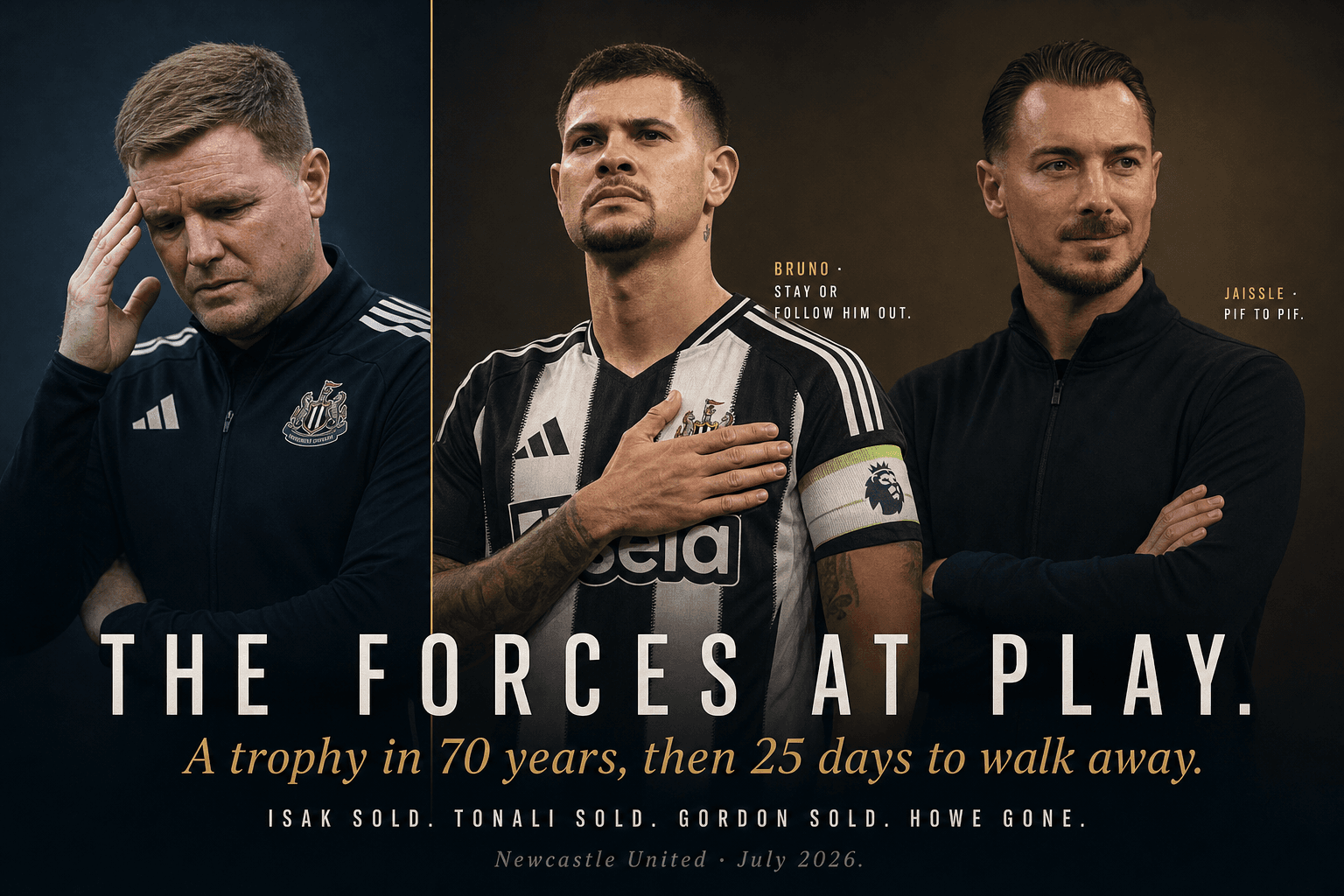
Eddie Howe stood in front of the cameras at Ashton Gate on Wednesday night, his Newcastle side just beaten 4-1 by a Championship team, and was asked whether he had been given assurances about his squad. "What will be, will be," he said. "We can't control the forces that are at play here." Less than twenty-four hours later, he was gone. Five years at St James' Park, ended not by a sacking or a scandal but by a manager looking at what remained of the team he built and concluding, with the season opener against Liverpool just twenty-five days away, that the forces at play had already won. The wider financial machinery behind that surrender is the subject of our companion piece on how PSR collapsed Newcastle's entire project. This is the story of the man himself, what he built, what was taken from him, and why he chose this exact moment to walk.
What Howe Actually Built: From 19th to a Trophy in 70 Years
Remember where this started. November 2021: Newcastle 19th, winless, freshly taken over, and Howe, the former Bournemouth manager whose stock had dipped, handpicked by the new ownership as the man to save them. He did more than save them. An 11th-place finish became fourth place in 2022-23, the club's first Champions League qualification in twenty years, and one of the great modern St James' Park nights, a 4-1 demolition of Paris Saint-Germain in the group stage. It became a Carabao Cup final in 2023, lost to Manchester United, and then the one that mattered: March 2025, Wembley, Newcastle 2-1 Liverpool, Dan Burn and Alexander Isak on the scoresheet, the club's first domestic trophy in seventy years. Burn's goal in that final is woven through both our pieces on his journey from released academy kid to England international and his outsized value in a PSR-squeezed squad. Howe took a relegation candidate and gave a fanbase seventy years of waiting its release. That is the ledger he leaves with, whatever came after.
The Season That Broke It: 12th, Sunderland Twice, Barcelona 8-3
Then came 2025-26, the season the project's foundations gave way. Isak had already gone, sold to Liverpool for a British-record £125 million, the sale that still headlines Newcastle's transfer record and Liverpool's record signings simultaneously. Without him, Newcastle slid to 12th. They were beaten twice by newly promoted rivals Sunderland, a double humiliation on Wearside and Tyneside that no supporter will forget quickly. Their Carabao Cup defence died against Manchester City in the semi-finals. And their return to the Champions League ended in an 8-3 aggregate destruction by Barcelona in the Round of 16, the night the gap between the project's ambition and its PSR-constrained reality stopped being deniable. Howe spent months afterwards reflecting on his future and concluded he could still take Newcastle forward, on one condition: that the club recruited well this summer. Instead, the club sold.
The Summer That Ended It: Tonali, Gordon, and the Kids
Sandro Tonali went to Tottenham for £100 million, instantly becoming Spurs' record signing and the anchor of the De Zerbi rebuild we detailed in our piece on Tottenham's record-breaking summer. Anthony Gordon went to Barcelona for £69.3 million. In their place arrived Bazoumana Touré, a 20-year-old winger, Sean Steur, an 18-year-old midfielder, and Ewen Jaouen, a 20-year-old goalkeeper, promising footballers, none of them remotely ready to replace what left. Howe, by his own admission after the Bristol City defeat, had lost authority over transfer matters entirely. A manager who was told the project would match his ambition watched the hierarchy replace £170 million of proven Premier League quality with teenagers, and understood exactly what it meant: the club he signed up to build no longer existed. The 4-1 at Ashton Gate did not cause the resignation. It simply removed the last excuse not to see it.
"What will be, will be. We can't control the forces that are at play here." Eddie Howe, hours before resigning, describing his own football club. He was handpicked by the owners in 2021. He delivered a trophy seventy years of Newcastle supporters never saw. And in the end, the forces at play sold Isak, Tonali and Gordon over his head, and he walked before they could sell his captain too.
Bruno, the Captain Left Behind
Which brings the story to Bruno Guimarães, the £35 million signing from Lyon in January 2022 whose full Newcastle arc we told in our pieces on the captain who believed Newcastle could win the league and the Arsenal pursuit that has shadowed this entire summer. Howe's final message as Newcastle manager was a public plea for Bruno to stay, praising the respectful way his captain has handled Arsenal's interest, a pointed contrast to the acrimony of Isak's exit a year earlier. Now the calculus has flipped in both directions at once. Arsenal's talks, running through intermediary Kia Joorabchian, may collapse because Newcastle cannot possibly sanction a fourth marquee departure in the same window their manager resigned. Or they may accelerate, because the man who was Bruno's biggest reason to stay just cleared his desk. Either way, the mechanics of how such a deal would actually trigger are exactly what we broke down in our piece on how release clauses and transfer discovery really work.
Jaissle: The PIF-to-PIF Appointment
Newcastle's succession plan tells its own story. Matthias Jaissle, 38, is expected to be appointed within days, arriving from Al-Ahli of the Saudi Pro League, a club owned, like Newcastle, by the Public Investment Fund. Jaissle's coaching pedigree is genuine: two Austrian Bundesliga titles at Red Bull Salzburg, back-to-back AFC Champions League Elite titles in Saudi Arabia. But the profile is unmistakable. A young, system-driven coach from within the ownership's own ecosystem, comfortable developing talent rather than demanding it, arriving to manage a squad of Tourés and Steurs rather than Isaks and Tonalis. Howe was hired to chase the big six. Jaissle is being hired to make peace with not catching them, at least not through spending. The contrast with what Chelsea are simultaneously doing under Xabi Alonso, tearing up their own youth-first model to sign proven veterans, which we cover in our piece on the BlueCo model's dramatic reversal, could not be starker. Two clubs, same rulebook, opposite directions.
The Legacy Question
Howe leaves at 48, reportedly planning time away from management, with a record no Newcastle manager of the modern era approaches: one major trophy, two top-four finishes, a Champions League return after twenty years, and a club transformed from punchline to power before finance dragged it back. His departure is described as amicable, and the wheels had been turning for weeks before the Bristol City match made it public. History will be kind to him on Tyneside, kinder than the ending suggests, because supporters can distinguish between a manager who failed and a manager who was failed. The question that follows him out the door is the one this entire summer has posed: if a project with the richest owners in world football, a beloved manager, and a seventy-year trophy drought finally broken can be unwound in three transfer windows, what exactly is the point of ambition outside the big six? Howe never answered it. He just stopped pretending the answer was coming.
Eddie Howe gave Newcastle their first trophy in 70 years and walked away 25 days before the season because the club sold his team over his head. Was resigning the right call, or should he have stayed and fought? Tell us below.