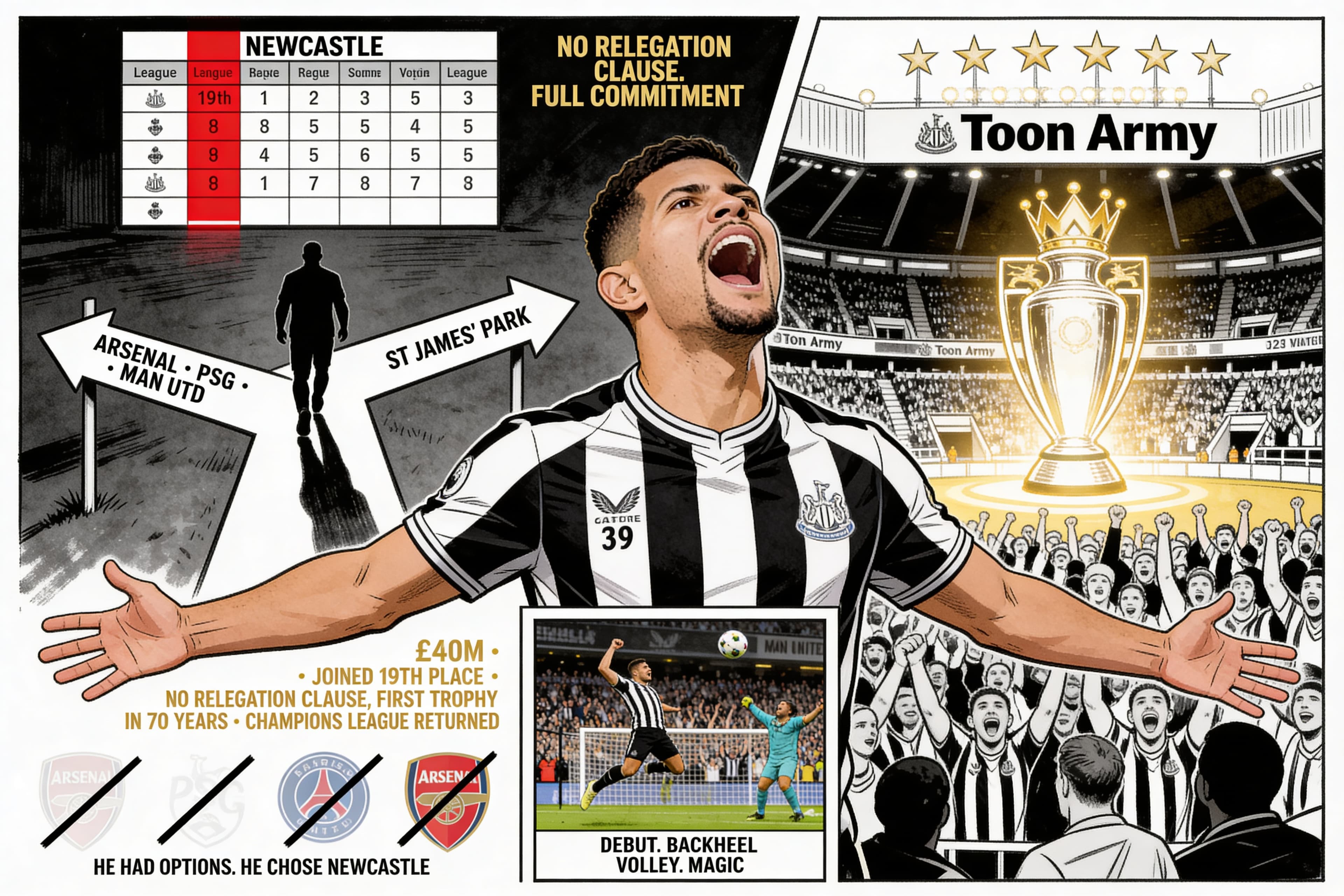
This is Part Two of our series on players who were made for their clubs. If you missed the Bukayo Saka episode, read it here first. Because the story of Bruno Guimarães begins at almost exactly the same moment as Saka's was reaching its first peak — and what Bruno did in January 2022, given the options he had and the circumstances he walked into, is one of the most remarkable transfer decisions a top-level footballer has ever made.
A Player Europe Wanted
Before the story of Newcastle, there is the story of why Newcastle seemed so improbable. Bruno Guimarães arrived at Lyon from Athletico Paranaense in January 2020 for €21.5 million, and within a year had established himself as one of the most complete midfielders in Ligue 1. Box-to-box, technically precise, aggressive without being reckless, with a passing range that made him look like a player who belonged in a larger arena. He was nominated for the Samba d'Or award — given annually to the best Brazilian player in European football — in both 2020 and 2021, competing against players of the calibre of Neymar, Casemiro, and Philippe Coutinho. Neymar won both editions. But the fact that a 23-year-old midfielder at Lyon was in that conversation at all told you exactly what level of player European clubs were tracking.
And they were tracking him. Arsenal were the most seriously interested, having publicly declared their need for a central midfielder and internally identifying Bruno as a primary target. Paris Saint-Germain and Manchester United had also monitored him. Reports at the time suggested Arsenal expected to make a formal bid in the summer of 2022. They had the profile sorted, the interest established, and the timeline planned. The problem was that someone else moved in January, and that someone else was a club nobody in European football had expected to become relevant again quite so fast.
Newcastle: Bottom of the Table, No Relegation Clause, Full Commitment
To understand what makes Bruno Guimarães' arrival at Newcastle special, you need to understand the precise situation that club was in when he signed. The Saudi-led Public Investment Fund consortium had taken over Newcastle United from Mike Ashley in October 2021 for around £305 million. Eddie Howe had been appointed as manager in November. The club had not won in any of their first 14 league matches — a record that, at the time, meant every club in Premier League history that had failed to win their opening 14 games had been relegated. No Premier League side in history had ever avoided relegation from such a position. At the turn of the year, Newcastle sat 19th — one point off bottom-placed Norwich, with just 11 points from 19 games.
Into this situation, on 30 January 2022, arrived Bruno Guimarães. Newcastle paid Lyon £40 million — £33 million initial plus around £6.5 million in add-ons — and crucially, no relegation clause was inserted into Bruno's personal contract. Sky Sports confirmed this at the time, noting it as remarkable given the circumstances. Relegation clauses are standard practice for players signing for clubs in trouble: a pre-agreed release fee, triggered if the club goes down, allowing the player to leave for a reduced price and avoid the Championship. It protects the player's market value. It is, by any measure, sensible. Bruno did not want one.
He joined a club that no team in Premier League history had ever escaped from in the same position. He had no relegation clause. On his first full start, he scored a backheel volley. Three years later he lifted the Carabao Cup as captain. The story writes itself — but it only works because Bruno wrote the first chapter.
The significance of that decision becomes clearer when you consider what a relegation clause would have meant in practice. Had Bruno signed with standard player protections and Newcastle been relegated, Arsenal — who had the relationship with his representatives, the money, and the need — could have signed him in the summer for a reduced pre-agreed fee. It would have been a textbook exit from a sinking ship. Instead, Bruno told Newcastle — a club rooted to the bottom of the table with one win in 19 games — that he was in, unconditionally. He said at his presentation that he really believed Newcastle could win the Premier League one day. A team in 19th said that. Those words, at that moment, did more for the club's rebuild than any tactical decision.
The First Start. The Backheel. The Statement.
Eddie Howe — showing the long-term thinking that would define his entire management of the club — did not immediately throw his £40 million signing into a relegation scrap. Bruno made five brief substitute appearances across his first six weeks. Then, on 10 March 2022, came the first start. Away at Southampton, St Mary's Stadium, a game Newcastle needed to win to meaningfully distance themselves from the bottom three.
With the score level at 1-1 in the 53rd minute, a corner was swung into the Southampton box. Dan Burn headed it across goal. Bruno Guimarães, back to the net, two defenders around him, took the ball on his heel and volleyed it backwards and into the roof of the net. BBC Sport described it as combining power, precision and sheer audacity. Newcastle won 2-1. The away supporters went ballistic. Bruno received a standing ovation when he was substituted in the 66th minute — not because he left the pitch, but because of what he had given to it in under an hour of his full debut.
The goal earned him a nomination for Newcastle's Goal of the Season award — a notable achievement for a player in his first start. More important was the context. The goal came at a moment when Newcastle's survival was genuinely uncertain, when the margin between a footnote in relegation history and a turning point in the club's modern era was as thin as it had ever been. Bruno scored on his first real appearance, in his most important game so far, having made the most committed possible choice to be there in the first place. It was the perfect beginning.
The Season That Changed Everything
Newcastle finished the 2021-22 season in 11th place — contributing five goals and an assist in his half-season. Eddie Howe became the first Premier League manager in history to keep a club up after they had failed to win any of their opening 14 games. It was a remarkable achievement for the manager, for the squad, and for the January signings — Trippier, Wood, Bruno — who had changed the entire character of the dressing room in a single window.
What followed across the next two seasons was the most dramatic sustained improvement by any Premier League club in the competition's modern history. In 2022-23, Newcastle finished fourth — qualifying for the Champions League for the first time since 2002-03. In 2023-24, they reached the Champions League group stages. Bruno was the engine of all of it: his physicality in midfield, his ability to win the ball and immediately transition into attack, his capacity to control games against top-level opposition. The £100 million release clause inserted into his contract renewal in 2023 told the market what Newcastle thought he was worth — and what they needed any potential buyer to pay before the conversation could even begin.
Captain. Trophy. History.
In 2024-25, Bruno Guimarães was appointed Newcastle captain for the first time. The significance of that moment was enormous. In a dressing room that now contained international players from across Europe and South America, the Brazilian who had arrived to a relegation battle was the choice to lead the rebuild to its next destination.
On 16 March 2025 at Wembley, Newcastle beat Liverpool 2-1 in the Carabao Cup final. Dan Burn headed Newcastle in front. Alexander Isak put the game beyond doubt after the break. Federico Chiesa pulled one back in stoppage time, but the result held. Newcastle had won their first major domestic trophy in 70 years — their last had been the FA Cup in 1955 against Manchester City. Bruno Guimarães, as captain, lifted the trophy at Wembley. He had said at his presentation three years earlier that he wanted to put his name in history. He had done exactly that.
An estimated 300,000 Newcastle supporters poured onto the streets of the city for the open-top bus parade. Bruno called it the best day of his life. He said that for the fans, it felt like winning the World Cup. He mentioned that Alan Shearer — the greatest Newcastle player in living memory — had texted him before the final. The symbolism was not subtle: the Brazilian who had chosen a relegation battle in January 2022 had, within three years, become the kind of Newcastle player whose name would be linked alongside the legends the club has produced across its history.
Why This Story Matters
The story of Bruno Guimarães at Newcastle is, at its core, a story about a choice. In January 2022, he could have waited for Arsenal. He could have accepted a relegation clause and kept his options open. He could have made the sensible, career-protecting decision. Instead, he signed without a safety net, committed to a project that had no guarantee of success, and said publicly — with a straight face and evident sincerity — that he believed the team he was joining could win the Premier League one day.
That choice, made at the right moment with the right sincerity, changed the direction of the entire club. It gave confidence to the dressing room. It gave the fan base something to believe in beyond the financial power of the new owners. It signalled to every subsequent signing that Newcastle was a club a serious player could choose — not out of necessity, but out of genuine ambition. As we explored in our breakdown of Real Madrid's transfer playbook, the most powerful thing in football recruiting is not the fee — it's the narrative a player buys into. Bruno Guimarães did not buy into Newcastle's narrative. He created it.
Three years after arriving to a team that no club in Premier League history had survived from being in the same position, the Brazilian midfielder is still there — captain, trophy winner, and the single most important figure in the most surprising sporting rebuild English football has seen in a generation. The Geordie faithful sing that he is one of them. The feeling, from everything he has said and done since January 2022, is entirely mutual.
Which other player do you think has made a similarly selfless, committed choice for their club — giving up a bigger stage to be part of something special? And who should we cover next in this series? Let us know in the comments. 👇