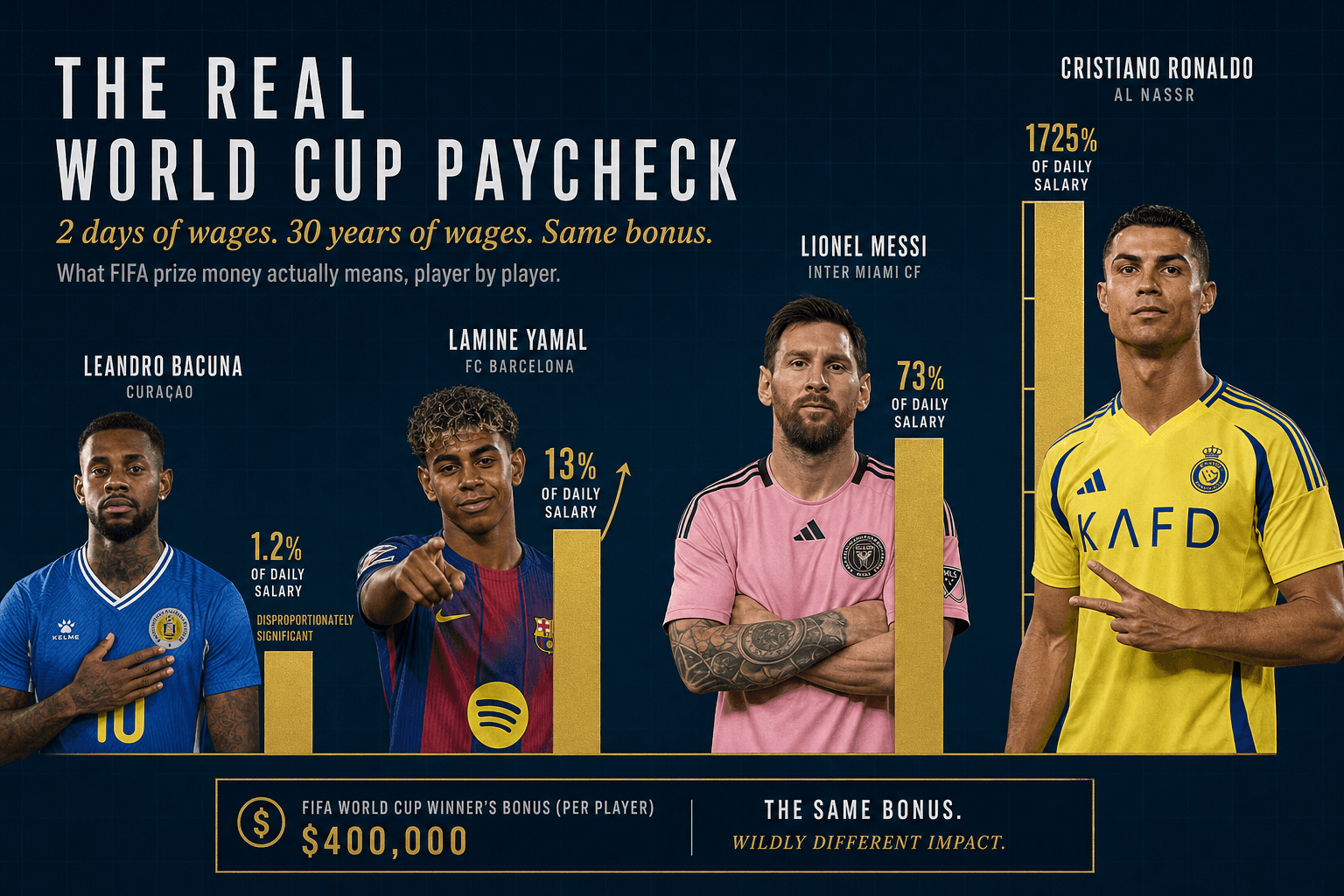
Cristiano Ronaldo earns his entire World Cup winner's bonus in less than two days working for Al-Nassr. That single comparison, confirmed by financial analysts tracking the 2026 tournament, captures something our previous coverage of player earnings, documented in full in our piece on this tournament's highest-paid sponsorship earners, deliberately left out: what FIFA and national federations actually pay players specifically for competing at the World Cup, separate entirely from club salaries and brand endorsements. The two figures tell completely different stories, and understanding the gap between them is the specific detail BackPage FC exists to surface.
The Club Benefit Programme: How Clubs Get Paid for Releasing Players
FIFA operates a Club Benefit Programme that pays clubs a fixed daily rate for every day a player spends away on World Cup duty, an agreement negotiated directly with the European Club Association. At the 2022 tournament, that rate was confirmed at roughly $21,000 per player per day, split proportionally between every club a player represented over the preceding two years. For 2026, that programme paid out $355 million in total to clubs whose players featured across the expanded 48-team tournament, a figure covered separately in our piece on FIFA's Club Protection Programme and Manuel Ugarte's injury compensation. This money goes to clubs, not players directly, compensating them for the wages they continue paying a player while he is unavailable for domestic football.
What Players Actually Receive: The Federation Split
Once FIFA's tournament prize money reaches a federation, it is typically split according to internal agreements between the association and its players, with the champion's $50 million performance tier commonly divided so that a player on the winning squad receives approximately $400,000, though the exact structure varies considerably by country. France reportedly offered their squad roughly $586,000 per player had they won the 2022 tournament, a specific figure that illustrates how widely these internal bonus structures differ even among wealthy federations. Argentina's approach, confirmed by financial analysts, follows the same general model: Messi does not receive a separate World Cup salary from the Argentine federation. Instead, he earns AFA match appearance fees plus a share of FIFA's prize money distribution to players, typically estimated at 20 to 30 percent of the federation's total payout, on top of any additional AFA-specific match bonuses.
Ronaldo's World Cup winner's bonus, if Portugal had lifted the trophy, would have been earned back in under 48 hours at his regular Al-Nassr salary. The same approximate $400,000 figure represents more than thirty years of domestic wages for a player from Curaçao. FIFA pays every squad from the same fixed prize pool. What that money actually means to the player receiving it depends entirely on where he is from.
The Curaçao Comparison That Puts Everything in Perspective
The specific value of a World Cup bonus payment only becomes meaningful once measured against a player's normal earnings, and the gap here is enormous. As financial analysts tracking the tournament noted, a $400,000 winner's share represents over thirty years of domestic salary for a player from Curaçao, the nation we documented in full in our piece on Curaçao becoming the smallest nation ever to reach a World Cup. The same comparison extends to the managers: Carlo Ancelotti's reported salary at Brazil is nearly one hundred times greater than Dick Advocaat's annual earnings coaching Curaçao, according to salary-tracking analysts, even though both men managed at the exact same tournament, competing under the exact same FIFA prize structure.
Messi's Actual 2026 Earnings Picture
Forbes estimated Messi's total annual earnings at $140 million for 2026, a figure built from his Inter Miami contract, his joint venture with Apple TV and MLS reportedly worth around $50 million per year according to The Guardian, and long-standing commercial partnerships including Adidas. His specific World Cup match fees and prize-money share from the AFA are, by comparison, a genuinely marginal addition to that total, confirming that for a player of Messi's stature, the tournament itself functions primarily as a stage for commercial and legacy value rather than a meaningful direct paycheck.
Ronaldo's Al-Nassr Baseline
Cristiano Ronaldo topped the 2026 World Cup earnings list, his Al-Nassr contract alone reportedly worth in the region of €200 million per year, a sum so large that his World Cup match fees and any Portuguese federation bonus become a rounding error by comparison. As we detailed in our piece on why football's earlier legends earned far less than today's stars, Ronaldo's specific position at the top of this list reflects three decades of accumulated commercial value that no amount of World Cup match fees could meaningfully move either way.
Yamal: The Newest Member of Football's Earnings Elite
Lamine Yamal, at 18, became the youngest top earner in World Cup history, with estimated total annual earnings between €16 and €21 million depending on the source, built from his Barcelona contract and a rapidly expanding endorsement portfolio. As we documented in our piece on Spain's youth development system, Yamal's specific commercial rise happened faster than almost any player in the sport's history, arriving inside football's genuine financial elite before his own World Cup-winning performance in the final against Argentina had even been played. His specific federation match fees from the RFEF, like Messi's from the AFA, represent a small fraction of his overall earnings picture, but his entry into this bracket at all, this young, is itself the story.
Where the Real Money Sits
The consistent pattern across every player examined here is the same: World Cup-specific pay, whether from FIFA's Club Benefit Programme, a federation's internal prize-money split, or individual match appearance fees, is real money, genuinely significant for players outside football's wealthiest bracket, but a small fraction of what already defines football's biggest earners. For a Curaçao squad member, that $400,000 hypothetical bonus would have represented a genuinely life-changing sum. For Ronaldo, Messi and even Yamal, the tournament's actual financial significance lies almost entirely in what it does for their existing commercial value, not in what FIFA or their federation directly deposits into their accounts.
Ronaldo earns his World Cup bonus in two days at his club salary. The same figure represents 30 years of wages for a player from Curaçao. Does this gap change how you think about what the World Cup actually means financially to different players? Tell us below.