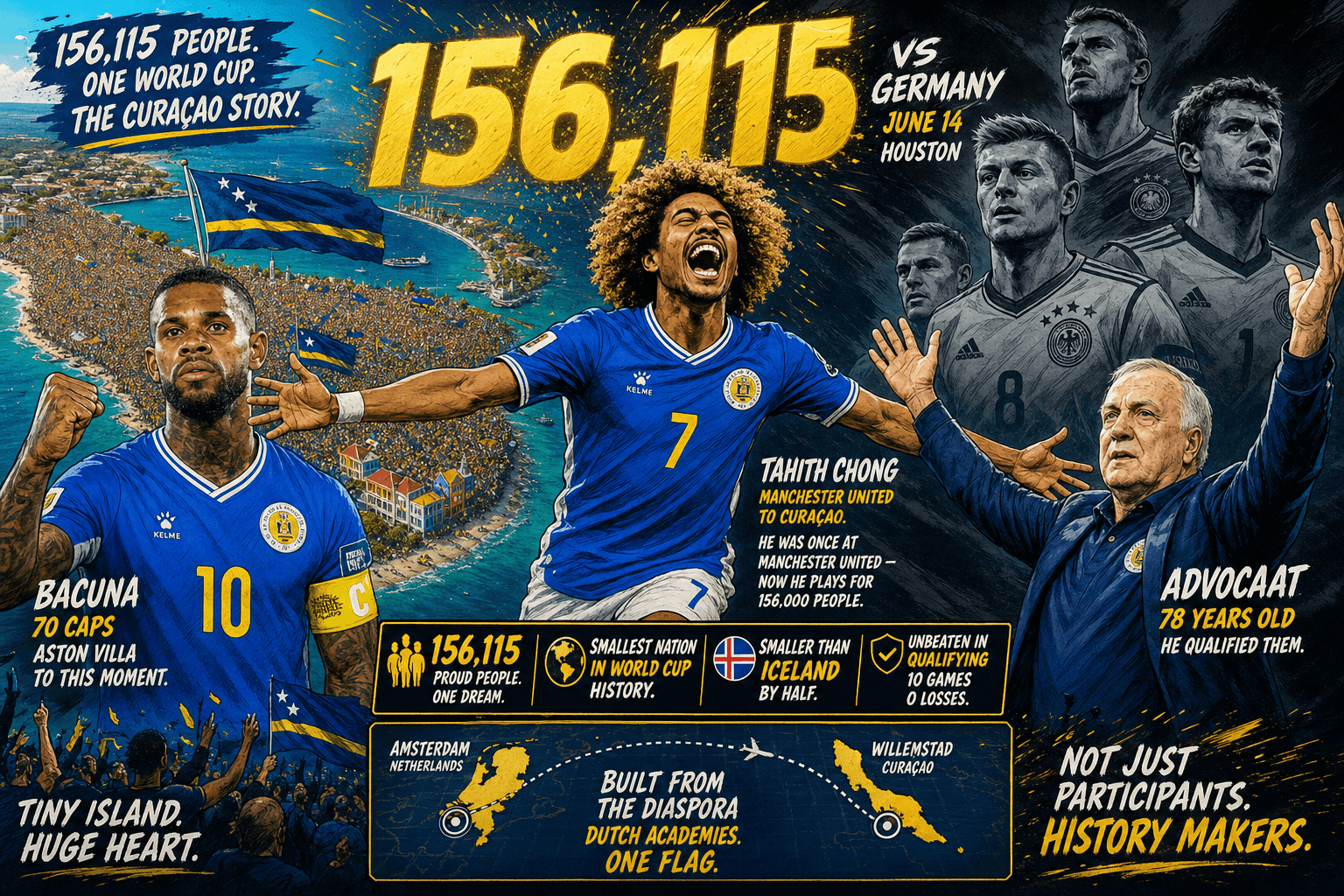
Imagine the version where it does not happen. An island of 156,115 people — smaller than Coventry, smaller than Exeter — attempting to qualify for the largest sporting event on earth. A country that technically stopped existing in 2010. A coach who was not even in the stadium for the decisive qualifying match. A squad almost entirely born in another country. A World Cup group containing four-time world champions Germany. That is not the version where something goes wrong. That is the version where everything went right. And on 18 November 2025 in Kingston, Jamaica, in a goalless draw with 90 minutes of suffocating defensive tension, the impossible was confirmed. Curaçao are going to the World Cup.
Willemstad, 2010: The Country That Stopped Existing
The story of Curaçao football begins not with a goal but with a dissolution. On 10 October 2010, the Netherlands Antilles — a political union of six Caribbean islands in the Kingdom of the Netherlands — ceased to exist after 55 years. Curaçao, Sint Maarten, Bonaire, Sint Eustatius, Saba, and Aruba had been bound together since 1954. That binding ended. For most purposes, the dissolution was an administrative event of interest primarily to constitutional lawyers and Dutch politicians. For football, it created something accidental and consequential: a new national team.
Curaçao assumed the Netherlands Antilles' FIFA membership and inherited its historical records, stretching back to 1921. It also inherited a FIFA ranking deep in the 180s — their lowest ever was 188th, recorded in December 2003. The first senior international under the new name was played on 18 August 2011, a 1-0 defeat to the Dominican Republic in San Cristóbal. Nobody beyond the Caribbean paid attention. Nobody was supposed to. A country had just been born on paper. On a football pitch, they were starting from almost nothing.
What makes the fifteen years that followed remarkable is not just the destination — the World Cup in 2026, first in the nation's existence — but the deliberate, specific architecture that produced it. Curaçao did not stumble into football relevance. They engineered it.
The Dutch Pipeline: How Curaçao Built From the Diaspora Down
The island is 444 square kilometres. It sits 60 kilometres off the coast of Venezuela in the southern Caribbean. Its population of 156,115 is scattered across a landscape defined more by industry — oil refining, tourism, finance — than by football infrastructure. There are no development academies producing players at the standard that major European nations require. There are no professional clubs competing at continental level. The pipeline that would normally feed a national team simply does not exist in Curaçao itself.
What does exist, through a quirk of colonial history, is a significant Curaçaoan diaspora in the Netherlands — and through that diaspora, access to one of the finest football development systems in Europe. The majority of Curaçao's current squad are Dutch-born, holding Curaçaoan heritage that makes them eligible to represent the island under FIFA eligibility rules. Many spent years in Dutch youth systems, some representing the Netherlands at age-group level before switching allegiance.
Captain Leandro Bacuna is the model. He made 116 appearances for Aston Villa in the Premier League, played for Cardiff City, and represented Dutch youth teams before committing to Curaçao. His brother Juninho Bacuna switched allegiance from the Netherlands to Curaçao in 2019 at 21 — a decision he described as significant, given his age and the years remaining ahead of him to challenge for a Dutch senior call-up. He chose the island instead. Tahith Chong made his choice even more recently. He had spent years at the edges of Dutch international contention: a handful of appearances for Manchester United, moves through Werder Bremen, Club Brugge, and Luton Town. He switched international allegiance to Curaçao in 2025. In his second cap, he scored twice. He will play against Germany this summer.
The model became clear over a decade: Curaçao could not build from the island upward because the infrastructure did not exist. So they built from the diaspora downward — identifying professionals with Curaçaoan heritage scattered across Dutch academies and lower European leagues, reclaiming them under one badge, and constructing a team that was technically professional without being locally produced. It was unconventional. It was also the only viable route.
Ten years ago Curaçao were 150th in the FIFA world rankings. Today they face Germany at a World Cup. The gap between those two facts is not talent falling from the sky. It is a deliberate, structural decision to find that talent in Dutch academies and bring it home under a different flag.
Dick Advocaat at 78: The Man Who Said Yes When Others Said No
In football management terms, a job with a Caribbean nation ranked outside the top 100, with limited federation resources and a long-running payment dispute between players and officials, is not an attractive proposition. Van Marwijk considered it and retired. Van Gaal was approached and declined. Then Dick Advocaat said yes.
Advocaat was 75 when he took the job. He is one of the most respected Dutch managers of his generation: he took the Netherlands to the 1994 World Cup quarter-finals, managed PSV Eindhoven, Rangers, Zenit St. Petersburg, Belgium, and South Korea — whom he guided through the 2006 World Cup. He had retired from club management. He chose to un-retire to lead 156,115 people toward their first World Cup. The decision, in hindsight, was either eccentric or visionary. It was both.
He resolved the payment dispute first — refusing to begin work until the federation honoured its obligations to the players. Then he built. The qualifying campaign that followed was defined by organisation, defensive discipline, and the kind of collective belief that is difficult to manufacture and impossible to fake. Curaçao finished the CONCACAF final round unbeaten — 3 wins, 3 draws, 0 defeats — with 12 points and first place in Group B ahead of Jamaica, Trinidad and Tobago, and Bermuda.
The decisive moment came in Kingston on 18 November 2025. Curaçao needed a draw against Jamaica to clinch. Advocaat was not there — he had returned to the Netherlands for family reasons. His assistant managed the touchline. His players managed the ninety minutes. The goalless draw held. The final whistle was followed by scenes of extraordinary emotion: players who had spent most of their careers in English third divisions and Turkish second divisions and Malaysian leagues collapsing onto a foreign pitch, realising that they had just done something no squad in Curaçaoan history had ever done before. They had qualified for the World Cup without their manager. They had done it anyway.
Kingston to Houston: The Moment Advocaat Found Out About Germany
The 2026 World Cup draw was held in Miami on 5 December 2025. Curaçao were placed in Group E alongside four-time world champions Germany, Ecuador, and Ivory Coast. It was, on any objective measure, one of the hardest possible groups a debutant nation could have drawn. Germany have won the World Cup in 1954, 1974, 1990, and 2014. Ecuador are ranked in the top 50. Ivory Coast are among the most talented squads in Africa.
Advocaat's public response at the draw was memorable. He called it the craziest thing he had achieved in a nearly four-decade managerial career. Then he offered something more considered: the best game to play against Germany, he said, was the first game — because Germany is a team that gets better as a tournament progresses. He was not playing down expectations. He was looking for the angle. At 78 years old, after qualifying the smallest nation in World Cup history, he looked at Group E and found one.
He would not take them to the tournament himself. In early 2026, Advocaat stepped down from the position due to his daughter's illness. Fellow Dutchman Fred Rutten — who had previously managed Feyenoord, PSV Eindhoven, and Schalke 04 — was appointed as his replacement. Rutten immediately recalled Tahith Chong and others to the squad for March friendlies against China and Australia, putting his own mark on the group while preserving the structure Advocaat had built. The project was bigger than any single manager. Rutten understood that. The players understood it. The island understood it.
The Squad: Professionals From Dutch Academies, Playing for a Caribbean Flag
All of Curaçao's starting eleven against Jamaica in the decisive qualifier were born in the Netherlands. Read that sentence again. The smallest nation in World Cup history — an island in the Caribbean — qualified for football's biggest tournament with an entire starting lineup born in another country. That fact alone tells you everything about how this team was constructed and why it works.
Captain Leandro Bacuna, 34, brings 70 international caps — joint-most in Curaçao history alongside goalkeeper Eloy Room. His career took him through Dutch academies, into English professional football with Aston Villa (116 appearances) and Cardiff City, and now to the Turkish second division. This is his World Cup. He has waited his entire career for a stage this large.
Goalkeeper Eloy Room played for Columbus Crew in Major League Soccer. Riechedly Bazoer made 51 appearances for Ajax and is now at Konyaspor. Armando Obispo plays for PSV Eindhoven — the same club where he was a teammate of Sergiño Dest and Ricardo Pepi. Shurandy Sambo played alongside them too. Jürgen Locadia spent time at FC Cincinnati, Brighton, and is now at Miami FC. The squad ranges across Greece, Israel, England, Turkey, the United States, and Malaysia. These are not superstars. They are honest professionals who made decisions about which flag to carry and, when given the chance, carried it all the way to a World Cup.
And then there is Tahith Chong. The 26-year-old attacking midfielder made a handful of appearances for Manchester United before moves through Werder Bremen, Club Brugge, and Luton Town. He switched allegiance to Curaçao in 2025. In his second cap, he scored twice. He is now at Sheffield United. He will play against Germany. The former Red Devil, on the game's biggest stage, wearing a Caribbean flag. Football produces few stories stranger or better than this one.
Houston, June 14: Germany vs Curaçao — The Match That Defines the Story
The fixtures, confirmed by UEFA and CONCACAF, run as follows. 14 June: Germany vs Curaçao, NRG Stadium, Houston, Texas. 21 June: Ecuador vs Curaçao, Arrowhead Stadium, Kansas City, Missouri. 25 June: Curaçao vs Ivory Coast, Lincoln Financial Field, Philadelphia.
The Germany match is the one that matters most to the story, even if the Ecuador and Ivory Coast games matter more to Curaçao's chances of progressing. Germany are ranked in the top six in the world. They have four World Cup titles. They arrive at this tournament with Jamal Musiala and Florian Wirtz as the creative spine — two of the most technically gifted players in European football. The gap in squad depth, financial resources, and collective experience between the two nations is not just large. It is almost unmeasurable.
And yet. Advocaat said the best time to play Germany was the first game. His logic was sound: Germany are historically slow starters at tournaments and improve as they build confidence. If Curaçao can make that first game uncomfortable, compact, and disruptive — if they can frustrate for 45 minutes and then survive — the tournament begins to open in unexpected ways. Against Ecuador and Ivory Coast, Curaçao have genuine chances. Ecuador are talented but not formidable. Ivory Coast have quality but have historically under-delivered at tournaments. A point from either game, combined with a disciplined performance against Germany, would be an achievement that the sport would remember for decades.
Realistically, Curaçao are here to compete, not to progress. But the same was said about Iceland in 2016 at the Euros, when they beat England 2-1 and eliminated them from the tournament. The same was said about Iceland in 2018 at the World Cup, when they held Argentina to a draw in their opening match with 352,000 people watching at home. Curaçao have less than half Iceland's population. They have the same absolute willingness to defend, suffer, and find something on the counter-attack. They have the same sense that being here at all is already the victory.
The Numbers That Require No Embellishment
Population of Curaçao: 156,115. Population of Germany: 84 million. That ratio — one playing the other on June 14 — is the largest population gap between two World Cup opponents in the tournament's history. Previous record for the smallest World Cup nation: Iceland, 2018, population 352,000. Curaçao's margin below that record: more than half of Iceland's entire population. The third-smallest qualifying nation at this tournament is Cape Verde, with 525,000 people. Curaçao are not just the smallest. They are smaller than the smallest by a margin that makes the record feel almost qualitatively different.
CONCACAF qualifying record: 10 matches played, 7 wins, 3 draws, 0 defeats across both rounds. Goals scored in the second round alone: 15 across 4 matches. Final round: 12 points, first in Group B, only unbeaten team in the group. FIFA ranking in approximately 2016: 150th. FIFA ranking at the 2026 World Cup: 82nd. A climb of nearly 70 places in a decade. Years as an independent footballing nation: 15. World Cup appearances: 1. Their first is on June 14, 2026, in Houston, Texas, against Germany. The manager who qualified them was 78 years old. He will not be on the bench for the first game. His players will be.
Why This Story Is Not Just About Football
The mainstream coverage of Curaçao at this World Cup will call them the minnow, the underdog, the charming story from a small island that nobody knew about. That framing is not wrong. It is just incomplete. The real story is more complicated and more interesting than the underdog narrative allows.
The Netherlands Antilles ceased to exist in 2010. A new country — Curaçao — inherited a football team with a FIFA ranking in the 180s and no professional infrastructure. In the fifteen years that followed, the federation made a specific, deliberate decision: they would not wait for the island to produce talent. They would go to where the talent already existed — Dutch football academies, Dutch youth leagues, Dutch professional clubs — and reclaim it. They would find every player with Curaçaoan heritage who had spent years trying to break into Dutch squads, present them with an alternative, and build a national team from the diaspora backward rather than from the island forward.
Players who chose Curaçao did not do so because they had no other options. Juninho Bacuna was 21 when he switched, with years ahead of him to pursue Dutch senior honours. Tahith Chong had spent years in the Dutch development system and at one of England's most famous clubs. They chose the island not because it was the only door available but because it was the door they wanted to walk through. That choice — repeated across a squad of professionals scattered across European football — is what makes this story more than sport.
As we explored in our piece on how Real Madrid built dominance through the Bosman strategy — signing players whose connections to a club or country ran deeper than their contract — the most powerful force in football is not money or infrastructure. It is a player who believes in a project enough to make an irreversible decision. Curaçao built their World Cup qualification on exactly that force: professionals who chose the flag of an island with 156,000 people over the flag of a nation with 17 million.
In the summer of 2026, in a stadium in Houston that holds 72,000, fourteen times Curaçao's entire professional football infrastructure will face four-time world champions. The result, almost certainly, will not go Curaçao's way. But the scoreline will not be the story. The story began in Willemstad, in 2010, when a country ceased to exist and a football team decided to build something from nothing. It continued in every Dutch academy where a player with Curaçaoan heritage was quietly approached. It reached its peak in Kingston on 18 November 2025, when eleven players born in the Netherlands held on for ninety minutes without a manager on the touchline, and qualified for the World Cup for the first time in history.
Nothing that happens in Group E can undo what they have already done. June 14, Houston, Germany. 156,115 people. One World Cup. The story is already written. The ending is still to come.
Curaçao face Germany on June 14 in their first-ever World Cup match. Can they get a point from Group E — and which game do you think gives them the best chance? Let us know in the comments. 👇