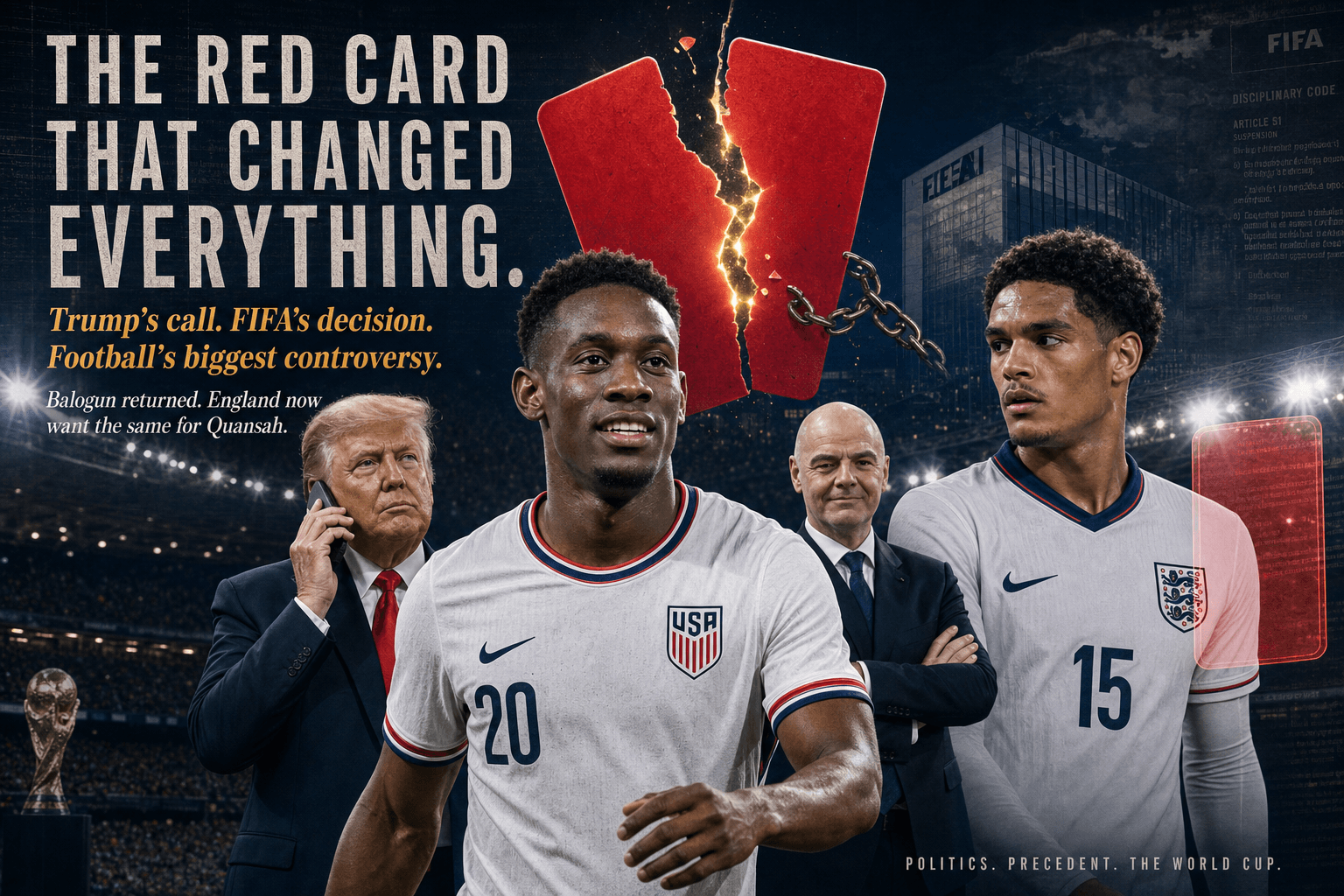
For the first time in more than 60 years of World Cup football, FIFA suspended a red card mid-tournament — and it happened because the President of the United States picked up the phone. Folarin Balogun's one-match ban was lifted after Donald Trump personally called FIFA president Gianni Infantino, a decision that let Balogun play against Belgium, enraged the Belgian federation, and has now left England quietly wondering whether they could use the same playbook to get Jarell Quansah back for their quarter-final against Norway.
How Balogun Ended Up in the Middle of a Political Storm
The original incident was straightforward enough, at least on the surface. Balogun received a red card in the USA's 2-0 win over Bosnia and Herzegovina after a video review showed his foot raking down the ankle of Tarik Muharemović, twisting it awkwardly during a challenge that looked innocuous at full speed but considerably worse in slow motion. Balogun himself later admitted he thought a yellow card "would have been fair" rather than the red he received, a rare instance of a player publicly softening his own defence even while benefiting from the suspension being lifted anyway. Under FIFA's own regulations, that red card triggered an automatic one-match suspension, barring Balogun — the USA's leading scorer at the tournament — from the Round of 16 tie against Belgium.
That should have been the end of it. Instead, Trump confirmed on the Monday of the Belgium match that he had called Infantino directly to ask for the suspension to be reviewed. "I asked for a review because I didn't think it was a foul," Trump told reporters. "I didn't know what the hell a red card was." FIFA suspended the ban within a day, allowing Balogun to start against Belgium, and then rejected an appeal from the Royal Belgian Football Association hours before kickoff, ruling it "inadmissible" on procedural grounds. Trump later took what he called a victory lap on social media, thanking FIFA for "doing what was right, and reversing a great injustice," a post that only added fuel to a controversy that was already spreading well beyond football media.
The Backlash Was Immediate and Unusually Unified
Reaction from across the entire sport was scathing and came fast. UEFA released a statement saying the decision "crossed a red line," arguing that an automatic suspension following a red card "is not a discretionary option" and cannot be subject to exception "in the middle of a tournament." The Belgian federation said it still had not received any explanation for the reversal, accusing FIFA of inventing an appeal process on the spot and giving Belgium only a few hours to respond to it.
Former players and pundits piled on. Wayne Rooney called the decision "an absolute disgrace," saying Infantino should be ashamed. Jürgen Klopp, never shy of a strong opinion, said plainly that if Trump and Infantino really had worked the decision out between themselves, "that's crazy. It calls everything into question." England manager Thomas Tuchel, whose own player would become collateral damage in the story within days, said he simply didn't understand who had the authority to overturn a VAR-confirmed red card, or where that process would end.
"Who overturns this decision then, and when? And on what grounds? How far does this go now? This is strange for me." — Thomas Tuchel
The Ronaldo Precedent FIFA Had Already Set
The frustrating part for critics is that FIFA did not actually invent this kind of leniency for Balogun — it had already used the same mechanism on the tournament's biggest name months earlier. Cristiano Ronaldo was sent off for elbowing Republic of Ireland defender Dara O'Shea during Portugal's second-to-last World Cup qualifier in November 2025, a violent conduct red card that carries a standard three-match ban under FIFA's Disciplinary Code. That would have cost Ronaldo Portugal's final qualifier and the first two games of his record sixth World Cup.
Instead, FIFA's Disciplinary Committee invoked Article 27 of its own code, which allows a judicial body to "fully or partially suspend the implementation of a disciplinary measure." Ronaldo served the mandatory first match of his ban in Portugal's final qualifier, a 9-1 win over Armenia, and FIFA then deferred the remaining two matches for a one-year probationary period, clearing him to start the World Cup on schedule. FIFA justified the leniency partly on the grounds that it was Ronaldo's first-ever red card in 226 international appearances, a rationale that drew criticism at the time but nowhere near the fury that followed the Balogun decision.
There is an important difference between the two cases, though. Ronaldo's reprieve was decided by FIFA's own disciplinary process roughly seven months before a ball was kicked at the World Cup, using a standing article of the code that had also previously been applied to players like France's Laurent Koscielny, Croatia's Mario Mandžukić and the Netherlands' Phillip Cocu in past tournaments. Balogun's reversal, by contrast, was announced within a single day, in the middle of a live knockout tournament, and came only after a phone call from the sitting U.S. president — which is precisely why UEFA, Belgium and figures like Klopp and Rooney treated it as a fundamentally different, and far more troubling, kind of decision.
Quansah's Red Card Raises the Same Question
The awkward part for FIFA is that the Balogun precedent landed right in the middle of England's own tournament. Jarell Quansah was sent off for a dangerous sliding tackle on Mexico's Jesús Gallardo during England's dramatic 3-2 win at the Azteca, a result built around Jude Bellingham's brace and a Harry Kane penalty, achieved despite England playing the final 40 minutes with ten men. Quansah's red card triggers the same automatic one-match ban that Balogun's originally did, ruling him out of England's quarter-final against Norway — unless FIFA is willing to apply the same standard it used for the American striker.
Tuchel was asked directly after the Mexico game whether England might lobby Trump to intervene on Quansah's behalf. His answer, only half in jest, was that it "might be a good starting point" — a comment that captured the mood around the tournament perfectly. If a phone call from the White House was enough to overturn a suspension for the co-host nation's own player, the question of why the same courtesy would not extend to any other team's red card is one FIFA has conspicuously failed to answer with any consistency. English tabloids speculated about whether informal channels might be explored before the Norway tie, though nothing beyond Tuchel's joke has been reported as an actual approach to anyone in government.
The comparison matters because Quansah's dismissal was, in the eyes of most pundits, considerably clearer-cut than Balogun's. A dangerous sliding tackle drew far less sympathy across British football media than the ambiguous ankle-twisting contact that got Balogun sent off in the first place, which makes the idea of England receiving similar leniency look even less likely on the actual football merits, whatever the political appetite for it might be. That imbalance, between a clear precedent-setting decision and a much harder case to argue on its own facts, is exactly the kind of inconsistency UEFA warned about when it called the original decision a breach of the tournament's rule of law.
FIFA's own defence, offered by Infantino himself, was that the organisation's judicial committees operate independently and "decide cases based on the applicable regulations and the specific facts before them" — a line that satisfied almost nobody once Infantino also confirmed the Trump phone call had actually taken place. Former FIFA president Sepp Blatter, who resigned amid corruption allegations in 2015 and rarely misses a chance to weigh in on his old organisation, joined the criticism as well, describing the episode as a breach of ethical standards and a dangerous precedent for a governing body to set mid-tournament. Belgium, for its part, said it had informed U.S. Soccer that it contested Balogun's eligibility to play at all, "leaving all further actions open" — a pointed reference to the possibility of a future appeal to the Court of Arbitration for Sport in Switzerland, which remained on standby throughout the tournament for exactly this kind of urgent case.
Why This Broke Almost 60 Years of Precedent
Automatic suspensions following a red card have been a fixture of World Cup regulations for generations precisely because they are supposed to be beyond argument. FIFA World Cup 2026 Circular No. 16 states plainly that a player sent off "will automatically be suspended from their team's subsequent match," with no built-in appeals mechanism for the team receiving the card, let alone for a third party head of state. That is the entire point of an automatic sanction: it removes discretion, and with it removes the possibility of political or financial pressure influencing who plays in the biggest matches of the tournament.
Once that removed, the Balogun case became less about one player's ankle-twisting challenge and more about what happens to a 96-year-old institution's credibility when the world's most powerful head of state decides a football decision personally offends him. Trump had stayed almost entirely silent on football matters for the first 24 days of the tournament, according to CNN's own analysis, making his sudden intervention in a routine disciplinary matter all the more jarring for football's governing bodies to process in real time.
A Relationship Years in the Making
None of this happened in a vacuum. Infantino and Trump have cultivated a close public relationship for years, dating back to a 2020 dinner at the Davos economic summit where Infantino reportedly called Trump "my great friend." That relationship deepened dramatically around this World Cup: Infantino awarded Trump FIFA's inaugural Peace Prize at the tournament draw in Washington in December 2025, telling him on stage that he could "always count" on FIFA's support, and FIFA has since opened office space inside Trump Tower in New York. Fifty members of the European Parliament sent FIFA a letter demanding the organisation's ethics committee investigate the Peace Prize award, arguing it raised serious questions about FIFA's political neutrality.
Infantino has publicly defended the closeness of the relationship as a practical necessity, arguing that FIFA needs cordial ties with the leader of a host nation to manage a tournament of this scale, one that requires federal cooperation on visas, security and logistics across three countries. Critics see it differently: CNN's own reporting noted that the arrangement is especially uncomfortable given that it was the FBI, the U.S. Justice Department and the IRS who exposed FIFA's biggest corruption scandal back in 2015, making the current warmth between FIFA's leadership and the White House a notable reversal of that history. Trump is expected to help present the World Cup trophy himself on July 19, a detail that will only sharpen scrutiny of the Balogun decision as the tournament reaches its climax.
What This Means Heading Into the Quarter-Finals
Balogun's reprieve did not even work on the pitch. The USA lost 4-1 to Belgium regardless, a result BackPage FC covered in full in our piece on the USA's elimination and Pochettino's uncertain future, meaning the entire controversy generated maximum political noise for a footballing outcome that changed nothing about the USA's tournament. That imbalance — enormous institutional damage to FIFA's credibility in exchange for a player who barely affected the result — is likely to be remembered as the defining lesson of the episode.
For England, the practical stakes are higher. Quansah's absence for the Norway quarter-final removes a defender who had been a fixture in Tuchel's back line, and unless FIFA moves to apply the Balogun precedent consistently, England will simply have to adapt without him. Whether any federation actually tries to use political channels to intervene in a refereeing decision again, at this World Cup or any future one, may now depend entirely on how badly this particular episode continues to damage FIFA's reputation over the final two weeks of the tournament.
It is also worth remembering that Infantino has already committed publicly to Trump helping present the World Cup trophy at MetLife Stadium on July 19, a symbolic gesture that was planned well before the Balogun controversy erupted but which now carries considerably more weight given everything that has happened since. Every image of the two men together for the remainder of this tournament will be read, fairly or not, through the lens of a red card decision that FIFA still has not fully explained to the two federations directly affected by it, and that has already reshaped how closely every subsequent refereeing call at this World Cup will be scrutinised.
Should FIFA apply the same standard to Quansah's red card that it applied to Balogun's?