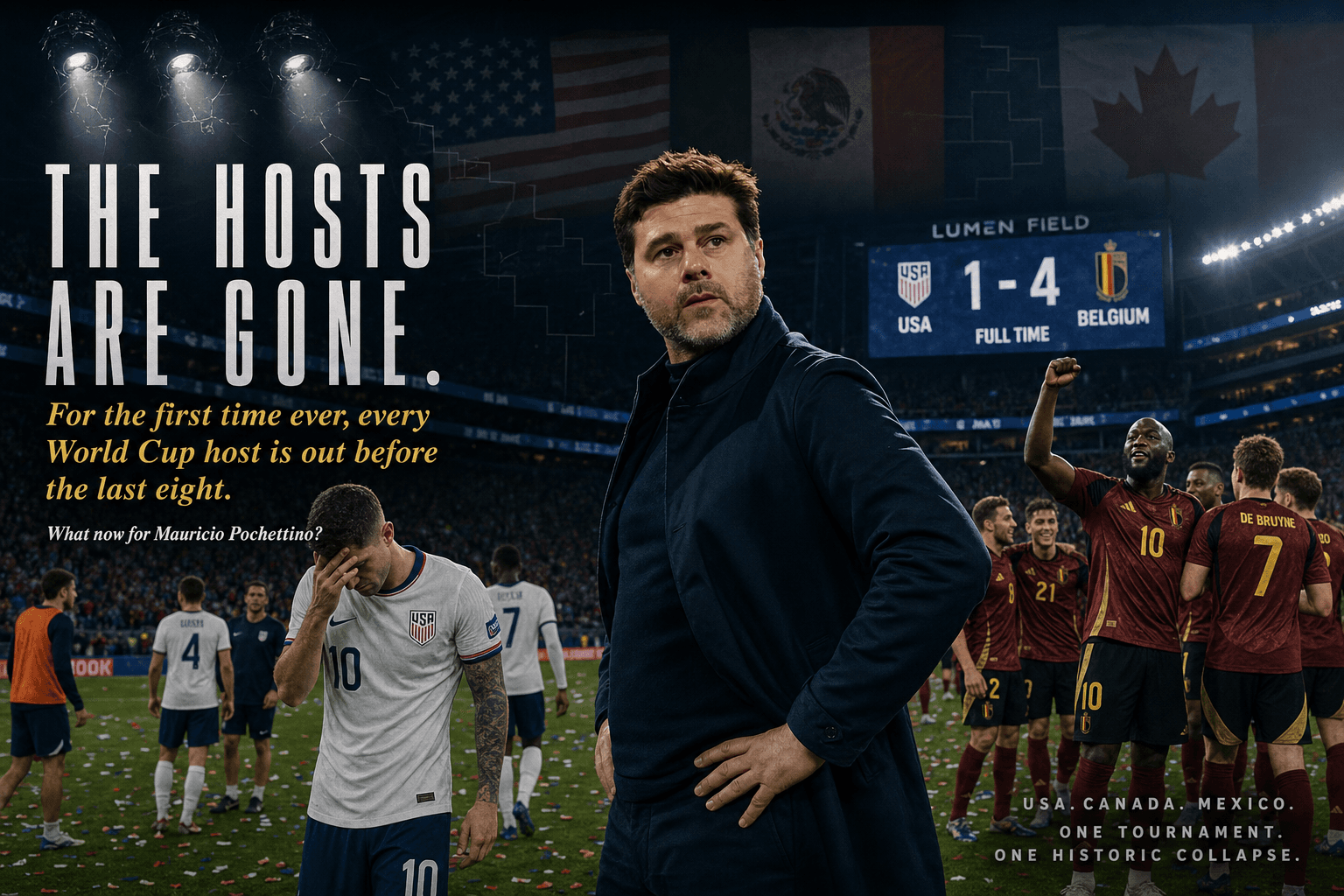
For the first time in World Cup history, all three co-host nations are out before the quarter-finals. Canada fell 3-0 to Morocco, Mexico lost 3-2 to England at the Azteca, and now the United States have followed them home after a 4-1 Round of 16 defeat to Belgium in Seattle — a result that leaves Mauricio Pochettino's future, and the wider promise of this USMNT generation, hanging in the balance.
How the USA's Exit Actually Happened
There is also a broader context worth acknowledging: this was the biggest and most expensive World Cup ever staged across North America, played in front of record crowds exceeding 3.6 million spectators by the end of June, with expectations for the co-hosts correspondingly enormous. That scale made the collective failure to produce even one host nation in the quarter-finals sting considerably more than a similar exit might have in a smaller, single-host tournament.
Belgium made home advantage look irrelevant. Charles De Ketelaere scored twice inside the first 33 minutes, sandwiched around a Malik Tillman equaliser that briefly gave the crowd hope, before Hans Vanaken pounced on a goalkeeping error from Matt Freese to make it 3-1 in the 57th minute. Romelu Lukaku, coming off the bench, added a fourth in stoppage time to complete a chastening night for the co-hosts. It was the USA's fourth Round of 16 exit in the last five World Cups, a pattern that raises real questions about whether this generation is actually progressing or simply repeating the same ceiling.
The defeat also ended the United States' run as the last of the three co-hosts standing, following Canada's exit to Morocco and Mexico's narrow loss to an England side reduced to ten men after Jarell Quansah's red card. It is the first time in World Cup history that all three host nations of a single tournament have been eliminated before the last eight, a statistic that will sting for a region hoping the biggest World Cup ever staged, with a record 3.6 million-plus in attendance by the end of June, would also be the one where a host nation finally broke through.
The Balogun Shadow Over the Belgium Game
Belgium themselves had topped a group featuring New Zealand comfortably before edging Senegal in the Round of 32, so their run to the quarter-finals, where they now face Spain, was hardly a surprise even if the manner of the USA's defeat was more one-sided than most had predicted heading into the tie.
The build-up to the Belgium match had already been consumed by the controversy over Folarin Balogun's red card, rescinded after President Trump personally called FIFA president Gianni Infantino to request a review — a decision UEFA called a breach of a "red line" in football's disciplinary regulations and that Belgium's own federation called a direct contradiction of the tournament's rules. Balogun did play against Belgium, but the American attack managed just seven shots to Belgium's fifteen, and the striker's leading role in the tournament could not translate into a breakthrough performance when it mattered most.
Whatever the merits of the original red card, the controversy meant the USA arrived at their biggest game of the tournament having spent days fielding questions about political interference rather than tactics. It is impossible to know how much that affected preparation, but it is not the ideal build-up to a knockout tie against a team that had already shown, in eliminating Senegal from 2-0 down in the Round of 32, that it thrives when written off.
All three World Cup co-hosts eliminated before the quarter-finals for the first time in the tournament's history.
Pochettino's Uncertain Future
Mauricio Pochettino, brought in with the same ambition to transform a program that defined his time in the Premier League with Chelsea before this USMNT role, declined to discuss his future after the Belgium defeat, saying it was not the moment to talk about contracts. His deal with U.S. Soccer runs out at the end of this tournament, and while the federation has reportedly offered him a four-year extension through the 2030 World Cup, talks have stalled amid the uncertainty of exactly how this tournament would end for the co-hosts.
Pochettino's résumé at Southampton, Tottenham, Paris Saint-Germain and Chelsea means a return to top-level club football remains a live option, and he has already been linked with vacancies at AC Milan, a rumour he only partially denied by noting his agents "need to do their job." A return to Tottenham, who appointed Roberto De Zerbi in March, is off the table. What is clear is that U.S. Soccer views him as a genuinely transformational figure for the sport domestically, and CEO JT Batson has spoken publicly about the federation's determination to keep him beyond this cycle, whatever offers arrive from elsewhere.
The parallel with Carlo Ancelotti's position at Brazil, another elite club manager parachuted into an international job under enormous pressure to deliver a home-continent tournament and then eliminated earlier than expected, is not lost on anyone covering this World Cup. Both men were hired for their pedigree and their ability to manage superstar egos; both now face very public questions about whether the project justified the outlay, with Ancelotti reportedly the third-highest-paid international coach in the world behind figures like Thomas Tuchel, and Pochettino not far behind him.
What Actually Went Wrong Tactically
Belgium's approach was built on patient pressing and quick transitions rather than sustained possession — exactly the profile that the FIFA EFI metrics highlighted throughout this tournament reward. BackPage FC's explainer on in-contest possession breaks down why raw possession share matters less than how quickly a team recovers the ball once it is lost, and Belgium's numbers against the US bear that out: De Ketelaere's opener came directly off a ball the American defence should have cleared, while Vanaken's goal stemmed from a Freese error rather than sustained Belgian pressure. Our related piece on ball recovery time as a FIFA metric is the clearest lens for understanding why the United States, for all their possession share in the tournament, kept conceding in transition against the better sides they faced.
Pochettino's system had looked genuinely progressive in the group stage and the Round of 32 win over Bosnia and Herzegovina, built around aggressive pressing triggers and quick vertical passing through Tillman and Pulisic. Against Belgium's superior individual quality in wide areas, though, the same aggressive structure left gaps that De Ketelaere and Trossard exploited repeatedly, and Pulisic's withdrawal with an injury after the third goal only compounded the problem.
Quansah's Red Card and a Trickier Precedent
The Balogun episode has already created a headache for FIFA beyond the USA's own elimination. England defender Jarell Quansah picked up a red card in the win over Mexico and is now serving an automatic one-game ban heading into the quarter-final against Norway, and England manager Thomas Tuchel has publicly questioned why Balogun's suspension was lifted while Quansah's stands. "Who overturns this decision then, and when? And on what grounds? How far does this go now?" Tuchel asked reporters in Mexico City, a question that FIFA has yet to answer with any consistency. Reports have since suggested England could explore a formal appeal of Quansah's ban using the Balogun case as precedent, though nothing has been confirmed.
UEFA's own statement calling the Balogun decision a breach of a "red line" in the sport's regulations makes any FIFA reversal of Quansah's ban considerably more awkward than it might otherwise have been, precisely because the American case already set a precedent that a red card suspension can, in fact, be lifted mid-tournament under the right political pressure. Whatever FIFA decides on Quansah, the credibility damage from the Balogun affair is not confined to the USA's own exit — it now shadows every remaining knockout tie where a contentious red card might be shown.
History Repeating for the Host Nations
The wider pattern is not unprecedented globally — South Africa in 2010 and Qatar in 2022 both exited early as hosts — but three co-hosts crashing out together, in the biggest World Cup ever staged, at a moment when North American soccer was supposed to be making its definitive leap forward, is a genuinely new kind of disappointment. Mexico's exit continued a longer run of frustration for El Tri, who had not won a knockout-stage match at a World Cup since 1986 until this tournament's Round of 32 victory over Ecuador, only to fall at the first real test against England. Canada's exit to Morocco, a repeat opponent from their group-stage meeting four years earlier in spirit if not literally, closed out a first home World Cup that had nonetheless represented genuine progress for a program that failed to qualify for six straight tournaments before 2022.
For the United States specifically, Pochettino pointed to the "perfect mindset" now established in the player pool and the emergence of a young core that should be well-placed heading into the next cycle, framing this tournament as a foundation rather than a ceiling. Whether he is the one who gets to build on that foundation, at U.S. Soccer or somewhere else entirely, remains the biggest unanswered question left hanging over the world's biggest football tournament.
The Money Behind the Decision
Whatever Pochettino decides, the financial numbers involved illustrate just how seriously U.S. Soccer has taken this appointment. Pochettino reportedly earns around $6 million a year in base salary, making him the third-highest-paid international men's coach in the world behind Brazil's Carlo Ancelotti and former Germany boss Julian Nagelsmann. That is a remarkable sum for a federation job rather than a top European club post, and it reflects U.S. Soccer's belief that Pochettino's reputation, built across Southampton, Tottenham, PSG and Chelsea, was worth paying a premium for regardless of the immediate results at this tournament.
His actual record with the USMNT, 17 wins, 2 draws and 12 losses across 31 matches for a 1.77 points-per-game average, sits behind only Gregg Berhalter, Bruce Arena and Jürgen Klinsmann among American managers who have taken charge of at least 30 games, giving U.S. Soccer a genuine statistical case for continuity even after a disappointing knockout exit. Whether that case is enough to keep him in the job past this World Cup, with Milan and potentially other vacancies circling, is the question that will define American soccer's next four-year cycle far more than any single result against Belgium. U.S. Soccer CEO JT Batson has already made clear the federation's preference is continuity, framing the pursuit of Pochettino as part of a longer institutional project rather than a reaction to any one tournament outcome, win or lose, regardless of how loudly critics questioned the wisdom of that approach after Seattle.
Should U.S. Soccer extend Pochettino's contract, or is it time for a new voice after a fourth Round of 16 exit in five World Cups?