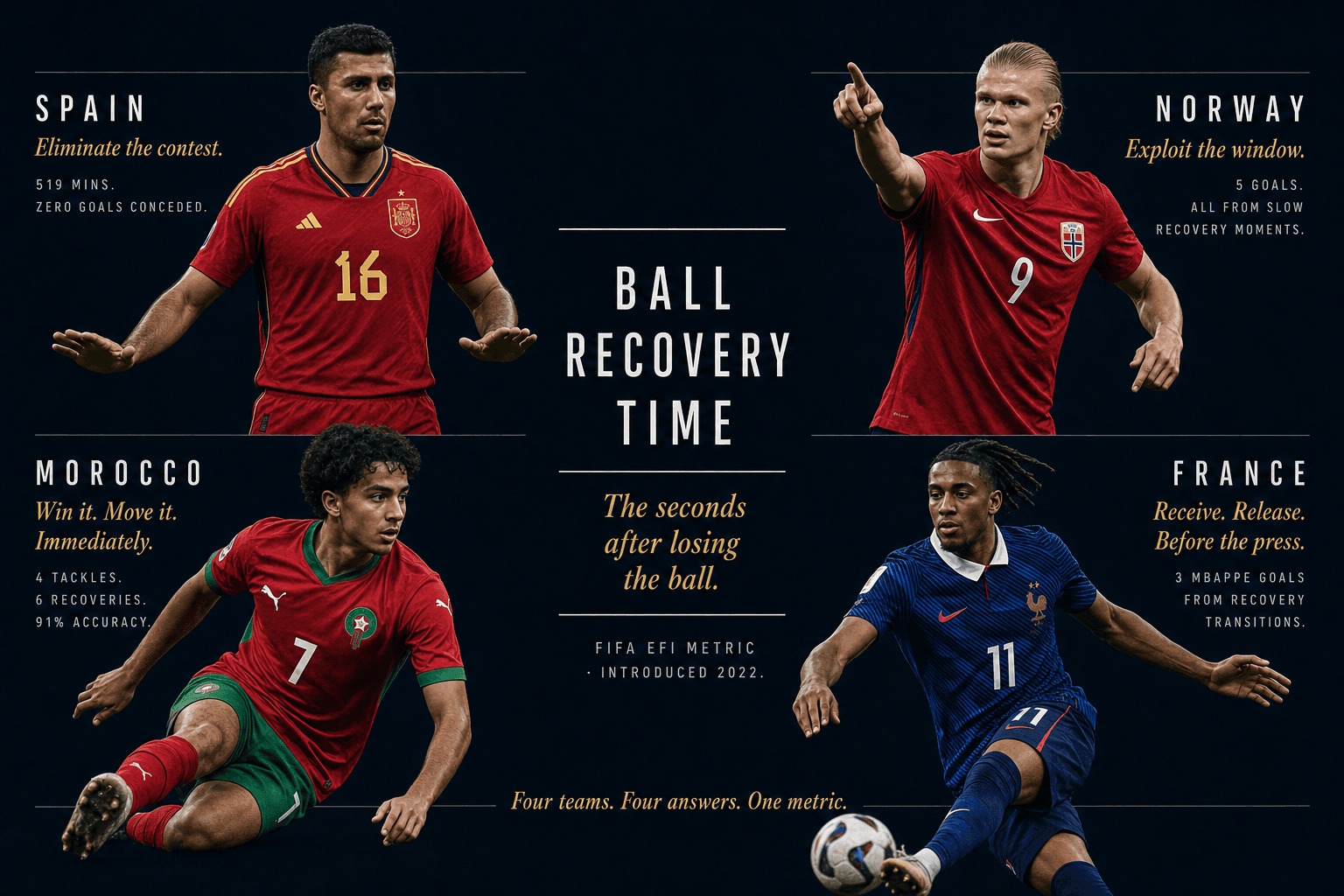
When FIFA's Technical Study Group sat down after the 2022 World Cup in Qatar and published the Enhanced Football Intelligence metrics that defined how the tournament should be analytically understood, one of the metrics they released on November 11, 2022 was ball recovery time. The definition is specific and simple: ball recovery time calculates the amount of time it takes for a team to regain possession of the ball after losing it. It indicates how efficient a team is at winning the ball back. That sentence — published on the official FIFA Training Centre — is the definition. Understanding what it actually means in competitive football at the 2026 World Cup requires significantly more unpacking than a single sentence suggests, because ball recovery time is not just a pressing metric. It is a window into every tactical decision a team makes after possession is lost — and the teams that understand it at the 2026 tournament are the teams that are still playing.
Where Ball Recovery Time Comes From: The EFI Metric Family
Ball recovery time is one member of a family of Enhanced Football Intelligence metrics that FIFA's Technical Study Group introduced for the 2022 World Cup in Qatar — the first tournament to broadcast these advanced analytical measures alongside conventional statistics. The FIFA Training Centre published ball recovery time on November 11, 2022, as part of a suite that also included possession control, line breaks, defensive line height and team length, final third entries, forced turnovers, pressure on the ball, expected goals, team shape, and receptions behind midfield and defensive lines. These are not statistics that replace conventional data — goals scored, shots on target, possession percentage. They supplement those figures by capturing what happens between the moments that conventional statistics measure: the pressing sequences, the defensive transitions, the moments of structured chaos that determine where a game's decisive chances originate.
The companion to ball recovery time in this metric suite is in-contest possession — a metric we explored in depth in our piece on how in-contest possession explains the 2026 World Cup better than conventional statistics. The two metrics work together. In-contest possession measures how much time the ball is in a contested state that neither team controls. Ball recovery time measures what happens when that contested state resolves in the opponent's favour — how quickly the team that just lost the ball can initiate a press and win it back. A team with low in-contest possession time is keeping the ball controlled and rarely losing it. A team with fast ball recovery time is pressing with intensity immediately after losing it. The best teams in world football achieve both simultaneously.
What the Metric Looks Like in Practice
The practical application of ball recovery time at the 2022 World Cup produced some of the tournament's most illuminating statistical contrasts. Spain, who averaged just 9% of their games in an in-contest state — the lowest at the 2022 tournament — also recorded among the fastest ball recovery sequences of the competition. The reason: their pressing system, built around the Barcelona DNA of immediate counterpress upon losing possession, means that the moment Spain's controlled possession is disrupted, the nearest two or three players immediately apply pressure to recover it. The ball is contested for a brief period and Spain win it back so quickly that the opponent never establishes the controlled possession needed to build an attack.
Saudi Arabia demonstrated the metric's opposite extreme. Averaged five seconds of controlled possession before losing the ball in 2022 — the shortest duration in the tournament. But Saudi Arabia's ball recovery time after those losses was significantly longer than Spain's, because their pressing system was less organised and their shape took longer to reform. The combination of short possession duration and slow recovery time is the specific statistical profile of a team that cannot control a football match at any phase. The ball was not in their control for long when they had it, and they were slow to win it back when they lost it. Saudi Arabia were eliminated in the group stage.
Ball recovery time is not the same as pressing intensity. It is the result of pressing intelligence — knowing when to press, where to press, and which player triggers the press. Spain at 2022 had the lowest in-contest possession time AND some of the fastest ball recovery sequences. Morocco at 2026 have the same combination through Bouaddi's midfield control. The numbers are different measures of the same thing: teams that understand what to do the moment the ball is not theirs.
Spain in 2026: The Masters of Both Metrics
At the 2026 World Cup, Spain's ball recovery time continues to reflect the same fundamental quality that made them world-record unbeaten across 35 competitive matches. As we documented in our piece on Spain's world-record unbeaten run and the Portugal Round of 16 preview, Spain have conceded zero goals in four World Cup matches. The zero goals conceded figure is the outcome. Ball recovery time is part of the process: a team whose press is so well-organised that the moment possession is lost, the opponent's window to build anything coherent is compressed to a few seconds before the ball is recovered. Their 3-0 win over Austria in the Round of 32 was the specific evidence: Austria are a technically competent team who won their group before this World Cup. Spain made them look as if they could not pass out of their own half, because every time Austria attempted to build, the recovery press was immediate and effective. Ball recovery time for that match, if the precise figure were available, would be among the lowest of any team in the tournament.
The Spain defensive record across the unbeaten run connects back through the same mechanism. Wikipedia's World Cup records section confirmed that Unai Simón holds the record for consecutive minutes without conceding a goal at 519 minutes across 2022 and 2026 — surpassing Walter Zenga's 517 consecutive minutes for Italy in 1990. That record does not belong to Simón alone. It belongs to the pressing system that ensures the ball is recovered so quickly after Spain lose it that the opponent's attack rarely progresses far enough to threaten his goal.
Morocco and Bouaddi: A Different Kind of Fast Recovery
Morocco's approach to ball recovery time at the 2026 World Cup is structurally different from Spain's but produces comparable outcomes in terms of defensive resilience. Where Spain's recovery time benefits from their possession dominance — they lose the ball less frequently, so each individual recovery is from a higher-quality defensive shape — Morocco's recovery time is driven by their double pivot pressing directly. Ayyoub Bouaddi, the 18-year-old Lille midfielder who chose Morocco over France weeks before the tournament, produced the specific ball recovery statistics against Brazil that make this abstract. Four tackles. Six recoveries. 91% pass accuracy. The 91% figure is the in-contest possession number. The four tackles and six recoveries are the ball recovery time metrics in individual player form: he is the player whose immediate press after possession loss provides Morocco's fastest recovery route.
As we explored in our pieces on Morocco's threat at the 2026 World Cup and the France vs Morocco potential quarter-final, Morocco's 82% possession in extra time against the Netherlands is the headline figure. But the ball recovery time explanation beneath it is Bouaddi and El Aynaoui winning duels in the central zones quickly enough that the Netherlands never established the passing rhythms their system requires. That is ball recovery time working at its most effective: not simply pressing, but pressing at the specific moment and from the specific position that makes the press successful in the minimum time.
Norway: Exploiting the Opponent's Slow Recovery
The flip side of ball recovery time is what happens when a team is slow to recover. Norway's five goals at this World Cup — documented in our pieces on Haaland's World Cup performance and the Brazil vs Norway Round of 16 preview — have almost all come from situations where the opponent's ball recovery time was too slow: the ball was lost in the middle third, Norway's transition was immediate, and Haaland arrived in the penalty area space before the defensive shape could be re-established. The 86th-minute winner against Ivory Coast followed exactly this pattern. The ball was contested, Ivory Coast's press was slow to engage, the transition happened in three passes, and Haaland was already in the position before Ivory Coast's defenders could recover. Ball recovery time for the opposition in that moment: too long. Ball recovery time for Norway in the transition: immediate.
The specific quality Erling Haaland brings to this dynamic is not his pressing — he is not a midfielder who wins the ball back himself. It is his movement timing. He does not start his run into the penalty area when the ball is recovered. He starts it in anticipation of the recovery, reading the defensive shape of the opponent and identifying where the space will be created when the ball arrives. The gap between Haaland's run starting and the opponent recognising it is the functional equivalent of a very fast ball recovery time: by the time the defensive shape registers the threat, it is already too late to close the space.
The Metric That Connects Everything at 2026
Ball recovery time is the third point in a triangle with in-contest possession and conventional possession statistics. Conventional possession tells you who had the ball. In-contest possession tells you how much of the game nobody had it. Ball recovery time tells you what happened in the seconds immediately after possession was lost — the most dangerous moment in football, the specific window where the majority of this tournament's decisive goals have originated. Spain keep that window as short as possible through their organised press. Morocco win the battle in that window through Bouaddi's central-zone dominance. Norway exploit the window when their opponents' recovery is slow, delivering the ball to Haaland before the defence is set. France use the Olise-Mbappe transition specifically in that window — as we covered in our piece on the Mbappe-Olise World Cup partnership, three of Mbappe's goals have come from Olise converting the in-contest moment into controlled possession faster than the defence could recover. The stat that FIFA's Technical Study Group first published in November 2022 is the specific analytical lens through which the 2026 World Cup's remaining matches can be most clearly understood.
Ball recovery time was introduced by FIFA at the 2022 World Cup as part of the EFI metric suite. At 2026 it explains Spain's press, Morocco's Bouaddi, Norway's Haaland goals and France's Olise-Mbappe transition better than any other single number. Which team do you think uses ball recovery time most effectively — and is this the stat that football coverage should be leading with? Tell us below.