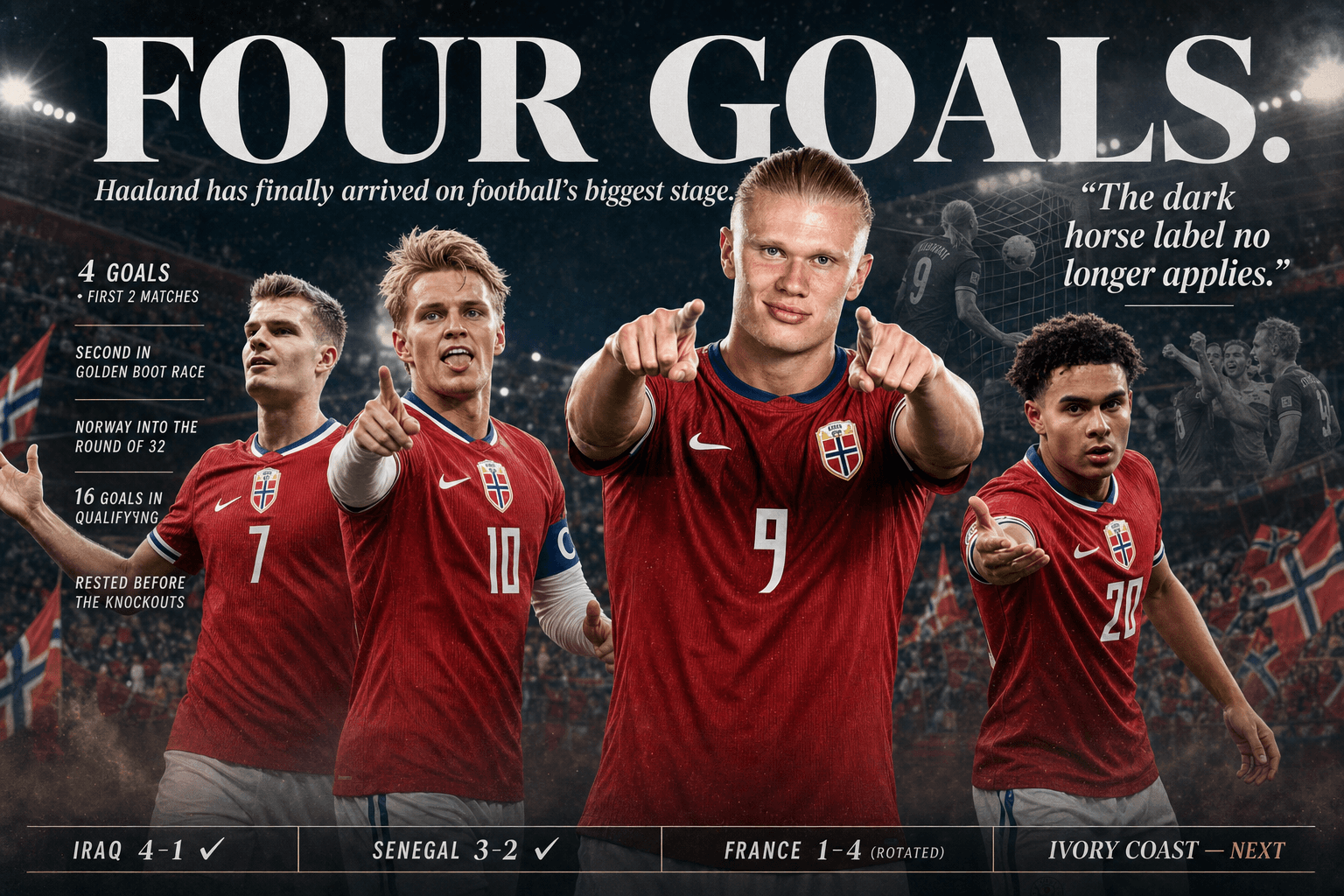
This article connects four pieces of BackPage FC coverage that have been building toward this moment. The story of how Manchester City locked Haaland down until 2034. The story of the release clause that doesn't exist and the legal warning that shut down a Real Madrid presidential stunt. The story of Norway as the most dangerous dark horse at the 2026 World Cup. And the story of why Norway waited 28 years to return to the World Cup and what it means that they are finally back. All four stories end here: at a tournament where Haaland has scored four goals in his first two matches, sits second in the Golden Boot race behind only Lionel Messi, and is playing for a nation that has not felt this way about football in nearly three decades.
The First Two Matches: What Haaland Has Already Done
The 2026 World Cup is Erling Haaland's first major international tournament. He was born on 21 July 2000 — two years after Norway's last World Cup game, a 1-0 defeat to Italy in the 1998 Round of 16. He has spent his entire professional career playing for a national team that kept qualifying but not qualifying, kept getting close and falling short, kept producing campaigns in which his absence through injury was the margin between success and failure. The 2022 cycle was the clearest example: Norway missed the World Cup in a group with the Netherlands and Turkey, with Haaland injured for key matches. The rest of European football's most productive player's early international career has been preparation for a tournament he had never been to.
He arrived. In his first match — Norway 4-1 Iraq on 16 June — Haaland scored twice: first sliding in at the back post from a David Møller Wolfe cross, then chasing down a goalkeeper's back-pass and converting from close range when the ball struck him from the keeper's attempted clearance. He was relentless, physical, and completely different in the way he applies his energy compared to any other striker at the tournament. Four minutes after halftime against Iraq, Leo Østigård headed in from a corner — Ødegaard's delivery, another set piece converted. Norway were 3-1 up before the match had fully settled. Four goals. Two from Haaland. The first World Cup match either of them had ever played.
In the second match — Norway 3-2 Senegal on 22 June — Haaland scored twice again. Marcus Pedersen gave Norway the lead from defensive errors. Haaland made it 2-0 immediately after the break. Ismaïla Sarr pulled one back. Then Haaland scored a stunning finish to make it 3-1 — a goal described across multiple outlets as the kind of strike that separates elite strikers from the merely very good. Sarr's late goal made it 3-2 but came too late to alter the result. Norway had beaten the AFCON champions. Haaland had scored in back-to-back World Cup matches.
The third match — France 4-1 Norway on 26 June — saw Ståle Solbakken rest Haaland and Ødegaard with qualification already secured. Ousmane Dembélé scored a first-half hat-trick, becoming the fastest hat-trick scorer in 2026 World Cup history. Norway gave a weakened side and lost 4-1. They finished second in Group I behind France. The result changed nothing about what the first two matches had established.
The Golden Boot Race: Haaland vs Messi vs Everyone Else
Four goals in two matches. The man leading the Golden Boot race as of the Round of 32 is Lionel Messi with five goals — his sixth World Cup, his final one, producing at the level of his greatest tournaments. Behind him, with four goals each, sit Haaland and a small group of elite attackers. At the group stage's close, Dembélé's hat-trick against Norway moved him alongside Haaland, Mbappé, and Vinicius Júnior in the race. Messi leads all players at five.
The specific context that matters for Haaland's Golden Boot position: he scored four goals in two matches. He did not play the third. He has two matches of rest built into his body compared to players who competed across all three group games. If Norway progress through the Round of 32 and into the Round of 16, the goalscoring opportunity that creates is significant — Haaland arriving at knockout-round matches with more physical reserve than his rivals in the Golden Boot race. Messi, at 38, will be managing minutes. Mbappé and Vinicius and Dembélé have been playing full matches. Haaland had a game off. That calculation, across a knockout tournament, may matter as much as individual quality in determining who lifts the award.
Is Haaland the Main Reason Norway Are No Longer Just a Dark Horse?
Before the tournament, the question was whether Haaland was the primary reason Norway were considered dangerous. After three group games, the question has shifted: Norway are no longer a dark horse. They are a qualified Round of 32 participant with the second-highest scorer in the tournament on their team, a Premier League-winning captain in midfield, and the best qualifying record of any European nation heading into the tournament. The dark horse label applied when they were theoretical. They are now actual.
Haaland is the reason the threat is quantified. Four goals is not a dark horse output. Four goals in two matches, against Iraq and the AFCON champions Senegal, at a player's first ever World Cup, at the age of 25 — that is the output of someone who has been preparing specifically for this moment for his entire career. The contract that Manchester City issued in January 2025, binding him until 2034, was not just about club retention. It was about stability. About a player who knew his World Cup was coming and wanted no distractions around it. The release clause stunt that prompted City's legal warning happened eight days before the tournament began. He scored twice in his first match anyway.
Haaland arrived at his first World Cup second in the world in international goals, holding a contract that runs until 2034 with no release clause, playing for a nation that waited 28 years for this tournament. He scored four goals in two matches. The dark horse label no longer applies. This is what it looks like when the most dangerous striker at the tournament plays like it.
Norway vs Ivory Coast: The Round of 32
Norway face Ivory Coast on 30 June at AT&T Stadium in Dallas at 1pm ET. Ivory Coast qualified as runners-up in Group E — the same group where Curaçao made history as the smallest nation ever at a World Cup, and where Germany won with six points. Ivory Coast reached the knockout stage for the first time in twenty years — their first knockout round since the 2006 World Cup. The match represents two nations each experiencing a significant historical moment.
For Norway, Ivory Coast represents a more navigable fixture than France in the potential Round of 16. For Ivory Coast — who beat Ecuador 1-0 in their group opener and will carry momentum and the confidence of historic progress — Norway represent exactly the kind of structured, physically dominant opponent they have been vulnerable against historically. Haaland, rested after the France match, arrives at the Ivory Coast game with full energy. That is the specific advantage Solbakken's rotation created. The manager who rested his best player against France was not making a tactical error. He was making a tournament decision.
The Route to the Quarter-Finals — and Why England Still Matters
If Norway beat Ivory Coast on June 30, their potential Round of 16 opponent depends on the bracket. England — who face DR Congo in Atlanta on July 1 — are the most likely high-profile opponent if both advance. As we noted in our Norway dark horse analysis, England under Tuchel have shown vulnerability against compact, low-block defensive teams in their group stage. Ghana and Panama created that difficulty. Norway, who combine that defensive compactness with a striker currently second in the Golden Boot race, is the specific version of that problem at its most acute. England's last World Cup match against Norway was a 1-0 win in the 1998 Round of 16 — David Beckham's free-kick. Norwegian football does not forget that result. It is, alongside the Brazil win, the defining memory of 1998.
The quarter-final route — Norway beat Ivory Coast, beat England, face whoever emerges from the other side of the bracket — is not a fantasy at this point in the tournament. It is a sequence of matches that Norway's squad, Haaland's goals, and Solbakken's tournament management have made genuinely possible. The team that started the tournament as a dark horse has earned the right to be discussed differently. Four goals in two matches earns that right. So does beating the AFCON champions while rotating a squad for the decisive match. So does a striker who waited 28 years — and whose father waited with him, playing for the same shirt in the generation before him — to score at a World Cup, and then scored twice in his first match and twice in his second.
What Haaland's World Cup Goals Actually Reveal About His International Game
The four goals are the headline. The nature of them is the analysis. Against Iraq, the first came from the kind of movement that makes Haaland uniquely difficult to mark in a compact defensive block — he read the low cross before the cross was played, arrived at the back post precisely when the ball did, and slid in with the certainty of a player who has visualised that moment ten thousand times on training grounds in Manchester and Oslo. The second came from an act of pure relentlessness: chasing a goalkeeper's back-pass into a dead situation, staying on his feet when most strikers would have given up, and letting the ball deflect off him into the net. Both goals were different. Both were Haaland.
Against Senegal, the pattern was similar but the quality of opposition was higher. Senegal, who won AFCON in 2022 and are among Africa's most complete squads, set up to contain Norway's direct play and specifically to eliminate Haaland's involvement in the box. Their plan held for seventeen minutes. Then Marcus Pedersen scored. Then Haaland made it 2-0. When Sarr pulled one back and the game tightened, Haaland produced the specific kind of goal — a stunning individual finish described by ESPN's commentary as separating elite strikers from the merely very good — that makes his threat impossible to fully legislate for. You can have a plan for him. He still scores.
The qualifying numbers — 16 goals in 8 games, top scorer across all of European qualifying — were always going to establish Haaland as the tournament's most potent individual threat on paper. The World Cup itself is different from qualifying. The opposition is compressed into fewer games. Every defensive unit arrives having watched the previous matches. The adjustment against each new opponent is faster and more specific than qualifying allows. Haaland has scored four goals anyway. The adjustment has been attempted. The goals have continued. That is the most important information the group stage has provided about the 2026 World Cup's most watched striker.
For Norway, the goals have done something beyond generating headlines. They have created space for the rest of the squad. ESPN confirmed Norway was one of four teams across the entire field to maintain a perfect qualifying record, led by Haaland's 16 goals in the European phase. At the World Cup itself, the attention on Haaland has created the space in which Ødegaard has operated as Norway's creative fulcrum — the corner that Leo Østigård headed in against Iraq came from an Ødegaard delivery. The goals come from Haaland. The angles are created by the system around him. That is what makes Norway dangerous rather than merely Haaland-dependent.
Haaland has 4 World Cup goals in 2 matches and faces Ivory Coast in the Round of 32. Is this the tournament where Norway reach the quarter-finals for the first time — and can Haaland win the Golden Boot ahead of Messi? 👇