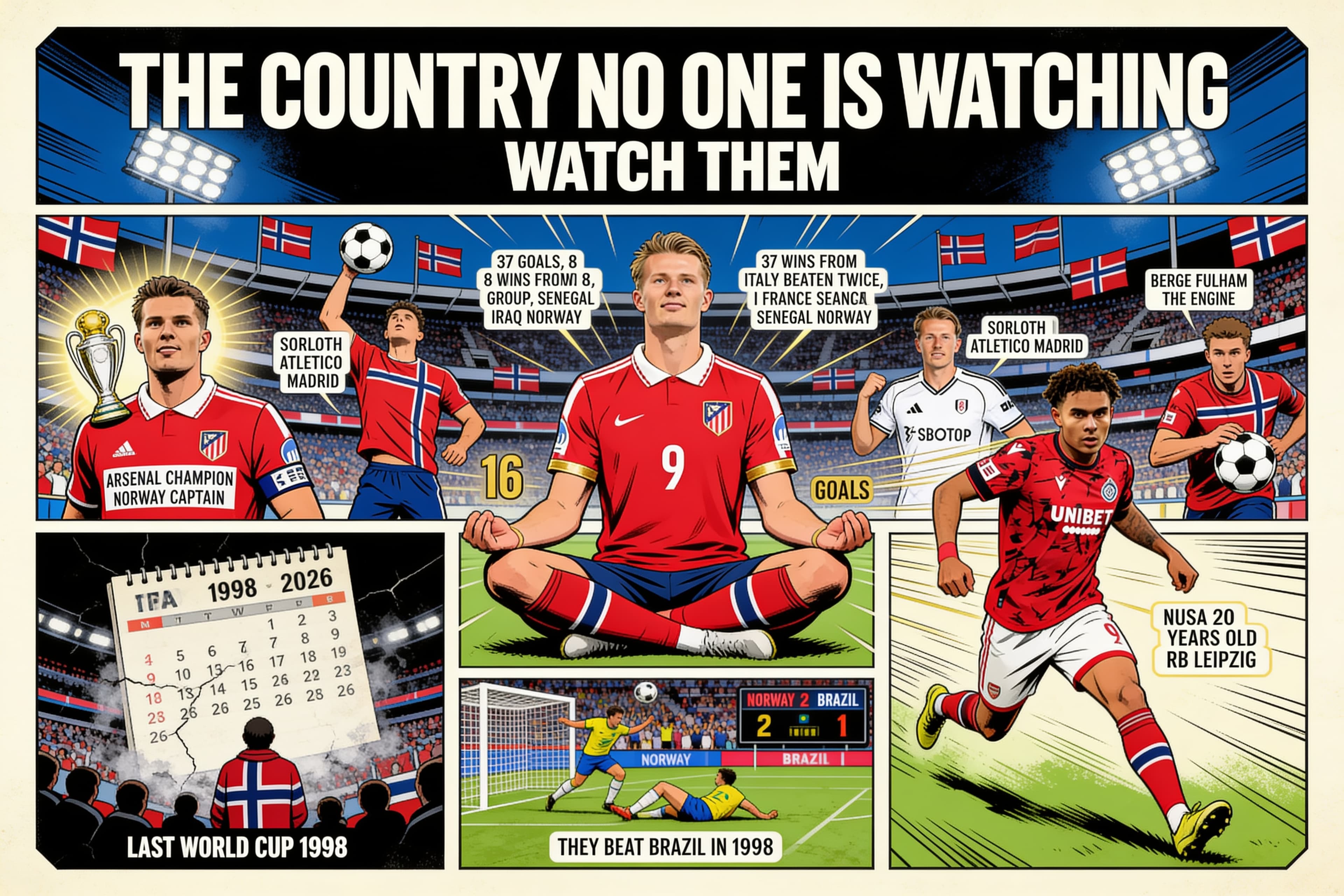
Everyone is talking about France. Argentina. England. Brazil. Spain. They should be — those nations have won the last seven World Cups between them. But while the world debates which superpower prevails in North America this summer, a country of 5.5 million people has done something extraordinary, quietly, without anyone quite noticing. Norway won every single qualifying match. Eight games. Eight wins. Thirty-seven goals scored. The best attacking record of any European nation in qualification. And they haven't been at a World Cup since 1998. An entire generation of Norwegian fans has never seen their country on football's biggest stage. That changes this summer. Start paying attention.
28 Years of Waiting: Norway's Long Road Back
To understand what this World Cup means, you need to understand how long it has been. The last time Norway played at a FIFA World Cup was 27 June 1998, at the Stade Vélodrome in Marseille. Italy beat them 1-0 in the Round of 16 — a cruel exit after one of the tournament's great group-stage moments four days earlier. They went home. And then they kept not qualifying. 2002. 2006. 2010. 2014. 2018. 2022. Six World Cup cycles, a series of near misses, and a growing sense that Norway's window had simply closed — that the generation of Ole Gunnar Solskjær and Tore André Flo was a historical anomaly, not a platform.
The drought is not an accident. It is not laziness or lack of investment. Norway tried. They just kept failing at the wrong moment — against the wrong opponent, in the wrong qualification group, with the wrong injury at the wrong time. The 2022 qualifying campaign was perhaps the cruelest: a group with the Netherlands and Turkey, and Haaland missing key matches through injury, Norway finishing third and watching the World Cup from home yet again. There are Norwegian fans in their thirties who have never seen their country in a major tournament. The children who grew up watching Solskjær score in the 1998 World Cup now have children of their own. Twenty-eight years is not a number. It is a life.
The reason this matters is not just sentimental. It explains the pressure this squad carried into qualifying and the scale of what they did with it. When Norway kicked off against Moldova in March 2025, the ghosts of all those failed campaigns were in the room. By the time they beat Italy in Turin to seal qualification in November 2025, the whole country exhaled at once.
The Qualification: 37 Goals, 8 Wins, Italy Beaten Twice
Norway were placed in UEFA Group I alongside Italy, Israel, Estonia and Moldova. On paper: manageable. In practice: they made it look effortless, which is to say they made it look nothing like what it actually was — because beating Italy home and away in a World Cup qualifying campaign is not something most teams ever achieve.
Norway scored 37 goals in 8 games — the best attacking return of any European nation in the entire qualification phase. That is 4.6 goals per match. They beat Moldova 5-0 in the away fixture, then 11-1 at home — the biggest win of any European qualifying campaign this cycle, coming within one goal of the all-time European qualifying record set by West Germany against Cyprus in 1969. They beat Italy home and away, becoming only the second European side in qualifying history to beat the four-time world champions twice in the same campaign. Italy, who failed to qualify for the World Cup for the third consecutive time, finished second in the group and scraped through the play-offs. Norway finished eight points clear of them at the top.
The goal difference that Norway accumulated does not capture the full story. They were not simply outscoring weak opposition. They were pressing with intensity, attacking with creativity, and defending with the kind of collective organisation that only comes from a squad that has been building together for years. Manager Ståle Solbakken, who has won 31 of his 52 matches in charge of the national team, spoke repeatedly during the campaign about how this was not a collection of individuals but a unit — a group that had been developing its identity and its system through cycles of failure and kept coming back. The qualification confirmed it. But confirmation is not quite the right word. The 37 goals were a statement.
Erling Haaland: The Record That Reframes Everything
Sixteen goals in eight qualifying matches. Top scorer in all of European qualifying by eight — the nearest rivals, Harry Kane and Memphis Depay, managed eight goals each. Haaland scored 16 goals in 8 qualifiers — matching the record for goals scored by a European player in a single World Cup qualifying campaign, set by Robert Lewandowski across ten games for Poland ahead of the 2018 edition. Haaland did it in two fewer games.
He scored five in a single game against Moldova — a career high for an international appearance and the most by a European player in a World Cup qualifier since Austria's Hans Krankl netted six against Malta in 1977. He scored at least once in every single qualifying game. For an entire calendar year before the campaign ended, Haaland had not failed to score for Norway in a single match.
The milestone that truly captures the scale of what he is doing came in August 2025. Haaland reached 50 international goals in just 46 appearances, becoming the sixth player in men's international football history to reach the half-century in fewer than 50 caps — and the first to do so in 53 years. The comparison table tells the story in the most direct way possible: Harry Kane needed 71 appearances to reach the same landmark. Neymar needed 74. Kylian Mbappé and Robert Lewandowski both took 90 games. Lionel Messi needed 107. Cristiano Ronaldo needed 114. Haaland did it in 46.
Haaland took 46 appearances to score 50 international goals. Kane needed 71. Mbappé 90. Messi 107. Ronaldo 114. He is 25 years old. This is his first World Cup. Whatever comes next, that number already belongs to history.
What makes that record more remarkable still is that Haaland has achieved it with a national team that, until November 2025, had not been to a major tournament in 26 years. These are not goals scored against weak opposition in comfortable qualifying groups. Several came against Italy, a nation that qualified eight of the previous ten World Cups. Several came against Israel, Estonia, and Moldova — teams ranked significantly below Norway — but the volume, the pace, and the consistency with which Haaland has accumulated them since his international debut in 2019 represents a goalscoring rate that men's international football has not seen in half a century.
He was born in July 2000. Norway's last World Cup was in 1998. He is quite literally going to a tournament that predates his own existence, stepping onto football's biggest stage for the first time at the age of 25. As we examined in our piece on Manchester City's unprecedented contract decision to lock Haaland down until 2034, the scale of his talent is not in question — only where the ceiling is. A World Cup, where the pressure and the quality of opposition is unlike anything a club environment can replicate, is the test that is left.
Martin Ødegaard: The Champion Who Arrives
This is where most previews stop — Haaland is the threat, the rest is support. That is the most common misreading of what Norway have built. The second name on the team sheet is Martin Ødegaard, and his story arrives at this World Cup with its own extraordinary momentum.
Ødegaard made his senior Norway debut at the age of 15 — still the record for the team. He was 16 when Real Madrid signed him as the youngest player in their history, at the time the most hyped teenager in European football. The move stalled, repeatedly. A series of loans to Heerenveen, Vitesse, Real Sociedad, and Arsenal while Real Madrid evaluated whether he was ready produced years of growing uncertainty. He did not play for Madrid's first team beyond token appearances. He eventually moved to Arsenal permanently in 2021. He became captain in 2022. In 2024-25, wearing the armband, he led Arsenal to the Premier League title — the club's first in 22 years. He walked into this World Cup as a champion.
In the qualifying campaign, Ødegaard was the competition's top assister — laying on seven of Norway's 37 goals, four of them directly for Haaland. His role in the system is the one that makes Haaland's record possible: the creative fulcrum who finds the space that the striker then exploits. Against organised defences, that combination is among the most difficult in international football to contain — because if you commit to stopping Haaland, Ødegaard finds the pocket. If you press Ødegaard, Haaland runs in behind. Norway have been running that double act for five years. They are now doing it on the biggest stage available.
The Squad Nobody Talks About
Three centre-forwards starting for clubs in Europe's major leagues. Most nations at this World Cup are fortunate to have one. Norway have three, and that depth is the single most underestimated aspect of what they bring to North America.
Alexander Sørloth plays for Atlético Madrid and stands 6ft 4in. He is not a deputy for Haaland. He is a different weapon — a target man who draws defenders physically, wins aerial duels, and scores goals in the top division of Spanish football. In qualifying, when Haaland was marked heavily, Sørloth was the solution. Solbakken can play them together, rotate them, or use the threat of both to force opposition defensive decisions before the game begins. In a moment that captured the squad chemistry, Sørloth described Haaland to reporters during qualifying as someone you keep thinking you have seen everything from, until he does something new. The respect between them is real. The tactical problem they create together is genuine.
Jørgen Strand Larsen plays for Crystal Palace. Another physical option, another forward who can hold up play and bring others into the game. Norway's depth in the number nine position is, in isolation, extraordinary for a country of 5.5 million people.
Antonio Nusa is 20 years old and plays for RB Leipzig. He has 20 caps and 7 international goals already. He is the type of winger who, in a knockout tournament, can end a tie in ten minutes — the directness, the pace, the willingness to take a player on in open space. In a group stage where Norway may need to unlock compact defensive teams who park against the Haaland threat, Nusa is the variation that defences cannot plan for the same way. Watch him.
Sander Berge plays for Fulham. He is 6ft 5in and does not make headlines. He wins the ball, controls the tempo, and allows Norway to press from a higher line without being vulnerable on the counter. Every tournament team that goes deep has one player who does the invisible work that makes everyone else possible. Norway's version has been Berge for the last three years, and the squad's balance in midfield — Ødegaard's creativity, Berge's defensive cover, Kristian Thorstvedt's aggression at Sassuolo — gives Solbakken more variation than most analysts acknowledge.
At the back, Julian Ryerson at Borussia Dortmund brings Premier League and Bundesliga experience to the right side. David Møller Wolfe at AZ Alkmaar has been consistent at left-back across the qualifying campaign. The defence carries questions — Norway conceded eight goals in qualifying, and against elite attacking units like France and Senegal, that defensive structure will be tested in ways the qualifying group did not replicate. But Norway know that. Their game plan is not to outdefend the world. It is to score more goals than they concede, and with the forward line they carry, that is not an unreasonable ambition.
Group I: The Path, the Problem, and the Possibility
The draw was not kind. Group I — France, Senegal, Iraq, Norway — has been called the Group of Death by most tournament analysts, and the label fits. France are the 2022 runners-up, the second-ranked team in the world behind Spain, and arrive led by Kylian Mbappé, Ousmane Dembélé, and a squad of generational depth. Senegal are the reigning Africa Cup of Nations champions, boasting one of the tournament's most organised defensive structures alongside attacking pace in Ismaïla Sarr and Nicolas Jackson. Iraq qualified through the inter-confederation playoff and, as the group's clear fourth seed, are the team Norway must beat.
The format matters here more than it usually does. At this World Cup, 48 teams compete, divided into 12 groups of four. The top two from each group advance automatically to the round of 32. Third-placed teams are evaluated across all groups, and the best eight third-place finishers also progress. That means, in practical terms, Norway need to finish in the top three of their group — and almost certainly need to beat Iraq to guarantee it.
Tuesday 16 June — Iraq vs Norway, Gillette Stadium, Boston. This is the floor. Norway beat Iraq, and they are almost certainly through. Haaland's goalscoring record against teams ranked outside the top 30 is astonishing, and Iraq — ranked 58th in the world — fit that profile. Starting the tournament with three points and a positive goal difference sets everything else up.
Monday 22 June — Norway vs Senegal, MetLife Stadium, New York. This is the decisive game. Senegal are physical, well-organised, and capable of containing one specific threat when they need to. Norway's width — Nusa on the left, Ryerson overlapping on the right — and the Ødegaard–Haaland axis will be tested by a Senegalese defensive block. A draw here, combined with a win over Iraq, almost certainly sends Norway through.
Friday 26 June — Norway vs France, Gillette Stadium, Boston. If both teams have already qualified, this becomes an opportunity to top the group. If it is a decider, it is one of the most intriguing individual matchups of the tournament's group stage: Haaland against a French defence that includes Dayot Upamecano, William Saliba, and a goalkeeper of Maignan's quality. Norway will not be favoured. But they will not be passive either.
The Knockout Threat: What Norway Can Do on One Evening
Norway will not win this World Cup. That framing — dark horse — only works if you define it correctly. They are ranked 31st in the world. Their defensive record in qualifying was not immaculate. Against France across 90 minutes, the quality gap is real. Norway know all of this. So does Solbakken. The case for Norway is not the trophy. The case for Norway is what they can do to one big team, in one knockout game, on one specific evening.
In the round of 32, if Norway finish second or third from their group, they could face teams from Groups J, K, or L — which currently includes potential opponents like the Netherlands, Portugal, England, or Germany. Any of those games is winnable. Not because Norway are better across 90 minutes. Because they have a striker who can produce something in the 73rd minute that no defensive plan on earth can fully contain. And because they have been in this situation before.
Marseille, 23 June 1998. Brazil took the lead through Bebeto in the 78th minute. Norway were going out. They had eleven minutes to find two goals against the tournament favourites — the Ronaldo Brazil, the side that would go on to contest the final against France. Tore André Flo equalised in the 83rd minute. Then Junior Baiano brought Flo down inside the area and Kjetil Rekdal stepped up to score the penalty in the 89th minute. Norway won 2-1. They knocked Brazil out of the group. Norway are the only team in football history that has never lost to Brazil across all competitions — they beat them twice in 1997 and 1998 and have never played them since.
That game happened with Tore André Flo and Kjetil Rekdal — talented players, good players, but not players of the calibre Norway carry now. The striker who arrives at this World Cup has scored 55 goals in 48 international appearances and has been the most prolific goalscorer in any European qualifying campaign. The captain who leads the midfield just won the Premier League. The 20-year-old winger on the left has never been to a major tournament and has nothing to fear from the occasion. When Norway did this in 1998, nobody expected it. The difference in 2026 is that people should expect it — and somehow, still aren't.
Norway's All-Time Numbers — and Why This Generation Is Different
Norway have appeared at four World Cups in their history: 1938, 1994, 1998, and now 2026. Their best performance was the 1998 Round of 16 exit. In 1994, they reached the group stage with a respectable performance. In 1938, they lost to Italy in a single-game knockout. What makes 2026 different — structurally different, not just optimistically — is the quality of the squad Solbakken has assembled across the age groups.
Three Premier League starters: Haaland at Manchester City, Ødegaard at Arsenal, Berge at Fulham. A Bundesliga starter in Ryerson at Dortmund. A La Liga starter in Sørloth at Atlético. A Ligue 1 regular in Nusa at Leipzig. The breadth of top-division club experience across this squad is unlike anything Norway has produced before. The 1990s generation had Solskjær and Flo — two genuinely elite players surrounded by good professionals. The 2026 generation has six or seven players who start every week for major European clubs. That is the difference.
The population comparison that the source document references is worth restating plainly: Norway has 5.5 million people. Italy has 60 million. Germany has 84 million. France has 68 million. Norway qualified above Italy — a four-time world champion — in their group, beating them home and away. That achievement, in the context of the resources and player pools available to each nation, is one of the quiet stories of this entire qualifying cycle.
The Games That Define the Moment
If you are picking one specific thing to watch for in Norway's group games, it is the Iraq fixture. Norway need to start the tournament with three points, a clean sheet if possible, and a goal or two from Haaland to set the tone. Al Jazeera's preview identifies Iraq vs Norway as the opener that defines the group's shape — if Norway win by two or more, the path to the knockouts becomes significantly clearer.
The Senegal game is the one with the most tactical depth. Senegal have the defensive tools to disrupt Norway's build-up and the attacking pace to punish high defensive lines. Aliou Cissé's side lifted the AFCON in January 2026, which means they arrive at the World Cup with genuine tournament momentum. If Norway can find a way through that defensive structure — likely through Nusa's directness or Sørloth's aerial presence rather than through Haaland finding space centrally — it will tell you something important about how far this team can go.
France last. By that point, Group I may already have its two qualifiers settled. But if Haaland gets a clean run at the French defence in a high-stakes, open final group game, one of the World Cup's most anticipated individual battles becomes available. Haaland vs Mbappé — the question of who is the world's best striker, which has circulated in club football for three years — resolved, in some small measure, by a single group-stage encounter. That game, whatever its implications, will be watched by everyone.
The Country Nobody Is Watching
The opening line of this piece asked you to start paying attention. Here is the version you should actually be thinking about as you plan your World Cup schedule.
Norway have Haaland, who is 25 and at the absolute peak of his powers, playing a World Cup for the first time with every incentive imaginable. They have Ødegaard, who arrived as a Premier League champion and leads this team with the settled authority of a man who spent a decade becoming exactly what he is. They have Nusa, who is 20 and unfazed, and Sørloth, who is 28 and has been waiting for this his entire career. They have Berge, who makes the whole thing possible. They have Solbakken, who has been building this quietly for five years.
They beat Brazil — the actual Brazil, the tournament favourites — in the last World Cup they attended, coming from a goal down with eleven minutes left. They beat Italy twice in qualifying. They scored 37 goals in 8 games to get here. And they have not been to a World Cup in 28 years, which means the entire squad is playing with a generational hunger that no amount of tactical analysis can fully account for.
Somewhere in Boston and New Jersey this June, a striker born two years after Norway last played at a World Cup is going to step onto the pitch for the first time. He has scored 55 goals in 48 appearances. He has never played at a major tournament. He has been waiting his entire footballing life for this moment.
Norway beat Brazil in 1998 with Tore André Flo and Kjetil Rekdal.
Imagine what they do with Haaland.
Norway are in the World Cup this summer for the first time in 28 years. If they get out of the group, which big team do you back them to knock out — England, the Netherlands, or Portugal? And how far do you genuinely think they can go? Drop your answer below. 👇