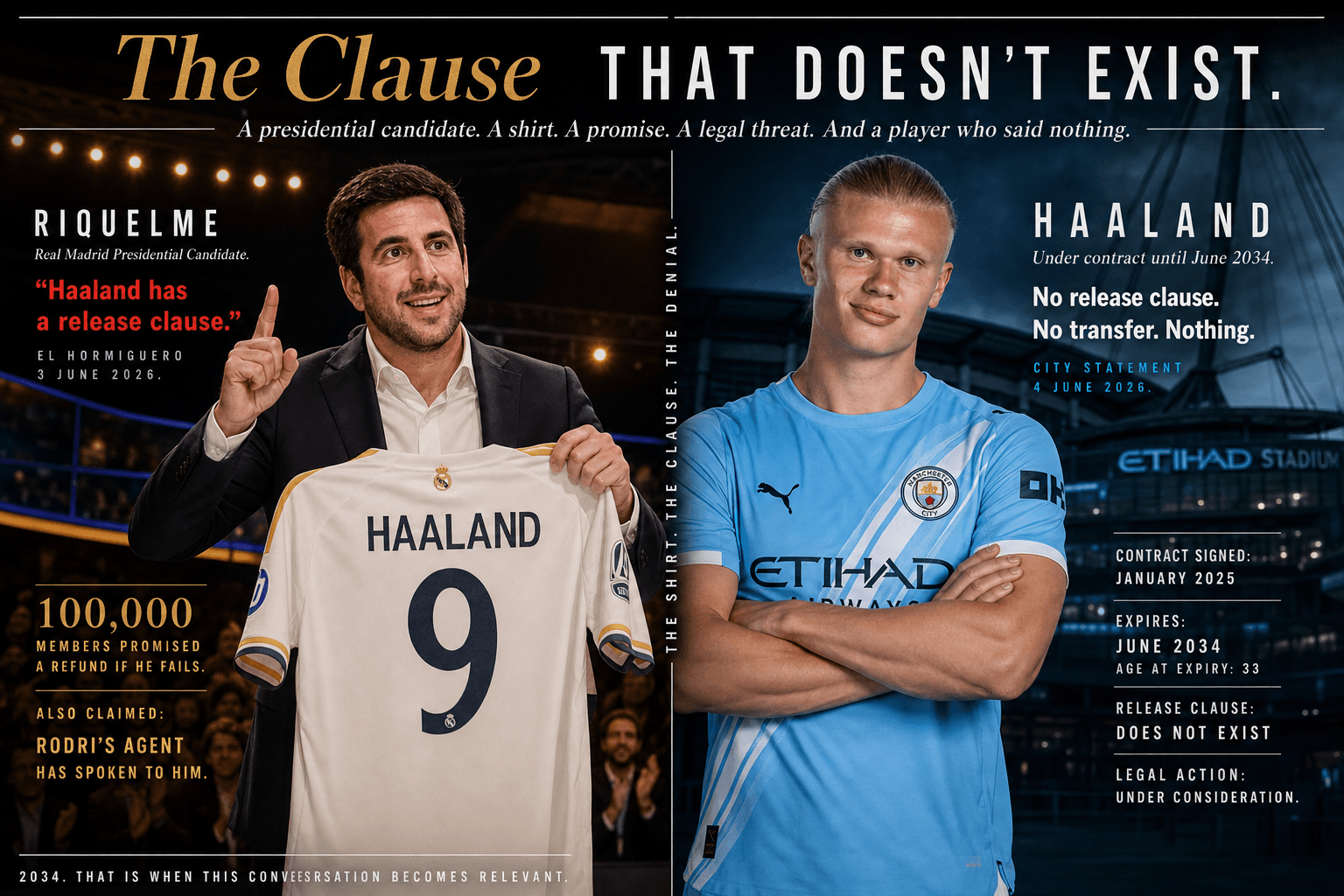
On the evening of Wednesday 3 June 2026, a Spanish businessman named Enrique Riquelme appeared on El Hormiguero — one of Spain's most-watched television programmes — reached into a bag, and pulled out a Real Madrid shirt with Haaland and the number 9 printed on the back. He held it up for the cameras and said, calmly and with evident theatrical planning: "Haaland has a release clause and wants to join Real Madrid." He then promised that if he became Real Madrid president and failed to sign Erling Haaland, he would personally refund the annual membership fees of every one of the club's 100,000-plus registered members. The audience applauded. The clip went viral before midnight.
By the following morning, Manchester City had issued a statement that contained more legal weight than most transfer sagas generate in an entire summer. The statement was direct: "The stories which have emerged from Spain regarding the future of Erling Haaland are untrue. There is no chance of this happening and there is no contractual clause to enable it. We are considering legal action for the use of our player image in this context." Separately, both Haaland's father Alfie and his agent Rafaela Pimenta issued their own denials. The man himself, preparing for Norway's World Cup campaign, said nothing publicly. He did not need to.
What Riquelme Actually Claimed — and Why It Spread
Enrique Riquelme is a 37-year-old Spanish businessman who is challenging Florentino Pérez in Real Madrid's first contested presidential election in nearly two decades. The context matters: a challenger running against a figure as dominant as Pérez — who has won multiple Champions Leagues as president, who signed Ronaldo, Zidane, Mbappé — needs a headline. Riquelme needed something that would make 100,000 Real Madrid members believe he could deliver what Pérez could not. He chose to promise Erling Haaland — the most prolific striker in the world — and to suggest he had information about a contractual mechanism that would make the transfer possible.
The release clause claim was the specific detail that caused the story to explode. Transfer rumours are a weekly occurrence in football. A presidential candidate claiming to know the terms of a specific clause in a specific player's contract — and backing the claim with a personal financial guarantee to 100,000 members — is a different category of story. It implied inside information. It implied a level of preparation and access that made the claim feel more credible than a standard speculation piece. It was designed to feel credible. That is the entire point of a stunt like this.
Riquelme did not stop at Haaland. He also claimed to have spoken to the agent of Rodri — Manchester City's Spanish midfielder — and promised his arrival at the Bernabéu as well. Two City players, one television appearance, one shirt, and a financial guarantee that would cost him millions of euros if either claim proved unfounded. The calculation is political: the promise generates votes. The failure to deliver, if he loses the election, costs him nothing. If he wins the election, he will discover what City already know: there is no release clause.
Erling Haaland's Manchester City Contract: What It Actually Says
The Haaland release clause question has been circulating in Spanish football media since before his contract extension was signed. As we documented in detail in our piece on Manchester City's unprecedented contract decision to lock Haaland down until 2034, the January 2025 extension was specifically designed to eliminate the kind of clause that allowed Spanish clubs to believe a summer move was feasible.
The original Haaland contract, signed when he joined City from Dortmund in 2022, contained a reported release clause of £175 million that could be triggered in the summer of 2024. That clause — which expired without being activated — was the one Spanish clubs, including Real Madrid, were monitoring. When City offered Haaland a new deal in January 2025, the extension was structured to run until June 2034 and, crucially, did not include a new release clause. City's statement was unambiguous: there is no contractual clause to enable a transfer to Real Madrid. When is Haaland's contract expiring? June 2034. Eight years from now. He will be 33 years old before City's obligation to him expires under the current agreement.
The contract's length and structure — which we covered in the context of City's response to Real Madrid's Bosman playbook — was never primarily about financial terms. It was about removing any mechanism that would allow the conversation Riquelme tried to have on El Hormiguero. No release clause means no opening. No opening means no transfer. No transfer means the shirt Riquelme held up is a prop rather than a prediction.
Riquelme promised 100,000 Real Madrid members he would sign Haaland. Manchester City threatened legal action within 24 hours. Haaland's contract runs until 2034. There is no release clause. The most theatrical transfer story of the World Cup summer was resolved before it began — by a player who said nothing and a club that said everything it needed to.
Manchester City's Legal Threat: What It Means and What It Doesn't
The phrase "considering legal action" in City's statement is precise and worth reading carefully. They are not threatening to sue Real Madrid — the club issued no statement and was not directly responsible for Riquelme's television appearance. The legal action City are considering is specifically directed at Riquelme and his campaign for the unauthorised use of Haaland's image in a political and commercial context. When someone uses a player's name and image — including a printed shirt — in a commercial context without the player's permission, image rights law provides a basis for a cease-and-desist or damages claim. City's statement establishes their position: Riquelme used their player's image without consent to advance a commercial campaign, and they reserve the right to pursue that legally.
Whether City pursue formal legal proceedings will depend on how the Madrid election resolves and whether Riquelme continues to use Haaland's image in campaign materials. The statement's primary purpose was not actually the legal threat itself — it was the speed and clarity of the denial. By issuing a statement within 24 hours that described the release clause claim as simply untrue, City closed the story before it could develop the kind of momentum that transfers take on when they remain undenied for 48 hours. The legal language was the amplifier. The denial was the substance.
Why Real Madrid Want Haaland — and Why They Cannot Have Him
The desire to sign Haaland is not irrational. Real Madrid, whose transfer history is built on securing the most famous player in the world at the right moment — as we documented in our analysis of Madrid's Bosman transfer strategy from Schuster to Mbappé — have been circling Haaland since before he left Borussia Dortmund. The reports from 2022, when Haaland chose City over Madrid, suggested that Madrid's plan was to wait — for the release clause, for a contract dispute, for any opening. The January 2025 extension closed those options explicitly.
The case for Haaland at Madrid is obvious: he is, statistically, the most efficient goal scorer in the history of international football. He extended his contract with City in January 2025 and has given no indication of wanting to leave — a fact confirmed by both his father and his agent in their statements responding to Riquelme's claims. He is 25 years old and at a World Cup with Norway for the first time in his life. The evidence that he is focused on his current club and his current tournament is not subtle.
For Madrid, the Haaland question remains what it has been since 2022: the transfer they want most and cannot access. Mbappé came on a free from PSG. Bellingham came from Dortmund at 19. Trent Alexander-Arnold came on a free from Liverpool. The Bosman model that has defined Madrid's recent transfer strategy works when players are available. Haaland is not available. He has no release clause. His contract runs to 2034. The shirt Riquelme held up is, at this moment in time, a fantasy.
What This Means for Norway's World Cup — and Haaland's Focus
The timing of the Riquelme stunt is worth noting specifically. It came on 3 June 2026 — eight days before the 2026 World Cup kicked off. Haaland was in the final stages of Norway's pre-tournament preparation, having scored 16 goals in qualifying to lead his nation to their first World Cup in 28 years. As we documented in our piece on Norway as the tournament's most dangerous dark horse, this World Cup represents a generational moment for Norwegian football — a striker born two years after Norway's last World Cup appearance, now playing in one for the first time at 25 years old.
The release clause story briefly threatened to become the dominant pre-tournament narrative around Haaland. City's swift statement ensured it did not. Haaland arrived at the World Cup as Norway's striker, not as a transfer target. The question his presence in North America generates is not whether Real Madrid can sign him. It is whether he can add World Cup goals to the international record that already has him among the fastest to 50 goals in men's football history. For Norway supporters who have waited 28 years for this tournament, the Riquelme stunt was noise. The group stage games are the signal.
Whether Haaland eventually becomes a Real Madrid player remains one of football's most compelling open questions — but not for the reasons Riquelme suggested on El Hormiguero. The answer to when is Haaland's contract expiring is June 2034. In 2034, Haaland will be 33 years old. Madrid will still want him. The clause that would have made it simpler does not exist. What exists is a Manchester City statement, a legal threat, and a striker who, right now, is playing at his first World Cup and could not care less about a shirt someone else is holding.
The Norway World Cup Context: Why the Timing Matters
There is one more layer to the Riquelme story that received less attention than the legal threat. The stunt happened on 3 June 2026 — eight days before the World Cup began. Haaland was in the final week of pre-tournament preparation with Norway, a squad heading to its first World Cup in 28 years. The timing was not accidental. A presidential campaign in Spain gains more attention if it attaches itself to a live, globally watched event. The World Cup was the news cycle. Haaland, as Norway's striker and the man who scored 16 qualifying goals to get them there, was already attracting global attention. Riquelme inserted himself into that attention.
The effect on Haaland's preparation appeared to be minimal. Norway head coach Ståle Solbakken said the squad was focused and undistracted. Haaland's father's denial was issued quickly and cleanly. The story was over before Norway played their first group game. But the keywords it generated — every version of "Haaland release clause" and "Haaland Madrid transfer" and "when does Haaland's contract expire" — remained active search terms throughout the tournament. The transfer story that never was became the most searched football news story of the week, for a transfer that cannot happen until at least 2034, about a player who is currently trying to score in a World Cup for the first time.
Did the Riquelme stunt change your view of Haaland's future — and do you think Real Madrid will eventually find a way to sign him before the 2034 contract runs out? Let us know below. 👇