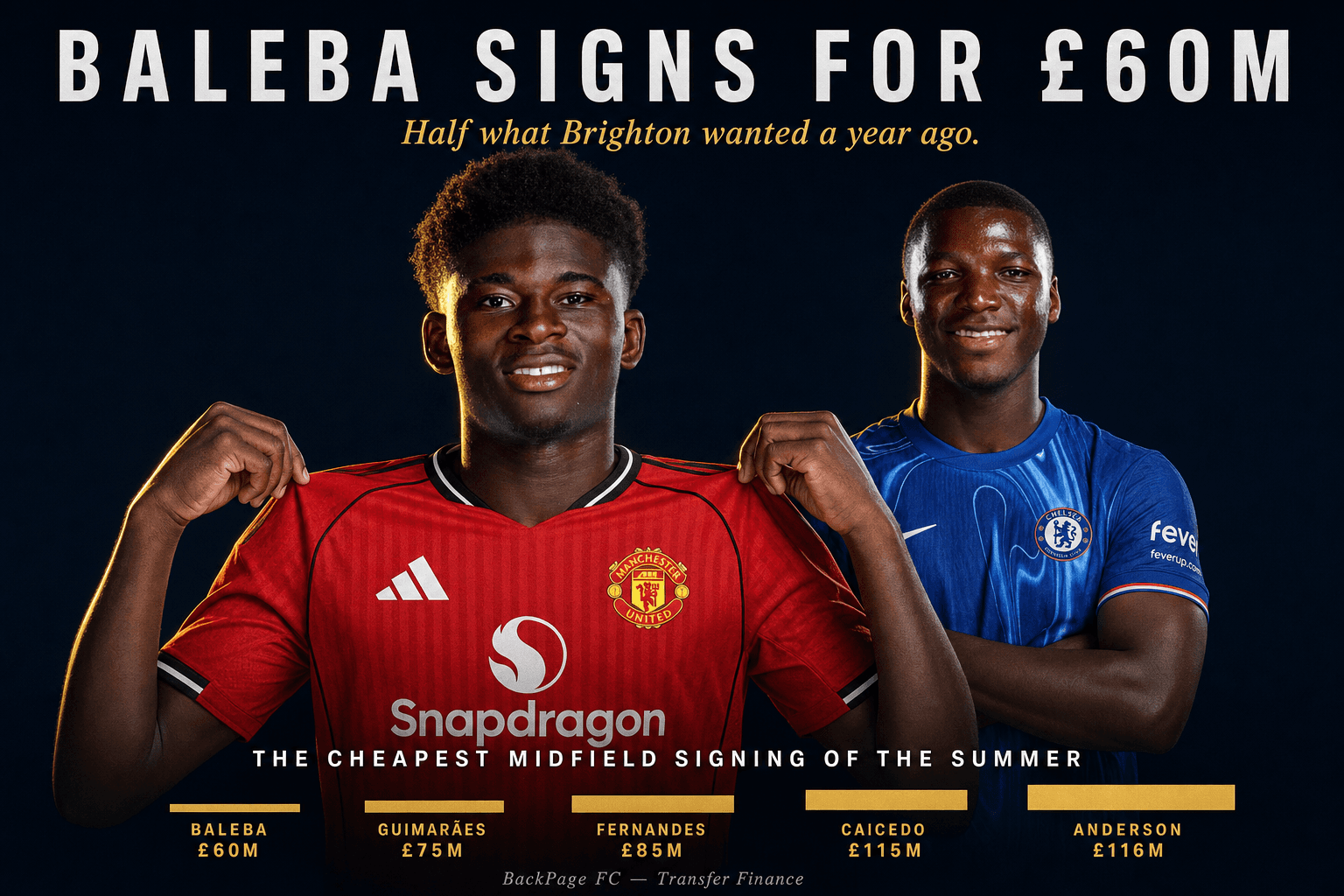
In summer 2025, Manchester United asked Brighton what it would take to sign Carlos Baleba. Brighton told them roughly £115 million, the figure Chelsea had paid for Moisés Caicedo. United walked away.
Twelve months later, they are closing on the same player for around £60 million plus £5 million in add-ons. Personal terms are agreed on a five-year deal to 2031. The same footballer has been repriced downward by close to £50 million in a single season, and he is not injured beyond recovery, not disgraced, not thirty-two years old. He is 22.
Set that against what every other midfielder cost in this same window and the number stops looking like a bargain and starts looking like a question nobody is asking properly.
Every Comparable Midfielder Cost More. Every Single One.
Here is the 2026 window's midfield market, laid out:
Elliot Anderson to Manchester City: £116 million. Sandro Tonali to Tottenham: £100 million. Mateus Fernandes to Tottenham: £85 million. Bruno Guimarães to Arsenal: £75 million. Carlos Baleba to Manchester United: around £65 million.
We covered most of these as they happened. Tonali's move was the centrepiece of our piece on De Zerbi's record-breaking Tottenham rebuild, and it came out of the Newcastle collapse we documented in our piece on how their project fell apart, where a forecast 98.5% squad cost ratio forced the sales of Tonali and Anthony Gordon and ultimately drove Eddie Howe out, covered in our piece on the night he resigned. Bruno's Arsenal move ran through the saga we tracked in our piece on the captain who wanted out.
But the comparison that should genuinely stop you is Mateus Fernandes. Tottenham broke their club record on a 21-year-old with exactly one Premier League season behind him, who was not selected for the World Cup, and who had been relegated with West Ham on the final day of that season. Eighty-five million pounds.
Baleba is 22, has three Premier League seasons behind him and 112 Brighton appearances, and is going for roughly £20 million less than a player who went down with West Ham. Brighton's business is tracked on our Brighton transfer records page, United's on our Manchester United transfer records page.
Tottenham paid £85 million for a 21-year-old who was relegated with West Ham and did not go to the World Cup. Manchester United are paying around £65 million for a 22-year-old with three Premier League seasons, 112 appearances, and a season in which Opta ranked him fourth among all Premier League defensive midfielders for progressive carries. The discount is real. The reason for it is one bad year, and the cause of that bad year was Manchester United.
What Baleba Actually Was in 2024-25
The £115 million valuation was not Brighton being greedy. It was Brighton reading their own data.
In 2024-25, Opta ranked Baleba seventh among all Premier League midfielders for possession regains at 6.5 per 90. Among defensive midfielders specifically, he ranked fourth for progressive carries per 90 at 6.3, behind only Manchester City and Liverpool players. He was second only to Enzo Fernández among defensive midfielders for carries combined with take-ons. He progressed the ball 5.2 metres per carry, bettered by only four nominal defensive midfielders in the entire division. And under genuine pressure, with an opponent within two metres, he completed 81.8% of his passes, tenth among defensive midfielders and ahead of players a decade older.
That is not a promising young player. That is a top-five destroyer-carrier in the division at 21 years old, which is precisely the profile that has been commanding nine figures since Caicedo and Declan Rice moved a month apart in 2023 for fees above £100 million each, a pair Sky now frames as the two best midfielders in the league with both outlays judged justified.
Why This Profile Costs So Much: The Running Data
There is a specific reason the modern number six is the most expensive position in football, and the Premier League's own tracking data spells it out.
Of the ten players who covered the most ground in the Premier League in 2025-26, seven were central midfielders or number tens. Elliot Anderson covered 411.06 kilometres, second most in the entire division, and Manchester City paid £116 million for him. Declan Rice covered 380.22 kilometres, more than any other Arsenal player. Bruno Guimarães set the season's single-match high, covering 13.24 kilometres against Leeds on 7 January 2026, and moved to Arsenal for £75 million six months later.
But the premium is not simply paid for legs, and this is where lazy analysis goes wrong. Caicedo does not appear anywhere in the 2025-26 distance leaders; Chelsea's hardest runner was Enzo Fernández on 384.52 kilometres. Caicedo's value rests on something different: he made more interceptions and tackles than any other Premier League player last season, and completes 88% of his passes under intense pressure.
What every one of these players shares is the third thing, and it is the one that quietly decides these fees. Availability. Of a possible 3,420 Premier League minutes in 2025-26, Anderson played 3,334, which is 97.5% of every available minute. Enzo Fernández played 3,121. Rice played 3,099. Clubs are not paying £100 million for a skill set. They are paying for a skill set that is on the pitch every single week.
The Season That Cost Baleba £50 Million
And that is exactly where Baleba's valuation collapsed.
His Premier League starts fell from 31 in 2024-25 to 23 in 2025-26, while substitute appearances rose from three to eight. He finished the season on 1,662 minutes, under half of the 3,420 available. Against Anderson's 97.5%, that is the entire gap between £116 million and £65 million expressed in one statistic.
The fitness record behind it is not encouraging either. He missed pre-season 2025 with a knee injury, was absent in late December 2025 with a hamstring problem and again in early January 2026, and is currently recovering from an ankle ligament injury that makes him a doubt for the season opener. For a profile whose entire premium is built on availability, that is the single most damaging thing that could have happened to his price.
The Twist: United Caused the Dip They Are Now Profiting From
Here is the part that makes this genuinely one of the strangest transfers of the window.
Baleba's own manager attributed the decline directly to the Manchester United interest itself. Fabian Hurzeler called for patience, noted that Baleba had not completed a full 90 minutes that season, and said plainly that when a young boy reads there is interest from Manchester United with a big, big offer, it might affect him deep, deep down.
So the sequence runs like this. United enquire about Baleba in 2025. Brighton say £115 million. United walk away. Baleba then has the worst season of his Brighton career, which his manager attributes in significant part to the unresolved United interest. And United return twelve months later to buy him for £50 million less, because of a dip their own interest helped cause.
Whether or not you accept Hurzeler's read entirely, the structure of it is remarkable. This is a club being financially rewarded for having unsettled a player and then not signing him.
Why United Need Exactly This, and Why the Timing Fits
United's summer has been deliberately restrained. Before moving for Baleba they had spent just £85 million, against more than £200 million on four players in 2025, when Matheus Cunha, Bryan Mbeumo and Benjamin Sesko arrived.
There is a reason for that restraint, and we explained it in full in our piece on why FFP only applies to clubs who qualify for Europe. United returned to the Champions League, which subjects every pound they spend to UEFA's 70% squad cost cap, while Chelsea and Tottenham, having missed Europe entirely, answer only to the Premier League's more permissive 85% domestic threshold, the system we broke down in our piece on Squad Cost Ratio replacing PSR. That is a genuine competitive disadvantage created by success, and it is why United have been working through affordable, staged deals rather than one glamorous purchase.
Against that constraint, a £65 million bid for a 22-year-old whose ceiling was priced at £115 million a year ago is not a compromise. It is arguably the only kind of deal the ratio permits.
The squad need is unambiguous too. Casemiro has gone. Manuel Ugarte is set to miss most of the season through injury, the World Cup knee damage we covered in our piece on FIFA's Club Protection Programme. Opta identified United's remaining gap the day before the bid as precisely Baleba's profile: an athletic, destructive number six who can also use the ball effectively. And United face a minimum of 48 matches this season after playing only 40 last term, their fewest in 111 years.
A club needing 48 matches of midfield running, with Casemiro gone and Ugarte injured, is not in a position to be picky about a slightly discounted 22-year-old.
The Bet, Stated Plainly
Strip everything else away and Manchester United are making one specific wager. They are betting that a dip caused by a failed transfer is cured by completing one.
If Hurzeler is right that the United interest itself destabilised Baleba, then resolving it removes the cause, and United get a top-five Premier League destroyer-carrier for £50 million below his 2025 valuation. If the decline was actually physical, a body that missed pre-season, two separate injury spells and is now recovering from ankle ligament damage, then United have bought availability risk in the one position where availability is the entire premium.
Note also what is not yet true. As of 19 August 2026, David Ornstein reports the bid sits below Brighton's valuation with no full club-to-club agreement. Sky has the package in excess of £60 million with a five-year contract drafted and Baleba preparing to travel for a medical, but the final fee and structure remain unagreed. This is a deal at the stage where a Here We Go is genuinely a judgement call rather than a fact, which is exactly the tension we examined in our piece on why the Here We Go format hit its ceiling.
Twelve months ago this player cost £115 million and United said no. If they are right about why the price fell, it will look like the shrewdest piece of business in the window. If they are wrong, they will have paid £65 million to find out that Brighton's original number was protecting them from something.
Watch our full breakdown of the Baleba deal and the £50m repricing on BackPage FC Videos.
United walked away at £115m, watched Baleba have his worst season partly because of their own interest, and are now buying him for £50m less. Genius patience or an expensive gamble on a body that keeps breaking? Tell us below.