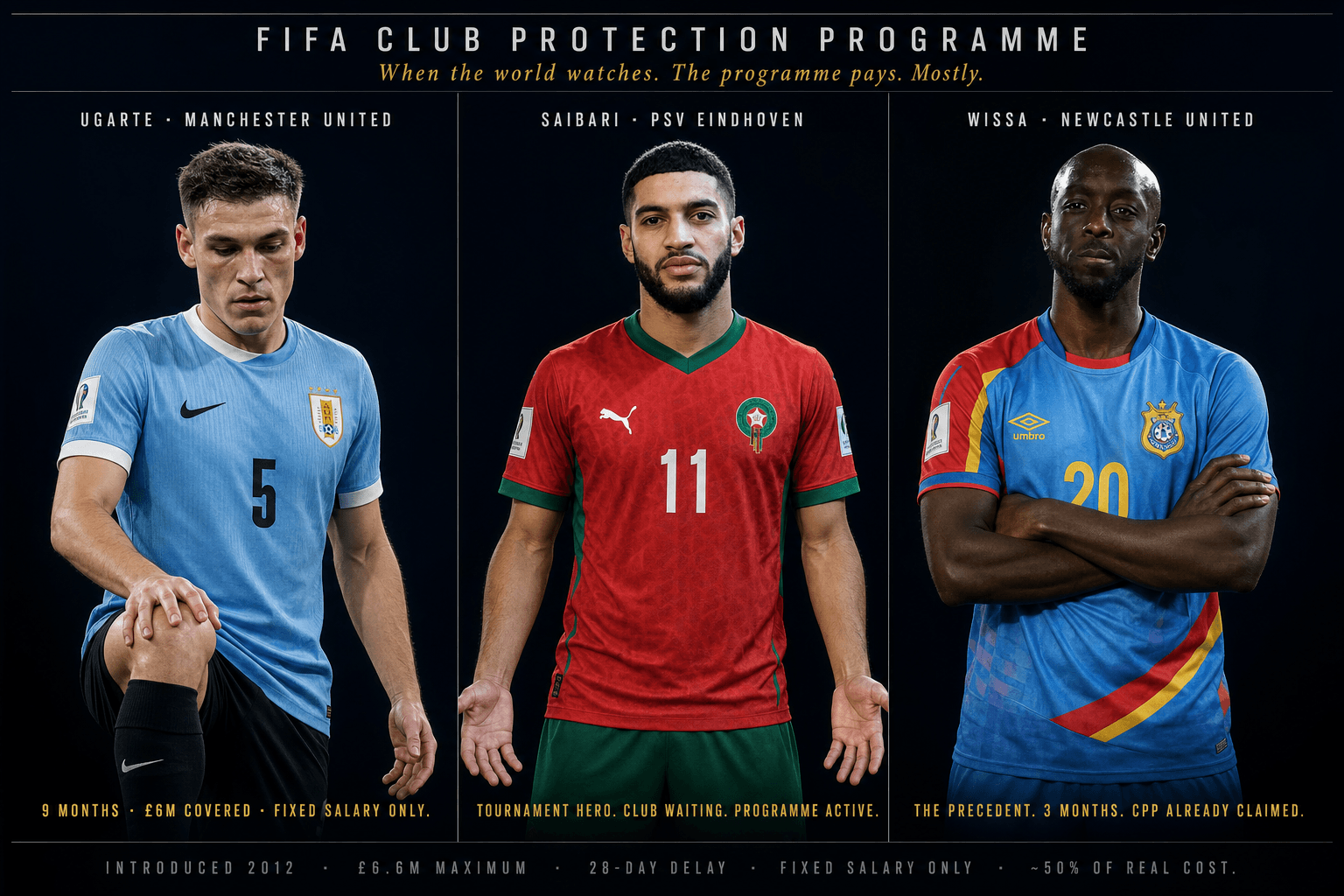
On June 27, 2026, during Uruguay's group-stage match against Spain at Estadio Akron in Guadalajara, Manchester United's Manuel Ugarte attempted a tackle, got his studs caught in the turf, and watched his teammate Mathias Olivera fall onto his outstretched leg. The 25-year-old was stretchered off in tears. Uruguay lost 1-0 — the same result that extended Spain's world-record unbeaten run, as we documented in our piece on Spain's 35-game record and the Portugal Round of 16 preview. Ugarte had knee ligament damage. He was expected to be out for nine months. And Manchester United, who were already rebuilding under Michael Carrick after Casemiro's departure and planning for the summer window, were about to discover what the FIFA Club Protection Programme means in practical financial terms.
What the FIFA Club Protection Programme Actually Is
The FIFA Club Protection Programme — CPP — is one of the least-discussed mechanisms in professional football despite being one of the most important financial instruments that makes the World Cup possible. FourFourTwo confirmed the programme's core function: it compensates clubs when players suffer serious injuries on international duty. It was introduced in 2012 specifically to address the reluctance clubs showed in releasing their best players for international tournaments, when the risk of a serious injury meant the club bore the full financial cost of a player's wages during a long-term absence. The calculation was simple: clubs were being asked to release their most valuable assets to tournaments that generated no direct benefit for the releasing club, while accepting the risk that those assets might return damaged. The CPP was the answer. It shifted the financial risk of international injuries from individual clubs to FIFA — funded by the tournament's commercial revenues — and created the structural basis for a more cooperative relationship between club football and the international game.
The programme describes the injury category that triggers compensation as "temporary total disablement" — a FIFA term for a player who is accidentally injured while on official national team duty and cannot return to club football for an extended period. The CPP does not cover illness, permanent injury, or death. It does not cover medical treatment costs. It covers only the financial loss of having a player's wages paid while they are unable to perform for their club as a direct consequence of an injury sustained while performing for their national team. SPORTbible confirmed that the CPP covers the fixed salary of an injured player for injuries lasting at least 28 consecutive days, up to a maximum of £6.6 million, starting 28 days after the date of the injury and paid pro-rata until the player returns.
The Ugarte Calculation: What Manchester United Actually Receive
The specific financial picture for Manchester United from Ugarte's injury is more complex than the headline figure suggests — and significantly less complete than some initial reporting implied. Yahoo Sports confirmed that Ugarte is expected to be out for nine months, which would potentially entitle Manchester United to close to £6 million through the CPP — eight months of covered wages (28-day delay before payments begin) at approximately £120,000 per week, the programme's salary cap.
The complication, explained in detail by GRV Media's Head of Football Finance Adam Williams in analysis reported across multiple outlets, is that the CPP covers only the fixed salary component. Williams identified three specific costs that FIFA will not cover: performance bonuses (such as the 25% Champions League qualification bonus that United players receive), image rights payments (typically around 10% of a player's total contract value), and National Insurance contributions on wages (15%). Combined, these exclusions mean the actual coverage United receive is closer to 50% of Ugarte's total pay package rather than the full figure. Ugarte's reported wages of £150,000 per week at United — from Capology data — sit above the programme's £120,000 weekly salary cap. FIFA will cover the capped amount. The remaining £30,000 per week, plus the bonuses, image rights, and NI contributions, remains United's cost regardless of the CPP.
The broader point is not that the CPP is inadequate — it is not. It is that the reports claiming United's wages would be "fully covered" were inaccurate in a specific financial sense. United receive significant compensation. They do not receive every pound that Ugarte's injury costs them.
Manchester United will receive close to £6 million from FIFA through the Club Protection Programme for Ugarte's nine-month injury. But the CPP only covers the fixed salary — not the Champions League bonus, the image rights, or the National Insurance contributions. The real coverage is around 50% of the total cost. FIFA pays for the injury. Football's financial complexity pays for the rest.
Why the Programme Exists: The Club-FIFA Tension
The tension between clubs and international football bodies over player release is one of the sport's longest-running structural disputes. The specific problem: clubs pay players' wages, develop their fitness, manage their health, and build tactical systems around them for ten months of the year. Then FIFA or UEFA calls those players to international duty for three weeks — a duration over which the club has no control, receives no revenue, and bears full liability for any injury that occurs. Without compensation mechanisms, the rational response from clubs is maximum resistance to every player release. The 2006 World Cup produced a serious moment of exactly this tension, when major European clubs threatened legal action over the FIFA player release rules. The CPP — introduced six years later — was the specific financial mechanism designed to resolve that tension by making international football financially safer for the clubs that enable it.
The programme was described as a "landmark moment" in strengthening relationships between clubs and national associations. The Insurance Journal's analysis of the programme confirmed that the CPP covers player wages for 365 days maximum, at up to €7.5 million (approximately £6.6 million) per injury, with payments starting 28 days after the injury date. The current version of the programme runs until the end of 2026, making the 2026 World Cup the last tournament covered under its existing terms before renegotiation. Manchester United are not the first or the only club to benefit. Newcastle United received CPP compensation when Yoane Wissa suffered a serious knee ligament injury during an international match with DR Congo the previous September — with United applying for his reported £140,000 per-week wages to be covered across his three-month absence.
The Historical Picture: Why This Matters Beyond United
The CPP is most visible when a high-profile club loses a high-profile player to a serious international injury. Ugarte's case, because it involves a Manchester United player, a World Cup tournament, and a significant financial calculation, generates coverage. But the programme operates across every level of professional football where clubs release players for international duty. The mechanism that protects United from Ugarte's nine-month wage bill also protects Championship clubs whose players are called up for international qualifiers and returned with ACL tears. It also protects League One clubs. The 2012 introduction created a uniform structure across all of FIFA's member associations — the same rules, the same caps, the same payment process — regardless of the club's size or the player's profile.
The specific challenge the CPP faces at the 2026 World Cup — with its 48-team format and expanded calendar — is that the pool of potentially compensable injuries is larger than at any previous tournament. More teams means more players called up. More players called up means more potential injuries. More potential injuries means a larger potential liability for FIFA's compensation budget. The expanded format that FIFA introduced for 2026, which we covered in our analysis of the smallest nations making their World Cup debut, also increases the risk profile for injuries from mismatched contests where smaller nations face significantly stronger opponents — the kind of aggressive physicality in losing causes more injuries than even-contest football.
Ugarte's Return and What It Means for United
For Manchester United specifically, the Ugarte injury created a situation that Adam Williams characterised as similar to a loan deal: a portion of the wages covered, a player absent for a period, a return expected before the following season's critical phases. Tribuna.com confirmed Ugarte has promised to come back stronger — a message he delivered from the Guadalajara medical facility where he received his initial treatment after being stretchered off in tears against Spain. The rehabilitation period of nine months means a return target around spring 2027. If that timeline holds, he would be available for the final months of United's 2026-27 season — the period when Carrick's rebuilt side could be making a late push for whatever position they are targeting. United keep the player. FIFA covers part of the cost. The specific financial impact is manageable. The footballing loss — a central midfielder with international quality absent for the majority of a season — is not fully compensatable by any programme. The money helps. The player's absence is simply the cost of competing at a World Cup that the whole world wants to watch.
The Wider World Cup Injury Picture at 2026
Ugarte's knee injury is the most prominent CPP case at the 2026 World Cup, but he is not the only player whose club will benefit from the programme. Every tournament at this scale produces injuries across the full range of competitive intensity — from the high-tempo knockout matches to the late group-stage games where physical fatigue increases collision risk. The expanded 48-team format, with its three-team group stages and additional rounds of knockout football, creates a higher cumulative physical load than the 32-team tournament that preceded it. The 72-hour minimum rest rule between matches, a new FIFA regulation for 2026, mitigates some of that risk. But the format's additional matches mean the CPP's liability exposure is higher than at any previous World Cup.
The specific irony of the expanded tournament creating more CPP cases is that FIFA chose to expand specifically on grounds of global participation and financial growth. The additional commercial revenue from 48 teams funds, among other things, the CPP that compensates clubs for the injuries that the additional matches generate. The circle is not perfectly virtuous — a club whose key player is injured for nine months receives financial compensation but not the player's contribution on the pitch — but the financial architecture holds. FIFA collects more revenue from the expanded tournament. It uses some of that revenue to compensate clubs for the increased injury risk the expansion creates. It is the specific mechanism that makes professional football's global structure function at the 2026 scale.
FIFA's Club Protection Programme means clubs receive compensation when players are injured at the World Cup — but the coverage is not total, and the financial reality is more complex than the headline figures suggest. Do you think FIFA's compensation to clubs is adequate — and should the programme be reformed before the 2030 World Cup to cover full salary costs? Tell us below.