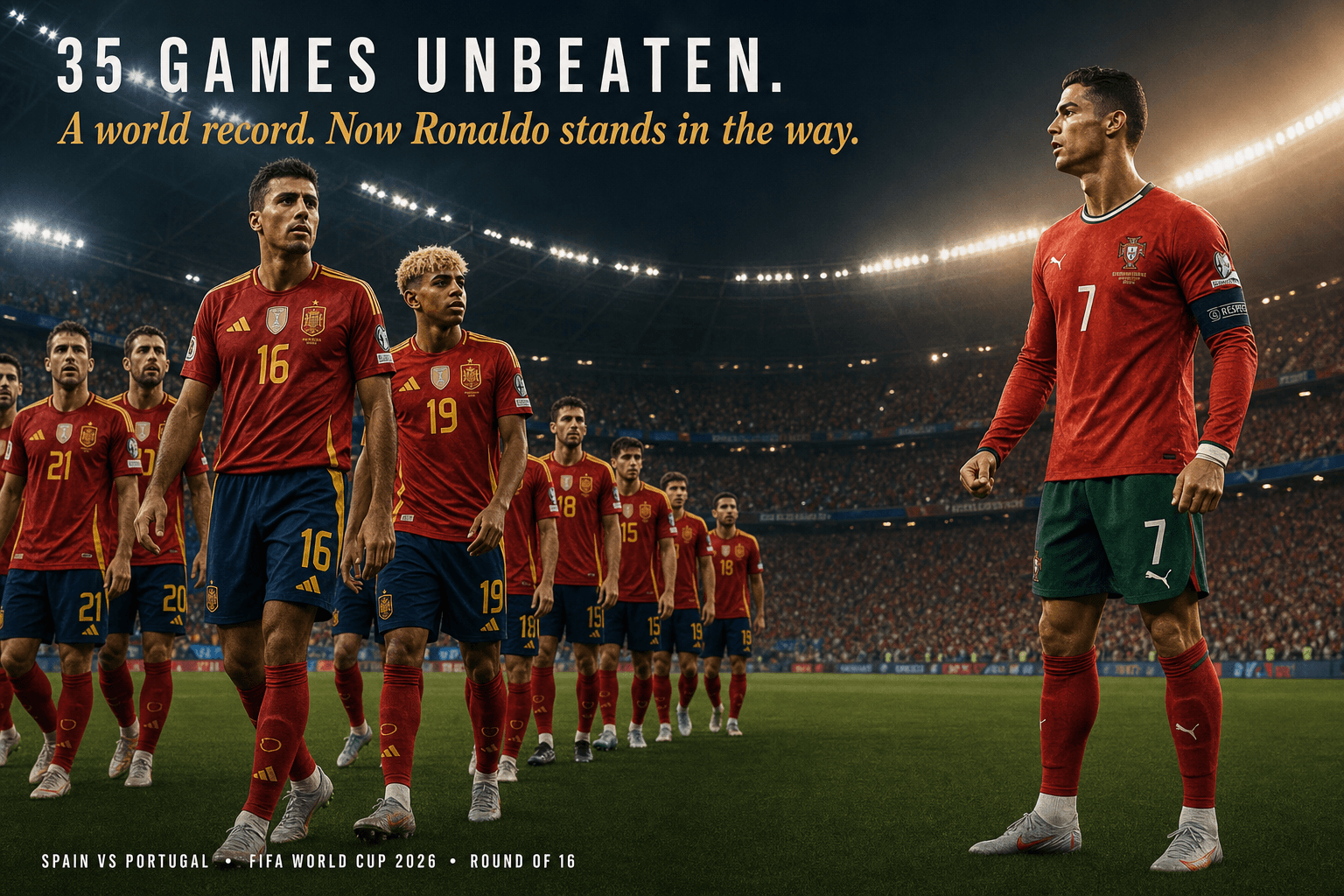
The number is 35. Thirty-five consecutive competitive matches without defeat across three years, two major tournament victories, and one World Cup campaign. That is the span of Spain's unbeaten run entering their Round of 16 match against Portugal at AT&T Stadium in Dallas on Monday July 6. The previous world record — held by Brazil across the period from 1993 to 1998 — stood at 33. Spain broke it on June 27 with their 3-0 win over Austria in the Round of 32. Tribuna.com confirmed Spain set an all-time world record for the longest unbeaten streak in competitive international football — breaking the record Brazil had held for twenty-eight years. And when the final whistle confirmed Spain 3-0 Austria, with Mikel Oyarzabal's second goal in the 89th minute completing a performance of controlled authority, the record was already in Spain's past. The question was never whether they would break it. It was always what number the record would reach when the tournament ended.
Where the Run Began: Scotland, March 2023
Spain's last competitive defeat was on March 28, 2023 — a 2-0 loss to Scotland in a Euro 2024 qualifying match that felt, at the time, like a painful qualifier blip rather than the last time anyone would beat them for three years and counting. Since that night in Glasgow, Spain have played 35 competitive matches and lost none. They won Euro 2024 in Germany — Luis de la Fuente's first major tournament, the generation of Yamal and Pedri and Rodri announcing itself to the world. They won the Nations League. They navigated the entirety of their 2026 World Cup qualifying campaign without defeat, topping their group and arriving in North America as the team with the longest documented unbeaten streak in the history of competitive international football. The qualifying record. The tournament record. The clean sheet record across four World Cup matches. All of these sit alongside the world record number, and all of them point to the same conclusion: the Spain of 2023-2026 is the most statistically consistent national team in the history of the sport.
The specific context of the run across these three years connects to multiple stories in BackPage FC's coverage. The decision to build Spain without Real Madrid's players — a squad built on Pedri, Gavi, Yamal, Rodri, Oyarzabal — was a story we covered in our piece on how Florentino Pérez's Galáctico model intersected with Spain's squad composition. The decision not to select Real Madrid's Bellingham, Vinicius, or Mbappé — players who are not Spanish — is less contentious than it seems. What is genuinely striking is that De la Fuente has built one of the greatest international sides in history without depending on any single club's identity. The Barcelona influences run through it. The Athletic Bilbao connection through Williams (who is out injured for this match with an adductor problem). The Sociedad core through Oyarzabal, who has four tournament goals in Dallas. The run belongs to all of them.
The Stats That Define the Record: Zero Conceded, Full Control
The headline number is the unbeaten streak. But the supporting statistics at this World Cup make the headline number more comprehensible. Spain have conceded zero goals in four matches — only Mexico matches that record at this tournament, as we noted in our Ecuador vs Mexico analysis. They drew 0-0 with Cape Verde in a match that, as we documented in our piece on Cape Verde's extraordinary World Cup debut, required Vozinha's seven saves and the top corner to keep out — it was not a comfortable 0-0. They beat Uruguay 1-0 in a match where their possession dominance was comprehensive without being spectacular. And they beat Austria 3-0 in a Round of 32 performance that Sports Mole confirmed was Spain's first knockout stage win at a World Cup since Andrés Iniesta's goal beat the Netherlands in the 2010 final — sixteen years of knockout frustration, ended with a performance of controlled dominance.
The in-contest possession numbers that underpin the run are explored in our dedicated piece on how in-contest possession explains the 2026 World Cup better than conventional statistics. The short version: Spain have been the masters of minimising contested possession across the unbeaten run. Their technical quality at every position — from Unai Simón's sweeping distribution to Rodri's ability to receive under pressure and immediately recycle — keeps the ball in controlled possession rather than contested space for a higher proportion of each game than any other team at this tournament. That is not simply having more possession. It is having possession that does not generate the dangerous in-contest moments from which opponent attacks are built. Zero goals conceded in four games is the result. The statistical explanation sits in the in-contest numbers.
Brazil's world record of 33 consecutive unbeaten competitive matches stood for twenty-eight years. Spain broke it on June 27 with a 3-0 win over Austria — their first knockout win at a World Cup since the 2010 final. They have not conceded in four World Cup matches. They have scored eight. Ronaldo stands between the record and its continuation on Monday. He has been substituted in his last match while the score was level. He has never beaten Spain at a World Cup. The record has never felt this exposed.
Spain vs Portugal: The Match That Should Be a Semi-Final
The specific cruelty of the 2026 World Cup bracket is that it has placed Spain and Portugal in the same Round of 16 tie. One of the two nations most likely to represent Europe in the World Cup final — alongside France — will be eliminated before the quarter-finals. Goal.com confirmed this is the first World Cup meeting between the two Iberian rivals since the 2018 3-3 draw in Russia — the match where Ronaldo completed a hat-trick with a sublime 88th-minute free-kick against David de Gea to deny Spain a win. That draw belongs to a different era. Spain were not 35 matches unbeaten in 2018. They had not won Euro 2024 in 2018. They were not the team that has conceded zero goals at a World Cup while scoring eight. The 2026 version of this match has a different weight of evidence behind it.
Portugal's route to this point has been harder than Spain's but also more fragile. ESPN confirmed that Portugal drew twice in the group stage before a 5-0 win over Uzbekistan, then beat Croatia 2-1 in the Round of 32 with Gonçalo Ramos scoring a 94th-minute header after Ronaldo was substituted at 1-1 in the 80th minute. Croatia actually had more shots on goal than Portugal in that match — 6 to 3. Portugal's defence came under intense pressure, and if not for controversial offside calls, they would have conceded multiple times. The midfield of Vitinha, João Neves, and Bruno Fernandes has not performed at its best. The defence, despite Rúben Dias, has looked vulnerable under sustained pressure. The team Roberto Martínez is bringing to Dallas is competitive, talented, and full of the quality that makes Portugal a potential world champion. It is also not, at this moment, a team playing anywhere near its ceiling.
Yamal and Ronaldo: The Generation Gap in a Single Match
The individual narrative that this match generates is unavoidable. Lamine Yamal is 17. Cristiano Ronaldo is 41. The footballer universally regarded as potentially the greatest of the next twenty years against the footballer who has collected more records than any European player in history. Ronaldo has scored 25 career goals at major international tournaments — five more than any other European man. His three goals at this World Cup include his first-ever knockout stage goal, scored from the penalty spot against Croatia. His sister Katia has described this as his last dance with Portugal. In Dallas on Monday, the last dance faces the most sustained defensive unit in international football's recent history — a back four of Llorente, Cubarsí, Laporte, and Cucurella that has not conceded once across four matches.
Yamal, by contrast, is playing at the World Cup at an age when most footballers are in their clubs' B teams. He scored at this tournament. He is the focal point of Spain's right-sided attack that has produced the majority of their goals and the most dangerous individual moments of their campaign. Squawka's model gives Spain a 64% chance of advancing, with betting markets pricing Spain at -111 (favourites) and Portugal out at +300. The generational comparison between the two players operates on an aesthetic level for the narrative, but for the actual football it is the Rodri vs João Neves midfield contest that will likely determine the match's tempo and, through that, its outcome.
What Portugal's 2025 Nations League Win Means for Monday
The most important recent form reference — more important than Spain's world record run in isolation — is the specific result between these two teams in the 2025 Nations League final. Portugal beat Spain in that final. It was the most recent competitive meeting between the two nations. It confirmed that Portugal can defeat Spain when the tactical preparation is specific, when the squad motivation is aligned with a clear tactical plan, and when their midfield produces the kind of performance that overcame Spain's possession dominance. Roberto Martínez will have had that result and that match analysis in his preparation since the bracket was set. De la Fuente will have examined every angle of that defeat since the final whistle confirmed it. The Nations League result does not invalidate the World Cup record. It confirms that Portugal have the specific capacity to produce the right performance to end it.
The tactical tension in this match is between Spain's desire to control in-contest possession — to keep the ball in their possession so completely that Portugal never generate the transition moments from which Ronaldo and Leão are most dangerous — and Portugal's desire to press high and win the ball back quickly enough that Fernandes and Neves can dictate terms in the midfield battle. Both teams average over 60% possession at this World Cup. In a match between two teams who both want the ball, the in-contest moments will be contested at a higher intensity than in any other match this tournament. The team that wins those specific moments — the duels, the second balls, the loose-ball situations — wins the match. As we noted in our in-contest possession explainer, Spain's 9% tournament average at 2022 was the lowest in the competition. They are attempting to replicate that control in 2026. Portugal, through Neves and Vitinha's technical quality in the press, will attempt to force that number higher.
The Record Beyond Monday: What Spain Need to Break 40
The world record, extended to 35 on July 2, can keep growing only if Spain keep winning. The path to the World Cup final — Portugal on July 6, then the winner of USA vs Belgium, then the semi-final, then the final on July 19 in New Jersey — produces a possible maximum of four more matches. If Spain win the tournament, their unbeaten run reaches 39 competitive matches. They would need a further six competitive matches after the World Cup final to break the 40-match barrier. The record that Brazil held for twenty-eight years would be rendered increasingly remote. The record that was already being called the most unbreakable in international football before Spain began this run now sits at 35 and counting.
The specific conversation about the World Cup double that was documented in our piece on the only two managers to have won both the Champions League and the World Cup is relevant here: only Vicente del Bosque has won the World Cup with Spain, in 2010, the same summer that Iniesta's goal beat the Netherlands. De la Fuente is not del Bosque. But Spain at 2026 are the most equipped Spanish team to win a World Cup since that 2010 group. Zero conceded. Eight scored. Thirty-five unbeaten. Portugal on Monday. The record is real. Whether it can survive Ronaldo's last dance is the specific question that AT&T Stadium in Arlington answers at 3pm ET.
Spain have broken the world record for consecutive unbeaten competitive matches. They have conceded zero at this World Cup. Ronaldo's last chance to beat them stands on Monday at Dallas. Does the record survive Portugal — and can Spain win this World Cup to make the number 39? Tell us below.