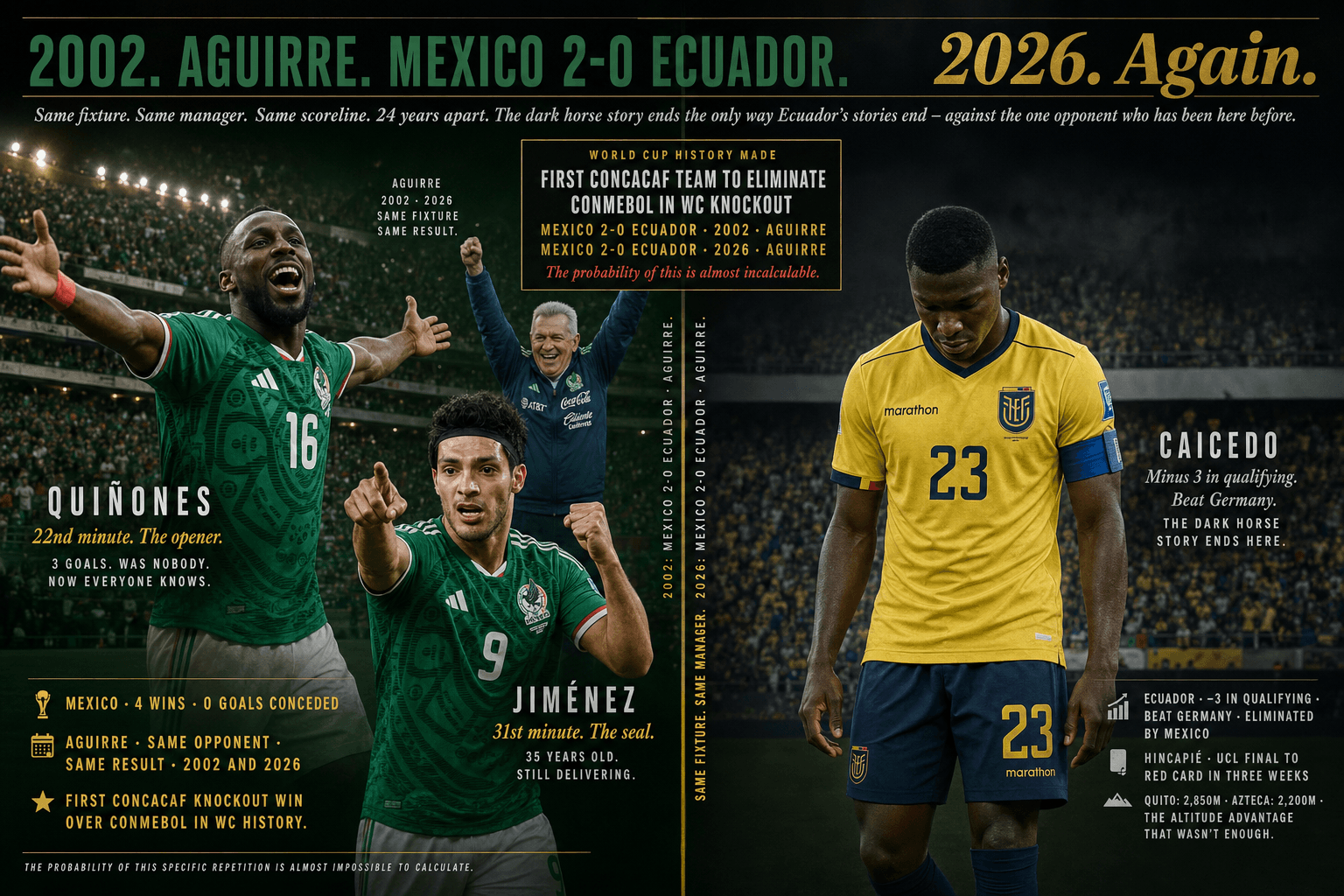
There is a football statistic so specific it sounds invented. Mexico's only previous World Cup knockout victory over a South American opponent — across the entire history of CONCACAF football at the tournament — came against Ecuador, in 2002, with Javier Aguirre as the coach. On Tuesday 30 June 2026 at Mexico City Stadium, Javier Aguirre watched his Mexico side beat Ecuador 2-0 to reach the Round of 16. Same fixture. Same manager. Different generation of players. The same result, to the same decimal place of scoreline. Ecuador, who had started this World Cup campaign minus three qualifying points, beaten Germany in the group stage, and arrived at the Azteca as the most compelling underdog narrative of the tournament — left the same way they arrived in international football's consciousness: on the losing end of a Javier Aguirre preparation.
The Match That Started an Hour Late and Ended in Nine Minutes
The context of Tuesday's match at Mexico City Stadium had been set in our Ecuador vs Mexico Round of 32 preview — the altitude argument, the clean sheet records, the specific tactical question of whether Mexico's defence had been tested by the kind of deep-sitting opponent Ecuador represent. What nobody planned for was a thunderstorm. The round-of-32 match was delayed for a full hour due to stormy weather. When it finally started, Mexico played as if the delay had only increased their energy. Wave after wave of attacks in the opening fifteen minutes. Julian Quiñones curling narrowly past the post. Raúl Jiménez heading wide. Ecuador looked exactly like a team that had absorbed an hour of waiting for a hostile stadium to finally be allowed in.
Quiñones scored in the 22nd minute — Roberto Alvarado's through ball, a run down the left, a powerful drive into the near post. Jiménez added the second nine minutes later, pouncing on an Ecuadorian error, playing a give-and-go with Quiñones and finishing confidently. Two goals in nine minutes. Ecuador, who had conceded only two goals across the entire group stage, had conceded both in the space of less than a quarter of the first half. The scoreline at half-time said everything the second half confirmed: Mexico 2-0 Ecuador. Mexico comfortable. Ecuador with almost nothing.
The statistical context makes the scoreline slightly misleading in terms of how the second half played: Ecuador's expected goals figure of 0.73 across the whole match suggests they created some threat, and goalkeeper Raúl Rangel made one fine save to deny John Yeboah. But Mexico were in control throughout — Beccacece made multiple substitutions to try to force the issue and found no avenue. Ecuador substitute Kevin Rodriguez poked just wide with fifteen minutes remaining. Their last genuine chance at this tournament disappeared into the side-netting.
The Unique Stat Nobody Was Saying Out Loud
Opta confirmed it after full time: Mexico have become the first CONCACAF team in history to eliminate a CONMEBOL nation in a World Cup knockout match. South American teams had won every single previous knockout meeting between CONCACAF and CONMEBOL nations at the tournament. Mexico's 2-0 win over Ecuador was not merely a World Cup result. It was the first time in the tournament's entire history that the balance of power between North and Central America and South America had tilted in a knockout game. Every previous knockout meeting had gone South America's way. This one did not.
And the second unique stat, which makes the first even more extraordinary: Mexico's only previous knockout-round win against South American opposition at a World Cup had also come against Ecuador — in 2002, also with Javier Aguirre as head coach. Two knockouts. Same fixture. Same manager. 24 years apart. The only CONCACAF over CONMEBOL knockout win in history until Tuesday happened to be the same CONCACAF team, the same CONMEBOL team, the same manager. The probability of that specific repetition is almost statistically impossible to calculate.
Mexico's only World Cup knockout win over South America before Tuesday was against Ecuador in 2002 — also with Javier Aguirre coaching. They also ended a 40-year knockout curse, became the first CONCACAF team ever to eliminate a CONMEBOL nation at a World Cup, and fielded the second-youngest knockout starter in World Cup history. All in one Tuesday night. All while an hour of thunderstorms waited outside the stadium gates.
Hincapié's Red Card: From Champions League Final to Early Bath in Three Weeks
Ecuador's evening ended with the single image that will define how their 2026 World Cup is remembered for the wrong reasons. Piero Hincapié — the Arsenal centre-back who played 90 minutes of the Champions League final in Budapest against PSG three weeks ago — was sent off in stoppage time for covering his mouth during a confrontation with Mexico forward Santiago Giménez. The sending-off, under anti-discrimination rules that punish players for concealing comments during confrontational exchanges, ended Ecuador's match in the worst possible way.
The specific cruelty of the timing is worth noting. Hincapié arrived at this World Cup having just competed in the Champions League final — the two Ecuadorian centre-backs on opposite sides of the same UCL final, Pacho and Hincapié, was the defining background detail to Ecuador's pre-tournament narrative, as we covered in our Ecuador dark horse analysis. He had been one of the best-performing defenders in European football's most prestigious competition. He then received a red card in stoppage time of a 2-0 defeat. The contrast between Budapest and Mexico City in the space of three weeks is a specific kind of football cruelty that produces no lesson and requires no explanation. It just happened.
The Altitude Argument — and Why Ecuador's Greatest Advantage Didn't Travel
The pre-match argument in favour of Ecuador, which we made explicitly in our Mexico vs Ecuador preview, rested partly on altitude. Ecuador train and play their home games in Quito at 2,850 metres above sea level. The Azteca sits at 2,200 metres. Our argument: Ecuador would be more comfortable at altitude than any European opponent Mexico had faced. They would not experience the oxygen depletion that European teams felt at 2,200 metres, because they trained every day at 650 metres above that.
The thunderstorm delayed the game by an hour. When it finally started, Mexico — playing at their home stadium, in front of a capacity crowd that had been waiting in that same storm for an extra hour — flew out of the blocks with the kind of energy that altitude does not diminish. The crowd noise at Mexico City Stadium in the first twenty minutes was a physical force that Ecuador could not prepare for regardless of their physiological acclimation. Beccacece's system — the disciplined block, the patient defensive structure, the single counter-attack converted from a set piece — is designed for the knockout football of a single moment. Against Mexico at the Azteca, the single moment arrived in the 22nd minute, from Mexico's side. Ecuador were unable to trouble the co-hosts throughout the match, despite their expected goals figure suggesting some threat was created. The system that worked against Germany — organised, patient, waiting — did not work against a home nation crowd that had been building for 90 minutes before a storm even cleared.
The Ecuador Dark Horse Arc: From Minus Three to Germany to Exit
The full story of Ecuador's qualifying campaign — the Byron Castillo point deduction, the five goals conceded in eighteen matches, the defensive record that prompted the dark horse label — is told across three BackPage FC pieces: our Ecuador dark horse analysis, our Byron Castillo deduction explainer, and the Mexico Round of 32 preview. The short version of the arc is this: a team that started qualifying on minus three, beat Germany to advance from the group stage, and then conceded twice in nine minutes to a home nation in a delayed knockout match at altitude. The Germany result — Gonzalo Plata's 77th-minute winner from a Kevin Rodriguez corner flick — will define Ecuador's 2026 World Cup. The Mexico result will be the footnote. A team that came further than almost anyone predicted, beaten at the last viable hurdle by the one specific combination — home crowd, home altitude, the same manager who beat them before — that their system could not dismantle.
Ecuador conceded four goals in four World Cup matches. Their qualifying record was five in eighteen. The improvement in goals conceded per game relative to qualifying — 1.0 per match at the World Cup versus 0.28 in qualifying — suggests the level of opposition stepped up in ways Beccacece's defensive structure could not fully absorb. The blueprint worked against Germany. It did not work against Mexico when the crowd and the manager and the weather and the history all combined in Mexico's direction simultaneously.
What Comes Next: England at the Azteca — and the QF Beyond
Ecuador's elimination means the Round of 16 fixture at the Azteca on Sunday July 5 is confirmed: Mexico vs England. Tuchel's side beat DR Congo 2-1 — Harry Kane scoring twice, Anthony Gordon setting up both goals from the bench after England went behind early. The details of what England face next — the Azteca's altitude, the 100,000-capacity crowd, Mexico's four-game unbeaten and clean-sheet run including Tuesday's dominant display — are covered in our preview of how knockout football at altitude works against teams who have not experienced it. More specifically, the potential consequence of England winning that match — a quarter-final against Brazil, Tuchel vs Ancelotti, the head-to-head record that sits at 0-2 in Ancelotti's favour through UCL knockout ties — is the tournament's defining narrative, covered in full in our Tuchel vs Ancelotti head-to-head analysis.
For Ecuador, Sunday is watching. The dark horse that beat Germany is watching England try to win at the stadium where Ecuador just lost. The altitude is the same. The crowd will be the same. The Mexican pressure from the first minute will be the same. Mexico are now unbeaten in 10 World Cup matches at Mexico City Stadium. Goalkeeper Raúl Rangel has kept four consecutive clean sheets at this tournament. Ecuador tested both records. Ecuador could not break either. England will attempt the same task on Sunday, carrying the weight of a historically difficult away record at this specific venue — and the knowledge that the team that couldn't break Mexico's home fortress on Tuesday was the one that had beaten Germany.
The Gilberto Mora Detail: 17 Years Old, Second Only to Pelé
One statistical footnote from Tuesday's match deserves its own sentence. Gilberto Mora, Mexico's 17-year-old midfielder, was named in the starting lineup for Mexico — becoming the second youngest player to start a knockout match at the World Cup finals, behind only Pelé in 1958. Mora was 17 years and 259 days old. Pelé was 17 years and 239 days when he started his first World Cup knockout game — 20 days younger. Mexico started a 17-year-old against Ecuador in the first knockout round. He was nearly the youngest knockout starter in World Cup history. He performed sufficiently well that Aguirre trusted him for the full first half. The generation behind Jiménez and Quiñones, who are 35 and 29 respectively, has a specific face. England will need to deal with that face on Sunday too.
Mexico's Clean Sheet Record: What England Must Break on Sunday
Tuesday confirmed what the group stage had suggested: Mexico under Javier Aguirre are the hardest team to score against at this tournament. Four games. Zero goals conceded. Raúl Rangel, the goalkeeper who has emerged from relative obscurity to become the tournament's outstanding last line of defence among the field's remaining sides, has not been beaten once in 360-plus minutes of World Cup football. Ecuador, who were not a weak attacking team — they beat Germany, they had Willian Pacho and Piero Hincapié at the back, they had a system designed to grind — managed zero shots on target of consequence across the full ninety minutes. The two Ecuador goals conceded in this year's group stage were both set-piece moments or transitions. Against a Mexico defensive unit that specifically organises to eliminate those situations, Ecuador had no plan B.
England now face that same clean sheet on Sunday. The full preview of what Tuchel's side must produce to break Mexico's home World Cup record — and what it means for the potential quarter-final meeting with Ancelotti's Brazil, a storyline covered in our Brazil vs England quarter-final preview — is the next chapter in the tournament's central narrative. Ecuador tried the system that beat Germany. It was not enough for Mexico City. Now England try something different, with different players, at the same stadium, against the same clean sheet record, under a manager who the head-to-head numbers say has never beaten the man who might be waiting in the quarter-final.
Ecuador's dark horse run ended 2-0 at the Azteca. Mexico's 40-year knockout curse is over. England face the same stadium, the same crowd, the same clean sheet on Sunday. Can Tuchel succeed where Ecuador failed — and does Mexico's four-game record mean they are the most dangerous team nobody is discussing? 👇