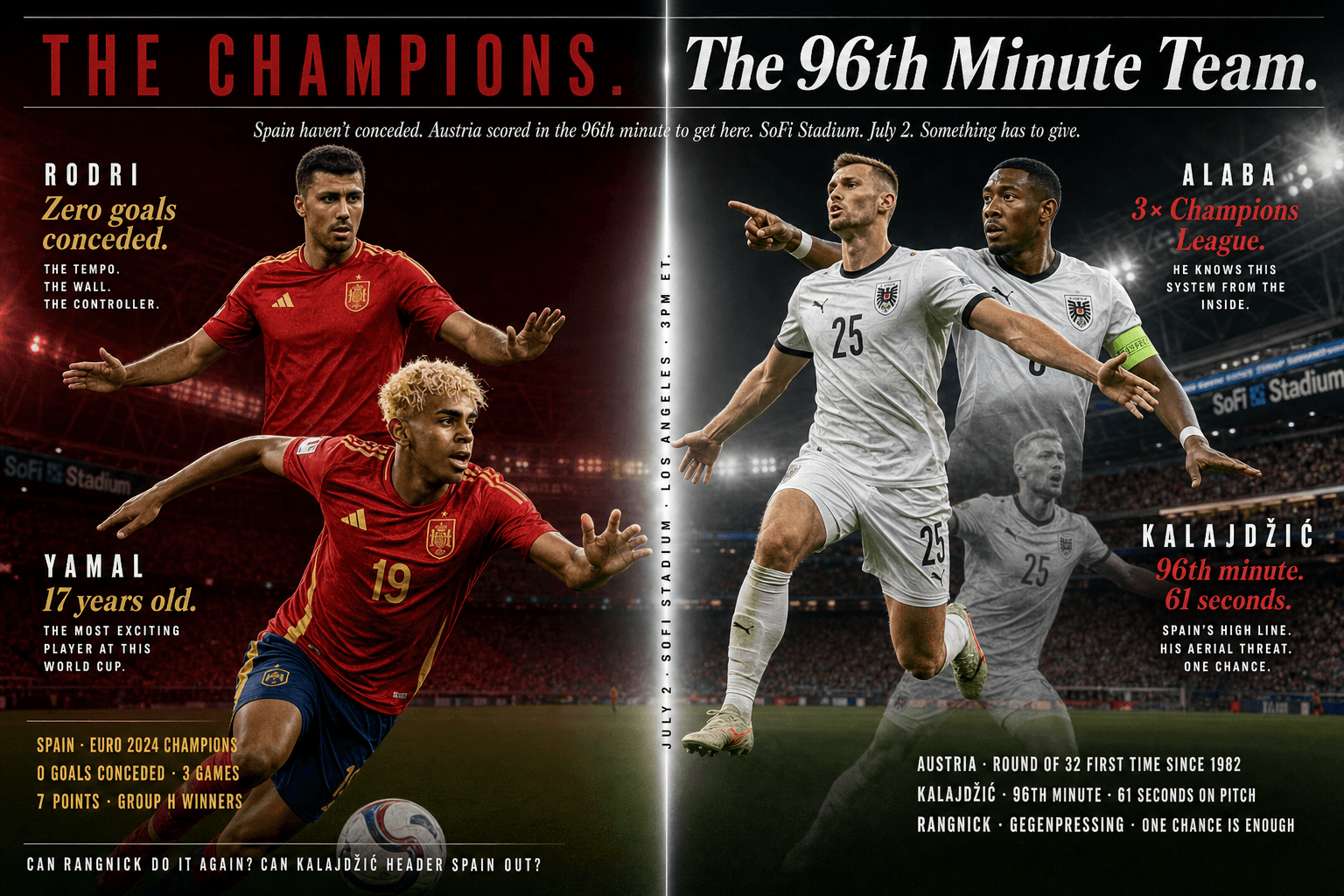
Three days ago, Saša Kalajdžić came on in the 90th minute with Austria heading out of the World Cup, scored with his first touch 61 seconds later, and turned Kansas City into a scene of collective national hysteria. The moment — its drama, its improbability, the specific cruelty of Riyad Mahrez's 93rd-minute goal that had appeared to seal Austria's fate just before Kalajdžić sealed it back — is covered in full in our piece on the Kalajdžić story and what that goal means. This piece is about what happens on Thursday 2 July at SoFi Stadium in Los Angeles, when Austria face Spain — the European champions, the reigning Euro 2024 winners, among the genuine favourites to lift the World Cup on 19 July in New York — and try to do something that would be more surprising than anything that happened in Kansas City.
Spain's Group Stage: Controlled, Clinical, Not Yet Brilliant
The tournament summary for Spain heading into the Round of 32 is better read as a statement of intent than a declaration of dominance. Three group games: a 0-0 draw with Cape Verde, a 4-0 dismantling of Saudi Arabia, and a 1-0 win over Uruguay in Guadalajara. Seven points. Group H winners. The Cape Verde draw was the first moment of interest — Luis de la Fuente's side could not break down a compact defensive block from a nation ranked far below them for the entirety of 90 minutes. The Saudi Arabia result restored confidence. The Uruguay win showed the ability to grind through a difficult opponent with patience and a single moment of quality.
Spain have not conceded a goal in the tournament. Their captain Rodri — the player who arguably embodies the modern Spanish midfield philosophy most completely — has controlled the tempo of all three matches from a deep position. Lamine Yamal, at his first World Cup, has produced flashes of the individual quality that makes him the most exciting young attacker in the sport. Mikel Oyarzabal leads Spain's scoring at this tournament with two goals. The squad that contains no Real Madrid players — a historical anomaly we explored in our analysis of how Florentino Pérez's Galáctico model created an unexpected national team consequence — has navigated the group stage without the kind of breakout performance that announces a team as tournament winners. They look like the level. They have not yet looked like the ceiling.
Austria's Full Group Picture: More Than the Algeria Drama
The Kalajdžić moment has understandably consumed the coverage of Austria's group stage. But a complete reading of their tournament tells a more nuanced story. Austria opened with a 3-1 win over Jordan in San Francisco — Marko Arnautovic, Marcel Sabitzer, and an own goal doing the damage. They then lost 2-0 to Argentina in a match they managed respectably rather than competed in fully. Then Kansas City. The sequence shows a team that performs best when the opponent provides space on the transition, struggles when the opponent controls possession in the way Argentina do, and produces its most extreme quality in the highest-pressure moments. That profile is relevant against Spain, who are much closer to Argentina's style than Jordan's.
The key figure in Austria's tactical makeup is not Kalajdžić or Arnautovic. It is David Alaba, the captain, Real Madrid's left-back for the previous decade, a three-time Champions League winner whose reading of the game under pressure gives Austria a defensive intelligence that raw numbers about their group stage do not fully capture. When Austria defend against Spain's possession, Alaba's positioning — his ability to shift across, cover, and redistribute — is what keeps the defensive shape intact long enough for the transition moments to arrive. Nicolas Seiwald and Xaver Schlager provide the midfield engine in a double pivot that Rangnick uses to protect space while pressing aggressively when the ball enters specific zones.
The Tactical Problem Spain Poses — and Why Austria Have One Specific Answer
Spain's system under De la Fuente is built around high positioning of the centre-backs when in possession — pushing them wide to create a back-three shape that allows Rodri to operate between the lines rather than as a pure defensive midfielder. The full-backs — Alejandro Grimaldo on the left, whose attacking output from Bayer Leverkusen has been outstanding — push extremely high, creating width that forces the opposition's defensive line to choose between tracking the movement or holding shape. Yamal on the right produces the same problem from the other side. The combination creates situations where a team defending against Spain finds itself stretched horizontally while Pedri and Fabián Ruiz combine vertically through the centre.
Austria's answer to this is not to defend it passively. Rangnick's gegenpressing approach specifically targets the moment Spain's full-backs are high — when the transition moment occurs and those full-backs are caught in advanced positions — as the specific window where a direct ball into the channels, aimed at Arnautovic's movement or Kalajdžić's aerial presence, creates a two-versus-two or three-versus-two situation in Spain's half. Tactical analysis from Juvefc confirms the central battle is Spain's midfield press versus Austria's ability to transition quickly — Rodri will look to deny Seiwald and Schlager time to turn and supply the forwards. The race is between Spain winning the ball back before Austria can execute the counter, and Austria making the transition fast enough that Spain's press arrives too late.
Set pieces are Austria's most reliable route to a goal. Kalajdžić's header against Algeria was a set piece. Arnautovic's opener against Algeria came from Alaba's lofted pass over the defence — not a conventional set piece but the same principle: aerial quality exploiting the space behind Spain's high defensive line. Austria are one of the best aerial teams in this tournament. Spain, whose defensive shape relies on a high line and positional coverage rather than dominant aerial defenders, are specifically vulnerable in exactly this way.
Spain have not conceded a goal at this World Cup. Austria scored three against Algeria and needed all of them. The match in Los Angeles on July 2 is the meeting of the tournament's tightest defence against the team whose most dramatic moment came in the 96th minute. One of those trajectories has to give. Rangnick's bet is that a single set-piece moment in the second half, with Kalajdžić on the pitch and the Spanish full-backs high up the field, is enough.
Key Battles: Where the Match Is Won or Lost
Rodri vs Seiwald/Schlager: Spain's midfield control depends on Rodri establishing his position as the tempo-setter. If Seiwald and Schlager can press high enough to deny him easy first touches and prevent him from playing forward quickly, they disrupt the central mechanism through which Spain build their attacks. If Rodri operates freely, Austria will spend large portions of the match defending without the ball.
Yamal vs Austria's left side: Lamine Yamal at 17 is the youngest player at a World Cup of this scale with this level of performance behind him. His movement against Austria's left side — whether that is Philipp Mwene or another option at left-back — will be the first test of the match. Austria's experience of high-quality wingers in the group stage was limited: Jordan and Algeria do not carry Yamal's level of technical and physical threat. The first time he receives the ball in space, the game has begun in earnest.
Kalajdžić/Arnautovic vs Spain's centre-backs: Spain defend with a high line and positional intelligence rather than physical dominance. Arnautovic, at 37, still has the upper body strength and movement to cause problems in the channel. Kalajdžić, at 6ft 7in and now playing on the confidence of the Algeria header, is Austria's single most dangerous weapon from set pieces and direct balls. Whether Spain's centre-backs — who have not been seriously tested by aerial quality in the group stage — can handle that specific threat is the question Austria's set-piece preparation will have been entirely focused on.
What Austria's History at Major Tournaments Says About This Match
Austria's best World Cup finish remains third place, at the 1954 tournament in Switzerland. They beat Uruguay 3-1 in the third-place play-off at a tournament where they also conceded seven goals to West Germany in a quarter-final — a match that remains the highest-scoring quarter-final in World Cup history. The 1954 team had quality in individual players. The 2026 team has a system. Rangnick's gegenpressing approach is a genuine tactical philosophy, not a collection of talented individuals trying to find a way to make things work. The question is whether the system, applied to a squad that contains multiple Champions League-level players (Alaba, Sabitzer, Arnautovic) alongside the specific weapons of Kalajdžić and the double pivot, is sufficient to create the kind of problem Spain cannot manage for ninety minutes.
Austria have not beaten Spain since 1978. The historical record at major tournaments overwhelmingly favours Spain. But Austria have qualified as a team that responded to being 3-2 down in the 93rd minute by scoring immediately. They are a team that wins through specific moments rather than sustained domination. Against Spain, who have not been at their absolute ceiling in this tournament, the specific-moment approach is their only realistic route to an upset.
Prediction: Spain, But Make Austria Work for Every Minute
Spain win this match. The probability gap between the two squads — between a nation that won Euro 2024 with a generation of players at their peak, and a nation that scored their most important goal in 44 years via a substitute who had been on the pitch for 61 seconds — is real and significant. Kick-off is 3pm ET on July 2 at SoFi Stadium, Los Angeles. Spain are 3/10 on the leading betting markets. That price is justified.
But Austria will not be passive. Rangnick's teams are never passive. They will press from the front, they will look for the transition moment, and they will have specific set-piece routines designed to give Kalajdžić and Arnautovic the aerial opportunities that Spain's defensive line is specifically vulnerable to. If either of those opportunities arrives in the first sixty minutes, the nature of this match changes entirely. A team playing with house money — a team that has already done the impossible once this tournament — is a different kind of opponent from one whose identity requires them to win.
Spain 2-0 Austria is the most likely result. Spain 2-1 Austria is the result that feels most like this specific Austria team. And if the match reaches the 90th minute with Austria still in it, everything that happened in Kansas City says you do not count them out until the final whistle is blown.
Alaba's Role: The Player Who Connects Everything
One figure in Austria's squad deserves specific attention before the Spain match. David Alaba — the captain, the left-back, the Real Madrid veteran — has been Austria's most important defensive intelligence throughout the tournament. At Real Madrid across the previous decade, he developed an understanding of how elite teams use positional superiority in possession that very few players in international football possess. He knows from the inside how the kind of system Spain play is designed to work. He has trained against it, competed in it, won Champions Leagues with players who built their careers around its principles. That specific football knowledge — the ability to recognise Spain's shape-shifts, to call the positional adjustments before they are needed, to communicate the defensive modifications in real time — is Austria's most undervalued asset against the one opponent in this tournament that requires exactly that quality to contain.
Alaba will not be the player who scores the goal if Austria win. He is the player who holds the structure intact long enough for the goal to become possible. In the Kansas City match, Austria's defensive shape held for 88 minutes before conceding to Mahrez. They needed it to hold for 61 more seconds after that. Against Spain on July 2, the calculation is similar — and Alaba is the reason it might be achievable.
Spain vs Austria. SoFi Stadium, Los Angeles. July 2, 3pm ET. Do you think Austria can produce another miracle — and if they do, where does Kalajdžić's World Cup story end? 👇