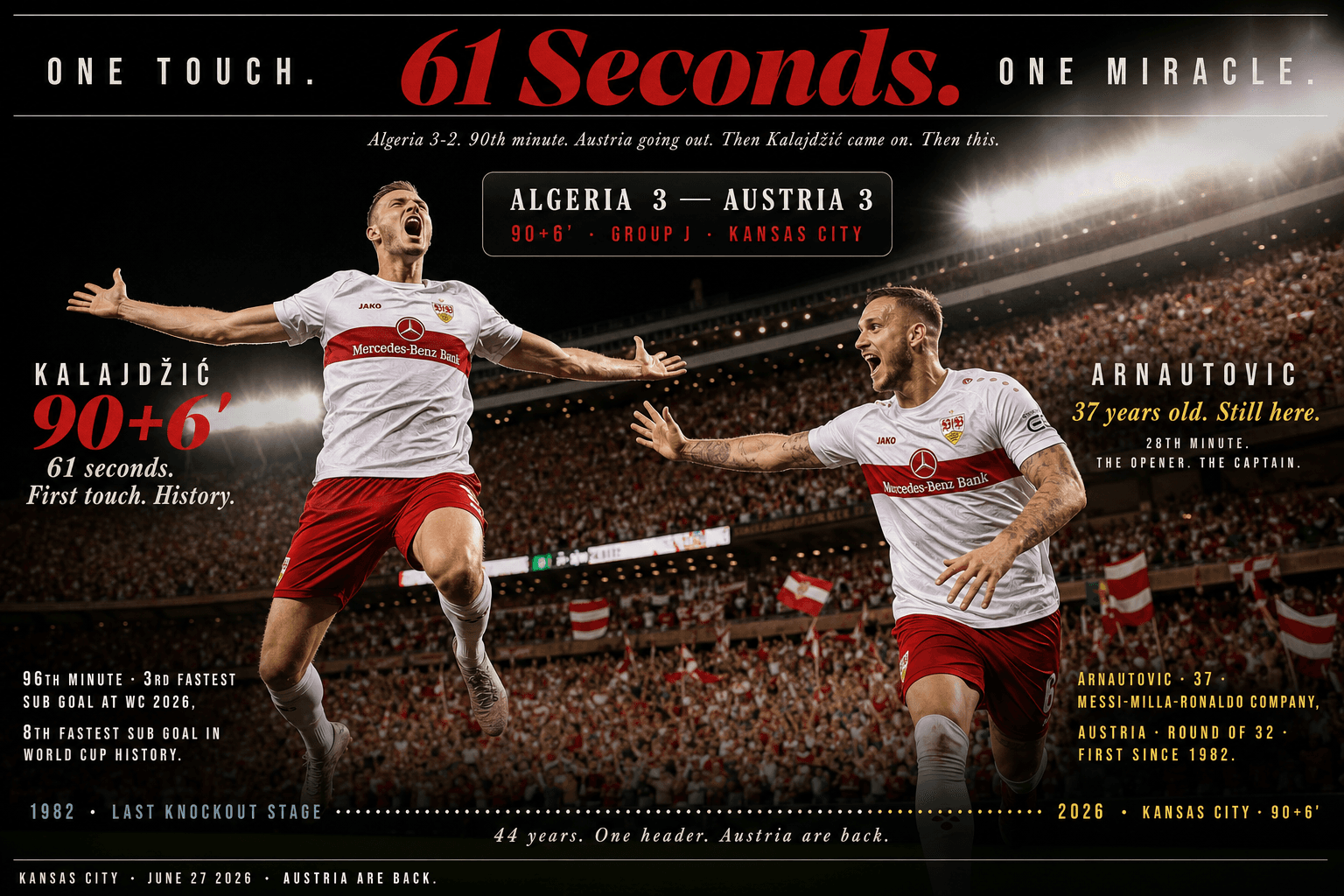
At 90+3 minutes in Kansas City, Riyad Mahrez — Algeria's captain and talisman, one of the most decorated wingers of his generation — found the far corner with a composed finish. Algeria led Austria 3-2. Somewhere in a different stadium, Iranian fans who had been following the live score erupted. That result sent Iran through as one of the eight best third-placed teams. Austria were out. The group was resolved. The World Cup had moved on.
Ralf Rangnick made one final substitution. He sent on Saša Kalajdžić — the 6ft 7in Austrian striker who had arrived at this tournament carrying more baggage than almost any other squad member at the 2026 World Cup. In the 90+6 minute, Michael Gregoritsch — himself a second-half substitute — met a long ball at the far post and headed back across goal. Kalajdžić arrived unmarked in the centre and powered a header into the net. Austria 3-3. Austria through. Iran out. Kansas City losing its mind. The time between Kalajdžić entering the pitch and scoring: 61 seconds. The number of touches it took: one.
The 61 Seconds That Rewrote Austrian Football History
The statistics around Kalajdžić's goal deserve to sit alone for a moment before the story around them is told. He scored 61 seconds after coming on as a substitute — the third-fastest goal by any substitute at the 2026 World Cup, and the eighth-fastest by a substitute in World Cup history. His first touch was a header. The goal came in the sixth minute of second-half stoppage time, answering a strike that had been scored three minutes into stoppage time. The sequence — lead, equaliser, lead, equaliser, lead, equaliser — all within six minutes of added time — is among the most compressed drama the tournament has ever produced in a single match.
Austria have not advanced beyond the initial group stage of a World Cup since 1982, in Spain. That was forty-four years ago. The generation of Austrian players who last experienced a knockout-round World Cup fixture were born in the 1950s and early 1960s. Rangnick had been building toward this for years. The qualification campaign had been convincing. The group stage had been professional — wins over Jordan, a disciplined display against Argentina, and then this chaotic, operatic finale against Algeria that required a man who had been on the pitch for one minute to rescue everything with his first touch. Austria finished second in Group J, behind Argentina, and will now face Spain — the European champions — in the Round of 32.
From Stuttgart to Wolves: The Career That Should Have Gone Differently
To understand what the 96th-minute header meant to Kalajdžić personally, you need to go back to the summer of 2022 and one of the cruelest injury moments any transfer had produced in years. Before the Wolves move, before the ACL, before the long road back, there was a 2021-22 season at VfB Stuttgart that announced Kalajdžić as one of the most dangerous strikers in European football.
He scored 16 Bundesliga goals that season — and he did it in a Stuttgart side that was fighting relegation for most of the campaign, playing with limited support around him, and operating against defences that could dedicate specific attention to a striker already known as a threat. Sixteen goals in a struggling team, using a physical profile that made him uniquely difficult to contain: 6ft 7in, powerful in the air, but also technically capable of turning and finishing at pace in a way that taller strikers rarely are. His Stuttgart season generated interest from across Europe. Wolverhampton Wanderers moved fastest, paying approximately £15 million for a striker who looked capable of transforming the club's attacking output at the highest level.
The move was made. The number was printed on the back of the shirt. The first competitive appearance was scheduled: Wolves vs Southampton, August 27, 2022. It lasted less than twenty minutes before Kalajdžić came down heavily after a challenge, clutched his knee, and was carried off. An ACL tear. Surgery. Months of rehabilitation. The move that was supposed to announce him to Premier League audiences had instead produced the most visible demonstration of football's capacity for cruelty that the transfer window had generated that summer.
He signed for Wolves in August 2022, tore his ACL in his first appearance, and spent the next two years trying to find the player who had scored 16 Bundesliga goals. On 27 June 2026, 61 seconds after coming on as a substitute in the 90th minute with Austria heading out of the World Cup, he headed the equaliser that confirmed his nation's first knockout-round appearance since 1982. The wait was worth it. For him. For all of them.
The Struggle Back and the Long Road to Kansas City
The post-ACL period for Kalajdžić at Wolves was the story that major football media largely stopped telling. Injury recovery is routine enough as a concept — players have ACL tears, they come back, they play again. But the specific challenge of an ACL suffered on a first competitive appearance, before a single sustained run of games at the new club had been possible, is a psychological burden as much as a physical one. You return to a dressing room where every teammate's reference point for your ability is the injury rather than the performance. You play for an audience that has never seen you healthy and is therefore comparing you to an idea rather than a memory.
Kalajdžić returned to action but could not consistently replicate the Stuttgart output at Wolves. The goals came irregularly. The form was inconsistent. The player who had announced himself with 16 Bundesliga goals seemed to have been replaced by a version of himself that was slightly slower, slightly less certain, slightly less dangerous than the headline numbers had promised. Whether that was purely physical — the residual effects of a serious knee injury — or psychological, or simply a reflection of the difference between Stuttgart's system and Wolves' tactical setup, the result was the same: the transfer that was supposed to elevate both player and club produced neither the goals nor the impact either party had anticipated.
What he could not lose — and what the ACL, the rehabilitation, and the difficult Wolves years did not take from him — was the Austrian national team. For Austria, Kalajdžić remained the most physically imposing forward in the squad, a player whose aerial threat from set pieces and long balls created a dimension that no domestic striker provided. Rangnick kept selecting him. The caps accumulated. The goals came less frequently than his Stuttgart peak had suggested they should. But the profile remained useful and the trust remained intact.
Austria at the 2026 World Cup: Rangnick's Project Delivered
The wider context of what Austria achieved in Kansas City requires a brief account of the group stage. Austria came through a genuinely difficult Group J that contained Argentina — the 2022 World Cup champions — alongside Algeria and Jordan. They handled Jordan with the efficiency expected. Against Argentina, already qualified and rotating heavily, they managed the game without embarrassing themselves. And then Algeria, in the final match, produced the scenario that required everything they had and then something extra from a man who had been watching from the bench.
Marko Arnautovic scored in the 28th minute — a composed finish from David Alaba's lofted pass over the Algeria defence. At 37 years and 70 days old, Arnautovic became the oldest Austrian to start a World Cup match, surpassing Michael Konsel's record from 1998. He is now in rare company: only Lionel Messi (six goals), Roger Milla (five), and Cristiano Ronaldo (three) have scored more World Cup goals at the age of 37 or older. Marcel Sabitzer restored Austria's lead after Algeria equalised. Then Mahrez, then Kalajdžić. The full match.
Ralf Rangnick has managed Austria since 2021 — a longer continuous tenure than almost any manager at this World Cup from a major European nation. His gegenpressing approach, developed across decades at RB Leipzig, Schalke, and later Manchester United, has been adapted for international football in a way that suits Austria's specific squad profile. The high press in possession phases, the compact defensive block without it, the willingness to use physical attributes — Kalajdžić's height, Arnautovic's experience — as specific tactical tools rather than general options. Austria qualified convincingly. They delivered in the group. They produced Kalajdžić from the bench when they needed him most.
Round of 32: Austria vs Spain — the Mountain Ahead
The reward for Kalajdžić's 61-second miracle is a Round of 32 fixture against Spain — the European champions, the reigning holders of the continent's most prestigious trophy, a team that won Euro 2024 in Germany with a squad that contains Lamine Yamal, Pedri, Rodri, Nico Williams, and the creative depth of a generation that may be the best Spain has produced since 2010. Fox Sports noted after the Algeria match that Austria are now playing with house money — the knockout stage was the target, and they have reached it. Whatever happens against Spain cannot diminish what Kansas City produced.
The tactical matchup is fascinating precisely because of its apparent imbalance. Spain, as we documented in analysis of the World Cup squad that contains no Real Madrid players for the first time ever, have built their system around short combinations, high pressing, and sustained possession that suffocates opponents into errors. Austria, under Rangnick, press high themselves and are comfortable in transition. Neither team wants to absorb pressure. Both teams will press. The physical dimensions that make Kalajdžić useful — the direct ball into the channel, the aerial contest, the set piece threat — offer Austria a specific route to a goal that Spain's passing-focused defensive system is occasionally vulnerable to.
The probability is that Spain progress. The precedent from Kansas City is that probability is not the only thing that determines outcomes. Austria know they have already defied the probability that mattered most. The question for the Round of 32 is whether Kalajdžić, with a full match if needed rather than 61 seconds, can produce what he produced against Algeria — and whether the system around him can create the moment he needs.
What the Goal Means — Beyond the Statistics
Sasha Kalajdžić is 28 years old. He signed for Wolverhampton Wanderers four years ago for £15 million after a season in which he was one of the most discussed strikers in European football. He tore his ACL in his first competitive game. He spent two years trying to find himself again. He arrived at the 2026 World Cup as Austria's backup striker — the option from the bench rather than the name on the team sheet from kick-off. He came on in the 90th minute with his country heading home. He scored with his first touch 61 seconds later.
That narrative arc — the Germany goals, the big transfer, the immediate devastating injury, the long rebuild, the World Cup redemption — is the kind of story that football produces rarely enough that it should be named when it happens. Kalajdžić did not just score a header. He scored the header that sent Austria to a Round of 32 for the first time in 44 years. He scored it with his first touch. He scored it after having been on the pitch for sixty-one seconds. He scored it after Mahrez had seemingly broken Austria's hearts three minutes earlier in a manner so final that the Austrian players had stopped pressing.
The Austrian fans in Kansas City did not go home on June 27 talking about a draw that saw both teams through. They went home talking about the moment in the 96th minute when a 6ft 7in substitute rose highest, connected with a header, and became the most unlikely hero of the tournament's most dramatic group stage night. Whatever happens against Spain, the story is already written. Football just gave Saša Kalajdžić the ending his Stuttgart season deserved.
Kalajdžić scored with his first touch, 61 seconds after coming on, to send Austria to a Round of 32 against Spain. Is this the greatest substitute moment at the 2026 World Cup — and can Austria produce another miracle against the European champions? 👇