A single World Cup match can feature a referee from one confederation, players from two nations that share no common first language, and a VAR team based in a completely different city, communicating in real time through a headset system most supporters never think about. The specific mechanics of how FIFA solves this problem, who gets chosen to officiate the biggest matches in the sport, what language they actually use on the pitch, and how a referee ends up assigned to a specific fixture, is a process most football coverage treats as background noise. It shouldn't be. As we detailed in our piece on the mistaken identity VAR rule that ended Switzerland's World Cup, the specific officials making these decisions operate inside a system with real rules, real training, and a real language protocol behind every single call.
English Is the Language of the Pitch, Whether a Referee Likes It or Not
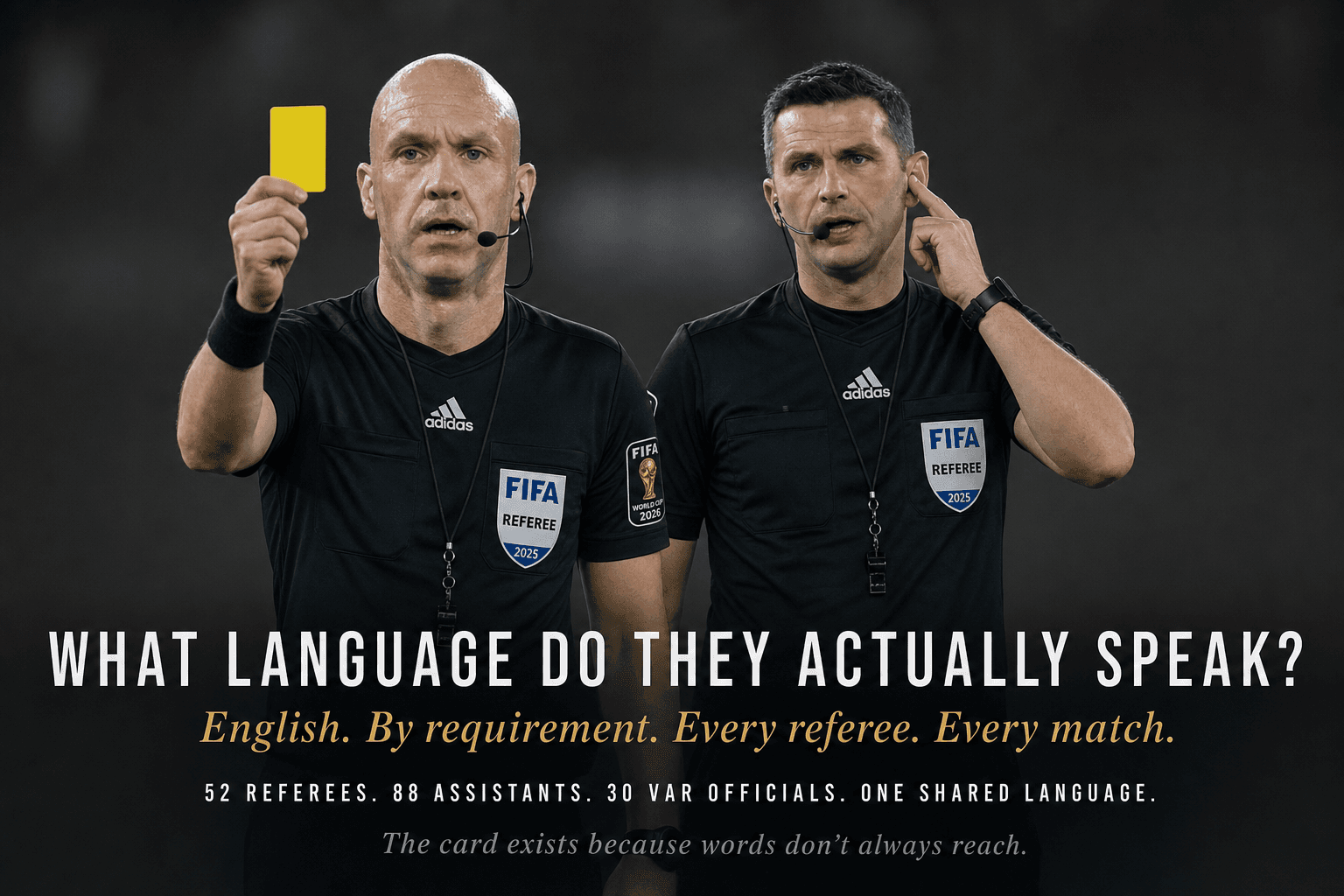
FIFA's four traditional official languages are English, Spanish, French and German, but the specific requirement for any referee hoping to officiate international football is more narrow than that list suggests: as Sports Illustrated has detailed, they must be able to communicate confidently in English. English functions as the default working language on the pitch at every FIFA tournament, including the World Cup, regardless of where the match is being played or which nations are competing. Match reports, official tournament documentation, and pre-match briefings between officials are conducted in English as standard. Many elite referees speak additional languages, commonly Spanish, French or Portuguese given the global spread of football's most talent-rich footballing nations, and FIFA does attempt, where logistically possible, to assign referees who share at least a partial common language with the teams they are officiating. But English remains the fallback that makes the entire system function when no shared language exists at all.
The specific limits of that system were exposed in dramatic fashion at the 2014 World Cup, when Japanese referee Yuichi Nishimura officiated Brazil's opening match against Croatia and awarded a contentious late penalty to the hosts. Croatia defender Vedran Ćorluka's complaint afterward, reported by Al Jazeera, became one of the most quoted grievances in recent World Cup refereeing history: "We were quite simply shocked with the fact that he communicated with us in Japanese all the time." Whether or not the penalty decision itself was correct, the specific breakdown in communication, a referee defaulting to his own native language rather than the tournament's working English standard, became the story, and remains the clearest real-world illustration of why FIFA's language requirements exist in the first place.
English is the language of the World Cup pitch. Not because it is anyone's mother tongue, but because it is the one language every certified international referee is required to speak well enough to be understood by players from anywhere in the world. When that requirement breaks down, as it did for Croatia in 2014, the consequences follow the referee for the rest of his career.
How FIFA Actually Chooses Who Officiates a World Cup
Referee selection for a World Cup begins years before the tournament itself, and the full pathway to becoming a FIFA International Referee can take a career: working up through domestic professional leagues, being nominated by a national federation, then passing FIFA's fitness tests, rules examinations and background checks before ever taking charge of an international fixture. FIFA's Referees Committee, chaired by Chief Refereeing Officer Pierluigi Collina, one of the most respected officials in the sport's history, monitors candidates across all six confederations for the entire cycle between tournaments, tracking performance data, fitness benchmarks, and consistency across continental competitions and qualifying matches. National football associations nominate their most consistently top-performing officials, FIFA narrows that list to an elite pool, and those candidates spend years attending seminars, undergoing fitness testing, and being evaluated in high-pressure matches before the final panel, published in full by WorldReferee.com, is confirmed ahead of the tournament. For the 2026 World Cup, FIFA appointed 52 referees, 88 assistant referees, and 30 video match officials, 170 officials in total, drawn from member associations across all six confederations. Collina called it the largest "FIFA Team One" ever assembled, 41 more match officials than at Qatar 2022, reflecting the expanded 48-team, 104-match format across the United States, Canada and Mexico.
One rule sits above every other consideration in the entire selection process: neutrality. FIFA does not allow a referee to officiate any match involving their own nation, at any stage of the tournament, in any role, whether as the lead referee, an assistant, or a video match official. The purpose is specifically to prevent any perceived conflict of interest, even where no genuine bias exists, because the mere appearance of a compromised official is treated as damaging to the tournament's credibility as an actual breach would be. The neutrality principle even extends into geopolitics: English and Argentine officials, for example, are kept away from each other's national teams, a sensitivity that traces back to the Falklands conflict. Once appointed, referees are based together at a central training hub for the duration of the tournament, with 2026's referees and assistants operating out of Miami while the video match officials work from the International Broadcast Centre in Dallas, training daily alongside FIFA fitness coaches, analysts and medical staff, and typically learning their specific match assignment only days before kickoff.
Oliver, Taylor, and the Rules That Ended England's Referees' World Cup
Nothing illustrates how strictly those neutrality rules bite better than what happened to England's own officials at this tournament. England sent two on-field referees to the 2026 World Cup, Michael Oliver and Anthony Taylor, both Premier League officials at their second World Cup after Qatar 2022, and Oliver used the tournament to break Howard Webb's record for the most World Cup matches taken charge of by an English referee. Yet the moment England reached the semi-final against Argentina, both men's tournaments were effectively over. The own-nation rule ruled them out of any England fixture, and the Falklands-era restriction ruled them out of any Argentina fixture too, and with one of those two nations guaranteed a place in the final, neither Oliver nor Taylor could be considered for the semi-final or the final regardless of how well they had performed, as ESPN explained when the bracket took shape. Two of the highest-rated officials at the entire tournament watched its biggest matches from the sidelines purely because of the passports they carry. That is the neutrality principle in its purest, most unsentimental form: FIFA would rather lose its best referees from its biggest games than allow even the theoretical appearance of bias to touch a World Cup final.
What Happens When Neither Team Shares the Referee's Language
The practical solution football has relied on for decades predates VAR entirely: visual communication. Yellow and red cards, hand signals for corners, throw-ins, offside and substitutions, and the whistle itself were designed specifically to allow a match to be officiated without any spoken language at all. English referee Ken Aston invented the coloured card system for exactly this reason, solving a genuine communication crisis at a previous World Cup where language barriers had caused real confusion over disciplinary decisions. That visual system remains the foundation of every match today, but modern refereeing layers spoken communication on top of it constantly, calming confrontations, explaining marginal decisions, managing player frustration, and, since Qatar 2022, announcing VAR rulings aloud to the crowd over the stadium's public address system. All of that verbal layer runs through English by default, with the specific expectation that even players who are not fluent understand enough football-specific English vocabulary, goal, foul, offside, handball, to follow what is being communicated in the moment.
Captains, VAR Headsets, and the Team Behind Every Decision
A referee at the 2026 World Cup is never making decisions in true isolation. Assistant referees, the fourth official, and the VAR team, physically located in Dallas rather than at the stadium, are connected through a constant headset communication system throughout every match, feeding information, confirming offside lines using semi-automated offside technology, and flagging potential review incidents in real time. FIFA's protocol restricts who is permitted to approach and speak directly with the referee during a match to team captains specifically, a rule designed to prevent the kind of mass confrontation that made officiating chaotic in earlier eras of the sport, and one that further concentrates the specific communication burden onto a small number of players who are often, deliberately, chosen by their national federations partly for their language ability as much as their leadership on the pitch.
Why This Matters Beyond the Whistle
The specific officiating controversies that have already shaped this tournament, documented in our piece on the Embolo mistaken identity dismissal, exist inside this same infrastructure of selection, training and communication. A referee's ability to explain a decision clearly, to the correct player, in a language that player actually understands under the pressure of a World Cup knockout match, is not a minor logistical detail. It is the specific mechanism through which the laws of the game are actually applied to real human beings from radically different footballing cultures, speaking different languages, inside the same ninety minutes. Nishimura's Japanese in 2014 became a footnote in World Cup history precisely because the system is supposed to prevent exactly that scenario from happening. Most of the time, it does. When it doesn't, the entire selection and training apparatus described above becomes the subject of exactly the kind of scrutiny FIFA spends three years trying to avoid.
The Body Cameras and Extra Layers of 2026
The 2026 tournament introduced a further transparency measure worth understanding alongside the language and selection protocols: referee body cameras, running in all 104 matches for the first time at a World Cup. A small, stabilised high-definition camera is built directly into the referee's headset and communications kit, giving broadcasters and fans real-time footage of exactly what an official sees in the moments leading up to a major decision. The system was first trialled at the 2025 FIFA Club World Cup, and the footage has since been improved with technology that reduces motion blur from rapid movement. Combined with the requirement that VAR rulings be announced aloud to the crowd over the stadium public address system, a practice introduced at Qatar 2022 and expanded significantly for 2026, the entire officiating process has become considerably more visible than at any previous World Cup. None of this technology changes the underlying language requirement. A body camera does not translate what a referee says to a player who does not understand English, and a PA announcement explaining a VAR review is still delivered in the tournament's default working language. The technology increases scrutiny of decisions. It does not, by itself, solve the specific communication challenge that has existed at every World Cup since nations that share no common tongue first met on the same pitch.
English is the working language of every World Cup pitch, whether the players like it or not. Do you think referees should be required to learn more languages relevant to the teams they officiate, or is a shared English standard the fairest system? Tell us below.