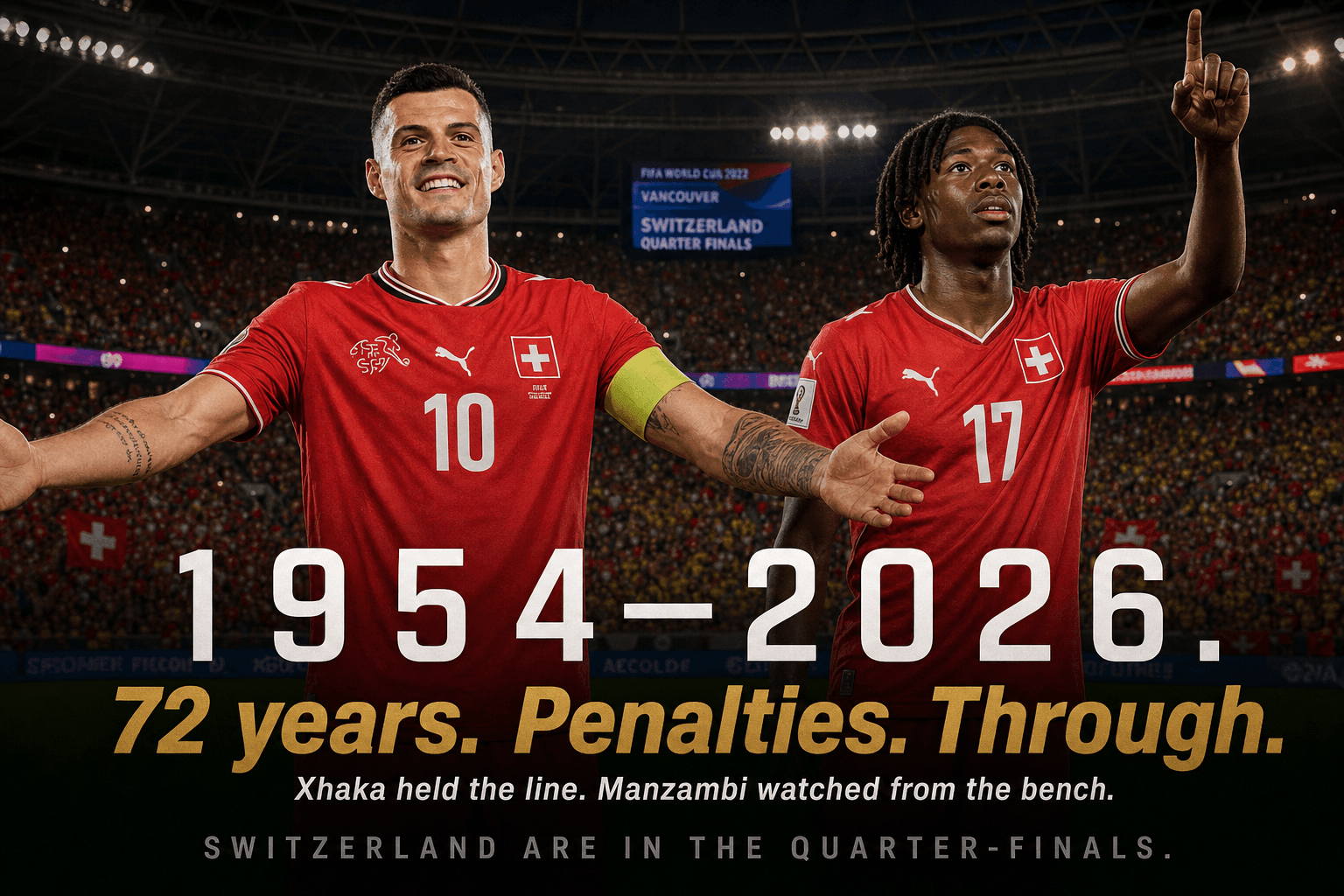
Switzerland are in a World Cup quarter-final for the first time since 1954. It took a goalless 120 minutes and a 4-3 penalty shoot-out to get past Colombia, and it happened without the player who got them there in the first place: 20-year-old Johan Manzambi, the breakout star of this tournament, watched from the bench with an injury as his teammates did the job without him. Switzerland's football federation has waited longer than almost any other nation in world football for this exact moment, and it arrived not through a dominant performance, but through nerve, organisation and a shoot-out that could have gone either way.
How Switzerland Actually Beat the Curse
The scale of what Switzerland have achieved only becomes clear against that recent history. Switzerland had reached the Round of 16 at the previous three World Cups and gone out every time, most recently humbled 6-1 by Portugal in 2022 when a 16-year-old Manzambi was watching as just another Swiss fan back home. This time, in Vancouver, neither side could break the deadlock across 90 minutes plus extra time, with Colombia arguably the better side on the balance of chances, finishing with an expected-goals value of 1.03 to Switzerland's 0.35. Jhon Lucumí hit the crossbar and Jáminton Campaz blazed over from close range in extra time after a rare mistake from Granit Xhaka, but Colombia could not find the finish their pressure deserved. As ESPN reported, Colombia's own John Arias summed up the frustration afterwards, saying the pain of the exit was made worse by how much belief the team had built over the tournament, only for it to end without a single goal scored across two hours of football.
The shoot-out swung on two Colombian misses. Davinson Sánchez struck his penalty against the bar and Cucho Hernández saw his effort saved by goalkeeper Gregor Kobel, either side of a missed Swiss penalty from Manuel Akanji. Rubén Vargas, who had shaken off his own pre-match injury doubts to feature only as a substitute, stepped up to convert the decisive fifth spot-kick and send Switzerland through 4-3. For a Colombia side appearing in the knockout rounds for the first time since 2014, and now eliminated on penalties in consecutive World Cup appearances after also losing to England in 2018, it was a cruel way to exit a tournament they had matched Switzerland shot for shot in.
The Wonderkid Who Wasn't Even Playing
The story of how Switzerland even reached this point in the first place belongs largely to Johan Manzambi, and his absence against Colombia only underlined how much the team has come to depend on him in a few short weeks. Born in Geneva to parents from Angola and the Democratic Republic of the Congo, the SC Freiburg midfielder started this tournament as a fringe option behind Switzerland's more experienced attackers before forcing his way into the conversation with an explosive substitute cameo in the group stage. Introduced with 20 minutes to play against Bosnia and Herzegovina, he scored twice in a 19-minute burst, becoming the youngest Swiss player to score a brace at a World Cup at 20 years and 247 days old and the only Swiss player ever to score multiple goals coming off the bench. He added a goal and an assist in a 2-1 win over co-host Canada, then an assist in the Round of 32 win over Algeria, taking his tournament tally to three goals and two assists in four appearances — the youngest player to reach five goal contributions at a World Cup since 1966, a mark previously held in this generation only by Kylian Mbappé and Thomas Müller among players his age or younger.
Manzambi's absence against Colombia came after he was forced to leave training early on the eve of the match alongside Vargas and midfielder Djibril Sow, with head coach Murat Yakin admitting he was "concerned" about how the side would cope without him. "He is a very precious and important player for us," Yakin said, praising Manzambi's all-round game and calling him "the kind of player that others like to watch." Teammate Manuel Akanji was equally effusive, saying simply that Manzambi "helped us to go to another level" and that the squad was fortunate to have him. That Switzerland found a way through Colombia without their most explosive attacker is, in some ways, the more encouraging signal heading into a quarter-final against holders Argentina — proof that this is a team capable of grinding out results even when its brightest individual talent is unavailable. It is also worth remembering just how far Manzambi has come in a short space of time: barely a fixture at Freiburg two seasons ago, he has gone from Bundesliga breakthrough to Europa League final runner-up to a genuine World Cup sensation within the space of little more than a year, all while still a teenager for much of that rise. Premier League clubs including Manchester United, Arsenal and Chelsea are already reported to be monitoring his situation ahead of the next transfer window, a level of interest that would have seemed unthinkable before this tournament began.
Switzerland's first World Cup quarter-final since 1954 — and their first World Cup knockout win of any kind since that same year.
Xhaka's Leadership Behind the Scenes
If Manzambi has been the spark, Granit Xhaka has been the foundation. The Sunderland midfielder and Switzerland captain has anchored the same organisational structure that let his team frustrate a talented Colombia side for 120 minutes, even after his rare loose touch nearly gifted Campaz a matchwinner in extra time. Xhaka's calm authority in midfield, built over more than a decade of Premier League and Bundesliga experience at Arsenal, Borussia Mönchengladbach and Bayer Leverkusen, has given a young and increasingly talented Swiss squad, featuring Manzambi, Vargas and Breel Embolo, the platform to express itself further forward. At 33, Xhaka is playing what is likely his final World Cup, and captaining Switzerland to their best tournament finish in over seven decades would be a fitting way to close out an international career that has spanned four World Cups and two European Championships.
That balance between Xhaka's control and the emerging attacking talent around him is exactly why this Swiss generation looks different to the sides that fell in the Round of 16 in 2018, 2022 and even at the reduced 32-team World Cup earlier in this cycle. Murat Yakin has built a squad capable of grinding out low-event, defensively sound performances like the one against Colombia, while still carrying enough individual quality further forward to change games when it is needed, as Manzambi has repeatedly shown. FIFA's president Gianni Infantino was among the spectators at BC Place for the win over Colombia, in a stadium overwhelmingly filled with yellow-clad Colombia supporters who left disappointed by a shoot-out defeat their team's underlying performance did not fully deserve.
A Cruel Exit for a Colombia Side That Deserved More
It would be unfair to tell this story without acknowledging how good Colombia actually were. Coached to press aggressively and create overloads out wide, Los Cafeteros produced 15 shots to Switzerland's 7 and generated the better quality chances across the full 120 minutes, only to be undone by the oldest cruelty in knockout football: a penalty shoot-out that does not care which team deserved the win on the balance of play. It marked the second straight World Cup in which Colombia have gone out on penalties, following their 2018 defeat to England, and their first appearance in the knockout rounds since reaching the quarter-finals as co-hosts in 2014, where they eventually fell to Brazil. Having failed to even qualify for the 32-team World Cup in Qatar four years earlier, this was still unmistakable, meaningful progress for Nestor Lorenzo's side, even if it will not feel that way in the immediate aftermath of Vancouver.
For Switzerland, meanwhile, the win completed a pattern that had been building throughout the group stage: a team that had looked underwhelming for stretches of their opening fixtures before finding another gear once the tournament's structure demanded it. The concerns that had quietly built around Yakin's side following unconvincing group-stage performances were eased first by Manzambi's emergence against Bosnia and Herzegovina, and now by a knockout-stage nerve the team had not previously been asked to show at this level.
Argentina Await — A Different Kind of Test
Switzerland now face defending champions Argentina in Kansas City on Saturday, in the same round of quarter-finals that includes Norway vs England, a side that survived its own round of 16 classic by coming from two goals down to beat Egypt 3-2, a match BackPage FC broke down in full in our piece on the controversy surrounding that Argentina win. Where Colombia offered a mostly comparable technical level, Lionel Messi, Julián Álvarez and an Argentina side that has now scored in every match of the tournament represent a considerably sharper attacking threat than anything Switzerland have faced so far. Argentina also arrive with the psychological boost of having twice come from behind in the knockout rounds already, first against Cape Verde in extra time and now against Egypt in the dying minutes, suggesting a squad that finds ways to win even when the football itself is unconvincing — not unlike Switzerland's own route to this stage. Both semi-final paths, in other words, run through a team that has already proven it does not know when it is beaten.
Pundits have been blunt about the scale of the task. Sky Sports' analysis of the win noted that Xhaka "won't be able to shackle Lionel Messi single-handedly" and that Switzerland will need "more intensity against better players" than they showed in a mostly cagey, low-event game against Colombia. Manzambi's fitness for the quarter-final remains a genuine doubt, and given how instrumental he has been to Switzerland's attacking threat all tournament, his availability may end up being the single biggest factor in whether this Cinderella run extends into the semi-finals or ends, as so many Swiss World Cups have before, at the quarter-final stage.
Whatever happens against Argentina, Switzerland have already rewritten a piece of their football history that had stood since before most of this current squad's parents were born. The question now is whether a team built on defensive discipline, Xhaka's leadership and Manzambi's explosiveness has enough left to do it again against the best player of this generation, in a match that will also decide whether continental Europe's dominance of this tournament's last eight extends even further at South America's expense, or whether Argentina can keep alive their own hopes of becoming back-to-back champions for the first time since Brazil managed it in 1962.
Can Switzerland's defensive discipline really contain Messi and Argentina without a fully fit Johan Manzambi to threaten at the other end, or will Kansas City mark the end of this remarkable 72-year wait finally coming to a close?