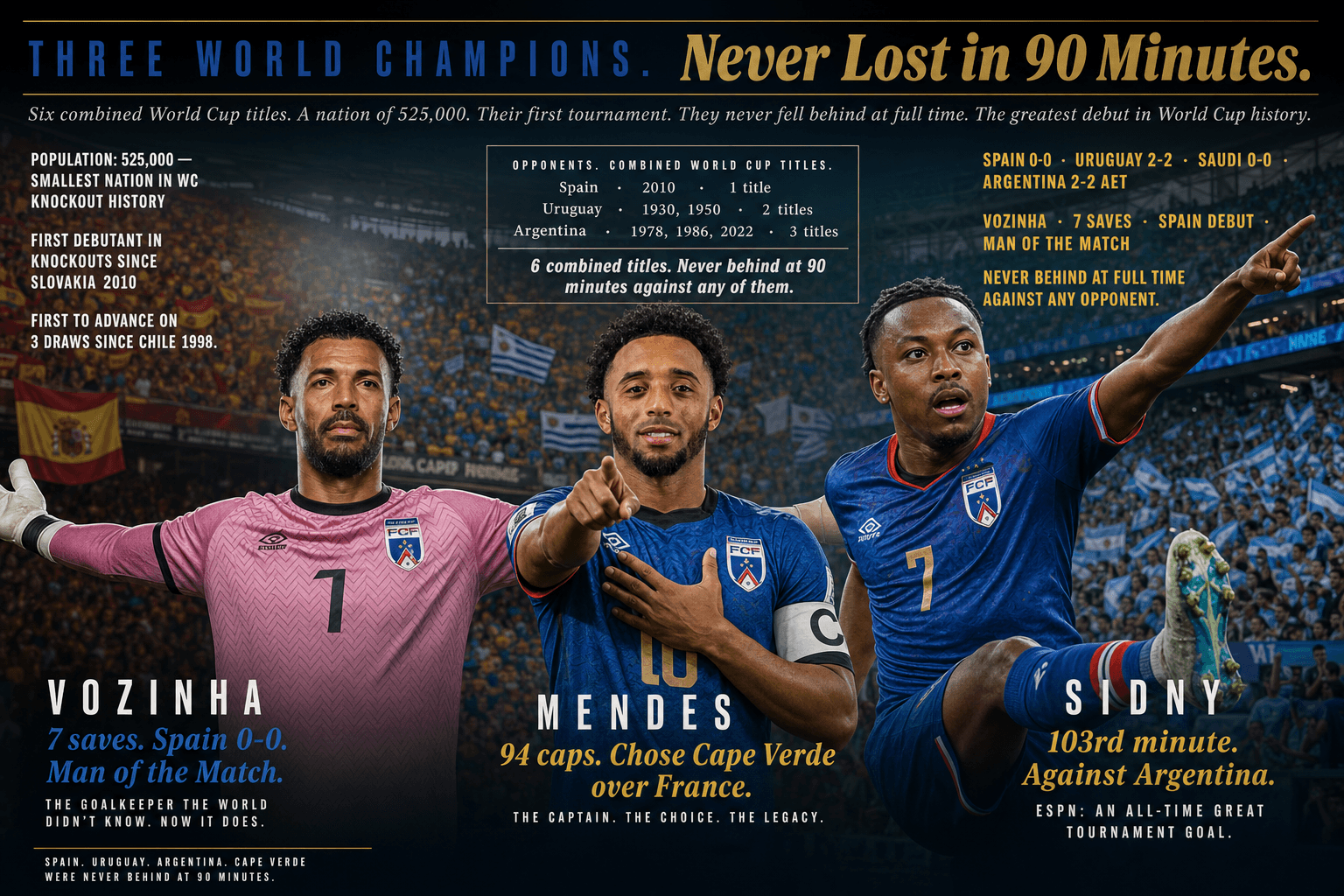
There are eight nations that have ever won the World Cup. In 96 years of football's greatest competition, only eight teams have lifted the trophy in the final. At the 2026 World Cup, across four matches — three in the group stage, one in the Round of 32 — Cape Verde faced three of those eight. Spain won it in 2010. Uruguay won it in 1930 and 1950. Argentina won it in 1978, 1986, and 2022. Six combined world titles, accumulated across nearly a century of the sport's highest competition. And in every match Cape Verde played against these three nations, they were still level after 90 minutes. Spain finished 0-0. Uruguay finished 2-2, with Cape Verde recovering from 2-1 down in the second half. Argentina required extra time — Cape Verde equalised to 2-2 in the 103rd minute before losing 3-2. A nation of 525,000 people, at their first World Cup, faced six world championship titles' worth of opponents, and never lost in 90 minutes. The definition of the greatest debut in World Cup history is right there.
Vozinha and the Day Spain Ran Into a Wall
The story of Cape Verde's World Cup begins properly on June 15 in Atlanta, with a match that most pre-tournament analysis assumed would confirm Spain's quality and produce a routine group-stage victory for the European champions. Goalkeeper Josimar José Évora Dias — known universally by his nickname Vozinha — made seven saves in his World Cup debut as Spain failed to score in 90 minutes of sustained attacking pressure. The name Vozinha had never appeared in a major international football preview. By full time, it was trending across every football-following country on the planet.
The specifics of what Vozinha produced are worth enumerating: Ferran Torres hit the bar from close range. Mikel Oyarzabal had a shot blocked. Diney almost put Cape Verde INTO the lead with a late corner header that went straight at Unai Simón. Vozinha was named Man of the Match in a World Cup game against the nation with the longest unbeaten competitive run in the sport's history — Spain, who had not lost a competitive match since March 2023 and had extended their world-record unbeaten streak to 34 consecutive games across the group stage. The 0-0 draw against Cape Verde was the only match in that run where their dominance was suppressed this comprehensively. Vozinha held them. Spain kept going. The final whistle happened. Cape Verde had their first World Cup point.
Pina's Goal and the Uruguay Comeback
Kevin Pina had scored twice in 22 appearances for Cape Verde before the World Cup. He scored the first World Cup goal in Cape Verde's history with his first meaningful contribution at the tournament — a low right-footed free-kick that drove through the middle of Uruguay's defensive wall and into the bottom-right corner in the 21st minute against the two-time world champions. Uruguay equalised through Araújo before the interval, then took the lead through Agustín Canobbio early in the second half. Cape Verde, 2-1 down against a nation that has won the World Cup twice, in only their second ever World Cup match, equalised through Hélio Varela after a disastrous Olivera back-pass. Two-time world champions 2-2 with a first-time qualifier. The Blue Sharks were still standing.
The final group match — a 0-0 draw with Saudi Arabia — confirmed Cape Verde as group runners-up. Three draws, three points, second place behind Spain. They became the first World Cup debutant to reach the knockout stage since Slovakia in 2010 — sixteen years earlier — and the first nation since Chile in 1998 to advance from a World Cup group by drawing all three games. Two historical firsts on their tournament debut, both achieved in the same tournament, in the same group, against three of the eight nations that have won the World Cup.
In 96 years of the World Cup, only eight nations have won the tournament. Cape Verde, in their first appearance at the competition, faced three of those eight across four matches — Spain, Uruguay, and Argentina. They were never behind at 90 minutes in any of those four games. They were level with Argentina in the 103rd minute of extra time. They went home. They had already made history before they left.
Sidny Lopes Cabral and the Goal That Defined a Nation
The Argentina match in Miami on July 3 was the one everyone expected to end Cape Verde's tournament quickly. Lionel Messi — at his sixth World Cup, in the form that has produced six tournament goals across the competition — scored in the 29th minute. One-nil to the three-time world champions. The tournament coming to its logical conclusion. Then Deroy Duarte equalised in the second half. Argentina required extra time. Lisandro Martínez restored Argentina's lead in extra time. Then Sidny Lopes Cabral — in the 103rd minute — curled a finish from the edge of the area into the net that ESPN described as an all-time great tournament goal. Two-two in extra time against the reigning world champions. The seismometer equivalent of the Azteca, in Miami's Hard Rock Stadium.
Argentina needed a deflected Romero header — ruled eventually as a Diney Borges own goal — to win 3-2. Cape Verde had come from behind twice in extra time against the world champions, produced a goal that will be replayed for years, and lost. They left the 2026 World Cup having never lost a match in 90 minutes against any of the teams they faced across the group stage and the knockout round. The record is permanent. It cannot be taken back. Whatever happens at future World Cups, Cape Verde's debut tournament will always contain that line: never behind at full time against Spain, Uruguay, or Argentina.
The Numbers That Will Define the Legacy
Cape Verde's population is approximately 525,000 — making them the smallest nation ever to reach a World Cup knockout round, surpassing Iceland's population of approximately 370,000 when they reached the Round of 16 at the 2018 World Cup. They are smaller than most mid-sized cities. They are larger than only a handful of European microstates. Their football infrastructure consists of domestic clubs that produce players who overwhelmingly move abroad in their teens or early twenties to develop in European academies. The squad that drew with Spain, Uruguay, and Saudi Arabia and then equalised in extra time against Argentina was built almost entirely from that diaspora — a fact explored in depth in our companion piece on the Cape Verde players who don't live in Cape Verde.
The comparison with other nations who have arrived at their first World Cup and made a historical impact is illuminating. Haiti's debut in 1974 produced a famous goal from Emmanuel Sanon past Dino Zoff's unbeaten record — a story we told in our piece on Haiti's first World Cup in 52 years. Curaçao qualified as the smallest nation in history and we documented their story in our piece on the 156,115-person island making World Cup history. What Cape Verde produced in North America is different from both. Haiti and Curaçao produced moments. Cape Verde produced a campaign — four matches, four occasions when they were not behind at 90 minutes, a goalkeeper who made seven saves against the European champions on his debut, and a goal in extra time of a Round of 32 match against Argentina that ESPN called an all-time great tournament goal. That is not a debut. That is a statement.
What Comes Next for the Blue Sharks
Cape Verde's manager Pedro Leitão Brito — known as Bubista, a former Cape Verde international himself — has created a programme that extends beyond the 2026 tournament. The diaspora recruitment model that filled this squad with players from Portugal, Spain, France, the Netherlands, and Turkey is not a short-term emergency measure. It is the deliberate, structured approach through which a nation of 525,000 people competes in a qualification system against African nations with ten and twenty times their population and significantly deeper football infrastructure. Cape Verde won their African qualifying group ahead of Cameroon. That result, in hindsight, was itself already extraordinary.
The players who defined this campaign — Vozinha's seven saves against Spain, Kevin Pina's first-ever World Cup goal through Uruguay's wall, Sidny Lopes Cabral's extra-time miracle against Argentina — are the players who will make up the 2030 qualifying squad. The baseline has been permanently elevated. A squad that arrived at the 2026 World Cup as a historical curiosity and left as a team that had never been beaten in 90 minutes against three nations holding six World Cup titles between them will approach 2030 qualifying in a fundamentally different position. They have earned the right to be expected now. The Blue Sharks know what they are capable of. The rest of African football now knows too.
The Eight World Cup Winners — and the One Who Faced Three of Them
To frame what Cape Verde achieved requires a brief historical list. The nations that have won the World Cup: Uruguay (1930, 1950), Italy (1934, 1938, 1982, 2006), West Germany and Germany (1954, 1974, 1990, 2014), Brazil (1958, 1962, 1970, 1994, 2002), England (1966), Argentina (1978, 1986, 2022), France (1998, 2018), Spain (2010). Eight nations. Twenty-two tournaments. That is the complete list.
Cape Verde, at their first World Cup, were placed in a group with Spain and Uruguay. Then drew Argentina in the Round of 32. In four World Cup matches, they faced teams carrying a combined six world title victories. They scored in the match against the two-time champions Uruguay. They held the 2010 world champions Spain scoreless. They equalised in extra time against the three-time champions Argentina. The goalkeeper on his debut made seven saves against Spain. A substitute scored a free-kick in the 103rd minute against Argentina that ESPN called one of the tournament's all-time great goals.
No team in the 96-year history of the World Cup has faced this combination of opposition on their debut. Cameroon's famous 1990 debut — their defeat of Argentina, one of the tournament's landmark moments — came as their second World Cup, not their first. Senegal's 2002 debut, where they beat France in the opening game, was their second appearance. Cape Verde's entire record — the 0-0 against Spain, the 2-2 comeback against Uruguay, the 0-0 against Saudi Arabia, the 2-2 at 90 minutes before eventually losing 3-2 in extra time against Argentina — was produced in their first-ever appearance. The context of those results, measured against the standard of the opposition, makes it reasonable to claim: no nation has had a better World Cup debut in the history of the competition.
Bubista's Plan and What 2030 Could Look Like
Manager Pedro Leitão Brito — known as Bubista — told reporters after the Argentina match that Cape Verde had not come to the World Cup to make up the numbers. He had been appointed in 2020 with a specific brief: qualify for the 2026 World Cup and, once there, show that Cape Verde were ready to compete at the level the tournament demanded. The squad he assembled for 2026 was built specifically for that brief — defensive organisation at its core, Vozinha as the specific personality to hold that organisation together, diaspora players whose technical quality bridged the gap between Cape Verde's domestic infrastructure and the requirements of competing against Spain and Argentina. He achieved both objectives and exceeded both. The brief for 2030 will be different. Cape Verde have shown they can qualify. They have shown they can compete against world champions. Now the question becomes whether they can win. That is a different brief, requiring a different version of the same squad, four years older and significantly more experienced. Bubista has earned the right to attempt it.
Cape Verde never lost in 90 minutes against Spain, Uruguay or Argentina at their first World Cup. Do you think they can qualify again in 2030 — and where does their debut rank among the greatest in World Cup history? 👇