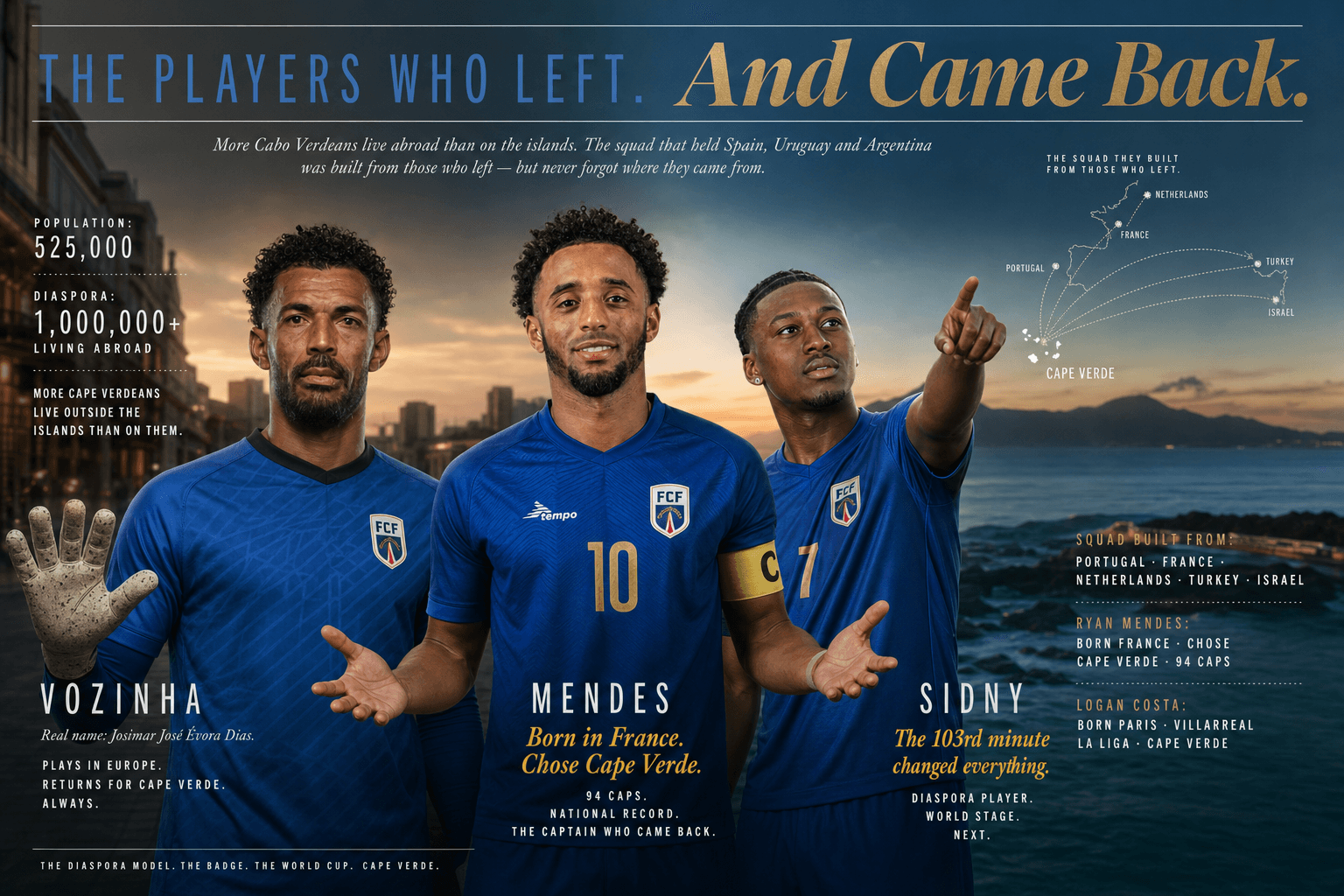
The nine-island archipelago of Cape Verde sits in the Atlantic Ocean, 570 kilometres off the coast of West Africa. It has a population of approximately 525,000 people. Its diaspora — the Cape Verdeans who have emigrated, and their descendants — numbers over one million. More people of Cape Verdean heritage live outside the islands than on them. That fact, unremarkable in the context of a small island nation with a history of emigration dating back centuries, produced something extraordinary at the 2026 World Cup: a squad assembled almost entirely from players who live, train, and compete in Europe — primarily Portugal, France, Spain, the Netherlands, and Turkey — playing under a single flag for a nation most of their opponents' supporters could not have located on a map before the tournament began.
The Blue Sharks held Spain 0-0. They came from 2-1 down to draw with Uruguay. They equalised in the 103rd minute against Argentina before losing 3-2 in extra time. They did all of this with a squad whose goalkeeper plays in Portugal, whose captain plays in Turkey, whose starting centre-back was born in Paris, and whose most discussed player at the tournament appeared to have scored one of the competition's great goals in a Round of 32 match against the reigning world champions. The diaspora model that many nations have attempted, and which Cape Verde have perfected, produced the tournament's most unlikely protagonists. This is the story of how they built it.
Vozinha: The Goalkeeper Behind the Name
The first name the world learned from Cape Verde at the 2026 World Cup was not a name at all. It was a nickname. Vozinha — the goalkeeper who made seven saves against Spain on his World Cup debut, named Man of the Match in front of a global audience of hundreds of millions, became an overnight sensation not just for what he did but for the name under which he did it. His full name is Josimar José Évora Dias. He plays in Europe — his career has spanned clubs in Portugal and beyond, the trajectory typical of Cape Verdean players who develop domestically and then move to European leagues for the professional structure their home islands cannot yet provide. The nickname Vozinha is a Portuguese diminutive — a term of affection applied to someone whose voice carries weight despite its quiet register. It fits a goalkeeper whose greatest performances come from stillness rather than spectacle, from reading the game before the shot arrives rather than reacting to it.
Against Spain, Vozinha faced the nation with the longest unbeaten competitive run in international football history — 34 games without defeat, including Euro 2024. He faced Mikel Oyarzabal, Ferran Torres, Pedri, and a Spanish attacking unit that had been scoring goals freely throughout their qualifying campaign. He made seven saves. Spain's Ferran Torres hit the bar. Diney almost scored at the other end. The game finished goalless. Vozinha was named Man of the Match in a World Cup debut game against the European champions. He did it playing for a country whose population is roughly equivalent to a mid-sized English city — roughly the same as Coventry, slightly larger than Oxford.
Logan Costa and the Paris-Born Centre-Back
Logan Costa is Cape Verde's most recognisable defender by European club standard. He plays for Villarreal in La Liga — a player of genuine European top-flight quality whose international career pathway is a direct product of the diaspora system. Costa was born in Paris, France. He is Cape Verdean by heritage but has spent his entire career in European football — Toulouse, Villarreal — and returned from an ACL injury just in time to make Bubista's final 26-man World Cup squad. His inclusion represents the specific promise of the diaspora model at its best: a player of European professional quality, technically developed in European academies, representing the nation of his family's origin. Against Spain, Costa organised the defensive line that held European champions to zero goals. Against Argentina, he was part of the structure that allowed Cape Verde to equalise twice against Messi, Martínez, and Romero.
Ryan Mendes: The Captain Who Chose Cape Verde Over France
The story of Ryan Mendes is the story of the diaspora choice in its most personal form. Born in France, he had the option of representing the French national team — the team of Mbappé, Griezmann, and Benzema that won the World Cup in 2018. He chose Cape Verde. He is Cape Verde's captain with 94 caps — the most in the nation's history — and 22 international goals, also the national record. He now plays for Iğdır FK in Turkey, far from the glamour of European leagues' top divisions, but the commitment to Cape Verde's badge has been absolute and irreversible. His presence in the squad as captain provides the kind of veteran leadership that a first World Cup requires — someone who has navigated the qualifying campaigns, the continental competitions, and the specific challenge of representing a small nation with limited infrastructure against opponents with far greater resources.
Cape Verde's squad includes players born in Paris, educated in European academies, playing in La Liga, Portugal, Turkey, and Israel. Their goalkeeper is called by a Portuguese nickname. Their captain chose them over France. The nation that held Spain 0-0 and equalised against Argentina in extra time was built from the people who left, returning to play for the people who stayed.
Hélio Varela, Kevin Pina, and the European Professionals
The player who scored Cape Verde's equaliser against Uruguay — the goal that completed their 2-2 comeback from 2-1 down against the two-time world champions — was Hélio Varela, a substitute who plays for Maccabi Tel Aviv in Israel. He came off the bench, received the ball from Olivera's disastrous back-pass, and converted with the composure of a player who has been in professional football long enough to know that the opportunity matters more than the circumstance. Kevin Pina, who scored Cape Verde's first-ever World Cup goal — a driving free-kick through Uruguay's wall in the 21st minute — plays in European football too, his career having followed the standard diaspora path of domestic development and European professional continuation.
The composition of the squad across all twenty-six positions reflects the same pattern. Dailon Livramento brings British football's physical standards to Cape Verde's attacking options. Defender Diney Borges has played across European leagues. Midfielder Pico — who was consistently involved in their defensive phase against Spain — provides the organisational backbone that diaspora players, trained in European systems, typically bring to squads that cannot fully replicate those systems domestically. This is not a critique of Cape Verde's domestic football. It is a description of how a small island nation, through deliberate structural strategy, has built a competitive international squad without the infrastructure that most competing nations take for granted.
The Diaspora Model: How Bubista Built the Squad
Manager Pedro Leitão Brito — Bubista — was appointed in 2020 with explicit instructions to build toward the 2026 World Cup. His recruitment model, confirmed by Al Jazeera, was built on identifying Cape Verdean heritage players across European leagues — players who had grown up in Portugal, France, the Netherlands, and the UK, who had received professional coaching in academies that Cape Verde's domestic system cannot yet provide, and who maintained the connection to the islands through family, culture, and identity even as their professional careers developed elsewhere.
The model is not unique to Cape Verde. We explored similar approaches in our pieces on Curaçao's Dutch-built squad and Haiti's diaspora-heavy qualification. What Cape Verde did differently is the quality of the diaspora they accessed. Costa at Villarreal is a top-five Spanish league professional. The goalkeeper who held Spain to 0-0 is experienced at European level. The captain has 94 caps for a nation he chose over France. The depth of the diaspora selection, rather than merely its existence, is what produced four matches at the 2026 World Cup without losing in 90 minutes against any opponent.
What the Model Produces — and Its Limits
The diaspora model has one specific structural limit that the World Cup performance made visible. Cape Verde's attacking output — seven shots on target across four matches, with goals coming from a free-kick, a goalkeeping error, and a curling extra-time finish — reflected a squad built predominantly to defend and transition rather than sustain attacking pressure. Against Spain's patient build-up, the defensive model worked perfectly. Against Argentina's individual quality, it required two miraculous moments to stay level before the individual quality proved decisive. The model produces resilience and organisation. It does not yet produce sustained attacking dominance.
For 2030, the question is whether Bubista can add that attacking layer — whether the next generation of diaspora players includes more Sidny Lopes Cabrals, more players capable of the specific moment of individual quality that decided the Argentina match. The 2026 tournament has changed the calculation. Players of Cape Verdean heritage who might previously have chosen France or Portugal when their eligibility options opened now have a different reference point: a first World Cup, a goalkeeper who became an overnight sensation, a moment in Miami in the 103rd minute that ESPN called one of the tournament's all-time great goals. The diaspora model recruits on identity and opportunity. Cape Verde just made both more compelling.
Sidny Lopes Cabral: The Player Who Nearly Wrote the Perfect Ending
The most dramatic individual story from Cape Verde's entire World Cup campaign belongs to the player whose name most of the world learned in the 103rd minute of a Round of 32 match in Miami. Sidny Lopes Cabral — another Cape Verdean diaspora professional, whose career path mirrors those of Varela, Pina, and the rest — curled a finish from the edge of the penalty area into the net against Argentina goalkeeper Emiliano Martínez in the 103rd minute, equalising at 2-2 in extra time against the three-time world champions. ESPN called it an all-time great tournament goal. Messi had scored first. Argentina had gone 2-1 up in extra time. Cape Verde were finished. And then Sidny Lopes Cabral curved the ball into the corner, and they were not.
The goal was not enough. An Romero header deflected off Diney Borges for an Argentina winner that sent Cape Verde home. But the goal itself — from a player the world did not know three weeks earlier, in a match against the reigning world champions, in the 103rd minute of extra time — is the purest expression of what the diaspora model produces: players who develop out of sight, who carry the weight of a small nation's identity in their boots, who emerge exactly when the biggest stage requires them to. Sidny Lopes Cabral did not become famous before this tournament. He became famous because of what he did in it. That is the Cape Verde story in one specific moment.
Cape Verde's squad was built from players across Europe who chose the islands over France, Portugal, and the Netherlands. Should more small nations follow this diaspora model — and which of Cape Verde's players do you think has the brightest future? 👇