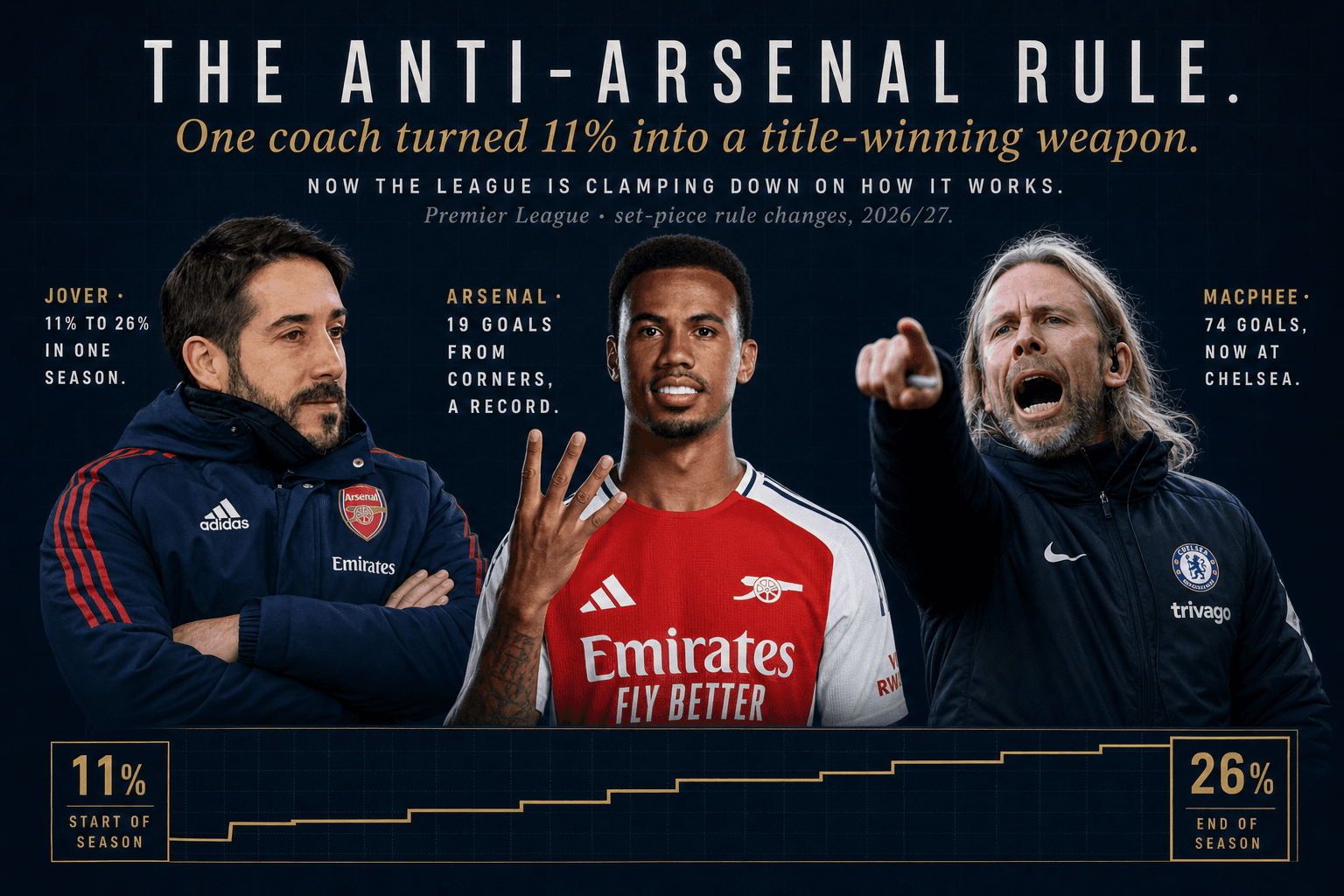
Here is the number that explains an entire Premier League title, and quite possibly an entire rule change. Nineteen. That is how many goals Arsenal scored from corners alone in 2025/26, comfortably beating the previous Premier League record of sixteen. Add free-kicks and throw-ins and the total reaches 25 set-piece goals excluding penalties, the highest in the division. ESPN's analysis found that 35% of Arsenal's total goals came from set-pieces, with another 7.5% from own goals, giving them a higher combined share than any title-winning campaign in Premier League history.
Arsenal did not win the league by outplaying everyone in open play. They won it by turning dead balls into a manufacturing process. And this summer, the Premier League introduced a set of officiating changes that target the exact physical mechanics that make that process work. Sections of the football world are already calling it the anti-Arsenal rule.
Six Goals to Twenty-Five: What Jover Actually Did
To understand why this matters, go back to the season before Nicolas Jover arrived. In 2020/21, Arsenal scored six set-piece goals in the entire Premier League campaign. Six. That was 11% of their total goals, which is roughly average, roughly forgettable, and roughly what most clubs treat as an acceptable return on the dullest part of football.
Mikel Arteta recruited Jover in July 2021 from Manchester City, where he had been Pep Guardiola's set-piece specialist. In Jover's first season, Arsenal's dead-ball share jumped from 11% to 26%. During one particularly hot stretch that season, Sky Sports reported 46% of Arsenal's Premier League goals were coming from set-pieces. Five years later, that project produced a record-breaking title-winning campaign.
What Jover built is not a trick. It is choreography: designed runs, blocking screens, decoy movement, targeted delivery zones, and bodies deliberately positioned to occupy defenders who are trying to mark someone else. Every element is rehearsed, and crucially, several of those elements depend on physical contact inside the penalty area. That last detail is the one the Premier League has now decided to look at much more closely.
The 2026/27 Crackdown, Explained
Match officials have been instructed to take a significantly stricter approach to holding, pulling and wrestling inside the penalty area during corners and set-pieces. Defenders who impede opponents through excessive physical contact now face tougher sanctions, and critically, penalty kicks are explicitly on the table where appropriate.
There is an important nuance in the guidance that most coverage skips: the instruction stresses that not every contact is a foul, keeping the intervention threshold deliberately high. This is not a ban on contact. It is a targeted crackdown on deliberate wrestling and obstruction. The same rule package also reclassified hair-pulling, which previously counted as violent conduct and an automatic red card, so that a pull without excessive force or brutality can now be a yellow. Challenges on goalkeepers are getting greater scrutiny too.
Read the package as a whole and the intent is clear. The Premier League has looked at what happens inside its own penalty areas at corners, decided it has drifted too far toward rugby, and acted.
Arsenal took set-piece goals from 11% of their total to a record-breaking 25 in a title-winning season, and 19 of those came from corners alone. One season later, the league introduced a zero-tolerance approach to holding and wrestling at corners with penalties on the table. Nobody at the Premier League will call it the anti-Arsenal rule. Plenty of other people already have.
Does It Actually Hurt Arsenal? The Honest Answer Is Nobody Knows
This is where it gets genuinely interesting, because the obvious reading may be wrong.
The case that it hurts Arsenal is straightforward. Jover's routines rely on screening: attackers positioning themselves to physically obstruct defenders from tracking runners. If officials penalise that contact, the choreography loses a load-bearing wall, and Arsenal's scripted movements become considerably easier to defend.
But run the logic the other way. Arsenal are the attacking side at these corners far more often than they are defending them. Nineteen goals from corners means Arsenal spend a lot of time trying to get free of defenders who are holding, pulling and wrestling them. A zero-tolerance policy on defensive holding gives attackers greater freedom of movement, and the club whose entire model is built on engineering free attackers into designed spaces might be the biggest beneficiary in the division. A defender who grabs Gabriel at a corner is now risking a penalty rather than a shrug.
There is a third possibility that is probably closest to the truth: it advantages whoever adapts fastest. Arsenal have a five-year head start in dedicated set-piece coaching, a specialist who has been refining these routines since 2021, and an entire squad drilled to execute them. If the rules change and everyone must relearn how to attack and defend corners, the club with the best set-piece coach does not obviously lose that race.
Chelsea Just Paid a Release Clause for a Set-Piece Coach
Which brings us to the development that proves how seriously this discipline is now taken. Chelsea signed Austin MacPhee from Aston Villa this summer, activating a release clause in his contract for an undisclosed fee, fighting off competition from other Premier League clubs and the Saudi Pro League. He joined Chelsea's pre-season tour in Hong Kong.
Read that sentence again. A club triggered a release clause to sign a coach. Not a player. The mechanics of that process are exactly what we broke down in our piece on how release clauses actually work and how clubs discover them, where we covered Morgan Gibbs-White's collapsed Tottenham move, Youri Tielemans leaving Villa for £35 million, and Matheus Cunha's instalment-structured exit from Wolves. The same instrument now applies to backroom staff, which tells you how completely the market has reclassified set-piece coaching from novelty to asset.
MacPhee's numbers justify it. Villa scored 74 set-piece goals across his five years at the club, and in 2025/26 they finished level with Arsenal for the most Premier League set-piece goals, with 18 in the league, five more than Chelsea managed. Chelsea did not sign a coach. They signed a specific, measurable output gap, and they closed it by taking it directly from a rival.
Villa's Bad Summer Just Got Worse
For Aston Villa, losing MacPhee lands in an already difficult window, and the financial context makes it worse. As we explained in our piece on how Squad Cost Ratio replaced PSR, Villa were fined €22.5 million, roughly £19.4 million, for a significant squad cost ratio breach after spending approximately £252 million against revenue of £257.7 million. That is a club under real pressure to sell, and this summer it has sold heavily: Morgan Rogers to Chelsea for a British-record £117 million and Youri Tielemans to Manchester United via that release clause.
Now the set-piece coach who delivered 74 goals in five years has gone to Chelsea as well, through the same mechanism. Villa's full window is tracked on our Aston Villa transfer records page, and Chelsea's on our Chelsea transfer records page.
The MacPhee hire also fits the pattern we identified in our piece on Xabi Alonso tearing up the BlueCo model. Alonso's Chelsea has moved decisively toward proven, immediate quality: Danny Welbeck at 35, Jordan Henderson at 36, Maxence Lacroix at 26. Hiring the league's most productive set-piece coach is the same instinct applied to the coaching staff. Buy what is already working rather than hope it develops.
Arsenal's Wider Summer Context
Arsenal, meanwhile, are trying to add midfield control to a title-winning side. As we covered in our piece on the Bruno Guimarães pursuit, talks with Newcastle have run through intermediary Kia Joorabchian, and the situation was thrown into uncertainty by Eddie Howe's resignation, which we detailed in our piece on the night he walked away after Newcastle's forecast 98.5% squad cost ratio forced the sales of Sandro Tonali and Anthony Gordon.
The contrast is worth sitting with. Newcastle are dismantling a squad because of a spreadsheet. Arsenal won a title partly through a coaching appointment made in 2021 that cost them a fraction of a single transfer fee. Marginal gains, properly funded and properly protected, are now competing directly with nine-figure transfer spending as a route to trophies. Arsenal's business is on our Arsenal transfer records page.
What to Actually Watch This Season
Three things will settle this quickly. First, whether referees hold the line. The guidance says not every contact is a foul, which leaves enormous discretion, and if officials retreat after the first controversial penalty in a big match, the crackdown dissolves into inconsistency by October.
Second, whether Arsenal's corner numbers actually fall. If 19 becomes 12, the anti-Arsenal framing was right. If it holds or climbs because defenders can no longer wrestle Gabriel and William Saliba off their designed runs, the entire narrative inverts and the league will have accidentally handed the best set-piece side in its history a further advantage.
Third, whether Chelsea's set-piece output jumps. MacPhee produced 18 league goals at Villa last season against Chelsea's 13. If that gap closes fast, every club without a dedicated set-piece specialist will be in the market for one by January, and the price of the good ones will go the way of everything else in this sport.
Arsenal spent five years quietly proving that the most undervalued asset in football was the dead ball. The league changed its rules in response. Whichever way that breaks, the argument itself is the clearest evidence that Jover's work mattered.
Watch our full breakdown of Arsenal's set-piece machine and the new rules on BackPage FC Videos.
Arsenal scored 19 goals from corners and the league changed the rules. Does the crackdown hurt them, or hand the best set-piece side in history an even bigger edge? Tell us below.