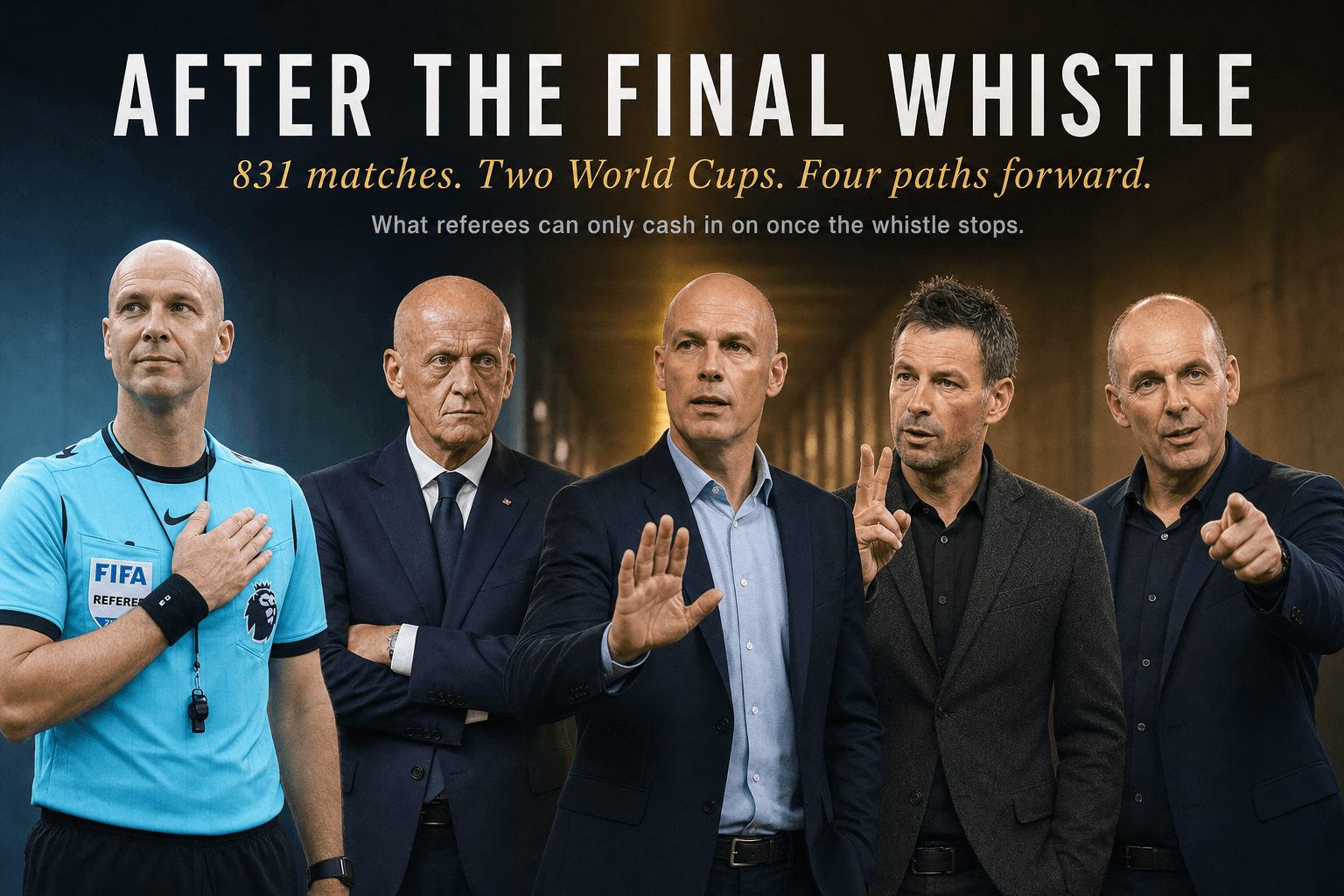
Anthony Taylor took charge of his final match on July 6, 2026, overseeing Spain's 1-0 win over Portugal in the World Cup Round of 16, decided by Mikel Merino's stoppage-time winner, a goal we detailed in full in our piece on Merino's corner flag tribute to his father. Two weeks later, at 47 years old, Taylor announced his retirement from professional refereeing, closing a twenty-year career that included 831 matches, two World Cups, two European Championships, and a 2024 Champions League final between Borussia Dortmund and Real Madrid. His departure raises a question most football coverage never properly answers: what does an elite referee actually do once the whistle stops, and why does retirement, rather than the career itself, often mark the true beginning of an official's earning power?
From Prison Officer to the Biggest Stage in Football
Taylor's route into refereeing began not on a football pitch but working as a prison officer, before he entered the Football League as an official in 2006. He made his Premier League debut in 2010, was added to FIFA's international list by 2013, and went on to officiate 432 Premier League matches and 163 international fixtures, including the 2015 League Cup final, the 2017 and 2020 FA Cup finals, the 2021 UEFA Nations League final between France and Spain, and the 2023 Europa League final, won by Sevilla on penalties against Roma. His path is a specific illustration of the route football's biggest officiating jobs actually require: not a failed professional playing career, but a completely separate profession first, followed by a slow, multi-decade climb through the exact refereeing pyramid we detailed in our piece on how FIFA actually selects World Cup officials.
The Cost Nobody Sees While the Career Is Active
The specific price of reaching that level was significant. Taylor has previously described being subjected to sustained abuse throughout his career, and after the 2023 Europa League final, his family faced direct confrontation from Roma supporters at the airport, a specific incident that led Taylor to reveal his family no longer attends matches he officiates. Announcing his retirement, Taylor said: "Officiating at the elite level has been an immense privilege, but the pressure is intense and the scrutiny is constant. So the time is now right to step aside." That specific tension, elite officials operating under a level of public scrutiny comparable to the players themselves, without anything resembling a player's commercial income while still active, is the exact imbalance that makes retirement financially transformative for referees in a way it rarely is for footballers.
An active international referee cannot sign the kind of sponsorship deals a player takes for granted. Neutrality rules prohibit conflicts of interest with betting companies, alcohol brands and partisan club sponsors throughout an official's entire working career. The moment that career ends, every one of those restrictions disappears at once, and the specific market for a recognisable, credible former World Cup referee opens up immediately.
Why Referees Can't Cash In While They're Working
The specific regulatory logic behind that restriction is straightforward: an official whose income depends partly on commercial partnerships would create an immediate and obvious conflict of interest with the clubs, leagues and competitions they are simultaneously responsible for officiating impartially. FIFA and domestic governing bodies enforce strict limits on what active referees can endorse, effectively locking elite officials out of the exact commercial economy that footballers, described in our piece on this tournament's highest-paid sponsorship earners, have exploited so effectively. A referee's entire career is spent building a recognisable public profile that he is contractually barred from monetising, right up until the specific moment he steps away.
What Taylor's Predecessors Actually Did
The path from elite whistle to post-retirement career has a well-established precedent among the sport's most recognisable former officials. Pierluigi Collina, widely considered the finest referee of his generation, retired from active officiating in 2005 and moved directly into governance, eventually becoming FIFA's Chairman of the Referees Committee, the exact role from which he defended match officials against Egypt's bias complaint at this very World Cup, a controversy we detailed in full in our piece on the tournament's complete retrospective. Howard Webb, who refereed the 2010 World Cup final, followed an almost identical trajectory, moving into refereeing administration and now serving as Chief Refereeing Officer at Pro Ref, the organisation that led the tributes to Taylor's own retirement. Mark Clattenburg, retired since 2017, took a different route entirely, building a prominent media punditry career while also taking a technical director role advising Saudi Arabia's refereeing structure. Mike Dean, since retiring in 2022, has built a full-time broadcasting career as a television pundit, breaking down contentious refereeing decisions for a mainstream audience in exactly the kind of role his active career would never have permitted.
The Specific Market for a Recognisable Former Referee
What these four paths, governance, punditry, technical consultancy and media work, share is a common underlying asset: name recognition built entirely through controversy and high-stakes decision-making, now available to monetise the moment retirement removes the neutrality restrictions. A retired World Cup referee carries a specific kind of credibility that a conventional pundit cannot replicate: he has stood inside the exact pressure of a Champions League final or a World Cup knockout match, made the calls, and lived with the consequences. Broadcasters, federations building their next generation of officials, and even individual leagues seeking technical consultancy all have a direct commercial and reputational interest in that specific credibility once it becomes available to hire.
What Comes Next for Taylor
Taylor has not yet confirmed his specific next step, describing only a transition to "the next chapter" of his career, but the precedent set by Collina, Webb, Clattenburg and Dean makes the realistic options clear: a media punditry role analysing the exact refereeing decisions he spent two decades making under real pressure, a technical or administrative position within Pro Ref or a comparable international body, or refereeing consultancy work with a federation looking to develop its next generation of match officials. Whichever path Taylor chooses, the specific commercial freedom retirement grants him, the ability to finally monetise two decades of built recognition without the conflict-of-interest restrictions that defined his working career, is the same freedom every one of his most successful predecessors used to build their own second act.
Anthony Taylor spent 20 years building a reputation he could never commercially exploit while working. Now that career is over. Should elite referees be allowed to take sponsorship deals while still active, or does neutrality require the restriction? Tell us below.