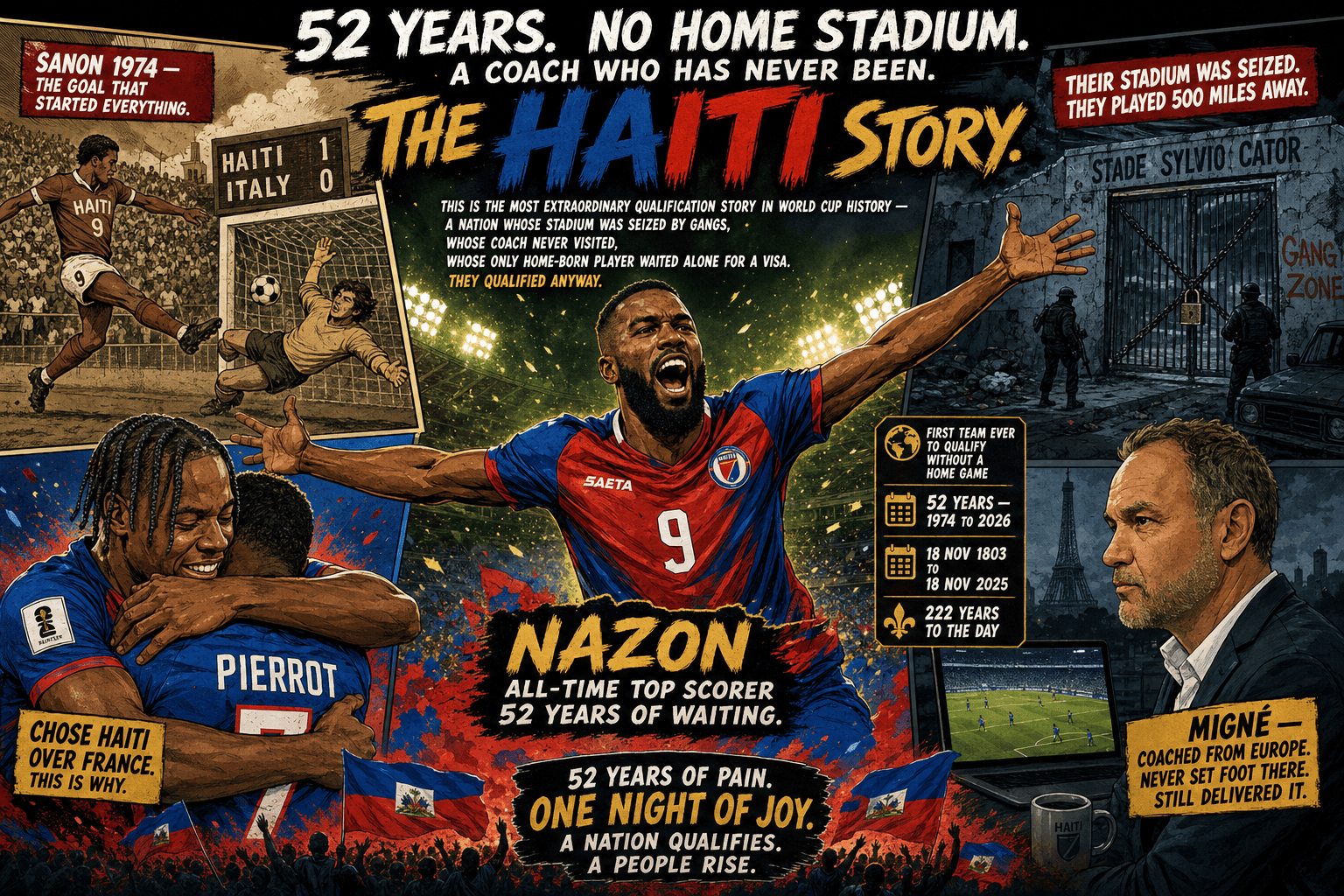
In 1803, on 18 November, Haitian forces defeated Napoleon's army at the Battle of Vertières and became the first Black republic in history. On 18 November 2025 — exactly 222 years later, to the day — Haiti's football team held Jamaica to a 0-0 draw in Kingston and qualified for their first World Cup in 52 years. If you wrote this as fiction, nobody would publish it. It happened anyway.
The Stadium They Cannot Use, the Coach Who Has Never Visited, the Country That Showed Up Anyway
Start with the conditions. In March 2024, Haiti's national stadium — the Stade Sylvio Cator in downtown Port-au-Prince — was overtaken by armed gangs. The Haitian federation issued a statement confirming it had lost possession of the facility and confirming acts of vandalism. No events have taken place there since. No events are expected any time soon. Gangs now control an estimated 80 to 90 percent of the capital. The country has been enveloped by violence since the 2021 assassination of President Jovenel Moïse, which left a power vacuum that organised criminal networks moved quickly to fill. The United Nations called the situation an unending horror story. By the time Haiti's World Cup qualifying campaign reached its decisive stage, more than 1.3 million people had been displaced from Port-au-Prince — the city that contains the only football infrastructure Haiti has ever had.
So Haiti left. They flew 500 miles to Curaçao — the same island simultaneously making its own World Cup history as the smallest nation ever to qualify — and played every home qualifier at the Ergilio Hato Stadium in Willemstad. Two nations. One borrowed pitch. Both going to the World Cup. No team in the history of the World Cup had ever qualified without playing a single home match. Haiti became the first.
And their coach has never set foot in the country. Sébastien Migné, a Frenchman who had previously managed Congo, Kenya, and Equatorial Guinea — the difficult jobs, the overlooked contexts, the postings other managers decline — was appointed in June 2024. He has not visited Haiti once. When asked about it, he was direct. He told France Football: the situation is simply too dangerous. There are no international flights. He usually lives in the countries he manages. He could not live in this one. He managed it from outside, built a World Cup qualifying campaign from outside, and delivered a World Cup from outside. Unglamorous men like Sébastien Migné do not get the front pages. They get the countries nobody else wants, and they find ways to make something from nothing.
Vertières to Kingston: The Anniversary Nobody Noticed
The Battle of Vertières on 18 November 1803 is the moment Haitian schoolchildren learn first. Jean-Jacques Dessalines led a force of formerly enslaved soldiers against the French army of Napoleon Bonaparte and won. Haiti declared independence in 1804 — the first nation established by formerly enslaved people in the history of the world, and the first Black republic. The date, 18 November, is taught and celebrated across every generation.
When the 0-0 draw in Kingston was confirmed and the players collapsed onto the pitch, very few people in international football stopped to notice what day it was. 18 November 2025. Two hundred and twenty-two years after Vertières to the day. The country that defeated Napoleon's army with machetes qualified for the World Cup on the same date it had first proved that impossible things could be done. Football, sometimes, is paying attention to something larger than football.
No team in World Cup history had ever qualified without playing a single home match. Their coach had never visited the country. Their most home-grown player waited alone for a visa. Haiti qualified anyway — and they did it on the anniversary of the day in 1803 when they defeated Napoleon and became the first Black republic on earth.
Emmanuel Sanon, 1974: The Goal That Started It All
To understand what this World Cup means, you need to understand what the last one meant. The year was 1974. The venue was Munich. The opponent was Italy — a side whose goalkeeper, Dino Zoff, had not conceded a goal in international football for 1,142 minutes. He had frustrated England twice, held Brazil, kept clean sheets across 12 games spanning over two years. The media speculated whether the forwards from the Netherlands or West Germany were even capable of beating him. Nobody was asking the same question about Haiti.
In the 46th minute, Haiti midfielder Philippe Vorbe played a through ball. Emmanuel Sanon — a 22-year-old who earned $200 a month playing for Don Bosco of Pétionville — ran onto it, beat Fabio Capello on pace, and rolled the ball into an empty net. Zoff's 1,142-minute record was over. For six minutes, Haiti led Italy at a World Cup. The stadium was stunned. Haiti celebrated. Sanon was mobbed by teammates in red tracksuits. Italy fought back and won 3-1. Haiti were eliminated after losing 7-0 to Poland and 4-1 to Argentina. But the goal lived forever — the most famous moment in Haitian sports history, the moment a Caribbean island in a group of death with three of Europe and South America's most powerful nations looked the world in the eye and refused to blink.
Sanon died in 2008 at 56 years old from pancreatic cancer. His funeral was held at the Stade Sylvio Cator — the same stadium that armed gangs would later seize. His teammates from the 1974 squad carried his coffin onto the pitch. He never saw Haiti qualify again. He never stopped believing they would.
The Squad Built on Diaspora and One Remarkable Exception
The current Haiti squad is built almost entirely on diaspora — professionals with Haitian heritage who grew up and built careers in France, the United States, and elsewhere. Jean-Ricner Bellegarde and Wilson Isidor both switched allegiance from France for this qualifying campaign. Isidor spoke openly about the choice. He chose Haiti. Goalkeeper Johny Placide, the veteran captain, is 38 years old and has waited his entire career for a stage this large. Duckens Nazon, Les Grenadiers' all-time leading scorer, anchors the attack with decades of international experience. These are not household names in European football. They are men who made a harder choice.
And then there is Woodensky Pierre. Of Haiti's entire World Cup squad, he is the only player who grew up in Haiti and still plays there. He is from Cité Soleil — one of Port-au-Prince's most gang-ravaged neighbourhoods — where he learned football playing with his father as a child. His agent scouted him remotely because the security situation made it impossible to watch him play in person. Pierre earned his World Cup place from inside the country everyone else had left. Then he watched his teammates prepare in Florida while he waited alone in Pétion-Ville for a US visa under the Trump-era travel restrictions. It finally came through. He is going to the World Cup. The only man on the squad who never left to get there.
Qualifying Without Them Knowing How to Stop It
Haiti were placed in CONCACAF qualifying Group C alongside Costa Rica, Honduras, and Bermuda. On paper: Costa Rica and Honduras were expected to occupy the automatic qualification places. Both nations had multiple World Cup appearances between them. Haiti had been to one — and that was in 1974. The group was supposed to sort itself out between the established nations. Haiti disrupted that story completely.
They beat Costa Rica 1-0 in Willemstad — a home game played on borrowed ground, 500 miles from home. They beat Nicaragua. They took a heavy 3-0 loss to Honduras but stayed in contention. They finished first in the group. When they beat Nicaragua 2-0 in their final match in Curaçao, the streets of Port-au-Prince erupted in celebration. Deedson Louicius, 25, one of the goalscorers that night, said afterwards that it had been a long time since he had seen Haitian people united the way they were in that moment. Earlier that year, gangs had set fire to the FIFA Goal Center in the capital — the development facility where Haitian children went to dream. A football result, played 500 miles away on a borrowed pitch, briefly gave an entire displaced population something to celebrate.
Group C: Brazil, Morocco, Scotland — and the Weight of What This Means
The World Cup draw placed Haiti in Group C alongside five-time world champions Brazil, Morocco — who reached the semi-finals in 2022 — and Scotland. Haiti open against Scotland on 14 June in Boston. They face Morocco. They face Brazil. The scale of what awaits them is not manageable. Brazil beat Haiti 4-0 in a World Cup qualifier in 2021. Morocco eliminated Belgium and Spain at the 2022 World Cup. Scotland are organised and competitive under a manager who has built genuine belief. For Haiti, none of this is the point. The point is being there at all.
The story the media will tell is about the underdog — the nation that qualified without a stadium, without a coach who'd visited, without the infrastructure that even modest footballing nations take for granted. In Haiti, football is played everywhere — barefoot on asphalt, in flip-flops on dirt, on worn-out artificial turf in neighbourhood leagues and inter-school tournaments. The game has survived everything the country has endured: the 2010 earthquake that killed over 200,000 people, the cholera epidemic, the political instability, the gang violence, the displacement. It survived because it was never housed in a stadium. It lived in the streets, in the people, in the culture that the armed gangs seizing the Stade Sylvio Cator could control physically but could not touch.
This is why Deedson Louicius' comment — about how long it had been since Haitian people were unified — carries so much weight. Football did not solve Haiti's crisis. A World Cup qualification does not rebuild a capital city. But for a country whose population has been displaced, whose stadiums are occupied, whose coach cannot visit — to still find a way to qualify for the most-watched sporting event on earth — is proof of something that transcends the sport itself.
What Connects 1974 to 2026
Emmanuel Sanon is not here to see it. He died in 2008, long before this qualifying campaign began, long before the idea that Haiti would return to a World Cup in his lifetime — or anyone else's — seemed realistic. But the goal he scored on 15 June 1974, in Munich, against Dino Zoff's unbeaten record, at 46 minutes into Haiti's first-ever World Cup match, is the thread that connects everything. It is why Haitian football fans know what this moment means in a way that purely analytical commentary cannot capture. Sanon proved, for six minutes, that a Caribbean island with barely five million people could step onto the biggest stage in football and produce something beautiful. The story did not continue then. It continues now, fifty-two years later, with a squad built from diaspora professionals who chose the harder flag, a coach who managed from Europe, and one player from Cité Soleil who waited for a visa and refused to give up.
For everything that has been taken from Haiti — the stadium, the safe training grounds, the national infrastructure, the sense of security — this cannot be taken. The World Cup is confirmed. The flights are booked. The players will walk out in Boston on 14 June 2026, fifty-two years after Emmanuel Sanon scored past Dino Zoff, and they will represent a country that has endured more than most football nations can imagine and is still here, still showing up.
You want context for what this World Cup qualification means? In 1974, Haitian defender Serge Racine told reporters: there were people who did not know Haiti existed, asking where it was. Fifty-two years later, the whole world will know again. And this time, they should remember.
For a look at the other extraordinary CONCACAF qualification story from this same tournament, read our piece on Curaçao: the 156,115-person island that also qualified — and also played their home games in the same borrowed stadium in Willemstad.
Haiti face Scotland on June 14 in Boston for their first World Cup match since 1974. Do you think they can cause an upset — and what do you think this qualification means beyond the football? Let us know below. 👇