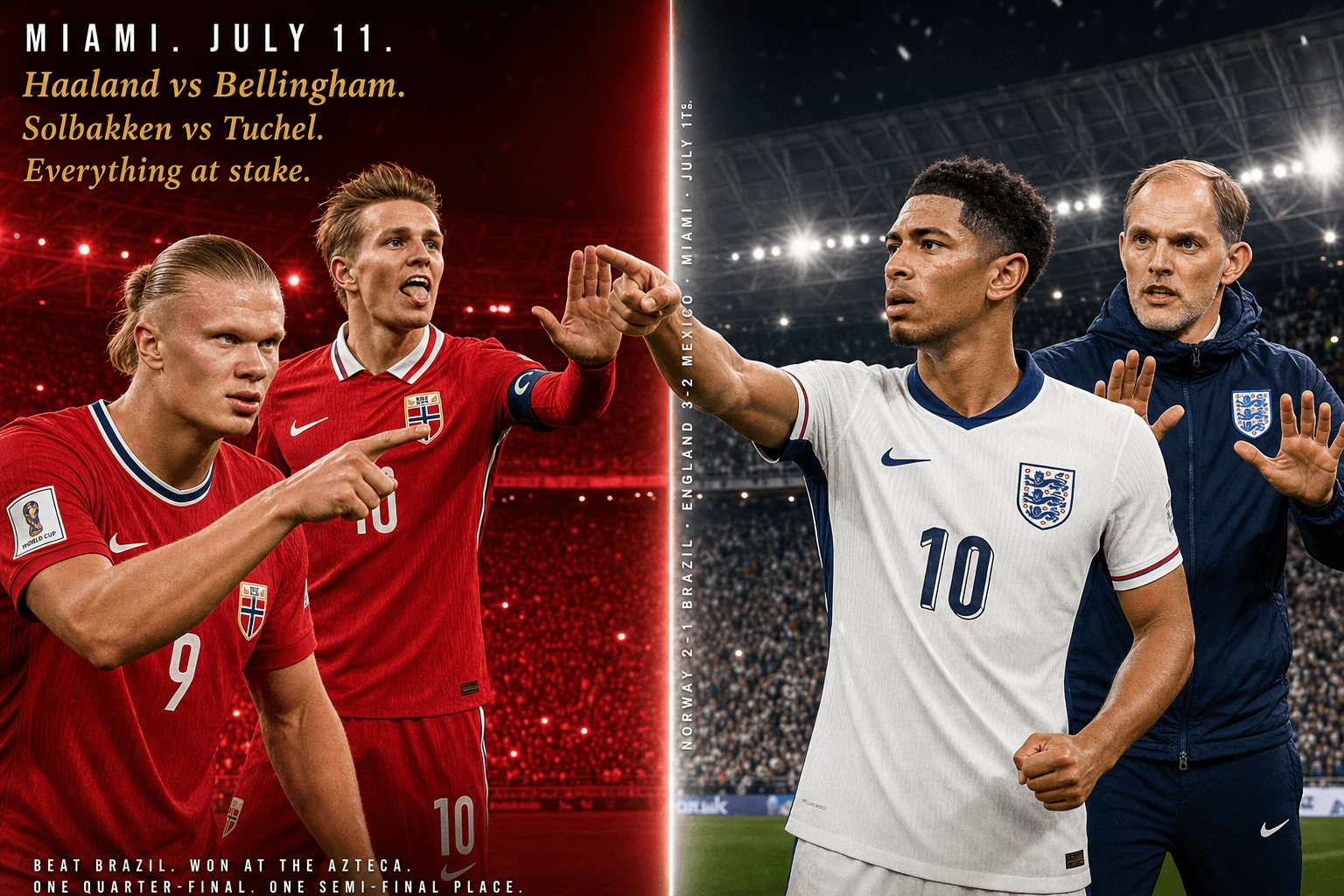
The 2026 World Cup quarter-final bracket has delivered the match that nobody planned and everybody wants. Norway versus England in Miami on Saturday July 11. Erling Haaland — seven goals, the world's most dangerous striker at his first World Cup — against the squad that won at the Azteca with ten men two nights ago. Ståle Solbakken — the Norwegian manager who has built something with players that are not elite — against Thomas Tuchel, who won the Champions League with Chelsea in 2021 and is now the only active candidate to complete the double of winning both the UCL and the World Cup. The managers never faced each other in UEFA club competition. They have never managed teams against each other at any level. Miami, July 11, 2026, is the first time. The stakes are: a semi-final place, a continuation of Norway's most extraordinary week in football history, and — if England win — Tuchel's closest approach yet to the rarest achievement in the sport's managerial history.
Haaland in Familiar Territory — But Not in the Way Mexico Was
The user brief for this match contained the observation that Miami is familiar territory for Haaland because he plays for Manchester City in the Premier League. That is true in one sense: Haaland competes against English clubs every week of the season. He knows how Bellingham moves, how Rice presses, how Pickford organises the defensive line. He has played against English opponents in Premier League matches, European competition, and — this week at MetLife Stadium — in a World Cup Round of 16 against a Brazilian team that contained Premier League exports in Vinicius Junior, Rodrygo, and Casemiro. He is not encountering an alien system on Saturday. He is encountering the football culture his club football is embedded in.
But the reverse is equally true. Every England player in that quarter-final squad has faced, or played alongside, Haaland. They know his movement — the deep drop, the run in behind, the specific timing of the late arrival into the box that beat Gabriel Magalhaes in the 79th minute against Brazil. Knowing Haaland's movement and stopping it are different competences. Sky Sports noted a TV pundit's verdict after the Brazil match: Gabriel Magalhaes knows Haaland better than almost any defender. He plays against him in training at Arsenal and City matches. Gabriel went for a straight race and lost. The lesson is not that knowing Haaland helps you stop him. It is that knowing him and stopping him are different problems. Marc Guehi and Ezri Konsa have both faced Haaland in Premier League football. Neither has solved him consistently across a full match. Saturday gives them 90 minutes to find a solution that their club football has not yet produced.
Solbakken vs Tuchel: The Manager Who Beat a Serial Winner
The previous iteration of this quarter-final was supposed to be Ancelotti vs Tuchel — the specific head-to-head we documented in our piece on the complete Tuchel vs Ancelotti UCL knockout record. Ancelotti is eliminated. Solbakken beat him. The specific coaching achievement of Solbakken eliminating the five-time Champions League winner with a squad built around Bodø/Glimt's captain, a 35-year-old backup goalkeeper, and a midfielder who reversed his international retirement four months ago — documented in our piece on Norway's squad stories and how they reached the quarter-final — is the specific credential Solbakken brings to Miami. He outcoached Ancelotti. Now he faces Tuchel.
The specific coaching matchup is interesting because Tuchel has significantly more European top-level managerial experience than Solbakken. The UCL, the Champions League final, the Premier League, the Bundesliga. Solbakken has managed in Denmark and Norway. But Solbakken has also beaten Manchester City, Atletico Madrid, Inter Milan, and Borussia Dortmund with Bodø/Glimt in the Champions League. He has just eliminated the world's most decorated active manager with a goalkeeper who plays four league games per season. The resource gap between Solbakken and Tuchel is significantly smaller than the resource gap between Solbakken and Ancelotti was. The result against Brazil has confirmed that resource gaps are not the relevant variable when Solbakken is organising a team.
Tuchel's Double: The Third Manager in History Within Reach
The specific consequence for the managerial achievement narrative is that Tuchel's path to becoming the third manager ever to win both the Champions League and the World Cup now requires winning four more matches. Norway, then the semi-final (France or Morocco), then the final on July 19 in New Jersey. As we explored in our comprehensive piece on only Lippi and Del Bosque having completed the double and in our piece on how Ancelotti and Tuchel were the two candidates, the specific rarity of the achievement — only two men in 96 years of the World Cup — makes Saturday's quarter-final the most important managerial step Tuchel has ever taken in international football. He won the Champions League with Chelsea in five months in 2021. He has managed England to a World Cup quarter-final via a win at the Azteca. The semi-final against France or Morocco — covered in our piece on the France vs Morocco quarter-final and its Real Madrid subplot — is the specific match that follows a Norway win. Three matches from history. Norway stand between Tuchel and the first of those three.
Norway beat Brazil. England won at the Azteca with ten men. Haaland has seven goals. Bellingham had the best night of his England career. Solbakken outcoached Ancelotti with a goalkeeper who barely plays club football. Tuchel is one win from a World Cup semi-final with the UCL trophy already on his CV. Miami, July 11. The quarter-final is everything it was supposed to be when the draw was made — and nothing like what anyone predicted it would look like.
Norway's Key Question: Can They Contain Bellingham?
The specific tactical challenge for Solbakken on Saturday is whether the defensive shape that made Brazil's 2.73 expected goals irrelevant can also contain Jude Bellingham. Brazil's attack ran primarily through Vinicius Junior's pace and direct running, Rayan's Bournemouth directness, and Martinelli's energetic pressing. England's attack runs through Bellingham's late runs into the box, Kane's movement in behind and between the lines, and the specific wide threat that Saka (if fit) or Gordon provides on the flanks. The specific qualities are different. Bellingham in the 36th minute — arriving unmarked at the back post from a Saka cross — is a different problem from Vinicius Junior in the second half. Nyland can stop a penalty from Guimarães. Stopping Bellingham arriving at the back post requires an organisational response from the outfield players before he gets there.
The England question going into Miami is the shape of the squad following the Azteca. Saka was substituted in the 57th minute with what Tuchel described as precautionary management. His availability for Saturday is the key fitness question. Quansah serves a one-match suspension following his red card. The back four for the quarter-final will require adjustment. Stones and Burn are likely to start. Dan Burn, who threw his body on the line repeatedly in the final stages at the Azteca, provides a specific physical dimension that the back line's conventional options do not. His Premier League experience — at Newcastle, where Haaland has scored against him — gives him specific knowledge of the threat. Saturday tests whether that knowledge is useful. Norway have not conceded in three consecutive matches at this World Cup. England are not Brazil. They scored three against Mexico with ten men. The quarter-final produces the answer to both questions simultaneously.
Norway's Momentum — and Why They Are Nobody's Underdog Anymore
The dark horse label that applied to Norway before the tournament — explored in our piece on Norway as the tournament's most dangerous underdog — no longer applies. A team that beats Brazil in the Round of 16 with a 35-year-old backup goalkeeper is not a dark horse. It is a contender. The specific evidence of what Norway have produced at this tournament — four goals conceded in five matches, Haaland with seven in those five, Nyland's penalty save against Brazil, Solbakken's bold half-time double substitution that produced both winning goals — represents a team performing at the level of the tournament's best. They are not in the semi-finals yet. They will need to beat the team that won at the Azteca with ten men to get there. But the description of Norway as a small team getting lucky is no longer available. They have beaten the five-time world champions. They have Haaland. They have Nyland. They have Berg from a club that beat Manchester City, Atletico Madrid and Inter Milan. They are not dark horses. They are a quarter-finalist.
The Norwegian football culture that has produced this tournament run is the same culture that produced Bodø/Glimt's European adventures, that produced the six-year project Westerhof began with Nigeria in 1989 — the belief that collective identity and preparation can overcome the resource gap between small nations and the sport's wealthiest clubs and countries. As we reflected in our piece on Norway's 28-year absence from the World Cup and the history behind this return, Erling Haaland was born in the year Norway last appeared at this tournament. He arrived in 2026 not as the reason Norway qualified but as the player through whom Norway's preparation found its most visible expression. Saturday in Miami is the next expression. England are favourites. Norway are not going away.
One final detail matters for the quarter-final narrative. Jordan Henderson, England's late substitute against Mexico who injured his wrist celebrating, was taken to hospital and is a doubt for Saturday. His loss from the squad would be manageable — Kobbie Mainoo and Morgan Rogers are available as central midfield depth. But it represents the specific cost of what the Azteca demanded physically. England's squad comes into Miami depleted by Quansah's suspension, potentially short of Henderson, and carrying Saka's precautionary substitution as the fitness question that shapes Tuchel's selection. Norway's squad is largely intact. They were the better-managed physical performance in their Round of 16. Solbakken's half-time substitutions preserved his starters for Saturday. England's squad managed their ten-man period with everything they had. The physical arithmetic of Saturday is not straightforwardly England's. The football argument is also not straightforward. That is exactly what the quarter-final of a World Cup should be.
The bracket beyond Saturday adds another layer. If Norway win, they face France or Morocco in the semi-final. If England win, they face the same choice. Both potential semi-finals were previewed in our pieces on the respective quarter-finals. The winner of Norway vs England will walk into the last four knowing they have eliminated either Brazil or Mexico in the round before. The tournament has produced the quarter-final correctly. Everything that has happened in the previous ten days has been building to Miami on Saturday. The Azteca. MetLife Stadium. Nyland. Bellingham. Haaland. Tuchel. Solbakken. The quarter-final is the game.
Norway vs England in Miami. Haaland vs Bellingham. Solbakken vs Tuchel. Norway reaching their first-ever World Cup semi-final or England completing the most confidence-building win of Tuchel's tenure? Who wins Saturday in Miami — and does England go all the way to win the World Cup? Tell us below.