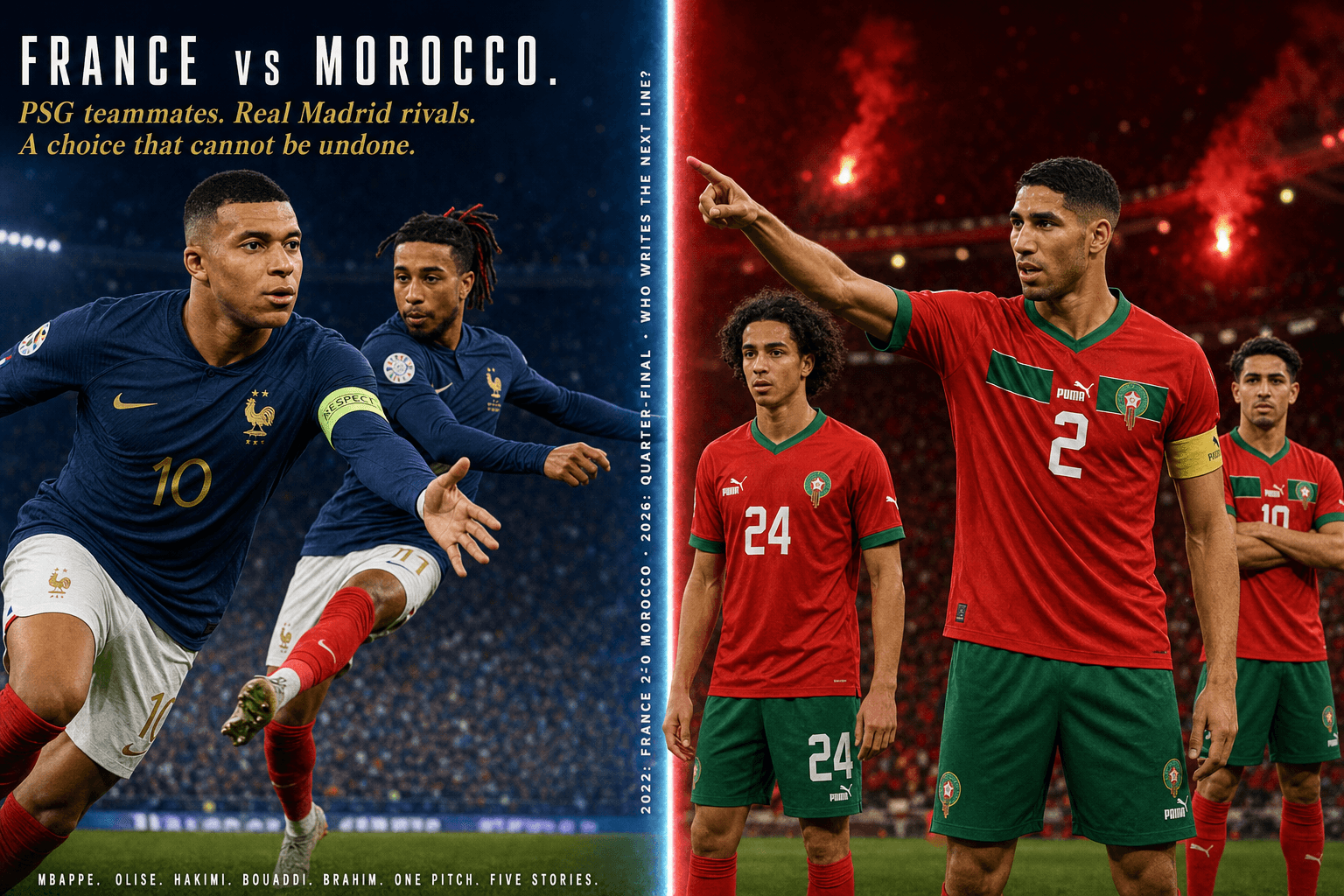
If Morocco beat Canada on July 4 in Houston and France beat Paraguay earlier that day, the 2026 World Cup quarter-final bracket produces the most loaded single match of the tournament. France versus Morocco. The two teams who met in the 2022 World Cup semi-final in Qatar — France winning 2-0, Mbappe scoring the second — facing each other again one round earlier at the 2026 edition, with the same French attacking pair in form and the same Moroccan goalkeeper who beat Spain on penalties in 2022 now having beaten the Netherlands on penalties in 2026. The footballing arguments for this potential quarter-final are compelling enough on their own. But there is a specific subplot within this match — the Real Madrid dimension — that makes it the most narratively dense fixture the tournament could produce. As we documented in our piece on Real Madrid's world-record pursuit of Michael Olise, the player they want to sign from Bayern Munich plays for France in this World Cup. The player whose Real Madrid role Olise would most directly affect plays for Morocco. The quarter-final pitch is also the transfer audition.
The 2022 Context: France Won. Morocco Remember.
The 2022 World Cup semi-final in Qatar produced one of the tournament's most emotionally resonant moments. Morocco — the first African team to reach a World Cup semi-final — faced France in a match that the continent had invested enormous emotional weight in. France won 2-0. Mbappe's goal was the second. The Moroccan players wept. The world applauded a campaign that had beaten Belgium, Spain, and Portugal on the way to that semi-final, and which ended 90 minutes short of the final. Morocco have spoken repeatedly in the build-up to the 2026 tournament about their desire to go further than 2022. A quarter-final against France — one round before the 2022 meeting — is not the revenge match they want. It is the opportunity to prove the semi-final was not the ceiling.
The French squad that beat Morocco in 2022 was formidable. The French squad that meets them in a potential 2026 quarter-final is better. As we explored in our piece on how the Mbappe-Olise partnership is driving France's World Cup ambitions, Mbappe has scored six goals at this tournament and Olise has provided five assists, three of which set up Mbappe directly. France are tournament favourites. Their attacking machine is operating at a level that produces goals regardless of defensive quality, as Sweden, Iraq, and Senegal have discovered. Morocco's capacity to replicate the 2022 defensive organisation that frustrated Belgium, Spain, and Portugal before the semi-final — in the context of Bouaddi's midfield control against Brazil and Bounou's shootout expertise against the Netherlands — is the specific question the quarter-final poses.
Olise vs Brahim Diaz: The Real Madrid Subplot
The most unusual element of a potential France vs Morocco quarter-final is the specific individual matchup it creates within the Real Madrid transfer narrative. Brahim Diaz — born in Málaga, raised in Spanish football academies, at Real Madrid since 2023 — represents Morocco internationally rather than Spain. He is Morocco's right-side attacking midfielder, the player who operates alongside Hakimi's overlapping runs on the right flank that accounts for 45% of Morocco's attacks. In a France vs Morocco match, Diaz plays on the Morocco side. Olise plays on the France side. The two players occupy versions of the same position. And as we documented in our full Olise transfer story, Real Madrid's reported €223 million pursuit of Olise would most directly affect Diaz's role in the Madrid attack. Olise arrives as the creative provider to Mbappe's left-channel running. Diaz currently occupies that creative role when fit. If Olise signs, Diaz's minutes at the Bernabeu decrease or his position shifts. The World Cup quarter-final is therefore not just France vs Morocco. For one specific dimension, it is the player whose Madrid role is under threat against the player who would take it.
Bouaddi Against France: The 18-Year-Old Who Chose Not to Play for Them
The Ayyoub Bouaddi dimension adds a different layer to the potential France vs Morocco match. Bouaddi was born in France, captained France's Under-21 side, and was in the French Football Federation's youth development system before switching his international allegiance to Morocco in May 2026 — just weeks before the World Cup. He chose Morocco over France. In a quarter-final, he would face the country he chose not to represent, in the midfield role France expected him to fill for the next decade. Against Brazil, his 87 touches, 91% pass accuracy, and 53 carries were the statistics that had Casemiro chasing shadows. The French midfield — Tchouameni, Rabiot, and the pressure Mbappe and Olise's forward runs create on transition — is more technically demanding than Brazil's. The test of whether Bouaddi at 18 can control a midfield against a tournament favourite, rather than simply against the five-time world champions, is the specific evidence that Arsenal, PSG, and the other clubs tracking him need before they can quantify whether his price tag competes with the elite European midfielders already established at those clubs. Arsenal have already moved to formal pursuit, Arteta has identified Bouaddi as a priority, and Liverpool and Man City are tracking him alongside PSG and Chelsea. The France quarter-final is the match that moves that interest to action.
Hakimi Against Mbappe's Former Club: The PSG Dressing Room Angle
Achraf Hakimi and Kylian Mbappe played together at PSG for multiple seasons. They know each other's patterns on the football pitch from hundreds of training sessions and competitive matches at the highest level. In a France vs Morocco quarter-final, that shared knowledge becomes a weapon for both sides simultaneously: Mbappe knows what Hakimi's attacking runs look like and how to position defensively when they begin; Hakimi knows how Mbappe accelerates in behind a defensive line and what space he will look to exploit. The specific rivalry between two PSG teammates who understand each other's game almost perfectly is the individual contest that makes this potential matchup the most technically informed meeting of the tournament. It is not two strangers discovering each other. It is two specialists who know the other's strengths and weaknesses and have spent two seasons finding ways to neutralise them. The contest will be decided by whoever executes their preparation more effectively on the day, rather than by surprise or novelty.
Can Morocco Beat France? Why 2022 Is Not the Answer
The instinct to use 2022 as the template for this potential match is understandable but imprecise. The Morocco of 2026 is not the Morocco of 2022. They have Bouaddi — a player who was 15 in 2022 and could not have played — in the double pivot, providing the specific midfield control that limits Brazil and the Netherlands to one goal and a single in-game lead respectively. They have won both of their World Cup penalty shootouts, meaning if the match is tight at 90 minutes, the specific expertise Morocco carry into extra time and penalties is the best in the tournament. And they have the specific motivation of a team that reached the semi-final in 2022 and knows exactly what the step beyond that semi-final requires — because they came within 90 minutes of understanding it from the inside.
France have six Mbappe goals and five Olise assists. France have the squad depth that Morocco's bench cannot match. France are tournament favourites for specific, quantifiable football reasons. But tournament favourites have been eliminated by Morocco before — Belgium in the group stage, Spain on penalties, Portugal in the quarter-finals — in circumstances where the statistics suggested France's equivalent should win. The Atlas Lions do not care about the statistics. They care about the 90 minutes and the shootout. As we noted in our analysis of the summer's biggest transfer story and what the World Cup performance means for the market, the football and the business are running in parallel this summer. For Morocco and France specifically, the quarter-final resolves the football question while simultaneously influencing the transfer decisions of Diaz's Madrid future and Bouaddi's club destination. Both stories end when the final whistle sounds — or, knowing Morocco, when the shootout winner is scored.
Why Morocco Are Specifically Equipped for This Match
Beyond the individual subplots, there is a tactical argument for Morocco being competitive against France that goes beyond the historical upset record. Morocco under Ouahbi use a 4-2-3-1 with Bouaddi and El Aynaoui as the double pivot — a shape that specifically compresses the central space that Griezmann and France's midfielders use to link play between lines. The 45% right-side attack emphasis, channelling through Hakimi and Brahim Diaz, is designed to stretch France's defensive structure horizontally before exploiting the space Hakimi's pace creates in behind. CBS Sports noted after the Netherlands match that Morocco are an exceptionally difficult team to play against when given any space to work, and that their transition quality — the speed from defensive shape to attacking threat — is among the most dangerous at the tournament. France's attacking quality is higher. Morocco's defensive organisation and specific counter-attacking threat are more than sufficient to create a genuine competitive match. France will not walk through Morocco. They will need to solve the same problems Spain and Portugal could not in 2022. This time they have Olise, who changes the problem set. Whether it is enough is what the quarter-final resolves.
The Precedent: Morocco's Approach to Big Opponents
The specific pattern Morocco establish against high-quality opponents is worth naming before the France quarter-final is fully assessed. Against Belgium in 2022, Morocco won from a position nobody expected. Against Spain in 2022, they held a technically superior possession team to a 0-0 over 120 minutes before winning on penalties — Bounou the hero. Against Portugal in 2022, En-Nesyri's header and a defensive performance of collective discipline produced a result that the Portuguese squad, individually, were significantly better equipped to prevent than they were able to. Against Brazil in 2026, Bouaddi's midfield control and Morocco's defensive organisation limited the five-time world champions to a single Vinicius goal. Against the Netherlands in 2026, they absorbed Gakpo's strike, found the 91st-minute equaliser, and won the shootout. The pattern is not a single performance. It is a consistent capacity to compete against the best available opponents at the specific pressure points that knockout football creates. France are the best available opponent. The pressure point is the quarter-final. Morocco have been here before. They know exactly what is required.
France vs Morocco in the quarter-final: Olise against Brahim Diaz's Morocco, Bouaddi against the country he chose not to represent, Mbappe against his PSG teammate Hakimi. Do you think Morocco can beat France and go one further than 2022 — and does this match decide where Bouaddi plays next season? Tell us below.