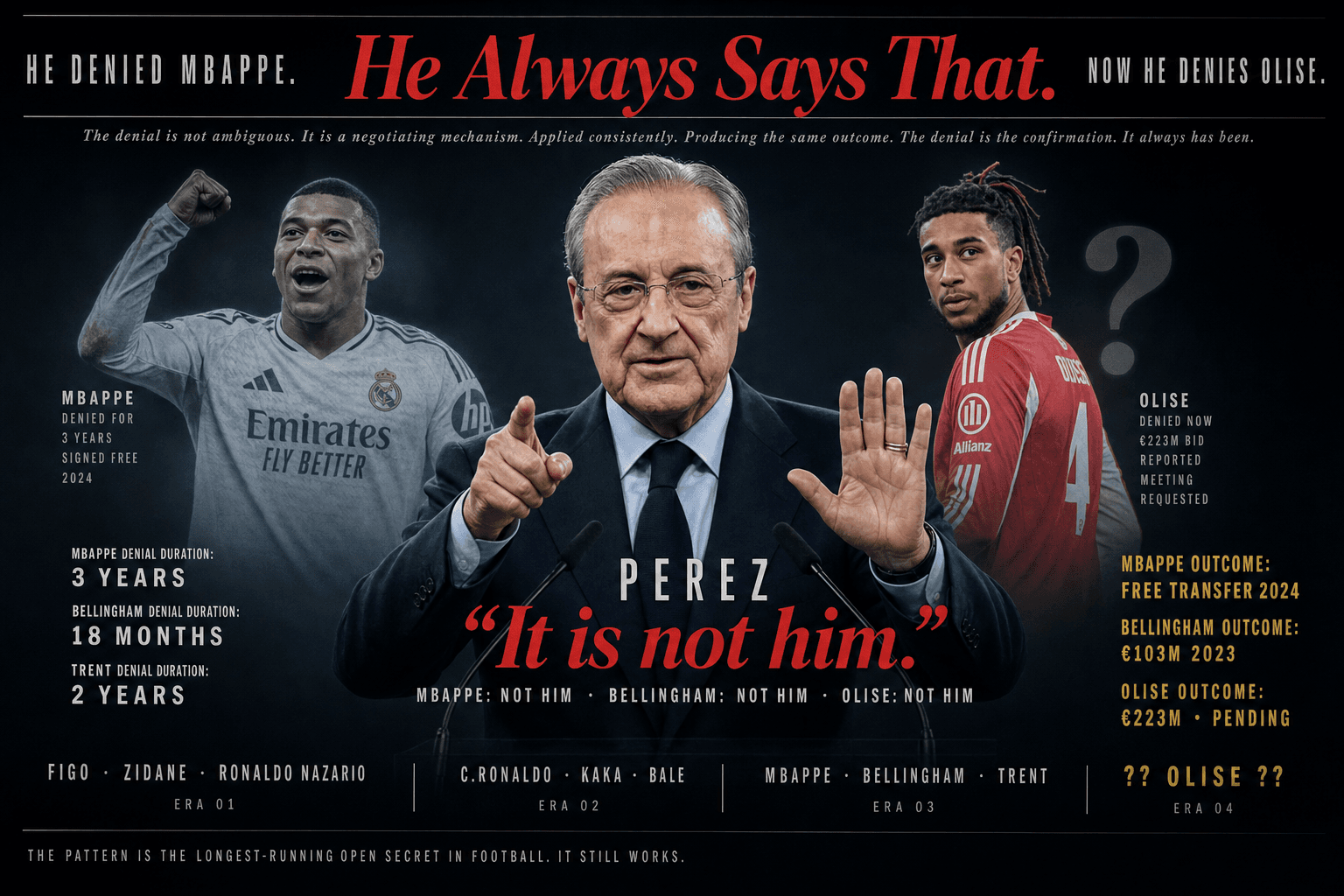
Florentino Perez has developed, across twenty-five years of Real Madrid presidency, the most consistent and most misread habit in European football: the public denial of the transfer target he is actively pursuing. He denied Mbappe for years. He denied Bellingham for eighteen months. His election opponent claimed a Haaland release clause — as we documented in our Haaland release clause explainer — and Manchester City's lawyers shut that version down within 24 hours. Now Perez has denied that Olise is his target, and multiple sources across three countries have simultaneously confirmed that Olise is exactly his target. The denial pattern is not ambiguous. It is a negotiating mechanism, applied consistently, producing the same outcome: the player arrives, the announcement lands, and the denial becomes a footnote. Understanding the pattern is the only reliable way to read a Real Madrid transfer summer.
The Mbappe Denials: The Complete Case Study
The most complete version of the Perez denial pattern is Kylian Mbappe. Real Madrid's interest in Mbappe began when he was still a teenager at Monaco. Perez denied it. Mbappe extended his PSG contract in 2022 in a deal that appeared to definitively end the Madrid pursuit. Perez denied he was still pursuing him. Then, in 2024, Mbappe's PSG contract expired and he joined Real Madrid on a free transfer — one of the most precisely anticipated moves in transfer market history. The denial and the signing are different stages of the same process. The denial protects the negotiation. The signing completes it. Jude Bellingham followed a similar trajectory: non-committal public language for eighteen months, then a decisive 103 million euro commitment. The pattern across both cases is identical in structure.
Why the Denial Serves the Deal
Understanding why Perez denies helps explain why the denial has become the most reliable signal that a transfer is being pursued. When a club publicly acknowledges interest in a player, several things happen simultaneously: the selling club raises their price, the player's representatives demand a larger commission, competing clubs enter the bidding, and the player gains leverage in contract renewal discussions. By denying publicly, Perez keeps all four of those dynamics from activating until the moment he is ready for them — typically when the signing is already agreed in principle and the announcement is imminent. The denial protects the conditions that make the signing achievable.
Multiple sources including TeleFootball confirmed that Olise is exactly who Perez was referring to when he promised his members a 150m+ Galactico signing during the presidential campaign. The denial was a public positioning statement rather than a factual claim about the target. The distinction matters not because Perez is being dishonest but because the denial serves a specific function in the negotiation process separate from its truth value. By publicly denying Olise, Perez achieves two things simultaneously: he protects the negotiation from pressure that forces clubs to dig in publicly, and he preserves the element of surprise that makes the eventual signing land with maximum impact.
Perez on Mbappe: not him. Mbappe signs free. Perez on Bellingham: no commitment. Bellingham signs for 103 million euros. Perez on Haaland clause: untrue. City agreed — but the interest was real. Perez on Olise: not him. Multiple sources: it is him. The denial is the longest-running open secret in football's transfer market. It is also the most reliable tell available.
What Bayern's Response Tells You About Their Reading of the Pattern
Bayern Munich's explicit statement — president Herbert Hainer publicly telling Madrid to save themselves the effort — is itself a recognition of the Perez denial pattern rather than a response to Perez's own public position. Bayern's contract offer — doubling Olise's wages, extending until 2031 — is specifically designed to close the ambiguity that the Perez denial pattern thrives in. Hainer did not respond to Perez's denial of Olise as the target. He responded to the underlying reality that the denials represent: Madrid are coming for their player, the denial is diplomatic cover, and Bayern need to establish their own unmistakable position before the negotiation reaches a stage where ambiguity becomes costly. The doubled wages make the Madrid offer financially less transformative than it would be against a lower salary base. The 2031 extension pushes the natural contract-expiry leverage point five years further away. Bayern understand the pattern. They are trying to break it before it completes.
The Olise Denial in the Context of the Galactico Model
The specific context of the Olise denial is the 2026 Real Madrid presidential election. As we documented in our analysis of Real Madrid's free transfer strategy and how the Galactico model has evolved, Perez's fundamental political position within Real Madrid is built on the delivery of transformative signings. The first era produced Figo, Zidane, Ronaldo Nazario, Beckham. The second produced Cristiano Ronaldo, Kaka, Bale. The third produced Mbappe, Bellingham, Trent Alexander-Arnold. Each era required its centrepiece signing to be announced, delivered, and celebrated. Olise, after five assists at the World Cup including three that set up Mbappe goals, has become the clearest available centrepiece signing for the next chapter. His age at 24, his profile as a creative feeder for Mbappe rather than a rival, his connection through the World Cup partnership — all align with the Galactico model's specific requirements. The denial is consistent with that model because the model requires the surprise. The announcement is the event. The denial preserves it.
The One Difference: Olise Has Requested a Meeting
There is one structural element in the Olise situation that does not appear in the Mbappe or Bellingham timelines in quite the same form. Olise has requested a meeting with Bayern Munich's hierarchy after the World Cup, according to multiple sources. He has not issued a statement of loyalty. He has not publicly endorsed a move. But he has scheduled the meeting that precedes one. In the Mbappe case, the signal was the contract extension that publicly appeared to close the door. In the Bellingham case, the signal was the non-committal language from all parties. In the Olise case, the signal is the meeting. The player who wants to stay does not request a post-World Cup meeting with club management — they issue a statement and extend their contract. The player who is genuinely weighing a departure requests a meeting. Olise has requested the meeting. The Perez denial pattern is running exactly on schedule.
Why the Pattern Keeps Working
The reason the Perez denial pattern persists across decades and multiple transfer windows is that it continues to serve its purpose even after becoming publicly recognised. The football media now actively tracks Perez denials as confirmation signals. Fans treat them as confirmation signals. Rival clubs have started treating them as confirmation signals. And still the pattern works, because the denial does not need to be believed — it simply needs to prevent the specific actions that would make the transfer more expensive. The selling club does not need to believe Perez's denial to benefit from acting as if they do. If Bayern publicly accepted that Olise was leaving, they would lose every piece of negotiating leverage simultaneously. By demanding that Perez stop talking about it, they protect that leverage. The denial serves both parties in the negotiation, even when both parties know it is a denial rather than a fact. That is why it persists. It is not a bluff. It is a mechanism.
The Olise version of the mechanism has one additional layer that previous cases did not always include: the player himself is the most important variable. Mbappe left PSG because he chose to leave. Bellingham left Dortmund because he chose to leave. Trent Alexander-Arnold left Liverpool because he chose to leave. In every case, the player's decision was the determinative factor, not the club's resistance or Perez's public statements. Olise has requested a meeting with Bayern after the World Cup. That meeting will determine whether this denial follows the pattern to its usual conclusion, or whether Bayern's contract offer produces the outcome their public statements have been claiming it will. The pattern says the denial is the confirmation. The meeting will tell us whether the pattern holds.
The Alexander-Arnold Precedent and What It Reveals
The most recent completed version of the Perez denial pattern — before Olise — was Trent Alexander-Arnold. Real Madrid's interest in Alexander-Arnold was documented as early as 2023. Perez declined to confirm or deny publicly across multiple transfer windows. Liverpool, aware of the interest, offered Alexander-Arnold contract extensions that he declined or allowed to proceed without signing. When his Liverpool contract expired in the summer of 2025, he joined Real Madrid on a free transfer — the Bosman outcome that the Perez denial pattern had been moving toward for two years. Alexander-Arnold chose Madrid. Liverpool received nothing. The denial had protected the negotiation across every window until the moment was right. The Olise situation is structurally different — Bayern hold a contract until 2029, not a six-month window — but the underlying dynamic is identical: Perez identifies the target, denies the target publicly, and waits for the specific moment where the signing becomes achievable. In the Olise case, that moment may require a record bid rather than a free transfer. But the direction is the same. The denial is the first stage of the same process that ends with an announcement at the Bernabeu.
Perez denied Mbappe for three years before signing him free. He denied Olise during a presidential election. Multiple sources say it is Olise. Do you think the denial pattern is the most reliable transfer signal in football — and does the meeting Olise has requested tell you everything you need to know? 👇