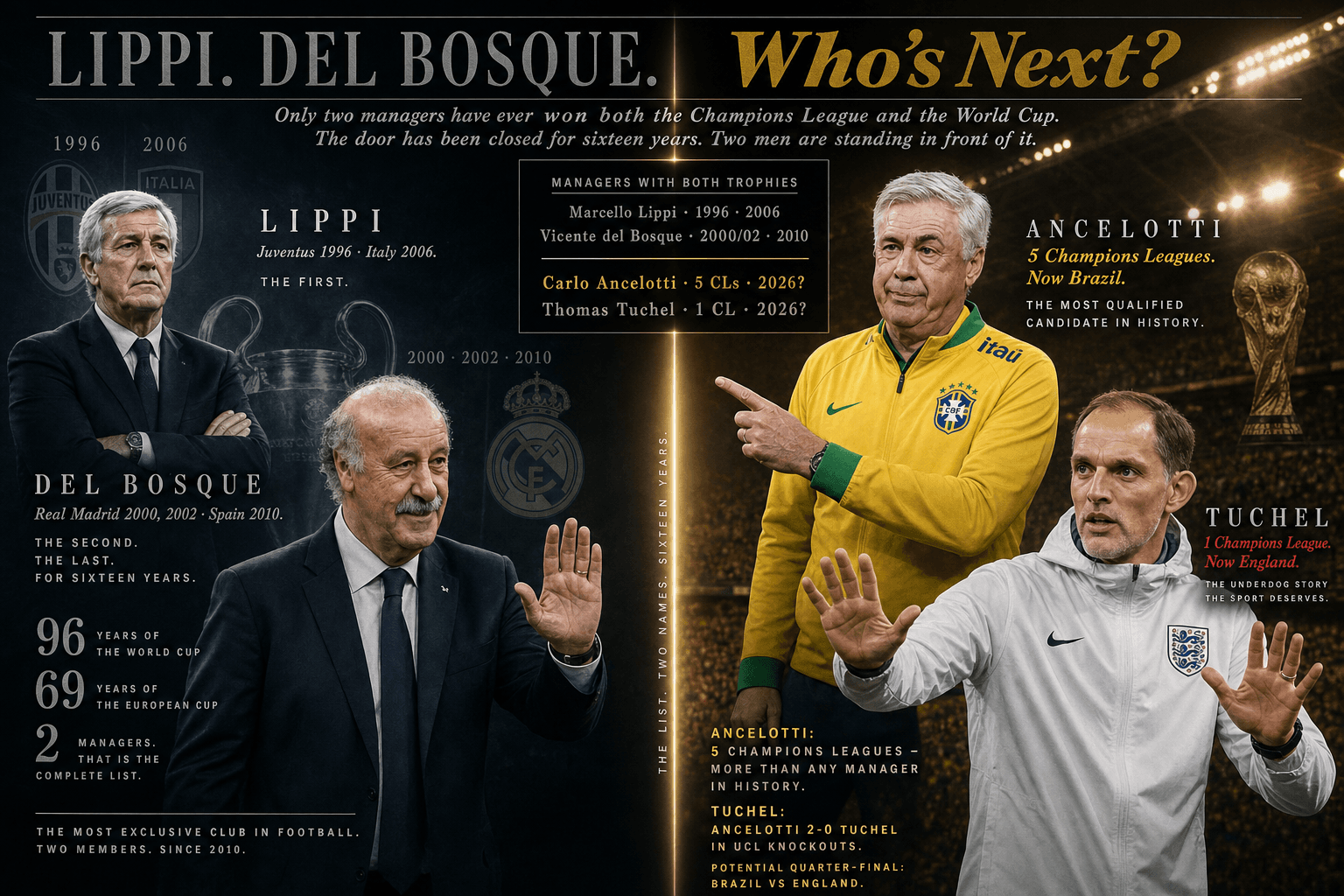
Start with the number. One hundred and forty-two men have managed a nation at a World Cup final. Dozens of the most celebrated managers in the sport's history have won the Champions League. In the entire intersection of those two facts — the Venn diagram of men who have achieved both — there are exactly two names. Marcello Lippi. Vicente del Bosque. That is the complete list. In 96 years of the World Cup and 69 years of the European Cup, in the full sweep of football's managerial history from Herbert Chapman to Pep Guardiola, two people have won the sport's defining club competition and then won the sport's defining international competition. The door to the most exclusive club in football has been shut for sixteen years. Carlo Ancelotti and Thomas Tuchel — analysed in full in our piece on Ancelotti and Tuchel chasing football's rarest double — are the two most credible candidates to open it. Before understanding their chances, you need to understand the two men who walked through it before them, and why so many others never did.
Marcello Lippi: The First Man Through
On 22 May 1996, at the Olimpico in Rome, Juventus beat Ajax 4-2 on penalties to win the Champions League — their first European Cup since Michel Platini's 1985 side. Lippi's team contained Alessandro Del Piero, Gianluca Vialli, Roberto Baggio, and Didier Deschamps as captain. They had won Serie A the previous two seasons. The 1995-96 Champions League was the completion of a club dominance that made Lippi the most decorated manager in Italian football at that moment. He won another Serie A title with Juventus in 1997-98, but the European Cup was not repeated — Juventus lost the 1997 and 1998 finals before Lippi was sacked in 1999. The club career was magnificent. The international career had not yet begun.
Lippi managed Italy at the 2002 World Cup — an early exit, a tournament that disappointed — and was sacked. He returned as Italy manager in 2004 and built a different kind of side. The defensive solidity, the tactical discipline, the specific understanding of how to win tournament football without depending on individual brilliance at every moment. On 9 July 2006, in Berlin's Olympiastadion, Italy beat France 5-3 on penalties after a 1-1 draw in the World Cup final. Fabio Grosso, who had scored the semi-final winner against Germany, stepped up to convert the decisive penalty. Lippi had done it. Champions League in 1996 with Juventus. World Cup in 2006 with Italy. The ten-year gap between them. The first person in football history to achieve both.
Vicente del Bosque: The Second Man Through
Vicente del Bosque had been managing Real Madrid since 1999. He had inherited a squad in transition and immediately inherited something else: the 1999-2000 Champions League, which Madrid won with a Raúl goal against Valencia in Paris. He won a second Champions League with Madrid in 2002, the famous Zinedine Zidane volley final against Bayer Leverkusen in Glasgow, and won two La Liga titles alongside them. Then the club sacked him in 2003 despite winning the league. The specific cruelty of that decision — a manager with two Champions Leagues and two league titles dismissed by the club he had loved — would become a footnote to a larger story.
Del Bosque took over Spain in 2008, inheriting the generation that Aragonés had assembled for Euro 2008: Iniesta, Xavi, David Villa, David Silva, Sergio Ramos, Carles Puyol, Casillas. They had won the European Championship under Aragonés. Del Bosque took the same group to the 2010 World Cup in South Africa and delivered the tournament's most complete tactical performance — a tiki-taka system so dominant that opponents struggled to touch the ball for extended periods. On 11 July 2010 in Johannesburg, Andrés Iniesta's extra-time goal beat the Netherlands 1-0 in the World Cup final. Del Bosque had done it. Champions League in 2000 and 2002 with Real Madrid. World Cup in 2010 with Spain. The second person in football history to achieve both. He then added a European Championship in 2012 — something even Lippi never managed.
The Men Who Came Close but Never Completed It
The roll call of managers who won the Champions League but never won the World Cup includes almost every great name in football's coaching history. Johan Cruyff won the European Cup with Barcelona in 1992 — but never managed a national team in competitive international football. José Mourinho won the Champions League with Porto in 2004 and Inter Milan in 2010 — but his national team appointment with Portugal was brief and inconclusive, never arriving at a tournament that matched his club record. Jupp Heynckes won the Champions League with Real Madrid in 1998 and Bayern Munich in 2013 — two remarkable campaigns, fifteen years apart — but never managed a national team at a major tournament.
The closest anyone came without completing the double was Arrigo Sacchi, who won the Champions League twice with AC Milan (1989 and 1990) and then managed Italy to the 1994 World Cup final — where they lost to Brazil on penalties. One decisive kick from completing what Lippi would later do. Sacchi's Italy had Roberto Baggio, who missed the final penalty. The miss remains one of the most discussed moments in World Cup history. Sacchi, who had achieved more in club football than almost any manager of his era, ended his World Cup involvement one penalty away from the unique double. He never managed another World Cup campaign that mattered.
The other compelling near-miss came from the international side. Didier Deschamps won the World Cup with France in 2018 — and is still managing them at the 2026 tournament. But Deschamps has never won the Champions League as a manager. He was the captain of the 1993 Marseille side that won it as a player, but his managerial career at Monaco, Juventus (who finished runners-up in 2015 and 2017 under him), and France has not produced the club equivalent. France could win the 2026 World Cup. Deschamps would still not have the Champions League. The double would remain incomplete.
In 96 years of the World Cup. In 69 years of the European Cup. Across every manager who has ever taken a top-level club and a national team to success. Only two men have won both. Marcello Lippi. Vicente del Bosque. The list is that short. The achievement is that rare. The door has been closed for sixteen years. Ancelotti and Tuchel are both standing in front of it.
Why the Double Is So Structurally Rare
The scarcity of the double is not simply a reflection of how difficult each achievement is individually — though winning the Champions League and winning the World Cup are both among the hardest things a football manager can accomplish. The scarcity is structural: the two competitions reward fundamentally different things, and the qualities that produce one success often conflict with the conditions that produce the other.
The Champions League rewards consistent squad quality across eight or ten months — the ability to win across group stage, knockout rounds, and a final, managing a large squad of international players, maintaining tactical edge across many matches, and handling the specific pressure of elimination across two-legged ties. The World Cup rewards the ability to prepare a squad of players who spend ten months a year working under different managers, impose a tactical system in a three-week window, and then win six or seven consecutive elimination matches in conditions — heat, altitude, different surfaces — that no club competition replicates. The manager who has been developing relationships with their club squad across a full season must suddenly adopt a completely different working model, with players who do not know each other's rhythms and a preparation period that clubs would consider impossibly short.
The managers who succeed in this environment tend to be those with the broadest tactical vocabulary — who can adapt their methods to the players available rather than imposing a fixed system — and the deepest experience of both levels of the game. Lippi had managed in Italy's top division for twelve years before his Champions League win. Del Bosque had managed at Real Madrid across five seasons of European competition. Both brought an accumulated understanding of elite-level football that translated across both environments. The coaches who win one competition without the other often do so by optimising specifically for that environment. Guardiola's Barcelona and Bayern were designed for European club dominance. Deschamps's France is designed for international tournament resilience. Both approaches are extremely successful within their domain. Neither has produced the double.
Carlo Ancelotti: The Case for the Third Man
The argument for Ancelotti completing the double is the simplest version of any argument available. He has won the Champions League five times — with AC Milan in 2003 and 2007, Real Madrid in 2014, 2022, and 2024. No manager in the competition's history has done it more often. His Champions League record spans four different clubs, across twenty years of management at the elite level, in four of Europe's five major leagues. If the double requires the tactical adaptability to succeed in radically different environments, Ancelotti's club career is the most comprehensive proof of that adaptability available.
The specific obstacle is the World Cup's team management challenge — and Brazil's specific history of failing against European opposition in the knockout stages, documented in full in our piece on Brazil's European curse and why they hired Ancelotti to solve it. Brazil have not won the World Cup since 2002. Ancelotti's appointment was explicitly framed as the solution to the specific problem of European tactical systems defeating Brazilian individual brilliance in the knockout rounds. If he can solve that problem with Vinicius, Rodrygo, and the squad he has assembled — and the potential England quarter-final, Brazil's round of 16, and beyond — he enters the company of Lippi and Del Bosque as the third manager in history to complete the double.
Thomas Tuchel: The Case for Something Nobody Has Done
Tuchel's case is different and, in one specific sense, more remarkable. Lippi won the Champions League ten years before his World Cup. Del Bosque won the Champions League eight years before his. Both men had extended periods of club excellence before the international achievement. Tuchel won his Champions League — a single title, with Chelsea in Porto in 2021, achieved in five months after joining the club in January — and now manages England as a legitimate World Cup contender. If Tuchel wins this World Cup, he completes the double in a compressed timeline that neither Lippi nor Del Bosque approached. One Champions League. One World Cup. Both in the same decade. Both without the extended club dominance that the previous two members of this club built their case on.
The head-to-head challenge — Ancelotti 2-0 Tuchel in UCL knockout ties, as we detailed in our complete Tuchel vs Ancelotti head-to-head analysis — adds the specific competitive context. Tuchel's path to the double runs directly through the man who has beaten him twice in European knockout competition. If England reach the quarter-final and defeat Brazil, Tuchel does not merely win a World Cup match. He wins a World Cup match against the only opponent with specific evidence that he cannot beat him at the decisive moment. The double, for Tuchel, comes with that specific footnote rewritten.
What the Third Name on the List Would Mean
When Lippi became the first person to complete the double in 2006, Italian football's century of accumulated wisdom about the game's deepest structures had found its ultimate expression. When Del Bosque completed it in 2010, Spain's golden generation — the most technically complete football culture Europe had produced in thirty years — had found the manager capable of channelling it into both the greatest club and greatest international stage simultaneously. The third name on the list will be added by a man managing in a different era, against different opposition, in a different tactical landscape.
Whether it is Ancelotti — who would become the first manager in history to win six Champions Leagues in addition to a World Cup — or Tuchel — who would become the only person to complete the double with England's first World Cup in sixty years — the addition of a third name to the list that contains only Lippi and Del Bosque would be one of the most significant individual achievements in football's managerial history. The 2026 World Cup in North America, playing to a final in New Jersey on July 19, has two credible candidates for that achievement standing on either side of a potential quarter-final. The list may still be two names long when July 19 arrives. It may not be. Either way, the summer of 2026 is the closest the sport has come to resolving that question since July 2010, when Iniesta's goal finally closed the book on the previous attempt.
The Guardiola Question: The Greatest Manager of His Era Who Never Tried
No analysis of the managers who could have completed the double is complete without addressing the most obvious omission: Pep Guardiola. The most decorated active club manager in the sport has won the Champions League four times across Barcelona, Bayern Munich, and Manchester City. He has managed in four different countries. He speaks five languages. His tactical influence across the sport is surpassed by nobody in his generation. And he has never managed a national team in a competitive international context.
Guardiola's career choices have consistently prioritised club management, and the reasons are not difficult to identify. The specific challenge of the World Cup — managing players who spend ten months a year implementing other coaches' systems, preparing a tactical approach in a three-week window, accepting the reduced control over training intensity and player development that international management imposes — is structurally opposite to the total football environment Guardiola builds at club level. His methodology requires time, repetition, and deep implementation. The World Cup format offers almost none of those things.
If Guardiola ever took a national job and won the World Cup, the debate about the greatest manager in history would effectively be closed. He has shown no indication of pursuing that path. The double that Lippi and Del Bosque completed, and that Ancelotti and Tuchel are chasing, may remain beyond Guardiola simply because he has never chosen to attempt it — not because he would be unable to complete it if he did. That specific omission from the list of two makes the list itself more remarkable. The best club manager of his era is not in the conversation. The list is still just Lippi and Del Bosque. And it has been closed for sixteen years.
Only Lippi and Del Bosque have ever won both the Champions League and the World Cup. Which of the two current candidates — Ancelotti or Tuchel — do you think is most likely to become the third? And is there a manager you think was unlucky never to complete the double? 👇