Before you read this piece, the full story of Carlo Ancelotti's pursuit of football's greatest double — the Champions League and the World Cup — is covered in our analysis of Ancelotti and Tuchel chasing history at the 2026 World Cup. This piece explores a different question: not what Ancelotti is chasing, but why Brazil chose him specifically to chase it.
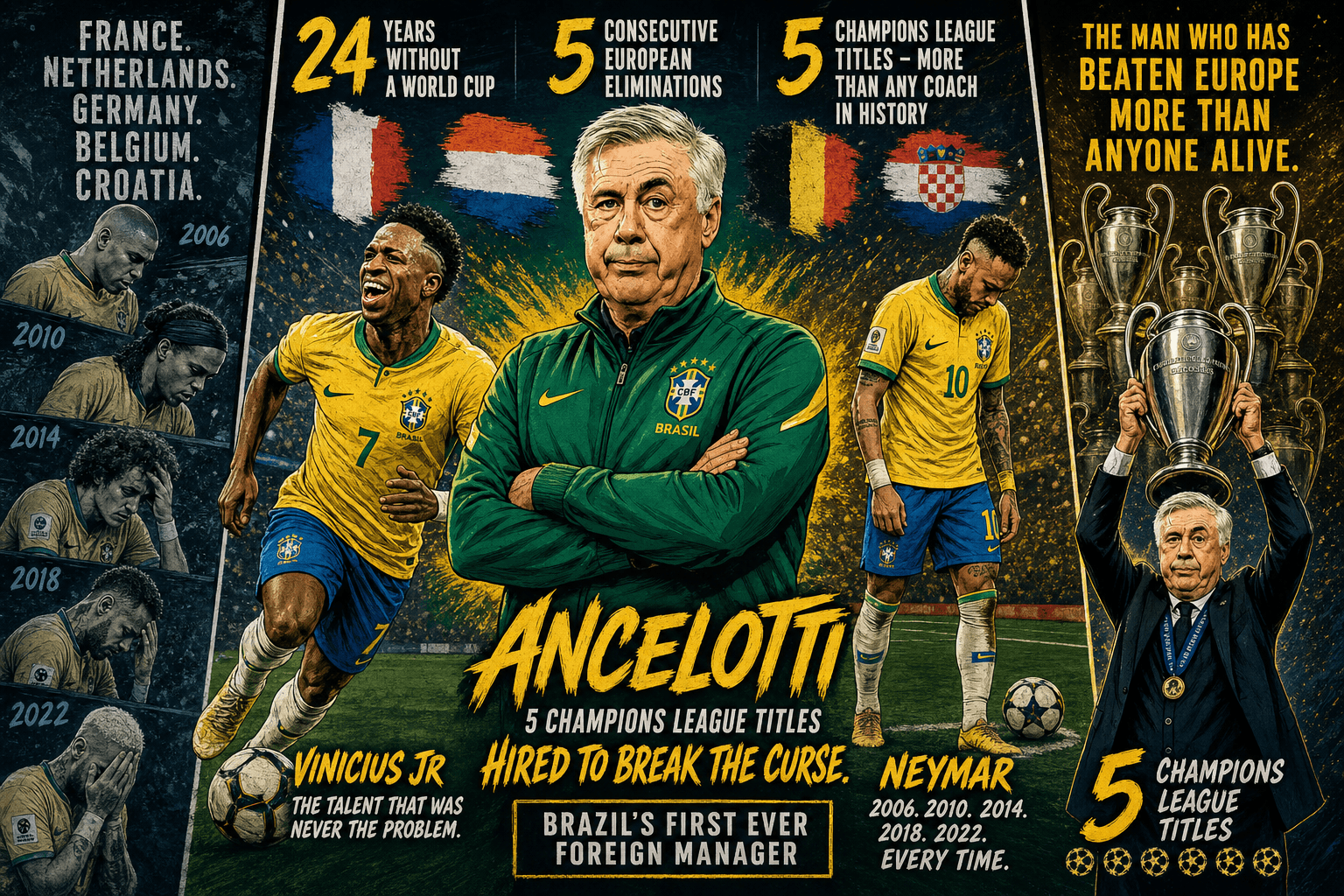
Five World Cups. Five consecutive exits before the final. Five opponents. France. The Netherlands. Germany. Belgium. Croatia. Look at that list. Every single team that has knocked Brazil out of a World Cup since they last won it in 2002 has been European. Not once — not in 2006, 2010, 2014, 2018, or 2022 — has Brazil been eliminated by another South American nation, an African side, or an Asian team. Every time the Seleção's World Cup ends, it ends against Europe. Brazil did not need a data scientist to identify this pattern. They needed the courage to act on it.
2002: The Last Time
The 2002 World Cup in Japan and South Korea produced one of the great individual recoveries in football history. Ronaldo had suffered two unexplained seizures on the eve of the 1998 final in Paris — he played, performed poorly, and Brazil lost to France 3-0. He spent four years fighting back through injury and form, and arrived at the 2002 tournament as a player who had something to prove to the world and to himself. He proved it. Eight goals in seven matches, including both in the final against Germany. Brazil won 2-0. Luiz Felipe Scolari's side — Ronaldo, Ronaldinho, Rivaldo, Roberto Carlos, Cafu — were one of the great World Cup winners.
That final, played on 30 June 2002 in Yokohama, is now 24 years ago. What has followed is a record that a nation of Brazil's footballing culture should find genuinely alarming: four quarter-final exits and one semi-final catastrophe, in five tournaments, all at the hands of European teams. Brazil have not merely lost. They have lost the same way, to the same type of opponent, with the same tactical and structural limitations, five times in a row.
2006: Germany. Zidane. The Beginning of the Pattern.
Brazil arrived at the 2006 World Cup in Germany with what was widely described as the most talented squad assembled since 1970. Ronaldinho was the best player in the world — the reigning Ballon d'Or winner. Kaká was his creative partner. Adriano was a physically devastating centre-forward. Ronaldo was still there, still capable. On paper, the competition should not have been able to contain them.
France eliminated Brazil 1-0 in the quarter-finals, with a single Thierry Henry goal setting up France's run to the final. More significant than the scoreline was the tactical story: Zinedine Zidane organised France into a disciplined defensive block that smothered Brazil's individual brilliance, compressed the space Ronaldinho needed to operate in, and won the game with a single moment of clinical efficiency. Brazil had more talent. France had better structure. Structure won. Zidane, at 33 years old in what would be his last World Cup, was the difference — a player of Brazil-level individual quality deploying European-level tactical intelligence. The combination was unmanageable.
2010: The Netherlands. Robben. The Pattern Confirmed.
Dunga's Brazil in South Africa were a different kind of team — less romantically gifted than the 2006 squad, more physically organised, built around defensive solidity rather than attacking flair. They won their group comfortably, beat Chile in the round of 16, and faced the Netherlands in the quarter-final. They were favourites. Robinho had given them the lead. Then Sneijder equalised. Then Arjen Robben — one of the most technically complete wide players in the world — won the game with a finish that required him to beat Brazil's entire defensive shape with sheer individual quality before delivering the decisive touch.
The Netherlands won 2-1. Brazil's structural issues were consistent: no reliable centre-forward, over-reliance on individual moments, a tactical approach that hadn't matched Europe's evolution in pressing and defensive organisation. The same criticism that applied to the 2006 exit applied again. They had talent. Europe had a system. Brazil left at the quarter-final stage for the second consecutive tournament.
2014: Germany. 7-1. The Mineirazo.
Everything about Brazil's 2014 World Cup campaign should be understood in the context of what happened on 8 July 2014 at the Estádio Mineirão in Belo Horizonte. Brazil were at home. Neymar had been injured and was absent. The nation expected the squad to respond, to find something in the occasion that individual talent alone could not provide. What they found was humiliation on a scale the sport has rarely produced.
Germany beat Brazil 7-1 in the semi-final. Four goals in six first-half minutes. Müller, Klose, Kroos twice, Khedira. Then Schürrle twice in the second half. Oscar scored a consolation in injury time. The Seleção, wearing their yellow shirts at home in a World Cup semi-final, were taken apart with tactical precision — high pressing, fast transitions, automatic movement patterns drilled to such a degree that individual talent became irrelevant. Brazil had produced a generation of superstars. Germany had produced a system. Brazil then lost 3-0 to the Netherlands in the third-place play-off. They had come to their home World Cup ranked as pre-tournament favourites. They finished fourth. The Mineirazo is not merely a painful footballing memory. It is the definitive proof that talent, in isolation, cannot compete with organisation.
2006: France 1-0. 2010: Netherlands 2-1. 2014: Germany 7-1. 2018: Belgium 2-1. 2022: Croatia on penalties. Five World Cups since 2002. Five European opponents. Every single time. The pattern is not a coincidence. It is a structural problem that has lasted a generation.
2018: Belgium. De Bruyne. The Third Quarter-Final in a Row.
Russia 2018 produced another quarter-final exit, another European opponent, and another variation of the same fundamental problem. Tite's Brazil were considered genuine contenders — Neymar at the peak of his powers, with Coutinho, Gabriel Jesus, and a squad deep enough to compete across seven matches. Belgium's Roberto Martínez had spent months studying Brazil's defensive patterns and prepared a specific tactical response: drop deep, absorb pressure, and attack rapidly through Kevin De Bruyne's passing range and Romelu Lukaku's physicality.
Belgium won 2-1 in Kazan — their second goal was a De Bruyne counter-attack that dissected Brazil's high defensive line with a single pass, the kind of clinical European transition play that Brazil's system had no structural answer for. Tite had been obsessed with the problem of European defensive organisations before the tournament. He left Russia without solving it. For the third consecutive quarter-final, a European team with a clear system had beaten a Brazilian team with superior individual talent.
2022: Croatia. Neymar's Last Chance. Penalties.
The 2022 World Cup in Qatar began with Brazil looking like the team everyone feared. They had Vinicius Júnior, Neymar, Raphinha, Richarlison, and a squad widely considered the deepest they had assembled since 2006. The group stage was convincing. The round of 16 was manageable. Then came Croatia and the quarter-final and the pattern continued.
Neymar scored a brilliant individual goal in extra time. It looked like the moment. Croatia equalised through Petkovic with three minutes of extra time remaining, converting a counter-attack from deep. The game went to penalties. Croatia won 4-2 on penalties. Brazil left at the quarter-final stage for the fourth time in five tournaments. Neymar missed a penalty. The decade defined by his talent and his burden ended without a World Cup. The pattern had repeated. European football had won again.
What the Pattern Actually Means
Five eliminations. Five European opponents. The obvious question is whether this is coincidence — whether any team with Brazil's record of reaching the knockout rounds would simply encounter European opposition at that stage, given how many European teams qualify. The answer is: not to this degree. Brazil have been eliminated before the semi-final stage by European teams in four of the last five tournaments. In the one exception — 2014 — the semi-final opponent was also European. Germany destroyed them at home.
The structural analysis that emerges from all five exits points in the same direction. European football, in the modern era, has developed systems — pressing structures, defensive organisation, transition patterns, set-piece exploitation — that consistently neutralise individual brilliance in ways that South American football does not replicate in the same volume or consistency. The Brazilian players who have played in these tournaments have often been among the most talented in the world. What they have lacked, again and again, is a system robust enough to function when European tactical organisation strips them of the space and time their individual quality requires.
Brazil, for their part, have produced a series of different managerial responses to this problem: physical, defensive football under Dunga; elaborate attacking football under Scolari; counter-pressing under Tite in his various tenures. None of them produced a World Cup. Each time, at the moment that mattered, a European team with a clear, well-drilled system removed them from the tournament. The problem was identified. The responses were inadequate. Something different was needed.
The Decision: Hire the Man Who Knows European Football Better Than Anyone
The CBF's appointment of Carlo Ancelotti in May 2025 should be understood in this exact context. Brazil did not hire a foreign manager for the first time in modern history simply because they admired Ancelotti's CV. They hired him because his CV represents the specific answer to the specific question their World Cup record poses. How do you beat European football at the highest level? You hire the manager who has beaten it more often than anyone else alive.
Ancelotti won the Champions League in 2003, 2007, 2014, 2022, and 2024 — five titles, more than any manager in the competition's history. He has managed in Serie A, Ligue 1, the Premier League, the Bundesliga, and La Liga. He has prepared Real Madrid sides for Champions League finals against Atlético Madrid, Juventus, Liverpool, and Manchester City. He has spent more time dissecting the defensive and tactical patterns of elite European football than almost any other coach in the game's history — not as an analyst from the outside, but as the manager who won those games from the inside.
The implicit argument behind Brazil's decision is straightforward: if European tactical systems are the problem, then the man with the most experience of deploying, adapting to, and overcoming European tactical systems is the solution. Ancelotti does not simply know how European football works. He is the person who has made it work, across five decades, at five different clubs, in five different countries, through five Champions League campaigns. He is the single most experienced person alive at beating the kind of opponent that keeps eliminating Brazil.
What Ancelotti Must Solve That Others Could Not
The appointment is logical. The execution is not guaranteed. Ancelotti has never managed a national team. The World Cup format — compressed preparation, infrequent training sessions, a squad assembled from players spread across European leagues — is structurally different from club management in ways that have frustrated far more experienced international coaches. The Brazilian dressing room, with its internal hierarchies and expectation of individual expression, is not Real Madrid's dressing room.
What Ancelotti brings that his predecessors did not is a specific kind of tactical flexibility. His great quality across his Champions League campaigns has been the ability to read what his opponent needs to do to win and build a system that removes that option. Against Bayern Munich in 2022, Real Madrid disrupted their pressing by using deep-lying movements that bypassed the first press line. Against Liverpool in 2022, they absorbed pressure and attacked in transitions. The pattern across his career is adaptability — building different solutions to different problems rather than imposing a single system regardless of opposition.
Brazil need that quality more than any other. Their problem is not a lack of talent. Vinicius Júnior is one of the best players in the world. Rodrygo is a Champions League winner. Raphinha, Endrick, and Estevão represent the deepest attacking generation Brazil has produced in two decades. The problem is that talent alone has proven insufficient. What they need is a system that uses that talent to produce results against the kind of opponents that have consistently eliminated them — and Ancelotti has built more systems of that kind, against opponents of that calibre, than any other manager at this tournament.
Group C and the Road Ahead
Brazil's path at the 2026 World Cup begins in Group C alongside Morocco, Haiti, and Scotland. Morocco are the most credible threat at the group stage — a side that reached the semi-finals in 2022 and has already beaten Brazil once in their history, in a 2023 friendly. Scotland and Haiti — whose extraordinary qualification story is documented in our piece on their first World Cup in 52 years — represent more manageable fixtures.
The real examination begins in the knockout rounds. If the bracket cooperates and Brazil emerge from the group, they will almost certainly face a European opponent before the semi-finals. They always do. The 2026 World Cup has expanded to 48 teams, with 16 European nations qualifying — more than any other confederation. The bracket is designed in a way that makes European opposition in the knockouts not merely possible but probable. For Brazil, that is not a threat. That is the test. The one they have been preparing for. The one that has beaten them five times since 2002. The one they hired Carlo Ancelotti specifically to pass.
Twenty-four years. Five tournaments. Five European opponents. One appointment that, if it works, closes the gap that has separated Brazil's talent from their destiny since the last time Ronaldo scored twice and the world bowed in Yokohama.
The Squad Ancelotti Has to Work With
The talent available to Ancelotti at this World Cup is, on its own assessment, the most complete attacking generation Brazil has assembled since the class of 2002. Vinicius Júnior is a two-time Champions League winner with Real Madrid and the most dangerous wide forward in world football when given space to attack in behind. Rodrygo is his partner, another Champions League-proven threat. Raphinha has been the creative spine of Arsenal's title-winning campaign. Estevão Willian, just 18, arrived at Chelsea in the summer of 2025 and produced an immediate impact that drew direct comparisons with Vinicius at the same age. Endrick, signed by Real Madrid from Palmeiras in 2024, offers a young, direct centre-forward option that Brazil have not had consistently since Ronaldo himself. If Ancelotti can organise that attacking talent within a European-calibre defensive and pressing system — the kind he has built at Real Madrid and AC Milan — Brazil will be the most complete side in the tournament. The question, as it always is for this national team, is whether the system holds when it needs to most.
Brazil have been knocked out by a European team in every World Cup since 2002. Do you think Ancelotti is the right answer — and which European side do you think poses the biggest threat to their run in 2026? 👇